
Updated June 2026 · Reviewed by Billy Forte
A Texas teen can get a provisional driver’s license at 16 by working through the graduated licensing steps: complete Module 1 of a TDLR-approved driver education course for the DE-964E and a learner’s permit at 15, hold the permit at least six months while logging supervised driving, then finish the full course (DE-964) and the free ITTD video before passing the driving test. Provisional driving at 16 comes with restrictions — a nighttime limit, a passenger limit, and no handheld devices — that last until age 18. This guide walks the full path from permit to provisional license so families know each milestone in order.
Applies to Texas teen driver education and licensing (ages 14–17). Requirements are set by TDLR (driver education) and the Texas DPS (licensing) and can change.
Key Facts
- Permit at 15: Complete Module 1 for the DE-964E, then get the learner’s permit and hold it at least six months.
- Full course (DE-964): Finish the 32-hour TDLR-approved course for the DE-964 certificate.
- ITTD before the test: Complete the free, two-hour ITTD video within 90 days before the driving test.
- Provisional license at 16: Available after the 6-month hold and required steps, with restrictions.
- Provisional restrictions: No midnight–5am driving (except work/school/medical emergency), max 1 non-family passenger under 21, and no handheld devices.
- Restrictions end at 18: Provisional limits lift when the teen turns 18.
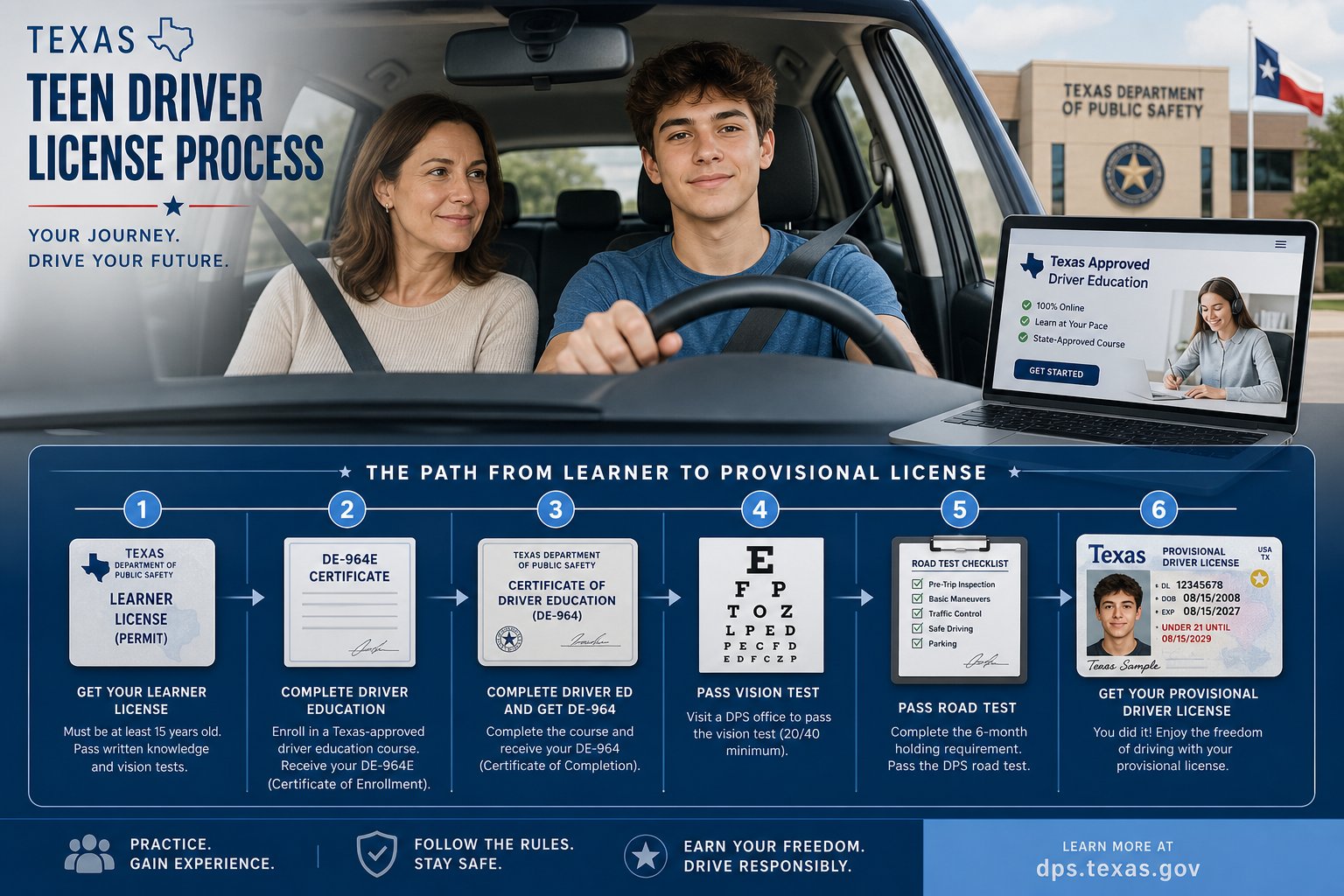
How The Texas Teen Driver License Process Works
Texas uses a Graduated Driver License (GDL) system for teens. That means you do not go straight to a full license. You move through two stages: a learner license first, then a provisional license.
Here is the simple path for a teen driver license Texas applicant:
- Complete the first part of teen driver education.
- Get the DE-964E partial certificate.
- Apply at Texas DPS (TxDPS) for a learner license at age 15 or older.
- Hold the learner license for at least six months.
- Finish all classroom and behind-the-wheel training.
- Get the full DE-964 completion certificate.
- Complete the free Impact Texas Teen Drivers (ITTD) course within 90 days before the road test.
- Book a Texas DPS appointment.
- Pass the vision test and driving skills test.
- Receive a provisional license at age 16 or 17.
That is the big picture. The details matter, because Texas uses different certificates at different steps. DE-964E is not the same as DE-964. The first is for the permit stage after Module 1. The second shows the full teen course is done and is used when you apply for the provisional license.
Also, keep the agencies straight. TDLR approves driver education providers and the Parent Taught Drivers Ed process. TxDPS issues the actual learner and provisional licenses. It is not the Texas DMV.
If you want an online option, Driving Logic offers state-approved Texas teen courses that fit busy schedules and can be done from almost any device. That can make the process easier to manage, especially when you are trying to line up school, practice hours, forms, and a DPS appointment.
Who Can Apply And What Age Requirements Matter
Age is a big part of the Texas teen licensing process. A teen can start driver education at 14, but that does not mean they can get a permit right away. To get a learner license, the teen must be at least 15.
To move up to a provisional license, the teen must be at least 16 and must have held the learner license for at least six months. If the permit was suspended, that can delay the timeline.
Here is the age breakdown:
- Age 14: May begin teen driver education coursework.
- Age 15: May apply for a learner license after meeting the early course requirement.
- Age 16 to 17: May apply for a provisional license after all training is complete.
- Age 18: Can move into a different licensing path, not the teen PTDE/TDE path.
That last point is important. PTDE and TDE are for teens under 18. They are not the same as Adult Driver Education (ADE). ADE is a separate course for adults 18 and older. Do not mix those up when choosing a course.
Texas also requires school enrollment and attendance proof for most teen applicants. Many teens need a Verification of Enrollment (VOE) from school, unless they present a diploma or GED instead. In practice, parents often miss this step and only realize it when they are getting ready for the DPS visit.
So if you are asking how to get Texas drivers license at 16, the short answer is this: start early, get the permit at 15, keep it for six months, finish all course work and driving practice, then test for the provisional license at 16.
What To Complete Before Getting A Learner License
Before a teen can get a learner license, they must begin a state-approved teen driver education program. In the parent-taught route, that means starting PTDE and completing Module 1 first. After that step, the student gets the DE-964E, which is the partial completion certificate used for the permit.
Teens cannot skip ahead to the driving test. The permit comes first.
Driver Education Options
Texas allows a few driver education choices for teens under 18:
- Public school driver education
- Private driving school programs
- Parent Taught Drivers Ed (PTDE)
All of these must be state approved. If you choose Parent Taught Drivers Ed, the parent or legal guardian must first request the PTDE Program Guide from the Texas Department of Licensing and Regulation. The fee is $20, and as of January 2026, the guide is sent by email only.
Teen driver education usually includes:
- 32 hours of classroom instruction
- Behind-the-wheel requirements
- Observation time in the car
- 30 hours of extra practice, including 10 hours at night
For the learner license step, the key milestone is not the whole course. It is the first required part that allows issuance of the DE-964E.
Driving Logic offers a flexible online Texas teen course that can help families fit this work into real life. That matters when your schedule is packed.
Tests, Forms, And Documents To Bring
When it is time to apply for the learner license at TxDPS, bring the right documents. Missing one item can end the trip fast.
Common items include:
- DL-14A application signed by a parent or guardian
- The parent or guardian with the teen, unless another form of authorization is accepted
- DE-964E for partial completion of teen driver education
- VOE, diploma, or GED
- Proof of identity
- Proof of Social Security number
- Proof of U.S. citizenship or lawful presence
- Two proofs of Texas residency
- Current learner-license related fees charged by TxDPS
At the office, the teen should expect a vision exam. Some knowledge testing may also apply if it was not already completed through driver education. Check current rules and appointment details at Texas DPS.
What Teens Must Do To Move From Permit To Provisional License
This is the step families care about most. To get from a learner license to a provisional license, the teen must finish every required part of teen driver education and meet the time rule.
Here is the step-by-step process:
- Hold the learner license for at least six months.
- Complete all 32 classroom hours.
- Complete the required in-car training.
- Finish the 30 hours of supervised practice, including 10 hours at night.
- Receive the full DE-964 completion certificate.
- Take the free Impact Texas Teen Drivers (ITTD) course.
- Make sure ITTD is done within 90 days before the driving test.
- Book a driving test with TxDPS or an approved third-party tester.
- Bring required documents to the appointment.
- Pass the vision test and driving skills test.
A key point: ITTD is separate from PTDE or TDE. It is a free, 2-hour TxDPS video course for teen drivers. It is not part of the main driver education course, and it is not the same as ITAD, which is for adults. Teens can take ITTD at Impact Texas Teen Drivers.
For the provisional license appointment, bring:
- DE-964 full completion certificate
- ITTD certificate
- Learner license
- Identity and residency documents if requested
Once the teen passes the road test, Texas DPS issues a provisional license. That license allows independent driving, but it still comes with teen driving restrictions until age 18.
Texas Teen Driving Rules Parents Should Know
A Texas provisional license is not a full adult license. It has rules, and parents should know them well.
For a learner license, the teen:
- Must have a licensed adult age 21 or older in the front seat
- May not use a cell phone or wireless device, even hands-free, except in an emergency
For a provisional license, the teen still has limits under the GDL system. These include:
- No driving from midnight to 5:00 a.m., unless it is for work, school activities, or an emergency
- No more than one passenger under 21 who is not a family member
- No wireless communication, including hands-free, except for emergencies
People often call the first rule midnight driving restrictions or a teen curfew. Either way, it matters. A new driver may have a valid license but still cannot legally drive during those hours unless one of the exceptions applies.
The provisional license stays marked as such until the teen turns 18. At that point, the restriction period ends if the license remains valid.
Parents can help by keeping a simple checklist:
- Track the six-month permit window
- Log the 30 practice hours carefully
- Make sure 10 of those hours are at night
- Do not wait too long to take ITTD
- Double-check every DPS document before the appointment
If you want a simpler path, Driving Logic offers a state-approved Texas PTDE/TDE course built for busy families who need flexible online access. You can explore the options at Driving Logic and then confirm official licensing details with TDLR and TxDPS.
FAQ
How does a teen get a Texas driver’s license at 16?
Complete driver ed for the DE-964E and learner’s permit at 15, hold the permit 6 months with supervised driving, finish the course (DE-964) and the free ITTD video, then pass the driving test.
What age can a teen get a license in Texas?
A learner’s permit is available at 15 and a provisional license at 16, after the 6-month permit hold. A full, unrestricted license comes at 18.
What certificates does a teen need?
The DE-964E (after Module 1) for the learner’s permit, and the DE-964 (full completion) for the provisional license, plus the separate ITTD completion certificate.
What restrictions apply at 16?
No driving midnight–5am (except work, school, or a medical emergency), no more than one non-family passenger under 21, and no handheld devices — until age 18.
Is ITTD the same as driver education?
No. ITTD is a free, two-hour DPS safety video; the PTDE or TDE course is the paid 32-hour driver education. Teens need both.
Conclusion
Getting licensed at 16 in Texas is a sequence of clear milestones rather than a single event: permit at 15, a six-month hold with real practice, the DE-964 and ITTD, then the driving test and a provisional license. The provisional restrictions that follow are part of the same graduated system, easing teens into full driving by 18. Start the driver education early and each milestone leads naturally to the next.
The first step is Module 1 of a TDLR-approved Texas parent-taught driver education course online, which issues the DE-964E and DE-964 your teen needs.
Related Articles
- Texas Graduated Driver License (GDL) System: The Three Stages Explained
- Texas Provisional License Restrictions: Complete Rules for 16-Year-Old Drivers
- When Do Texas Teen Driving Restrictions End?
- Texas Car Insurance for Teen Drivers: What Parents Should Ask Insurers
Sources
Billy Forte is the owner of Driving Logic, a TDLR-approved Texas driver education provider. Driving Logic offers the online Texas parent-taught and teen driver education course that helps Texas teens complete the 32-hour classroom requirement and work toward a learner’s permit and provisional license.
This article is general information about Texas teen driver education and licensing, not legal advice. Requirements, fees, and procedures are set by TDLR and the Texas DPS and can change, so confirm current details with official Texas sources before you enroll or visit a DPS office.