
Updated November 2026 · Reviewed by Billy Forte
If you searched “careless driving ticket dismissed NJ,” the short answer is yes, the charge can be lowered or end without a conviction, but no one can promise it. A municipal prosecutor may agree to a lower charge in a plea agreement, and the judge must approve it and may refuse. A defensive driving course never dismisses the ticket, but it can take 2 points off your New Jersey Motor Vehicle Commission (NJMVC) record after a conviction.
Key Facts
- The charge: careless driving is N.J.S.A. 39:4-97 and carries 2 points. See what the charge is.
- Reduced: a plea agreement can lower the charge, the fine or the sentence. See how a plea agreement works.
- Who decides: the prosecutor negotiates, and the judge must approve. See who decides.
- Contesting: plead not guilty and your case moves to trial before a judge. See pleading not guilty.
- Paying: paying the ticket is a guilty plea. See what paying means.
- The course: removes 2 points once every five years and does not dismiss a ticket. See after a conviction.
Careless Driving Ticket Dismissed NJ: The Short Answer
Yes, both can happen. Neither is automatic. The official New Jersey Courts pages describe three ways a careless driving ticket can end:
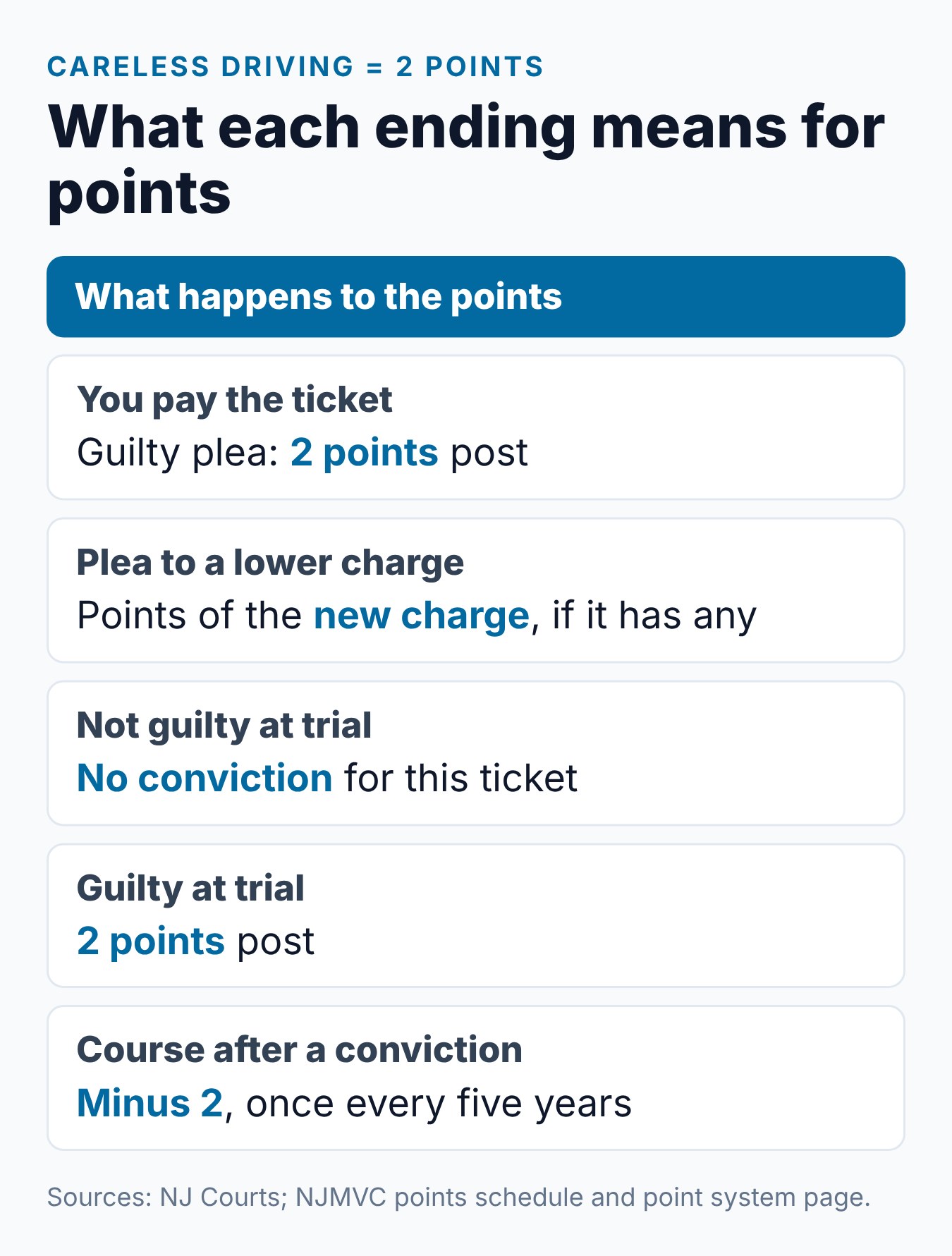
- You pay it. Paying is a guilty plea. The charge is not reduced, and the points post.
- You reach a plea agreement. The prosecutor agrees to a lower charge, a lower fine or a lighter sentence, and you plead guilty to that. The judge must approve it.
- You go to trial. You plead not guilty, and a judge decides the case. A not-guilty finding means no conviction for that ticket.
So “reduced” has a clear meaning in New Jersey. It is a plea agreement that a judge approves. “Dismissed” is less clear. The public NJ Courts pages we read do not list a form or a rule for asking that a traffic ticket be dismissed.
That does not mean a dismissal never happens. It means the decision sits with the prosecutor and the judge in your case. We cannot predict it, and no honest source can.
What the Charge Is
Careless driving is one sentence of state law. N.J.S.A. 39:4-97 says a person who drives “carelessly, or without due caution and circumspection,” in a way that endangers or is likely to endanger a person or property is guilty of careless driving.
The NJMVC points schedule lists careless driving at 2 points. Many people call the agency the “NJ DMV,” but its real name is the Motor Vehicle Commission, or NJMVC.
Our careless driving NJ points guide covers the charge, the fine and the points in full. This page stays on one question: how the ticket can end in court.
How a Plea Agreement Works in Municipal Court
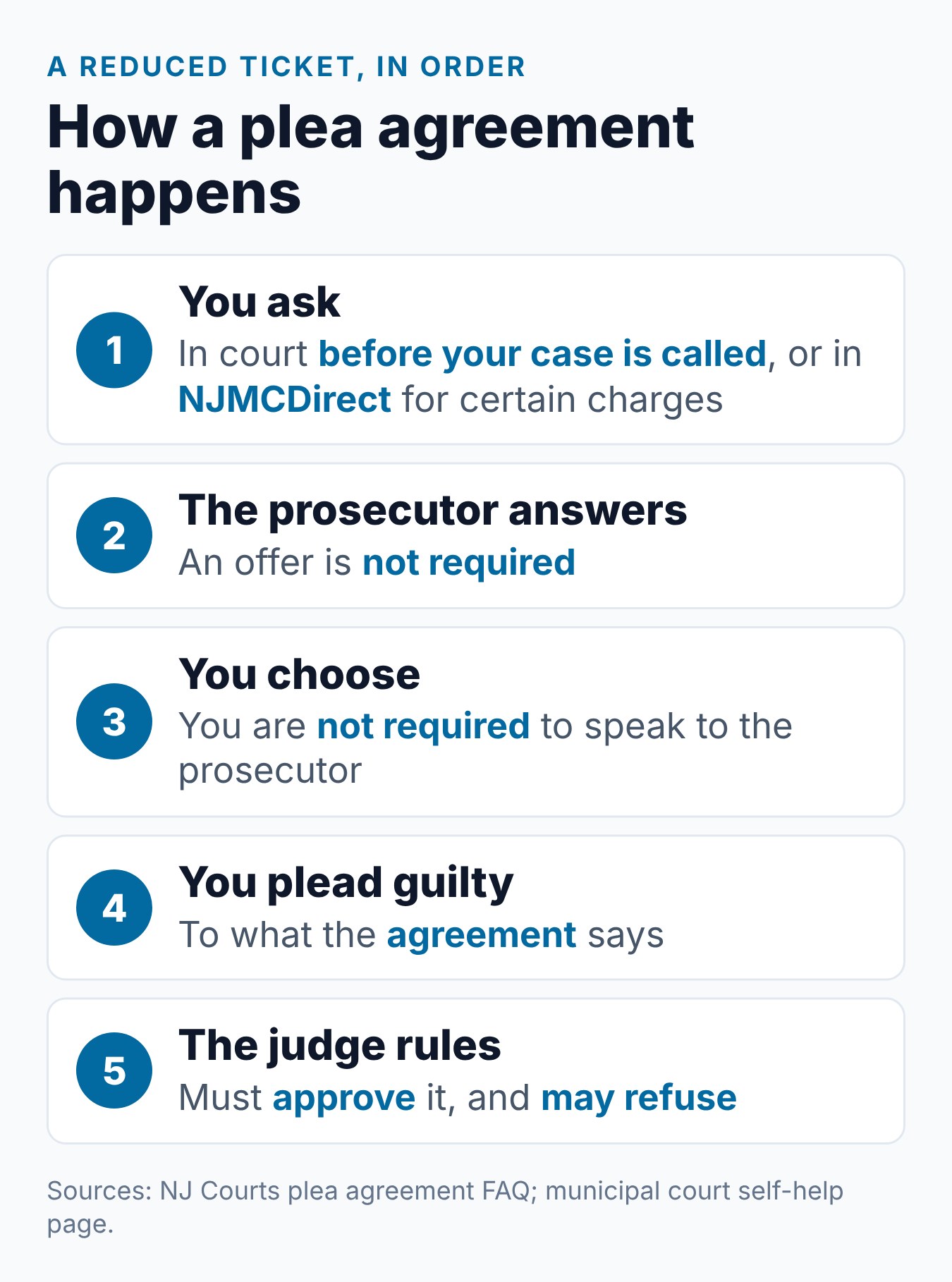
A plea agreement is the official name for a reduced ticket. The NJ Courts plea agreement FAQ says “a plea agreement is a way to settle a case.”
The municipal court self-help page defines it. A plea agreement is when the prosecution agrees to lower charges, reduce fines, or reduce sentencing in exchange for a guilty plea.
Two points in that definition matter:
- You still plead guilty. You plead guilty to what the agreement says, not to the first charge.
- It is an exchange. The prosecutor is not required to offer anything.
Who Decides
Two people decide, and you are not one of them. NJ Courts say plea agreements in municipal court are negotiated with the prosecutor, an attorney who represents the state.
Then the judge reviews it. In the words of the FAQ, “all plea agreements must be approved by the judge.” The self-help page adds that the judge retains the right to refuse a plea agreement.
You do have one choice. NJ Courts say you will be given the chance to speak to the prosecutor, and that “you are not required to speak to the prosecutor.”
How to Ask for One
NJ Courts describe two ways to start:
- In court. You might be able to work on a plea agreement with the prosecutor before your case is called.
- Online. The NJ Courts municipal court page says NJMCDirect can be used to request a plea agreement from a municipal prosecutor, for certain charges.
The court page does not list which charges qualify online. Check your ticket in NJMCDirect, or ask the court staff at the court named on your ticket.
A Lower Charge Drivers Ask About: Unsafe Driving
New Jersey has a separate offense called driving in an unsafe manner. It is N.J.S.A. 39:4-97.2. Drivers ask about it because of how the points work.
We compared the two offenses on November 24, 2026. The points come from the NJMVC points schedule. The fines come from the text of each law.
| Careless driving (39:4-97) | Unsafe driving (39:4-97.2) | |
|---|---|---|
| Points, first offense | 2 | None |
| Points, second offense | 2 | None |
| Points, third or later offense | 2 | 4, if within five years of the last one |
| Fine named in the law | None named in this section | $50 to $150, then $100 to $250, then $200 to $500 |
| Surcharge named in the law | None named in this section | Yes, on top of the fine |
Three cautions go with this table:
- No official page says a prosecutor will offer it. A plea agreement to any lower charge is up to the prosecutor and the judge.
- It costs money. The unsafe driving law adds a court surcharge on top of the fine. The same law says the surcharge ends after a state notice set by a 2019 law. We could not confirm on an official page whether that notice was sent, so we do not print an amount. Ask the court what you would owe.
- The no-point treatment runs out. A third or later offense carries 4 points, unless more than five years passed since the prior one.
Contest a Careless Driving Ticket in NJ: Pleading Not Guilty
To contest a careless driving ticket, you plead not guilty. NJ Courts say NJMCDirect can be used to enter a not guilty plea. You can also plead in court when your case is called.
The self-help page explains what follows. “If you plead not guilty, your case moves to trial.” Municipal cases do not have a jury, so the judge decides.
Your Rights in Court
The NJ Courts guide Your Day in Court lists the rights of every defendant. They include:
- Presumed innocent. You are presumed innocent until proven guilty beyond a reasonable doubt.
- Informed. You have the right to be told the charges against you.
- Silent. You have the right to remain silent about the charges.
- A lawyer. You have the right to retain an attorney.
- Witnesses. You have the right to call or subpoena witnesses.
- Your own testimony. You have the right to testify or not to testify.
The judge opens the session with a statement on court procedures, defendants’ rights and penalties. Listen to it. It tells you how that court runs its day.
If the Judge Finds You Guilty
A guilty finding at trial is a conviction for careless driving. The judge sets the penalty, and you must pay all monetary penalties the judge orders.
You can appeal. Your Day in Court says you must file the appeal within 20 calendar days of your conviction. The guide also lists a $100 filing fee.
What Paying the Ticket Means
Paying feels like the fast way out. It is also final.
A separate NJ Courts FAQ on paying a fine says that if you pay without going to court, you are pleading guilty. You also give up your right to a lawyer and your right to a trial.
You can pay only when the “Court Appearance Required” box on the complaint is not checked. Once you pay, there is nothing left to reduce or dismiss.
So decide first, and pay second. Our guide to NJ traffic ticket options walks through paying, payment plans and missed court dates.
When a Traffic Attorney May Make Financial Sense
You may bring a lawyer to municipal court, and you may go without one. Both are allowed. NJ Courts add two facts that help with the choice:
- More time. A case might be postponed so you can obtain an attorney and prepare your defense.
- A public defender. You might be entitled to one. It depends on the nature of your charge and on income guidelines.
Whether a private lawyer is worth the fee is a money question. We cannot answer it for you, and we name no law firm. The official numbers below let you size up what is at stake:
- Your point total now. A careless driving conviction adds 2 points to it.
- The 6-point line. NJMVC says 6 or more points within three years brings a surcharge of $150, plus $25 for each point over six.
- The 12-point line. NJMVC says that at 12 or more points, your license will be suspended.
- Insurance. NJMVC says points on your license may also increase your insurance rates.
Here is one way to use those numbers. A driver with 0 points who gets 2 is far from both lines.
A driver with 4 points from the last three years who gets 2 lands on the surcharge line. A driver with 10 points who gets 2 lands on the suspension line.
The closer 2 more points would put you to a line, the more a conviction costs you. Ask a lawyer for the fee in writing, and compare it to that cost. A lawyer can also tell you what is realistic in your court, which no article can.
If You Are Convicted: Points and the Course
A conviction is not the end of the story for your point total. NJMVC keeps a permanent record of all points earned. Its point system page also lists ways to earn deductions:
- One year with no violations or suspensions: 3 points come off.
- Defensive Driving Program: 2 points come off, and it may be used once every five years.
The course has firm limits. It does not dismiss a ticket, undo a guilty plea or change a judge’s decision. It lowers the points already on your record.
The NJMVC Driver Programs page explains the paperwork. The provider notifies NJMVC within 7 to 10 business days, and NJMVC does not accept certificates from drivers. You may also qualify for an insurance rate reduction, so contact your insurance agent.
One more limit matters if you are near 6 points. The NJMVC surcharges page says the two-point course reduction does not reduce a surcharge point total. Our guide to the NJ defensive driving 2-point reduction explains the timing.
Common Mistakes to Avoid
Each of these mistakes comes from a rule on an official page:
- Paying, then asking for a reduction. Paying is a guilty plea, and it gives up your right to a trial.
- Expecting an offer. The prosecutor is not required to offer a plea agreement.
- Treating an offer as final. The judge must approve it and may refuse it.
- Thinking a plea agreement means no guilty plea. You plead guilty to what the agreement says.
- Counting on a course to erase the ticket. A course removes 2 points. The conviction stays.
- Missing the appeal window. It is 20 calendar days from the conviction.
- Forgetting your point total. Two points mean more at 4 or 10 than at 0.
- Assuming a no-point charge is free. The unsafe driving law adds a fine and a surcharge.
How Requirements Can Vary
New Jersey’s point system and defensive driving rules are set by state law and NJMVC rules, and they apply statewide. Fines and court costs come from the municipal court that handles your ticket, so the amount you owe depends on the court and the violation.
Insurance discounts also differ. State law requires insurers to reduce your premium after an approved course, but each insurer sets the amount.
Check the NJMVC Driver Programs page, your driver history abstract, and your insurer for current rules before you sign up for a course.
Frequently Asked Questions
Can a careless driving ticket be dismissed in NJ?
It can end without a conviction, but no one can promise that. A judge can find you not guilty at trial. The NJ Courts pages we read list no form for requesting a dismissal, so ask the court or a lawyer.
Can a careless driving ticket be reduced in NJ?
Yes, through a plea agreement. NJ Courts say the prosecution may agree to lower charges, reduce fines or reduce sentencing in exchange for a guilty plea. The judge must approve it.
Do I have to talk to the prosecutor?
No. NJ Courts say you will be given the chance to speak to the prosecutor to try to settle your case. They also say you are not required to.
Can the judge reject a plea agreement?
Yes. NJ Courts say all plea agreements must be approved by the judge. The judge retains the right to refuse one.
How many points is unsafe driving in NJ?
The NJMVC points schedule lists points only for a third or later offense within five years. That offense carries 4 points. A first or second offense carries none.
Does a defensive driving course dismiss a careless driving ticket?
No. NJMVC says the Defensive Driving Program subtracts 2 points, once every five years. It does not dismiss a ticket or change what the court decided.
How long do I have to appeal a conviction?
You must file within 20 calendar days of the conviction. The NJ Courts guide Your Day in Court also lists a $100 filing fee.
Conclusion
A careless driving ticket in New Jersey can be reduced through a plea agreement or end in a not-guilty finding at trial. The prosecutor and the judge decide, so no result is promised. If the 2 points do post, an approved course can take them off once every five years. Driving Logic’s New Jersey Defensive Driving Course is now available 100% online.
Related Articles
- Careless Driving NJ Points, Fines, and What to Know
- NJ Traffic Ticket Options: Pay, Contest, or Defensive Driving
- Careless vs Reckless Driving NJ: Key Differences
- How Many Points Is Careless Driving in NJ?
- Delaying Traffic Ticket NJ: How to Ask for a New Court Date
Sources
- New Jersey Courts — What is a plea agreement?
- New Jersey Courts — Municipal Court Self-Help
- New Jersey Courts — Your Day in Court
- New Jersey Courts — Do I need to appear if I plead guilty and pay the fine?
- New Jersey Courts — Municipal Courts (NJMCDirect)
- N.J.S.A. 39:4-97 — Careless driving
- N.J.S.A. 39:4-97.2 — Driving in an unsafe manner
- NJMVC — Points Schedule
- NJMVC — Point System and Suspensions
- NJMVC — Surcharges
- NJMVC — Driver Programs (defensive driving, DIP, PDP)
- NJMVC — Driver History Abstract
- N.J.A.C. 13:21-24.2 — Point reduction for defensive driving
- N.J.A.C. 13:21-24.5 — Course length and content
- N.J.S.A. 17:33B-45.1 — Insurance premium reduction
Billy Forte is the owner of Driving Logic, a state-approved driver improvement course provider serving Florida and other U.S. states.
This article is general information, not legal advice. New Jersey point rules, surcharges, and insurance discounts are set by New Jersey law, the Motor Vehicle Commission, and your insurer, and can change. Check the NJMVC website, the court on your ticket, and your insurer for current requirements.