
Updated November 2026 · Reviewed by Billy Forte
If you searched “Texas defensive driving course near me,” you may not need a class near you at all. TDLR says some licensed providers offer the driving safety course online, and others require you to attend in person. So you can take an online course from home once your court says you are eligible.
Key Facts
- Near you or not: TDLR says some providers teach online and others require in-person attendance. See whether you need a local class.
- Same clock: every course has at least 300 minutes of instruction and 360 minutes in total. See the time rule.
- Court first: for a ticket, you need notice from the court that you are eligible before you take the course. See court first.
- Finding a provider: TDLR suggests three ways to look and cannot recommend a specific provider. See how to find one.
- License check: TDLR’s provider search verifies license status, and a listing is not an endorsement. See the license check.
- Certificate check: a certificate can take up to 5 days to appear in TDLR’s lookup. See the certificate check.
Texas Defensive Driving Course Near Me: Do You Need a Local Class?
Not always. The words “near me” assume the course happens in a room close to home. In Texas, that is only one of two formats.
TDLR, the Texas Department of Licensing and Regulation, approves the course. Its student page, Taking a Driving Safety Course, says some providers offer online courses while others require in-person attendance. An online course can be taken from home, so the distance to a classroom stops mattering.
The course also goes by two names. The law calls it a driving safety course, and most drivers call it defensive driving. Our guide to the two names explains why they are one course.
So the useful question is not “what is closest?” The useful questions are these:
- Has my court said I am eligible?
- Is the provider licensed by TDLR?
- Which format, online or in person, fits my week?
The rest of this page takes those three questions in order.
What TDLR Says About Online and In-Person Courses
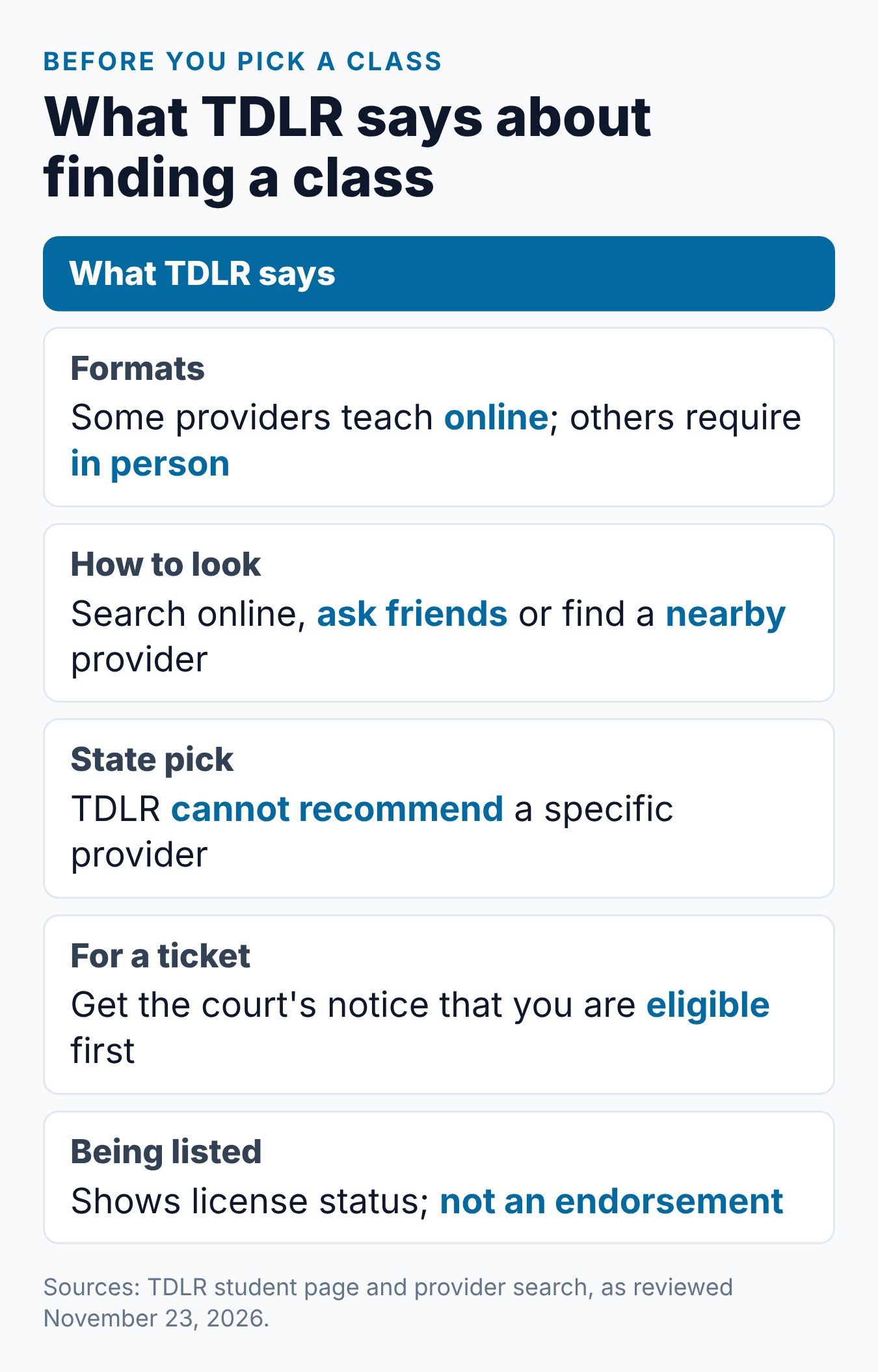
TDLR’s student page makes four points that matter for a “near me” search:
- Two formats exist. Some providers offer the course online. Others require you to attend in person.
- You do the looking. TDLR suggests searching online, asking friends or finding a nearby provider.
- No state pick. TDLR says it cannot recommend a specific provider.
- The court comes first. Before you use the course for a ticket, you must first get notice from the court that you are eligible.
Notice what follows from that. The state will not pick a provider for you, near or far. The choice of provider and format is yours.
Agency names can also cause mix-ups. TDLR approves this course, not Texas DPS and not the Texas Department of Motor Vehicles. Some drivers look for a “DMV-approved” class nearby, but in Texas the Department of Public Safety (DPS) handles driver licenses, and neither agency approves this course.
Online vs In Person: Side by Side
The two formats share the same state rules. What changes is where you sit.
| Question | Online course | In-person class |
|---|---|---|
| Where do I take it? | From home | At the place the provider names |
| Do I have to travel? | No | Yes |
| Does a nearby location matter? | No | Yes |
| Minimum instruction time | 300 minutes | 300 minutes |
| Minimum total time | 360 minutes | 360 minutes |
| Do I need the court’s notice first for a ticket? | Yes | Yes |
| Where do I check the provider? | TDLR’s provider search | TDLR’s provider search |
Only the first three rows differ. Every other row is the same, because the rules follow the course and not the building.
That is why “near me” matters for one format only. If you choose an in-person class, distance is a real factor. If you choose an online course, it is not.
The Time Rule Is the Same in Both Formats
Some drivers hope a class down the street will be shorter. Others hope an online course will be. Neither is true under the state rule.
Every course has at least 300 minutes of instruction and 360 minutes in total. That is five hours of instruction inside a six-hour course. The numbers come from 16 TAC 84.504 and 84.505, as printed in the Texas Register on August 16, 2024.
Online courses use timers to make sure the instruction time is completed. So an online course is more flexible about where you are. It is not shorter than the rule allows.
Two of our guides cover the clock in depth. See how long the course takes and how the 6-hour course works online.
Court First: Get the Court’s Notice Before Any Class
If the course is for a ticket, the court matters more than the map. TDLR says you must first get notice from the court that you are eligible. A class you finish before that notice may not help your ticket.
Timing comes first. The request is due on or before the answer date on your citation. A later request is up to the court.
You may not need to drive to the courthouse either. Under Article 45A.352(a) of the Code of Criminal Procedure, some courts take the request at a court email address or through an internet portal, if the court allows it. Ask your court which ways it accepts.
Our guide on how to request the course from a Texas court covers each way to ask. Then confirm your court’s own deadline for finishing and filing. The deadline guide explains the dates.
Who Cannot Use the Course for a Ticket
No class, near or far, fixes a ticket that does not qualify. Check these limits before you pay a provider:
- CDL holders. Anyone who holds a CDL, or held one when the offense happened, cannot use the course to dismiss a ticket, in any vehicle.
- High speeds. Speeding 25 mph or more over the limit, or 95 mph or more, does not qualify.
- Certain offenses. Passing a school bus, leaving the scene of a crash, work-zone offenses with workers present, serious traffic violations and DWI do not qualify.
Deferred disposition is a different way to handle a ticket. It has its own rules, and it is not the same as the driving safety course.
Each limit has its own guide. See the requirements checklist, the eligible violations guide, the CDL guide and the deferred disposition guide.
How to Find a Provider, Near or Far
TDLR names three ways to look for a provider. Only one of them is about distance.
- Search online. This is where both formats show up.
- Ask friends. Someone you know may have taken the course.
- Find a nearby provider. This is the “near me” route, and it fits an in-person class.
Whichever way you look, the state will not choose for you. TDLR says it cannot recommend a specific provider. A site that claims TDLR recommends it is saying something TDLR says it cannot do.
When you find a provider, ask which format it teaches. Some teach online. Others require you to attend in person.
For an in-person class, ask where and when it meets before you pay. For an online course, ask what you need to start. Our guide on how to choose a course lists more questions to ask.
Check the License Before You Pay
A short drive does not make a class valid. A license does. Run the same check for a classroom across town and for a course on your phone.
TDLR’s provider search exists to verify license status. Look up the provider there before you pay.
Read the result the right way. Being listed is not an endorsement. The search tells you a provider’s license status, and it does not tell you which course is best or closest.
Our TDLR approval guide walks through the search screen by screen.
Check Your Certificate After You Finish
The license check comes before the course. The certificate check comes after it.
TDLR has a lookup called DESSearch. To check a certificate, enter the digits after the dash in the certificate number.
Give it time. A certificate can take up to 5 days to appear. If yours is not there on the first day, that alone is not a sign of trouble.
This check works the same for both formats. Our certificate guide explains the certificate and how to turn it in.
Does a Nearby Class Cost Less?
Not by rule. The price floor does not depend on where the class is. The minimum course price is $25, and since September 1, 2025, no separate $3 charge is added to it.
Above that floor, ask each provider for its full price. An in-person class can also cost you travel time, which no price tag shows.
Two guides cover money in depth. See the cost breakdown and our look at free course offers.
Which Format Fits You?
Both formats can count. The better one is the one you will finish before your court’s deadline.
An online course may fit if:
- No in-person class is close to you.
- You want to take the course from home.
- Getting to a classroom would be hard that week.
An in-person class may fit if:
- A licensed provider teaches one close to you.
- You would rather sit in a room with a teacher.
- You do not want to take a course on a screen.
Either way, the minimum time is the same. So choose by where you want to be for those 360 minutes, not by a hope of finishing sooner.
Taking the course for insurance and not for a ticket? Ask your insurer before you sign up. Our insurance discount guide lists what to ask.
The Order of Steps
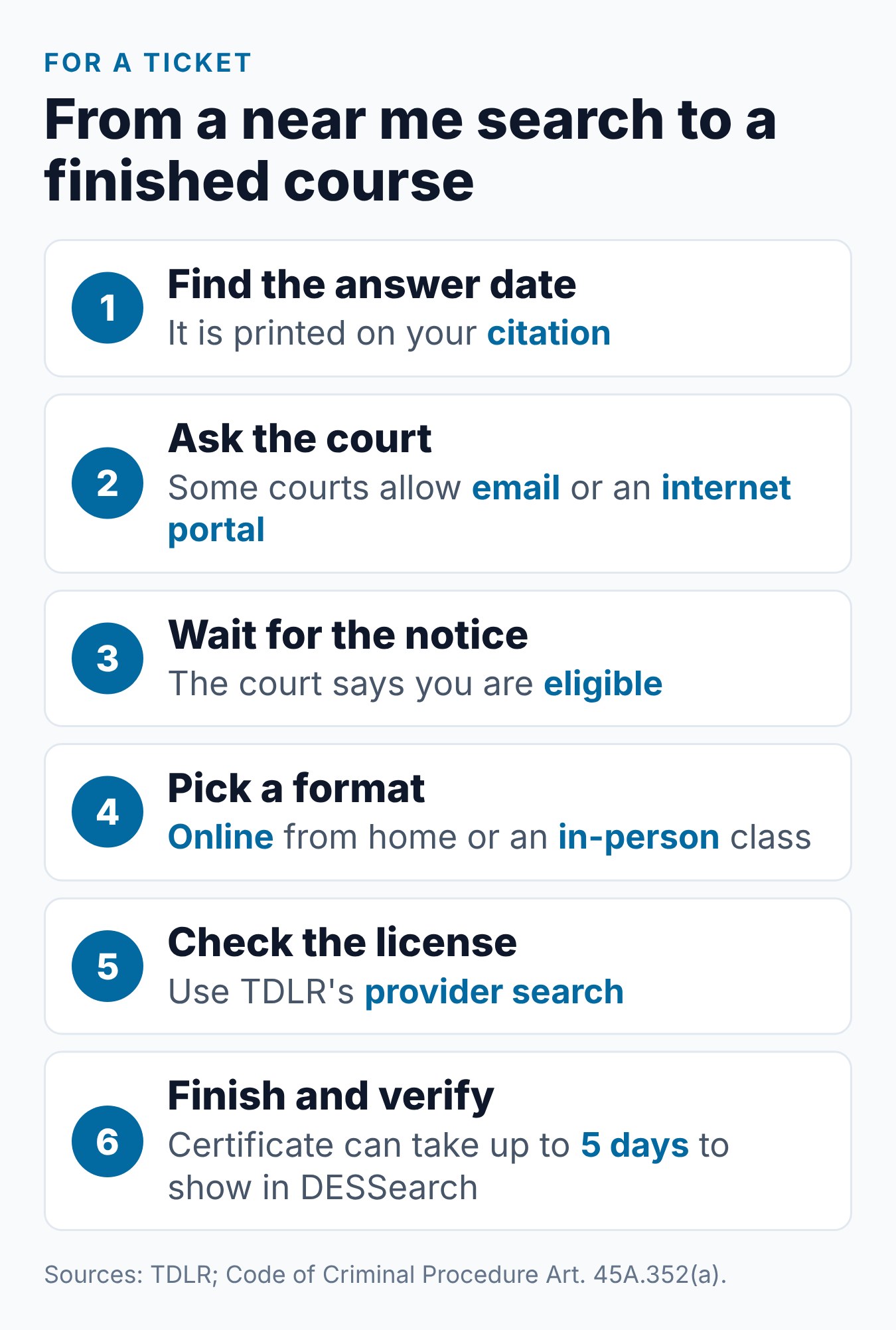
Most “near me” searches start at the wrong step. They start with a class. For a ticket, this order follows the rules above:
- Find the answer date. It is on your citation, and your request is due on or before it.
- Ask the court. Use a way your court accepts. Some courts allow email or an internet portal.
- Wait for the notice. The court tells you that you are eligible.
- Pick a format. Choose online from home or an in-person class.
- Check the license. Look up the provider in TDLR’s search.
- Finish and verify. Complete the course, then look up your certificate in DESSearch.
After step six, turn in what your court asks for by its deadline.
Steps one to three have nothing to do with location. Only step four asks whether a class is near you. And if you pick the online format, it does not ask that either.
Our complete guide to the Texas driver safety course ties these steps together, from the citation to the dismissal.
What We Found on the Official Pages
We read five official sources for this article on November 23, 2026. Here is what they showed about “near me”:
- Distance is one option out of three. TDLR suggests searching online, asking friends or finding a nearby provider.
- Format is the provider’s call. Some providers offer the course online, and others require in-person attendance.
- The minutes do not change. Every course has at least 300 minutes of instruction and 360 minutes in total.
- The request can be remote. The law lets a court take the request by email or internet portal, if the court allows it.
- The checks are online. The provider search and the certificate lookup are both TDLR web tools.
Put those five points side by side and a pattern shows. A driver whose court allows email or a portal could ask the court, check the provider, take the course and look up the certificate without a trip.
That will not be true at every court. Each court decides which request methods it allows. But it shows why “near me” is the smallest part of the choice.
Common Mistakes to Avoid
Each mistake below goes against one of the official sources above:
- Signing up before the court answers. For a ticket, the court’s notice that you are eligible comes first.
- Picking the closest class without a license check. Being close is not the same as being licensed.
- Reading the search list as a rating. A listing shows license status, and it is not an endorsement.
- Trusting “recommended by TDLR.” TDLR says it cannot recommend a specific provider.
- Expecting a faster class. Every course runs at least 360 minutes, online or in person.
- Worrying when the certificate is not listed right away. It can take up to 5 days to appear.
- Missing the answer date while you shop. A late request is up to the court.
How Requirements Can Vary
The driving safety course rules come from Texas law and TDLR and apply statewide. Each justice or municipal court still sets its own fees, filing steps and contact methods, and the facts of your citation decide which options you have.
Laws, fees and court procedures can change. Check your citation, ask the court that handles your case, and use the TDLR and Texas DPS websites for current rules before you act.
Frequently Asked Questions
Do I need a Texas defensive driving class near me?
Not always. TDLR says some licensed providers offer the course online, and others require in-person attendance. With an online course, you take it from home.
Is an online course the same course as an in-person class?
Yes. The same minimums apply to every course: at least 300 minutes of instruction and 360 minutes in total. Online courses use timers to make sure the instruction time is completed.
Can TDLR tell me which class near me is best?
No. TDLR says it cannot recommend a specific provider. It suggests searching online, asking friends or finding a nearby provider.
Do I need the court’s permission before I take the course?
For a ticket, yes. TDLR says you must first get notice from the court that you are eligible. Your request is due on or before the answer date on your citation.
Can I ask the court for the course without going there?
Sometimes. The law lets a court take the request at a court email address or through an internet portal, if the court allows it. Ask your court which ways it accepts.
How do I know a provider near me is licensed?
Use TDLR’s provider search. It verifies a provider’s license status. Being listed is not an endorsement.
How do I check my certificate?
Use TDLR’s DESSearch and enter the digits after the dash. A certificate can take up to 5 days to appear.
Is an in-person class shorter than an online course?
No. Every course has at least 360 minutes in total, in either format. Pick the format that fits your schedule, not the one you hope is faster.
Conclusion
You may not need a class near you, because TDLR says some licensed providers teach the driving safety course online. Get your court’s notice that you are eligible first, and confirm the court’s deadline. Our guide on how to take the course online walks through each step. When your court says yes, see Driving Logic’s texas defensive driving online course page.
Related Articles
- Texas Driver Safety Course (DSC): The Complete Guide
- Texas Defensive Driving Course Online: How to Take It
- Best Defensive Driving Course Texas: How to Choose
- TDLR-Approved Driver Safety Course: What It Means and How to Verify
- Bilingual Texas Defensive Driving Course: English or Spanish
- Texas DMV Defensive Driving Course: DMV, DPS or TDLR?
- Cheapest Defensive Driving Course Texas: The Legal Minimum
- Shortest Defensive Driving Course Texas: The 6-Hour Rule
Sources
- TDLR — Taking a Driving Safety Course
- Texas Code of Criminal Procedure Chapter 45A (PDF)
- Texas DPS — How to Order Your Driver Record
- TDLR — Driving Safety Provider Search
- TDLR — Validate a Driving Safety Certificate
- Texas Register, August 16, 2024 — Title 16, Economic Regulation (text of 16 TAC 84.504 and 84.505)
Billy Forte is the owner of Driving Logic, a state-approved driver improvement course provider serving Texas and other U.S. states.
This article is general information, not legal advice. Texas traffic and driving safety course rules are set by Texas law, TDLR, Texas DPS and each court, and they can change. Check with the court on your citation and the official TDLR and DPS websites for current requirements, and talk to a Texas lawyer about your specific case.