
Updated October 2026 · Reviewed by Billy Forte
The 6 hour defensive driving course Texas uses for ticket dismissal runs at least 360 minutes, with at least 300 minutes of instruction and 60 minutes of breaks or added content. No approved course can be shorter, because TDLR rules set that minimum for every provider. For a ticket, the course and your paperwork must also fit inside the 90 days the court gives you after your plea.
Key Facts
- Total length: at least 360 minutes under 16 TAC 84.504. See the minutes.
- Instruction: at least 300 minutes, which is five hours. See the minutes.
- No shortcuts: online courses use built-in timers to make sure the 300 minutes are spent. See why no course is shorter.
- Daily limit: the TDLR rule sets none, and providers may set their own deadlines. See splitting it up.
- For a ticket: 90 days after the plea to finish and file your papers. See the 90-day timeline.
What the 6 Hour Defensive Driving Course Texas Rules Require
TDLR, the Texas Department of Licensing and Regulation, sets the course length. Its rule, 16 TAC 84.504, says: “A minimum of 300 minutes of instruction is required.” It adds that “the total length of the course must consist of a minimum of 360 minutes.”
TDLR’s Course of Organized Instruction calls it the “6-Hour Driving Safety Course.” It also says “Total instruction time must be a minimum of five (5) hours, excluding breaks.” So “6-hour” means five hours of teaching plus one more hour.
Note the word “minimum” in each rule. A course may run longer, but it may not run shorter. TDLR’s student page calls it “a 6-hour course” for ticket dismissal or insurance discounts.
How the Minutes Break Down
The 360 minutes are not all lessons. Here is how the rule splits the time:
| Part of the course | Minutes | What the rule says |
|---|---|---|
| Instruction | At least 300 | Teaching time on the required topics |
| Breaks or added content | 60 | Separate from the 300 instruction minutes |
| Audio or video | 60 to 165 | Counted inside the 300 instruction minutes |
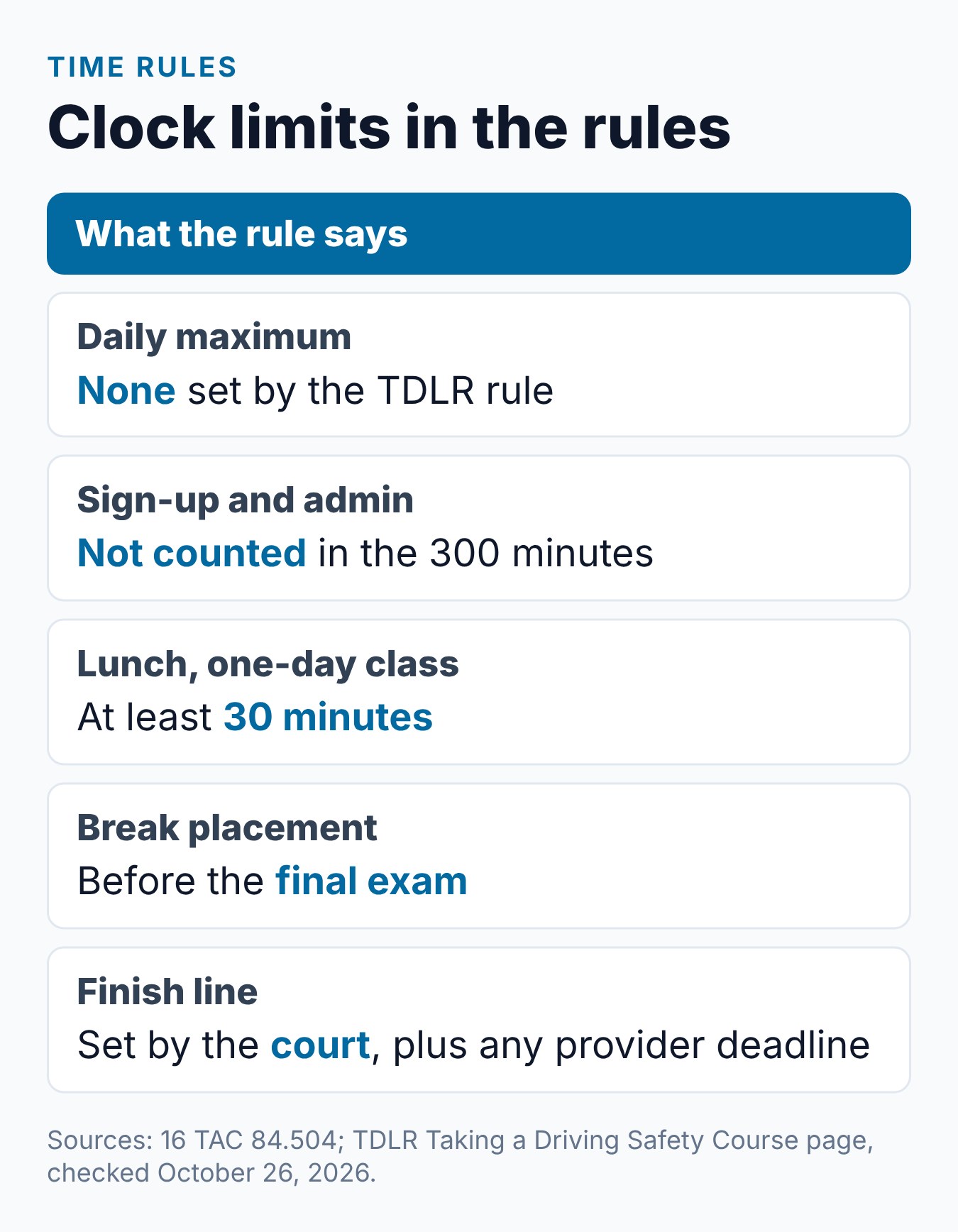
| Enrollment and admin tasks | 0 | Not counted toward the 300 minutes |
| Whole course | At least 360 | Instruction plus breaks or added content |
So signing up, paying and other admin steps add time on top of the 360 minutes. The rule does not count them.
Why No Approved Course Is Shorter
Each format has its own way to prove the time. In a classroom, the provider must document attendance under 16 TAC 84.504.
Online courses use a formula and timers. Under 16 TAC 84.505, written text counts at 180 words per minute. Video counts by its play time, and each chart counts as one minute.
The rule then requires “built-in timers to ensure that 300 minutes of instruction have been attended.” A timer stops you from moving on before the time for a section is up. That is why a course that promises to be faster than six hours does not meet the rule.
Our online course guide covers the timers, identity questions and exams in detail.
What Fills the 300 Minutes
The instruction time is set by topic. Under 16 TAC 84.504, every course must teach a list of required subjects. Some of them are:
- Preventing human trafficking.
- The Texas Driving with Disabilities Program.
- Passing certain vehicles under Transportation Code § 545.157.
- Ways to cut traffic violations, injuries, deaths and money losses.
- Building traffic skills over a lifetime of driving.
The content must use current statistics from TxDOT or NHTSA, plus references to the law. Since Sept. 1, 2025, Education Code § 1001.1102 also requires a lesson on the dangers of breaking traffic laws in work zones.
How Exams and Retests Affect the Time
The final exam has at least 20 questions under 16 TAC 84.504. You need 70 percent or more to pass. In an online course, each exam question may count for up to 90 seconds of content time.
A low score can add time. Under 16 TAC 84.505, an online provider uses one of two retest options when a student misses more than 30 percent:
- Option A. You repeat the whole unit, and all timers reset. There is no limit on repeats.
- Option B. You retake the exam with different questions. Failing the same unit exam or final exam three times fails the course.
Under Option A, each repeat adds the full unit time again. Under Option B, failing the course means starting a new one. Ask which option your provider uses.
Where the Breaks Go
The 60 extra minutes have rules too. Under 16 TAC 84.504, all breaks come after instruction begins. They come before the final exam and the closing summary.
In-person classes have more specific limits:
- One-day class. At least 30 minutes for lunch.
- Multi-day class. Breaks on a schedule equal to a one-day class.
- Break timing. After the introduction and before the last unit of the day or the exam.
Online, the provider may give 60 minutes of breaks or add 60 minutes of content instead. Either way, the total reaches 360 minutes.
Can You Split It Over Several Days?
The TDLR rule sets a minimum length, but no daily maximum. It also allows multi-day classroom courses, since it sets break rules for them.
The rules do not say whether an online course must be done in one sitting. TDLR’s student page says courses must be finished within a certain time and that providers may set their own deadlines. Ask the provider how long you have and whether you can stop and come back.
For a ticket, the court’s clock is the one to watch. Under 16 TAC 84.504, a student gets no credit unless the full course, including any makeup lessons, is done within the timeline set by the court.
Fitting the Course Into 90 Days
For a ticket, two deadlines frame your time. Both come from Code of Criminal Procedure Chapter 45A.
First, you plead guilty or no contest and ask for the course on or before the answer date on your citation. Second, under Article 45A.356, you have 90 days after the plea to finish the course and file three papers. Those are the certificate, your driving record and a signed affidavit.
The six hours are a small part of the 90 days. The waits around them can take longer. Here is what to plan for:
- Certificate. TDLR says it should arrive within 14 days of finishing.
- Certificate lookup. TDLR says a certificate may take up to 5 days to appear in its validation tool.
- Driving record by mail. The DPS ordering page says to allow three weeks.
- Driving record online. DPS says you can print or email it right away.
Our deadline guide covers the answer date in depth.
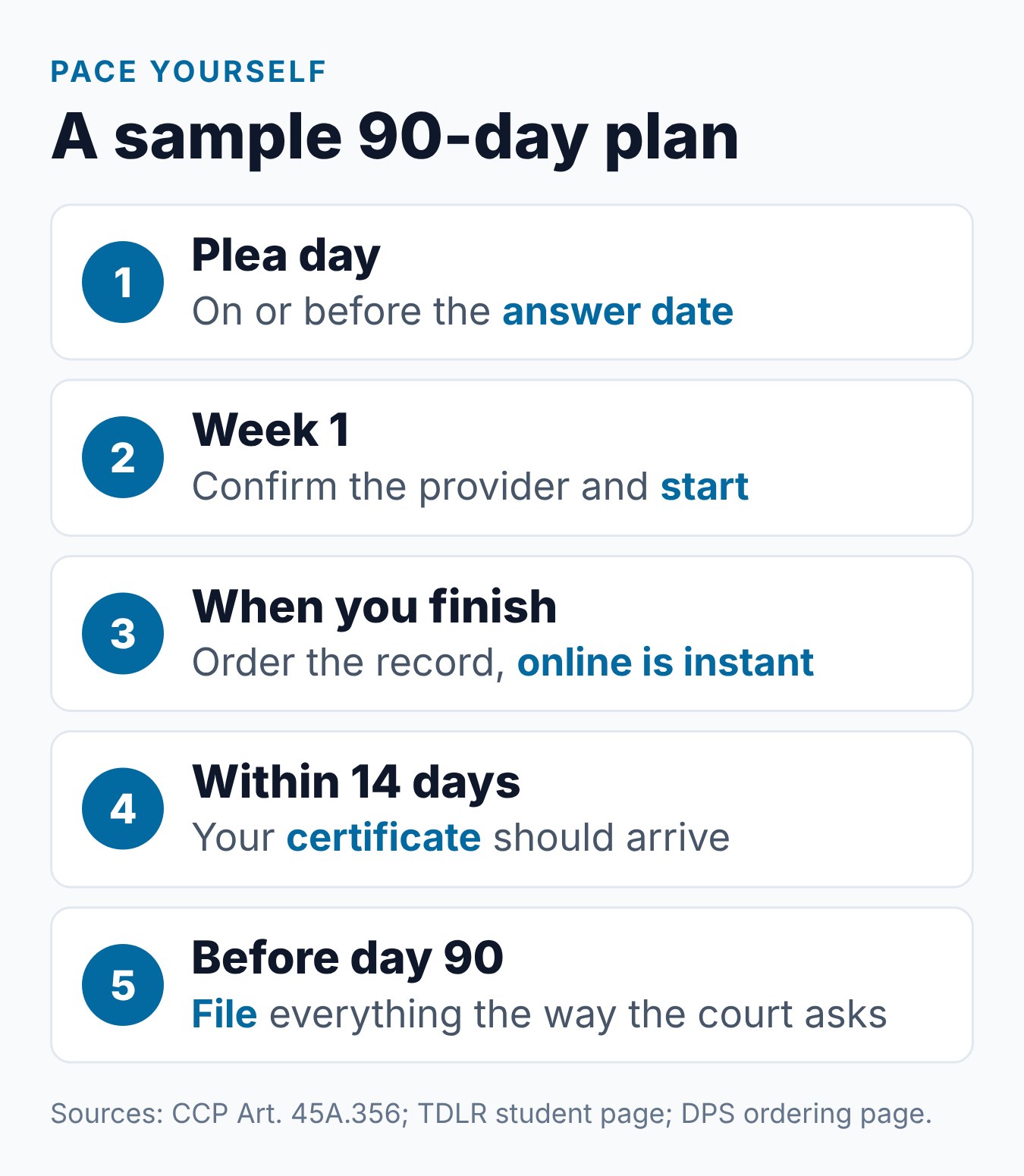
A Sample 90-Day Plan
This plan uses only the official time frames above. Your court may set its own steps.
- Plea day. Enter your plea and request on or before the answer date.
- Week 1. Check the provider’s TDLR license and start the course.
- When you finish. Order your Type 3A record online, or by mail if needed.
- Within 14 days of finishing. Watch for your certificate.
- Before day 90. File the certificate, record and affidavit the way the court asks.
Starting early leaves room for a lost certificate or a slow record. If something goes wrong, contact the court before the 90 days end.
If You Need More Time
The court can give more time in one case. Article 45A.355 says that if you show good cause for not filing on time, the court “may allow an additional period.”
That is up to the court. If you miss the 90 days with no extension, the court mails a notice and you must appear and show cause.
Without good cause, the court finds you guilty and sets a sentence. See our guide on a missed deadline.
A Second Clock: The 12-Month Window
There is one more time rule to know. Under Article 45A.352(a), you have the right to the course only if you did not finish an approved course in the 12 months before the new offense date.
So the date you finish a course matters later too. The court reports the completion and its date to DPS, which keeps it on your record.
If your next offense date falls within 12 months after you finish, you have no right to the course for that ticket. The court may still allow it, but it does not have to. Our guide on how often you can take the course explains the count.
Course Length for an Insurance Discount
The same course serves both uses. TDLR says a licensed provider’s 6-hour course “can be used for ticket dismissal or insurance discounts.” There is no shorter version for insurance.
Without a ticket, there is no court deadline. Only the provider’s deadline applies. Ask your insurer whether it gives a discount before you start, since TDI says each company decides.
What We Found in the Length Rules
On the 16 TAC 84.504 text we checked on October 26, 2026, the rule set a minimum of 360 total minutes and 300 minutes of instruction. It set no daily maximum. It said enrollment and admin tasks do not count toward the 300 minutes.
TDLR’s course outline, revised May 2026, used the same five-hour instruction minimum. It called the course the “6-Hour Driving Safety Course.”
Common Mistakes to Avoid
Each of these comes from a TDLR rule or Texas law:
- Looking for a faster course. Every approved course runs at least 360 minutes.
- Counting sign-up time. Enrollment and admin tasks are not part of the 300 minutes.
- Starting late in the 90 days. The certificate alone can take up to 14 days to arrive.
- Mailing for a record at the last minute. DPS says mail orders take about three weeks.
- Missing the provider’s deadline. Providers may set their own time limits.
How Requirements Can Vary
The driving safety course rules come from Texas law and TDLR and apply statewide. Each justice or municipal court still sets its own fees, filing steps and contact methods, and the facts of your citation decide which options you have.
Laws, fees and court procedures can change. Check your citation, ask the court that handles your case, and use the TDLR and Texas DPS websites for current rules before you act.
Frequently Asked Questions
How long is the Texas defensive driving course?
It runs at least 360 minutes. That includes at least 300 minutes of instruction and 60 minutes of breaks or added content.
Can I finish the course faster than six hours?
No. Online courses use timers to make sure the 300 minutes of instruction are spent, and the full course is at least 360 minutes.
Do I have to do it all in one day?
The TDLR rule sets no daily maximum and allows multi-day classes. Providers may set their own rules and deadlines, so ask yours.
Does sign-up time count toward the six hours?
No. 16 TAC 84.504 says enrollment and other admin tasks are not counted toward the 300 minutes of instruction.
How long do I have to finish for a ticket?
You have 90 days after your plea to finish the course and file your papers. The court may allow more time if you show good cause.
How long until I get my certificate?
TDLR says you should get it within 14 days of finishing. It comes by mail or electronically.
Can a failed test make the course take longer?
Yes. If the provider uses the repeat-the-unit option, you retake the unit and its timers reset. That adds the unit’s full time again.
Does the course count as finished on the day I pass the final exam?
The rules tie credit to finishing the full course, including any makeup lessons. Your certificate shows its issue date. Ask the provider if you need the finish date for a court.
Conclusion
The 6 hour defensive driving course Texas uses runs at least 360 minutes, with 300 minutes of instruction, and no approved course is shorter. For a ticket, the bigger clock is the 90 days after your plea.
Start early so the certificate and record arrive in time. You can begin with Driving Logic’s online Texas driving safety course.
Related Articles
- Texas Driver Safety Course (DSC): The Complete Guide
- Texas Approved 6 Hour Driving Course Online: How It Works
- Texas Defensive Driving Course Online: How to Take It
- Texas Defensive Driving Deadline: Request Before the Appearance Date
Sources
- 16 Tex. Admin. Code § 84.504 — Driving safety course length
- 16 Tex. Admin. Code § 84.505 — Alternative delivery (online) courses
- TDLR — 6-Hour Driving Safety Course of Organized Instruction (PDF)
- TDLR — Taking a Driving Safety Course
- TDLR — Validate a Driving Safety Certificate
- Texas Code of Criminal Procedure Chapter 45A (PDF)
- Texas DPS — How to Order Your Driver Record
- Texas Education Code Chapter 1001 — Driver and Traffic Safety Education (PDF)
Billy Forte is the owner of Driving Logic, a state-approved driver improvement course provider serving Texas and other U.S. states.
This article is general information, not legal advice. Texas traffic and driving safety course rules are set by Texas law, TDLR, Texas DPS and each court, and they can change. Check with the court on your citation and the official TDLR and DPS websites for current requirements, and talk to a Texas lawyer about your specific case.