
Updated June 2026 · Reviewed by Billy Forte
How long a violation stays visible on your Texas driving record depends on the record type you pull: a 3-year record (Type 2 or certified Type 2A) shows roughly the last three years, while the Type 3A certified complete record shows your full history. Because Texas has no points system, what appears are convictions, crashes, and license actions rather than points. Serious offenses and license actions remain on the complete record far longer than minor violations show on a 3-year copy, so always order the record type that matches the timeframe you need to confirm.
Applies to Texas. Court rules and deadlines vary by county.
Key Facts
- Record type sets the window: A 3-year record (Type 2/2A) shows about three years; the Type 3A complete record shows your full history.
- No points: Texas records convictions, crashes, and license actions — there is no point total to age off.
- Minor vs. serious: Minor violations drop off a 3-year record after roughly three years; serious offenses persist on the complete record.
- Insurer look-back: Insurers commonly review three to five years regardless of which record type you order.
- Dismissal avoids the entry: A court-approved Driver Safety Course keeps an eligible ticket from being recorded as a conviction.
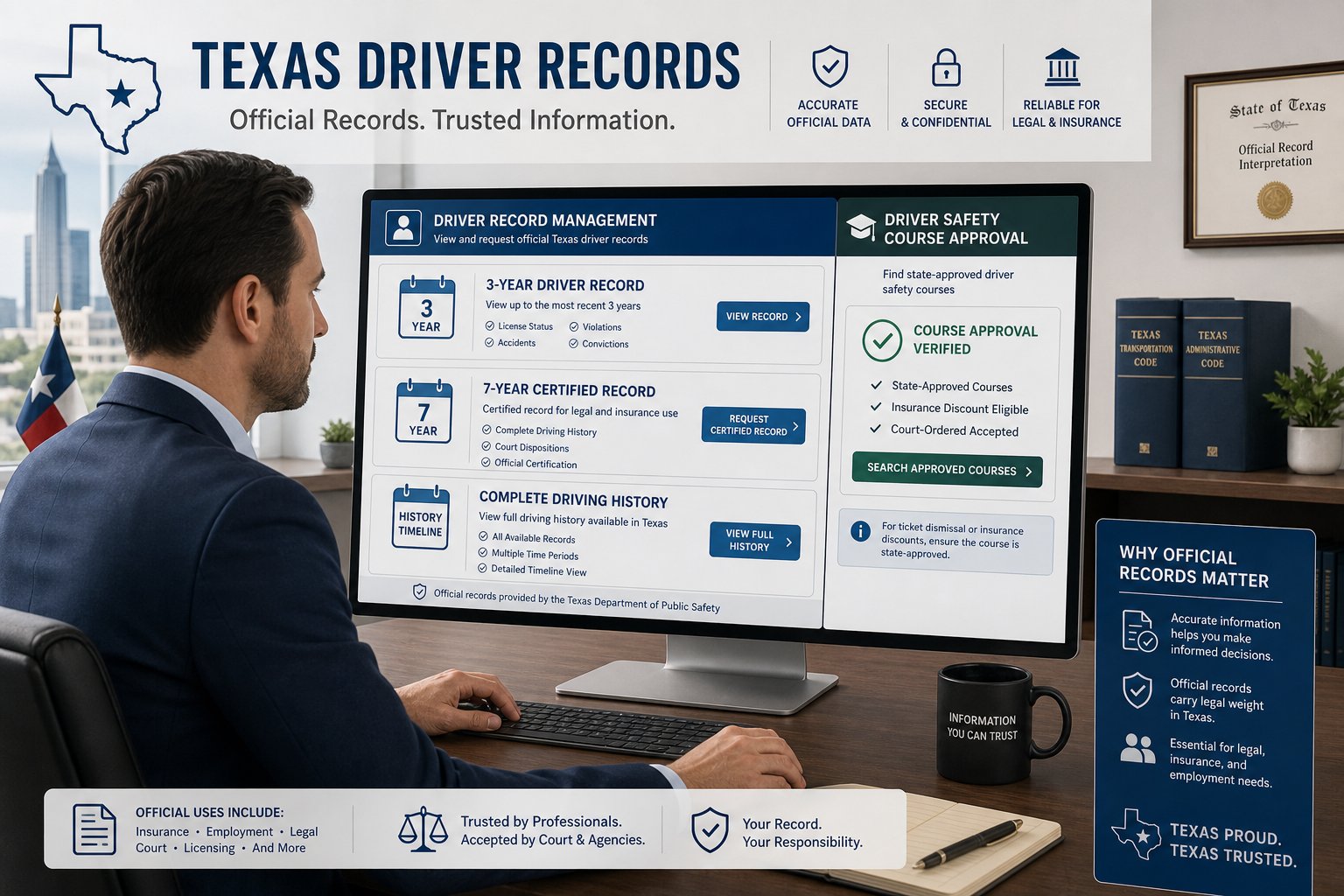
What “On Your Record” Means In Texas
When people ask how long do violations stay on Texas driving record, they often mean two different things. First, they may mean what shows up on a Texas DPS or TxDPS driving record. Second, they may mean how long a ticket can still affect insurance, jobs, or your license.
Texas uses more than one record type. So the answer depends on which driving record you pull. A short record may not show older tickets, but a longer or certified record may still include them.
Here are the main ideas to know:
- A 3-year record (Type 2, or certified Type 2A) shows roughly the last three years.
- The Type 3A certified record shows your complete history, not just three years.
- Which older events appear depends on the record type you pull.
- Courts, insurers, and employers may not all look at the same record.
Texas DPS handles driver license records. You can learn more through the official Texas DPS site. That is different from the Texas Department of Licensing and Regulation, or TDLR, which approves the Driver Safety Course program. TDLR does not manage your driver license record.
That matters because many drivers mix up these agencies. TxDPS keeps the driving history. TDLR approves the 6-hour Driver Safety Course, also called a defensive driving course in Texas. They are the same course when used for ticket dismissal.
So, “on your record” does not always mean one fixed list forever. It usually means visible on a certain record type for a certain time period.
How Long Minor And Major Violations Usually Stay Visible
For most drivers, minor moving violations stay visible for about 3 years on the standard Texas record. That is the simple answer most people need.
Common examples include:
- speeding
- failure to yield
- running a stop sign
- improper lane change
- other routine traffic convictions
Texas record types can measure that window from the date of conviction or, in some cases, the date tied to the offense history shown on that record. In practice, the takeaway is the same: most routine tickets do not stay on the standard record forever.
More serious violations can last longer. The Type 3A certified complete record shows your full history, so major offenses and license actions can appear well beyond the recent three-year window that a 3-year record shows.
Examples of violations that may remain visible longer include:
- DWI-related offenses
- reckless driving in some contexts
- suspension-related violations
- repeat serious traffic convictions
And there is an important real-world point. Even if a ticket no longer shows on a short record, that does not always mean it vanished from every system. Courts may still have case files. A full history may still reflect the event. That is why how many years has more than one answer: a 3-year record shows about three years, the Type 3A complete record shows your full history, and serious matters can persist the longest.
Do Tickets Ever Fall Off Your Texas Driving Record?
Yes. Many tickets do stop appearing on a standard Texas driving record after the record’s lookback period ends. But “fall off” does not always mean the event was erased.
For example, a routine traffic conviction may no longer show on a 3-year record (Type 2 or 2A) after that three-year window passes. On the Type 3A certified complete record, that same conviction remains part of your full history.
So there are really three different ideas:
- no longer visible on a short record
- still stored in a broader history
- dismissed so no conviction was entered
That third point is the best result for many eligible drivers. If the court approves a Driver Safety Course (DSC) dismissal and you complete all court rules on time, the ticket is usually dismissed and no standard traffic conviction is added to your driving record.
Under Texas Code of Criminal Procedure Art. 45.0511, courts may allow this option for eligible drivers. But timing matters a lot. You must ask the court for the DSC option before the appearance date on the citation. Missing that deadline can cost you the chance.
So yes, many tickets fade from standard records. But a dismissal is different from simply waiting for time to pass.
How Long Violations Can Affect Insurance, Jobs, And License Status
A violation can affect you longer than it stays on a short Texas driving record. That is where many drivers get surprised.
Insurance companies often use their own lookback periods. A ticket may affect rates for 3 to 5 years, depending on the insurer and the violation. So even if a 3-year record no longer shows an older ticket, an insurer may have used a different review window when pricing your policy.
Jobs can work the same way. If you drive for work, an employer may request a longer or certified record. Some employers care most about recent moving violations. Others focus on serious offenses, repeat patterns, or anything tied to safe driving.
License status is another issue. Repeated violations can raise concerns about your driving history even if each ticket seems minor by itself. In older Texas systems, points and surcharge-type effects often tracked around 3 years from conviction. Rules have changed over time, but the key idea remains: repeated convictions can still hurt you.
Pay close attention if you have:
- multiple moving violations close together
- a suspended or restricted license issue
- a commercial driving job
- a major offense such as DWI
If you want to check what is visible, order your record from Texas DPS. If you want to use a dismissal option for a new ticket, act before the court date on the citation.
Ways To Keep A Violation Off Your Record Or Reduce The Damage
The best way to reduce harm is to avoid a conviction when the court allows a lawful option. In Texas, that often means a Driver Safety Course, deferred disposition, or a defense handled through the court process.
Not every option fits every case. Courts decide eligibility, and deadlines matter. You should always read the citation and follow court instructions.
Two common ways drivers try to protect their record are:
- asking for a Driver Safety Course dismissal
- looking at whether a dismissed case may qualify for later record relief
The most useful option for routine tickets is often the DSC route. That is because a successful dismissal usually prevents the ticket from becoming a standard moving violation on your Texas driving record.
For some people, record clearing comes up later. But in Texas, true expungement or sealing is limited. It usually depends on how the case ended and what type of charge it was.
If you are trying to avoid long-term damage, do not wait. A missed court deadline can turn a fixable ticket into a conviction or a bigger problem.
Defensive Driving And Ticket Dismissal
In Texas, a defensive driving course and a Driver Safety Course (DSC) are the same 6-hour TDLR-approved program when used for ticket dismissal. The court may let you take it for an eligible ticket, and if you complete every step on time, the case is usually dismissed instead of becoming a conviction.
That can protect your driving record in a very direct way. No conviction usually means no standard moving violation entered from that case.
But there are important limits:
- the course must be approved by TDLR, not TxDPS or TxDMV
- you must ask the court before the appearance date on the ticket
- the court must approve your request
- you must complete all court-required documents on time
You can verify course rules through the Texas Department of Licensing and Regulation.
If you need a flexible online option, you can take the Texas course through Driving Logic. For busy drivers, that can be the simplest way to meet a court order or dismissal requirement without sitting in a classroom.
Just remember: the course helps only if the court grants the option and you meet every deadline.
Expungement, Sealing, And When They May Apply
Expungement and sealing are not the normal fix for a standard traffic conviction in Texas. They are limited remedies, and they usually apply only in certain cases.
In general, expungement may be possible when a charge was dismissed or you were acquitted. An order of nondisclosure may seal some records in limited situations. But serious offenses, especially some DWI cases, have strict limits or may not qualify.
That means most drivers should not assume an old ticket can simply be erased later. For routine traffic cases, the more practical question is often whether you can stop the conviction before it lands on your record.
A few key points:
- dismissed charges may be treated differently from convictions
- sealing is not the same as deletion
- court records and driving records are not always the same thing
- eligibility depends on the exact case outcome
So if your goal is to keep a ticket from hurting your record, the strongest move is often early action with the court. If you think a past case may qualify for record relief, review the official rules first and get case-specific help if needed.
FAQ
How long do traffic violations stay on a Texas driving record?
On a 3-year record type, about three years; on the Type 3A certified complete record, they remain part of your full history. The record type you pull determines what you see.
Do tickets ever fall off my record?
Minor convictions stop appearing on a 3-year record after roughly three years, but the complete record retains your history. Serious offenses and license actions persist much longer.
Are there points that expire?
No. Texas has no points system, so nothing expires as points. The record reflects convictions and license actions instead.
How can I keep a violation off my record?
For an eligible ticket, a court-approved Driver Safety Course results in dismissal before a conviction is recorded, so the violation never posts as a conviction.
Conclusion
Retention on a Texas record is really a question of which record you are looking at: three years on a short record, your full history on the Type 3A complete record. With no points to expire, the practical concern is convictions and license actions, and serious ones stay for the long haul. When a ticket is eligible, dismissing it through a Driver Safety Course keeps it from ever becoming part of that history.
If your ticket qualifies and the court approves it, you can keep it off your record with a TDLR-approved Texas Driver Safety Course completed online.
Related Articles
- Your Texas Driving Record: How to Get It and What It Shows
- How Long Does a Speeding Ticket Stay on Your Texas Driving Record?
- Texas Defensive Driving for Ticket Dismissal: The Complete Guide
- Texas Driving Record Points: Does Texas Still Have a Points System?
Sources
- Texas DPS — Online Driver Record System
- TDLR — Driver Safety
- Texas Code of Criminal Procedure Art. 45.0511
Billy Forte is the owner of Driving Logic, a state-approved driver safety and defensive driving course provider serving Texas and other U.S. states. Driving Logic offers online driver safety, defensive driving, and traffic-ticket courses for drivers handling court, license, and insurance-related requirements.
This article is general information, not legal advice. Texas court rules, TDLR requirements, deadlines, eligibility, and case facts can differ by county and court. Use official Texas court and state sources for current requirements, and consult a qualified Texas attorney for legal guidance specific to your situation.