
Updated June 2026 · Reviewed by Billy Forte
Your Texas driving record is the official history TxDPS keeps for your license, showing your license status, traffic convictions, crashes, and any suspension or reinstatement activity. You can order it from the Texas DPS online driver record system or by mail with Form DR-1, choosing the record type that fits your purpose — a Type 3A certified complete record for court and Driver Safety Course requests, or a simpler uncertified copy for personal review. Texas no longer uses a points system, so the record reflects convictions and license actions rather than any point total, and which entries appear depends on the record type you request.
Applies to Texas. Court rules and deadlines vary by county.
Key Facts
- Six record types: Type 1 (status), Type 2 (3-year), Type 2A (certified 3-year), Type 3 (complete), Type 3A (certified complete), and Type AR (certified abstract).
- For DSC/ticket dismissal: Texas courts require the Type 3A certified complete record — a certified 3-year (Type 2A) record is not accepted.
- No points system: Texas repealed the Driver Responsibility Program in 2019, so the record shows convictions and license actions, not points.
- Two ways to order: Online through the Texas DPS driver record system (often immediate) or by mail with Form DR-1 (about three weeks).
- What it shows: License status, moving-violation convictions, crashes, and any suspension, revocation, or reinstatement.
- Fix errors at the source: Record corrections go through TxDPS, which maintains the data.
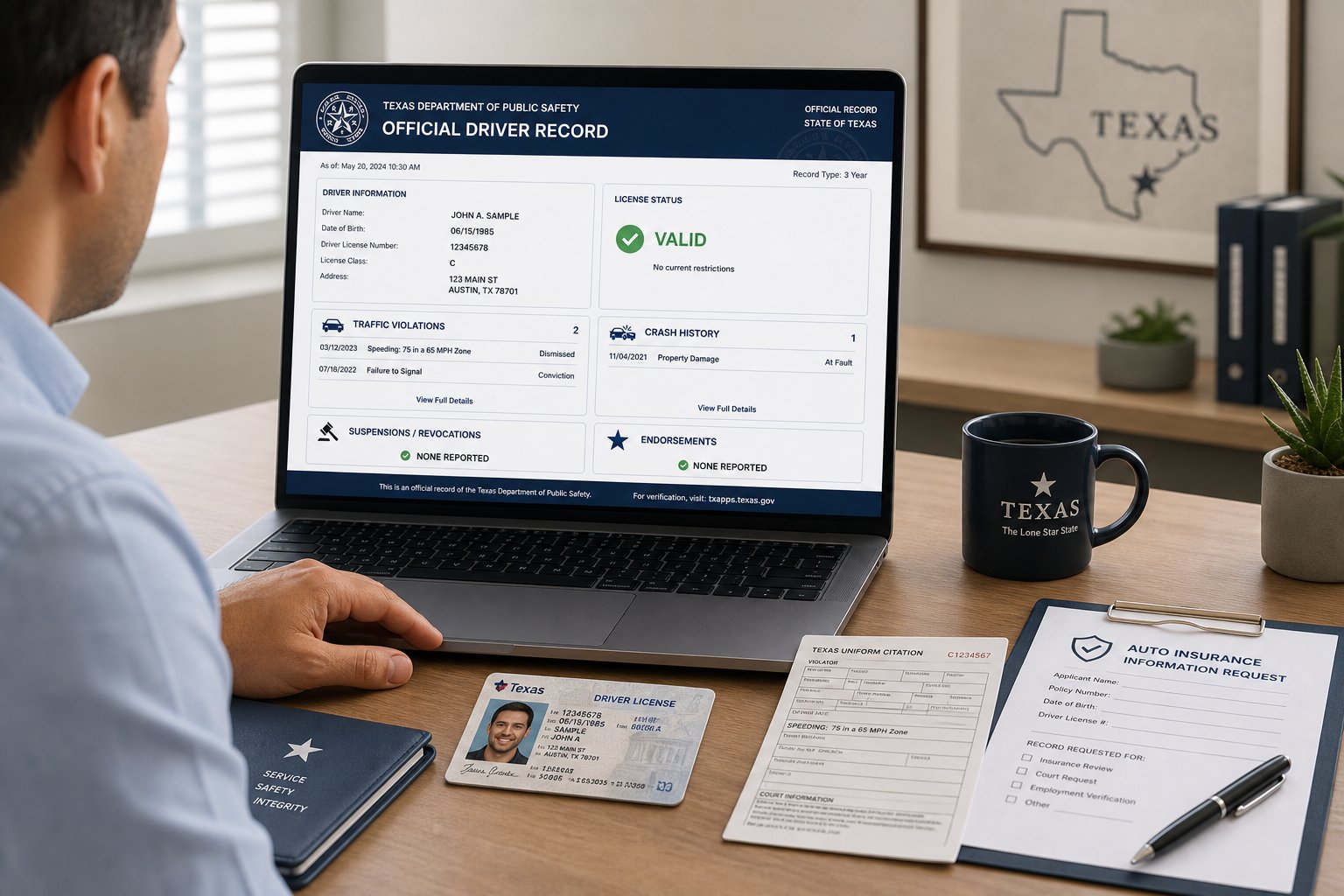
What A Texas Driving Record Is And Why You Might Need One
A Texas driving record is an official record from Texas DPS. It shows the main facts tied to your driver license and your driving history in Texas.
That can include:
- Your license status
- Traffic convictions
- Moving violations
- Crashes on record
- Suspensions or revocations
- Restrictions or endorsements
People ask for a driving record texas report for simple reasons and urgent ones. Sometimes you just want to check your status. Other times, a court, school, insurer, or employer asks for a specific copy.
A common reason is a traffic ticket. If you want to use a Driver Safety Course (DSC) for dismissal, the court will often ask for a Type 3A driving record. In Texas, a defensive driving course and a DSC mean the same 6-hour course approved by the Texas Department of Licensing and Regulation (TDLR). It is not approved by TxDPS. And if you want that option for ticket dismissal, you must ask the court before the appearance date on the citation under Texas Code of Criminal Procedure Art. 45.0511.
You may also need your record for:
- Court requests
- Insurance review or quotes
- Driver education
- Job applications, especially driving jobs
- Checking for errors before a renewal or background check
The key point is simple: the right record depends on who is asking. Texas DPS issues several record types, and the one you need is based on the use.
The Main Types Of Texas Driving Records And What Each One Is Used For
Texas DPS offers more than one kind of record. That is where many drivers get stuck.
The most useful types are the ones people ask for most often:
- Uncertified records (Type 2 for three years; Type 3 for complete history)
- Certified 3-year record (Type 2A) — not accepted for a Driver Safety Course
- Certified complete record (Type 3A) — required for court and Driver Safety Course use
An uncertified record (Type 2 for the last three years, or Type 3 for your complete history) is often used for personal review and may be enough for some insurance or employer checks. Many Texas courts do not accept an uncertified copy as DSC proof.
The certified 3-year record (Type 2A) is official and authenticated by TxDPS, but Texas does not accept it for a Driver Safety Course, so do not order this one for ticket dismissal.
The certified complete record (Type 3A) is the one that matters most for official use. It is TxDPS’s certified record of your full accident and violation history, and it is commonly required to prove eligibility for a Driver Safety Course or defensive driving course.
Courts and schools often care about certification because it proves the record came from Texas DPS in official form. Employers may also prefer a certified copy when the job involves driving.
Other Texas DPS record labels you may see include Type 1, Type 2, Type 2A, Type 3, Type 3A, and Type AR. Still, for most readers, the practical question is this: do you need a short unofficial copy, a longer unofficial copy, or a certified one? If you are not sure, check the exact words on the court notice, school checklist, or employer request before you order.
Which Texas Driving Record You Need For Defensive Driving, Court, Insurance, Or Driver Education
For defensive driving or a Driver Safety Course, the record most courts usually want is the Type 3A certified driving record. That is the safe default when a court tells you to send a driving record with your course completion certificate.
This matters because Texas uses specific terms. A defensive driving course and a Driver Safety Course (DSC) are the same thing in Texas: a TDLR-approved 6-hour course. TDLR approves the course provider. TxDPS handles driver licenses, and TxDMV handles vehicle registration.
If you plan to use DSC for ticket dismissal, do not wait past your court date. You must request permission from the court before the appearance date on the citation. The law for this process is Art. 45.0511.
Here is the simple match-up:
- Defensive driving / DSC / ticket dismissal: usually Type 3A certified
- Driver education: often Type 3A certified
- Insurance review: often a 3-year or other recent-history record
- Employment: often a certified record if the role involves driving
- Court matters: usually the exact certified type named by the court
What do courts and employers look for? Usually these items:
- Current license status
- Recent traffic convictions
- Moving violations
- Suspensions
- Major restrictions
- Crash history when relevant
If you need a course for a ticket, you can take the Texas DSC with Driving Logic, but first confirm the court approved that option and told you which record to file.
How To Request Your Texas Driving Record Online Or By Mail
The fastest way to get your texas driving record is online through TxDPS My License Online. If you qualify, you can order the record, pay the fee, and download a PDF right away.
Use the official Texas DPS system through the driver license services linked from Texas DPS. You will usually need:
- Your Texas driver license or ID number
- Your audit number
- Date of birth
- Last four digits of your Social Security number
- A credit card or other accepted payment method
Then choose the record type you need. Texas DPS lists different fees by record type, so the cost depends on whether you order a basic, unofficial, or certified copy. Since fees can change, check the live DPS order page before you submit payment.
If you need to request by mail, complete the DR-1 driver record request form and send it to:
Texas Department of Public Safety PO Box 149008 Austin, TX 78714-9008
Mail is slower, but it can help if you cannot use the online system. Include the form, the right fee, and any required details so DPS can match your request.
For most people, online is best because it is immediate. Mail requests usually take about three weeks after DPS receives them.
Before you order, double-check the exact record name. If a court says Type 3A, do not guess with a 3-year unofficial copy. That small mistake can cause delays.
What Information Appears On A Texas Driving Record And How Long It Takes To Receive
A Texas driving record can show a lot more than just tickets. The exact details depend on the record type, but most copies include core license and history data.
You may see:
- Your full name and address
- Date of birth
- License number and class
- License status
- Endorsements and restrictions
- Traffic convictions
- Moving violations
- Suspensions or revocations
- Crash entries on record
- Administrative actions
Certified records often give the most complete official picture. That is why courts and schools ask for them. They want a record that clearly shows your status and history from Texas DPS.
For a recent-history record, employers or insurers may focus on traffic convictions, crash history, and whether your license is valid. For court use, the key issue is often whether your record supports the request you made, such as DSC eligibility.
How long does it take to receive?
- Online request: usually immediate download or print access after payment
- Mail request: about three weeks after DPS receives the form
That timing matters if you have a court deadline. If a court asks for your driving record and your course certificate, build in enough time for both. And if the court order says certified, use the certified copy.
If you only need to check your own status, an unofficial record may be enough. If another person or agency will rely on it, ask whether they require certification first.
How To Fix Errors And Keep Your Texas Driving Record Clean
If your Texas driving record has an error, you cannot change it yourself. You must contact Texas DPS and ask for a correction with proof.
Useful proof may include:
- Court records
- Clearance letters
- Case dismissal papers
- Identity documents
- Other official records tied to the item
Start with the driver license services area at Texas DPS. If the problem is linked to a course, remember the roles are different. TDLR oversees approved Driver Safety Course providers, not your driver record. You can review TDLR information at Texas Department of Licensing and Regulation.
To keep your record clean, focus on habits that stop violations before they post:
- Follow speed limits
- Put the phone away
- Leave more space in traffic
- Use signals
- Keep your car in safe condition
- Review your record from time to time
A clean record can help with court issues, job checks, and insurance review. It can also help you catch a wrong entry early, before it causes a bigger problem.
If you need a record for a court-approved DSC, get the correct Type 3A from TxDPS and pair it with your completion certificate from a TDLR-approved provider such as Driving Logic.
FAQ
What does a Texas driving record show?
It shows your license status, traffic-violation convictions, reported crashes, and any suspension, revocation, or reinstatement. Texas has no points system, so it reflects convictions and license actions rather than a point total.
Which record do I need for a Driver Safety Course?
The Type 3A certified complete record. Texas courts require this certified record for ticket dismissal; a certified 3-year (Type 2A) record is not accepted for the course.
How do I get my Texas driving record?
Order it online through the Texas DPS driver record system, usually delivered immediately, or by mail using Form DR-1, which takes about three weeks.
Does Texas use a points system?
No. Texas ended the Driver Responsibility Program in 2019, so there are no driver points. Convictions still appear on your record and can affect insurance and license status.
How do I fix an error on my record?
Contact TxDPS, which maintains the records. Order the correct record type first so you can see exactly what is on file before requesting a correction.
Conclusion
A Texas driving record is less complicated once you match the record type to the reason you need it: a Type 3A certified complete record for court and the Driver Safety Course, or a simpler copy for a personal look. Remember there are no points to track in Texas — only convictions and license actions — so the practical task is pulling the right record and reading it closely. Order from TxDPS, check it for errors, and you will know exactly what courts, insurers, and employers can see.
If a court has approved your request, you can complete a TDLR-approved Texas Driver Safety Course online and pair the certificate with your Type 3A record before the deadline.
Related Articles
- Texas Type 3A Driving Record: What It Is and How to Get It
- How to Get Your Texas Driving Record Online
- Texas Certified Driving Record vs. Type 3A: Which One Do You Need?
- Texas Driving Record Points: Does Texas Still Have a Points System?
Sources
- Texas DPS — How to Order a Driver Record
- Texas DPS — Online Driver Record System
- TDLR — Driver Safety
- Texas Code of Criminal Procedure Art. 45.0511
Billy Forte is the owner of Driving Logic, a state-approved driver safety and defensive driving course provider serving Texas and other U.S. states. Driving Logic offers online driver safety, defensive driving, and traffic-ticket courses for drivers handling court, license, and insurance-related requirements.
This article is general information, not legal advice. Texas court rules, TDLR requirements, deadlines, eligibility, and case facts can differ by county and court. Use official Texas court and state sources for current requirements, and consult a qualified Texas attorney for legal guidance specific to your situation.