
Updated June 2026 · Reviewed by Billy Forte
In Texas the real question is not “certified record versus Type 3A” — because the Type 3A is itself a certified record, specifically TxDPS’s certified copy of your complete driving history. The distinction that matters is which certified record you need: the Type 3A (certified complete) is what courts require for a Driver Safety Course, while the Type 2A (certified 3-year) is official but not accepted for the course, and uncertified Type 2 or Type 3 copies are fine for personal review. Match the record to the requester’s exact wording, and for ticket dismissal order the Type 3A unless the court specifies otherwise.
Applies to Texas. Court rules and deadlines vary by county.
Key Facts
- Type 3A is certified: It is TxDPS’s certified record of your complete driving history — not an uncertified copy.
- For DSC/court: Order the Type 3A certified complete record; the certified 3-year Type 2A is not accepted for a Driver Safety Course.
- Uncertified options: Type 2 (3-year) and Type 3 (complete) are uncertified and suit personal review or insurance shopping.
- Certification is the value: A certified record is authenticated by TxDPS, which is what courts, employers, and agencies rely on.
- Follow the wording: Order exactly the record type your court, employer, or agency names to avoid buying the wrong one.
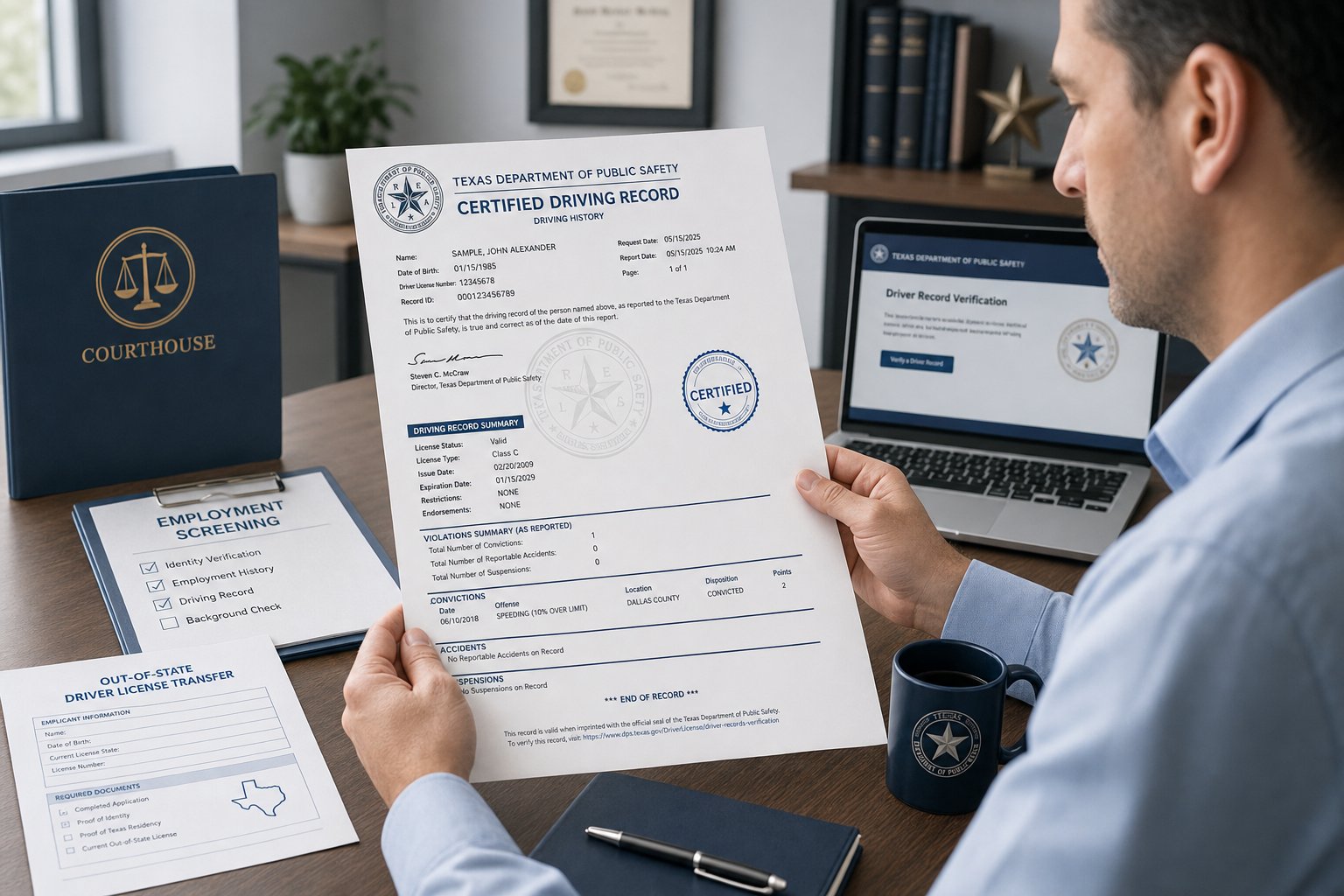
What A Texas Certified Driving Record Is And When You Need One
A Texas certified driving record is an official copy of your driving history issued by Texas DPS. It carries DPS certification, which matters when a court, employer, agency, or another state needs proof that the record is official.
That is the main point. A regular record may show the same facts, but a certified record has added value because it is authenticated by TxDPS.
You may need one in a few common situations:
- Court matters, including traffic cases
- Driver Safety Course (DSC) requests or follow-up filings
- Employment screening for jobs that check driving history
- Out-of-state license transfers when another state asks for an official record
- Legal proceedings where a plain copy may not be enough
In Texas, a Driver Safety Course and a defensive driving course are the same TDLR-approved 6-hour program. If you want to use that course for ticket dismissal, you must ask the court before the appearance date on your citation under Texas Code of Criminal Procedure Art. 45.0511.
Many drivers get confused by the names. The key point is that the Type 3A is itself a certified record — specifically, TxDPS’s certified copy of your complete driving history. A plain “3-year record” (Type 2) is a different, uncertified document, and a certified 3-year record (Type 2A) is yet another. So the real question is not “certified or 3A,” but which certified record you need. The safe move is to check what your court, employer, or agency specifically asks for, then order that exact record from Texas DPS.
Which Texas Driving Record Type To Order For Court, Insurance, Or Driver Education
The right record depends on why you need it. For many traffic courts and DSC requests, drivers are asked for a Type 3A or a certified abstract that shows recent history and meets court rules.
Here is the simple breakdown of the types of Texas driving records that matter most in this context:
- Type 3A (certified complete history): the certified full record Texas courts require for DSC ticket dismissal
- Type 2A (certified 3-year history): official and certified, but not accepted for a Driver Safety Course
- Type 2 or Type 3 (uncertified): fine for personal review, insurance shopping, or a quick history check
For court, the record named on your instructions matters most. Some courts say “certified driving record.” Others say “Type 3A.” Texas DPS also states that the Type AR certified abstract of complete driver record can be used for a defensive driving course, which adds to the naming confusion.
For insurance or your own review, an unofficial 3-year record may be enough in some cases. But if the request is formal, ask whether certification is required.
For driver education or a Driver Safety Course, do not assume all providers or courts want the same thing. The course itself is regulated by the Texas Department of Licensing and Regulation (TDLR), not TxDPS. You can review TDLR information at tdlr.texas.gov.
If you are using a course for ticket dismissal, follow the court’s wording exactly. And do not miss the deadline on the citation.
How To Request Your Texas Certified Driving Record Online Or By Mail
Texas DPS lets you request your driving record online or by mail. DPS says online ordering is the fastest and most convenient option, and DPS does not provide in-person driver record services.
To order online through Texas DPS, you usually need:
- Your Texas driver license or ID number
- Your audit number
- Your date of birth
- The last four digits of your Social Security number
- A payment card
Online ordering works best if you need the record fast. In many cases, you can view, print, or email the record right after purchase.
Mail is still an option if you prefer paper forms. That route can work well if you are not in a rush, but it takes much longer. DPS says mailed requests can take about three weeks after receipt.
Before you order, read your court notice or employer instructions one more time. A quick check can save you from ordering the wrong version. If the request says certified, do not assume a plain 3-year driving record will be accepted.
If you need the record for a Texas ticket, pair speed with accuracy. Ordering the right record the first time helps you stay on schedule.
What Information Appears On A Certified Driving Record
A certified driving record shows key facts from your Texas driving history. The exact details can vary by record type, but a Type 3A or similar certified record usually includes the items courts and agencies care about most.
You can expect to see information such as:
- Current license status
- Traffic convictions
- Moving violations
- Accidents or crashes reported on the record
- Restrictions on your license
- Other entries tied to your driving history
Some sources also describe the record as showing both moving and nonmoving violations and parts of your complete driver history. That is why courts often ask for a specific type instead of saying only “send your record.”
If you are ordering a record for DSC paperwork, review the court checklist first. Many courts want the record to clearly show enough history to confirm eligibility. If your citation instructions mention a certified record, submit the certified one, not a screenshot or informal copy.
This matters for simple reasons. A court wants a reliable state-issued document. An employer may want the same. And another state may need a formal record before handling a license transfer.
So while many Texas driving records contain similar core facts, the official certified version carries more weight when the request is formal.
How Long It Takes, What It Costs, And How Delivery Works
If speed matters, online ordering is usually fastest. Texas DPS says you can often access the record right away after payment, which is why many drivers choose that option when a court deadline is close.
For mail requests, the wait is much longer. DPS says mailed requests take about three weeks after receipt. That timeline does not include mailing time on your end, so plan carefully if your court date is near.
Cost can vary by record type and method. A city FAQ reports these common prices for the certified Type 3A-style record:
- $12 online
- $10 by mail
Those figures are widely cited, but you should still verify current fees with Texas DPS before you pay.
Delivery also differs by method:
- Online: print or email access may be available right away
- Mail: paper delivery takes longer and depends on processing and postal time
If you also need a Driver Safety Course, remember that the course fee is separate from the driving record fee. Under Texas law, the minimum course fee is $25 plus a $3 materials fee for the TDLR-approved course, though other court costs or filing fees may apply depending on the court and case.
If you are short on time, order the record first and confirm your court steps next.
How To Use Your Record For Defensive Driving And Court Requirements
For a Texas ticket, your driving record is often part of the paperwork needed for a Driver Safety Course request or completion. The first rule is simple: ask the court before the appearance date on the citation if you want to use the course for dismissal.
That rule comes from Texas Code of Criminal Procedure Art. 45.0511. Do not wait, and do not assume a late request will be accepted.
In Texas, defensive driving and DSC mean the same 6-hour course. It must be approved by the Texas Department of Licensing and Regulation, not Texas DPS or TxDMV. After the court allows the request, drivers are often told to submit:
- The course completion certificate
- A certified Texas driving record or the record type named by the court
- Any court forms or fees required by that court
Always read your court instructions closely. One court may ask for a Type 3A, while another says certified driving record.
If you need a fast online option, Driving Logic offers a TDLR-approved Texas DSC built for busy schedules and mobile use. It is a practical choice when you need to fit the course around work, family, or travel.
The key is to match the record to the court request, finish the right course, and submit everything on time.
What To Do If Your Texas Driving Record Has An Error
If your Texas driving record has an error, contact Texas DPS as soon as you spot it. A mistake on your record can affect court filings, job checks, insurance reviews, or other official requests.
Common issues may include:
- A violation that should not be listed
- Wrong dates or case details
- A crash entry that looks inaccurate
- License status information that appears outdated
Start by comparing the record to your court papers, receipts, or other official documents. Look for exact mismatches, not just rough memory. Clear details help when you contact DPS.
Use the information and contact paths provided by Texas DPS. If the error affects a traffic case, keep following the court’s deadlines while you work on the correction. Do not ignore a citation, hearing date, or filing date because the record looks wrong.
If a court has approved you for a Driver Safety Course, keep copies of everything you submit. That includes your motion or request, payment proof, certificate, and driving record. Good records make follow-up easier if a problem comes up.
FAQ
Is the Type 3A a certified record?
Yes. The Type 3A is TxDPS’s certified record of your complete driving history. The phrase “certified driving record” can describe several types, but the Type 3A is the certified complete version.
Which certified record do I need for a Driver Safety Course?
The Type 3A certified complete record. The certified 3-year record (Type 2A) is official but is not accepted for a Driver Safety Course.
What is the difference between Type 2A and Type 3A?
Both are certified. Type 2A covers about the last three years and is not accepted for the course; Type 3A covers your complete history and is the record courts require for DSC dismissal.
When is an uncertified record enough?
For personal review, insurance shopping, or a quick history check, an uncertified Type 2 or Type 3 is usually fine. Official and court uses generally require a certified record.
Conclusion
Once you know the Type 3A is itself a certified record, the choice gets simple: pick the certified complete record (3A) for court and the Driver Safety Course, know that the certified 3-year record (2A) will not be accepted for the course, and save the uncertified copies for personal use. The deciding factor is always the exact wording from whoever is asking. Order that specific type from TxDPS and you avoid paying twice for the wrong record.
When the court approves your request, you can complete a TDLR-approved Texas Driver Safety Course online and submit it with your Type 3A certified record.
Related Articles
- Your Texas Driving Record: How to Get It and What It Shows
- Texas Type 3A Driving Record: What It Is and How to Get It
- How to Get Your Texas Driving Record Online
- Texas DPS Driving Record: What TxDPS Tracks and Why It Matters
Sources
- Texas DPS — How to Order a Driver Record
- Texas DPS — Online Driver Record System
- TDLR — Driver Safety
Billy Forte is the owner of Driving Logic, a state-approved driver safety and defensive driving course provider serving Texas and other U.S. states. Driving Logic offers online driver safety, defensive driving, and traffic-ticket courses for drivers handling court, license, and insurance-related requirements.
This article is general information, not legal advice. Texas court rules, TDLR requirements, deadlines, eligibility, and case facts can differ by county and court. Use official Texas court and state sources for current requirements, and consult a qualified Texas attorney for legal guidance specific to your situation.