
Updated October 2026 · Reviewed by Billy Forte
Your Texas DPS driving record is the file the Texas Department of Public Safety keeps on your license, your crashes and your traffic convictions. Courts must report a traffic conviction to DPS within seven days, and DPS uses the file when it decides on your license. The same record also affects the driving safety course, your insurance and what others with legal access can see.
Key Facts
- Who keeps it: Texas DPS, under Transportation Code Chapter 521. See what DPS records.
- How entries arrive: courts report traffic convictions within 7 days. See how convictions reach DPS.
- Suspension risk: 4 or more moving-violation convictions in 12 months, or 7 or more in 24, makes a habitual violator. See habitual violators.
- Course check: the record shows the fact of a driving safety course, not the reason. See course eligibility.
- Unknown: DPS does not publish how long items stay on the full record. See what DPS does not publish.
What the Texas DPS Driving Record Is
DPS issues Texas driver licenses and keeps the records that go with them. The rules for those records sit in Subchapter C of Transportation Code Chapter 521, titled Department License Records.
Other agencies do different jobs. TDLR, the Texas Department of Licensing and Regulation, approves driving safety courses but does not keep driver records. The Texas Department of Transportation handles crash report questions, according to the DPS ordering page.
TxDPS and DPS are two names for the same department. You will see both on state pages and on court forms.
What DPS Records
State law tells DPS what to keep. The sections below come from Chapter 521.
Applications and License Actions
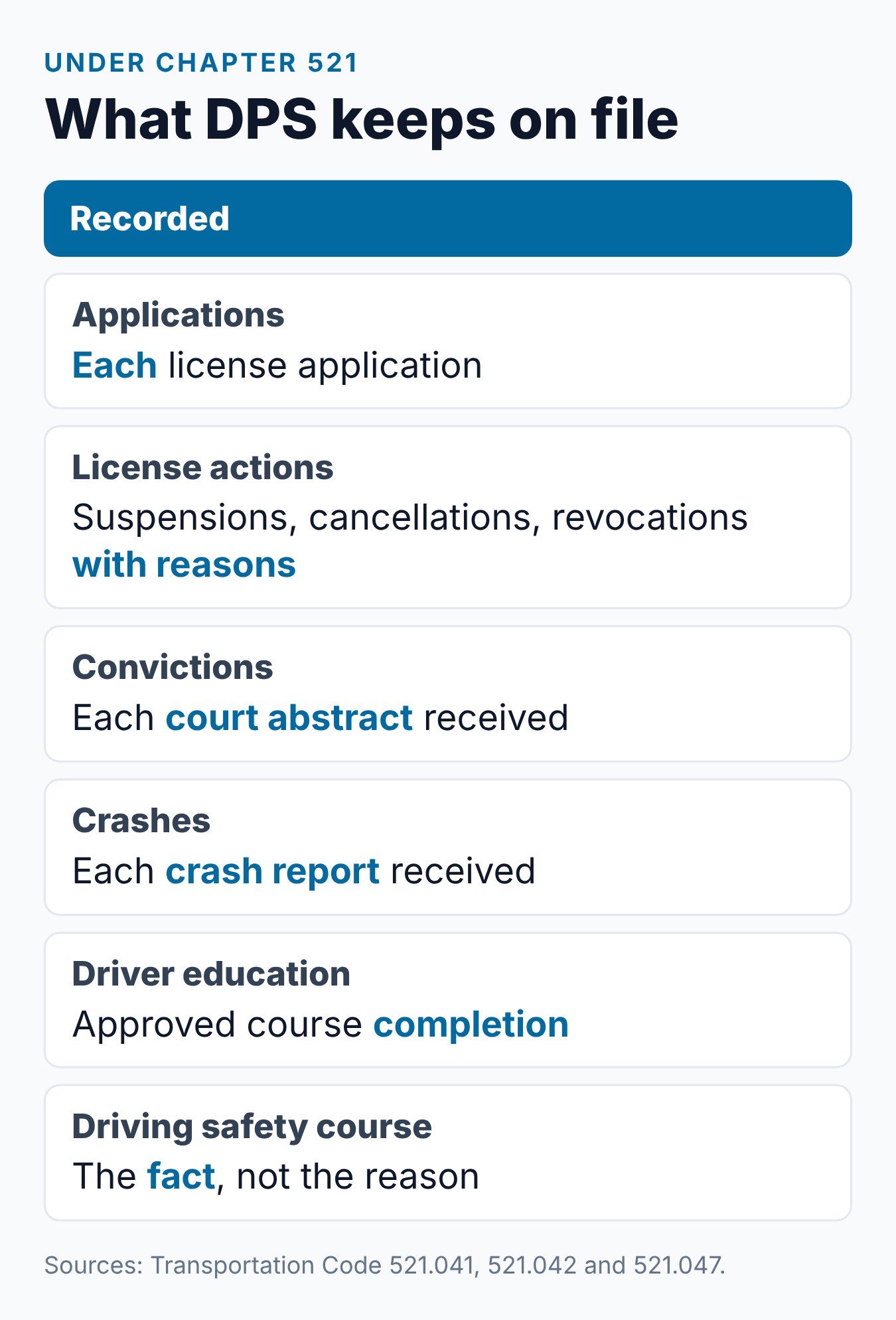
Section 521.041 says DPS must record each driver license application it receives. It also keeps lists of:
- Applications that were denied, with the reason.
- Applications that were granted.
- Licenses that were suspended, canceled or revoked, with the reason.
Crashes and Convictions
Section 521.042 says DPS records each crash report and each court abstract of a conviction it receives. The records must let DPS review your convictions and crashes when you apply to renew, and at other suitable times.
That review can have teeth. Before it issues or renews a license, DPS examines the applicant’s record. The law lets DPS refuse a license if issuing it would be “inimical to the public safety.”
What Your Own Copy Can Show
Section 521.047 lists what DPS can give you about yourself:
- Your birth date, license status and address.
- Completion of an approved driver education course.
- The fact that you finished a driver safety course, but not the reason.
- Each reported traffic violation and crash, by date and location.
How Convictions Reach DPS
DPS does not write tickets into the record on its own. Courts send the information.
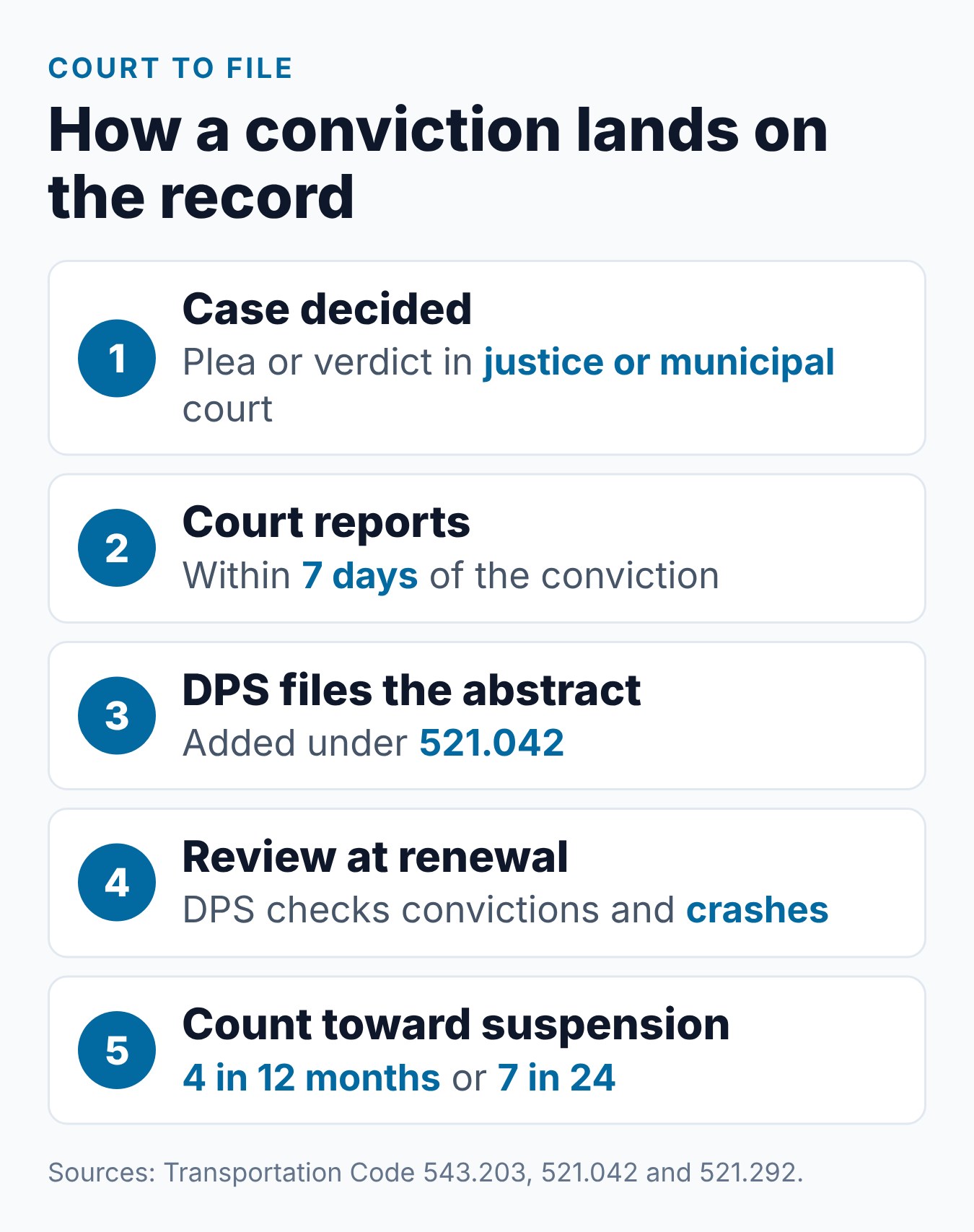
Under Transportation Code § 543.203, a court must report a conviction for a traffic law to DPS no later than the seventh day after the conviction. Paying a ticket means a plea of guilty or no contest, which leads to a conviction the court reports.
Some outcomes are handled in a different way:
- Deferred disposition: under § 543.204, a justice or municipal judge who defers a case may not send a conviction record to DPS. If guilt is later found, the record must go to DPS within 7 days.
- Driving safety course dismissal: under Code of Criminal Procedure Art. 45A.356, the court reports that you finished the course and the date. Art. 45A.357 says the dismissed charge “may not be part of a person’s driving record or used for any purpose.”
Late Reports
Timing matters on the DPS side too. Under § 521.042(f), DPS generally may not use a conviction it receives more than one year after the conviction date for enforcement.
That limit has exceptions. It does not cover commercial license holders, commercial vehicle drivers, hazardous materials haulers or Penal Code Chapter 49 offenses such as DWI.
Convictions From Other States
Texas is a member of the Driver’s License Compact of 1993, under Transportation Code Chapter 523. Member states must report a driver’s conviction to the driver’s home state. That is one way an out-of-state ticket can reach your Texas file.
Why the Texas DPS Driving Record Matters
The record is more than a list. Several decisions draw on it.
The Habitual Violator Rule
Texas no longer uses points, but suspensions are still part of the law. Under § 521.292, DPS must suspend the license of a “habitual violator.” That means:
- 4 or more moving-violation convictions from separate incidents within 12 months in a row, or
- 7 or more within 24 months.
If you do not ask for a hearing, the suspension lasts 90 days. Section 521.292 also lists other grounds for suspension. Our Texas points system guide explains what replaced the old points program.
A quick count shows how the 12-month window works. Say you have moving-violation convictions from separate stops in February, May, August and November of the same 12-month stretch.
That is four, which meets the habitual violator test. The count runs over any 12 months in a row, not the calendar year.
What Changed in 2019
DPS used to add surcharges based on the record. The DPS repeal notice says the Driver Responsibility Program assessed surcharges “based on points or convictions” from September 1, 2003. HB 2048 ended it on Sept. 1, 2019, and DPS waived existing surcharges and DRP suspensions.
Driving Safety Course Eligibility
The driving safety course (DSC), also called defensive driving, can dismiss an eligible ticket. Under Art. 45A.352(a), one condition is that you have not completed an approved course in the 12 months before the new offense date.
Your record is how the court checks. Within 90 days of your plea, you turn in the certificate, your DPS record and an affidavit, unless the judge gets the record. The DPS FAQ says, “While most courts generally require a Type 3A driver record,” you should confirm with the court.
Insurance Rates
Insurers set their own prices. The Texas Department of Insurance auto guide says, “Insurance companies will charge you more if you’ve had accidents or gotten tickets.” It lists “Your driving record and claims history” among the things companies consider.
The DSC has a protection here. Art. 45A.357 says an insurer may not cancel a policy or raise a premium because you completed a DSC or had a charge dismissed through it.
Commercial Drivers
A CDL changes the picture. Under Art. 45A.351(c), the DSC dismissal rules do not apply to anyone who holds a CDL or held one when the offense happened. That is true in any vehicle, including a personal car.
Federal law adds a second layer. 49 CFR 384.226 bars states from masking or deferring a CDL holder’s traffic conviction in any type of motor vehicle. Our Texas CDL defensive driving guide covers the details.
Who Else Can See It
Other people can get part of your record if the law allows them. Under § 521.046, eligible requesters can get moving-violation convictions and crashes with a citation from the three years before the request. Our background check guide covers who qualifies.
What DPS Does Not Publish
DPS does not post a number of years that items stay on the full record. The DPS record types give a partial answer. Type 2 covers three years, while Type 3 and 3A list all crashes and violations.
State law sets a purpose instead of a year count. Section 521.043 lets DPS drop records it finds unnecessary.
It must keep conviction records as long as they may be used for license actions or to find frequent violators. Read how long violations stay on a Texas driving record for the time windows.
How to See Your DPS Record
You can order your own record online or by mail. DPS says it does not provide driver records in person. Online, you need your license or ID number, its audit number, your birth date, the last four digits of your SSN and a credit card.
You can then print or email the record right away. By mail, use form DR-1 and allow about three weeks. The Texas driving record guide lists all six types and their fees.
What We Found on the DPS Pages
On the DPS driver record pages we checked on October 26, 2026, the ordering page sent crash report questions to the Texas Department of Transportation. The FAQ said a wrong drug or DWI conviction must be corrected by the court that filed the report.
The FAQ also said DPS needs 21 business days to update the record after it gets a court’s correction. That matches the idea in this guide: courts create the entries, and DPS stores them.
Common Mistakes to Avoid
These come from Texas law and DPS guidance:
- Thinking no points means no risk. The habitual violator rule still leads to suspensions.
- Asking DPS to fix a court entry. A wrong conviction goes back to the court that reported it.
- Ignoring out-of-state tickets. Compact states report convictions to your home state.
- Assuming deferred cases are reported right away. Under § 543.204, they are not reported unless guilt is later found.
- Confusing TDLR and DPS. TDLR approves courses. DPS keeps the record.
- Ordering Type 2 to see older entries. Type 2 covers three years. Type 3 and 3A list all crashes and violations.
How Requirements Can Vary
The driving safety course rules come from Texas law and TDLR and apply statewide. Each justice or municipal court still sets its own fees, filing steps and contact methods, and the facts of your citation decide which options you have.
Laws, fees and court procedures can change. Check your citation, ask the court that handles your case, and use the TDLR and Texas DPS websites for current rules before you act.
Frequently Asked Questions
What does Texas DPS track on my driving record?
DPS records license applications, license actions such as suspensions, crash reports and court conviction abstracts. Your own copy can also show driver education and the fact of a driver safety course.
How fast does a ticket show up on my DPS record?
Texas law says a court must report a traffic conviction to DPS no later than the seventh day after the conviction. A dismissed DSC charge is not part of the record.
Can DPS suspend my license without points?
Yes. Under § 521.292, DPS must suspend a habitual violator: 4 or more moving-violation convictions in 12 months, or 7 or more in 24 months. Other grounds for suspension also exist.
Does a DSC dismissal show on my DPS record?
The charge itself does not. Texas law says a dismissed charge may not be part of the record. DPS can show that you finished a course and when, but not the reason.
Does my insurer get my DPS record?
Insurers can get record data only if state law makes them eligible. TDI says companies consider your driving record and charge more after tickets or accidents.
How long do items stay on my DPS record?
DPS does not publish a number of years for the full record. Type 2 records cover three years, and Type 3 and 3A list all crashes and violations.
Does a crash show if no one got a ticket?
It depends on the record type. DPS says Type 2 includes crashes only when a ticket was given, while Type 3 and 3A list all crashes. Order the type that fits your need.
Who fixes a wrong entry on my DPS record?
It depends on the entry. DPS says to contact the Texas Department of Transportation about a wrong crash. For a wrong drug or DWI conviction, contact the court that reported it.
Conclusion
Your Texas DPS driving record is built from court reports and DPS license actions, and it feeds license reviews, suspensions, insurance and the DSC. Keep it clean where you can, and check it for errors before you rely on it. If you have an eligible ticket, Driving Logic’s online Texas driving safety course is one way to start the dismissal process if you qualify.
Related Articles
- Your Texas Driving Record: How to Get It and What It Shows
- Texas Driving Record Points: Does Texas Still Have a Points System?
- Texas Driving Record Background Check: What Employers and Insurers See
- How Long Do Traffic Violations Stay on Your Texas Driving Record?
Sources
- Texas Transportation Code Chapter 521 — Driver’s Licenses (PDF)
- Texas Transportation Code Chapter 543 — Arrest and Prosecution of Violators (PDF)
- Texas Code of Criminal Procedure Chapter 45A (PDF)
- Texas DPS — How to Order Your Driver Record
- Texas DPS — Driver Record FAQ
- Texas DPS — Driver Responsibility Program repealed
- Texas Department of Insurance — Auto insurance guide
- 49 CFR § 384.226 — Prohibition on masking convictions
Billy Forte is the owner of Driving Logic, a state-approved driver improvement course provider serving Texas and other U.S. states.
This article is general information, not legal advice. Texas traffic and driving safety course rules are set by Texas law, TDLR, Texas DPS and each court, and they can change. Check with the court on your citation and the official TDLR and DPS websites for current requirements, and talk to a Texas lawyer about your specific case.