
Updated June 2026 · Reviewed by Billy Forte
A court-approved Texas Driver Safety Course can keep an eligible citation off your driving record by getting it dismissed, so no conviction is recorded — but it cannot erase convictions that are already on your record. To use it, you request the course before the appearance date, complete the six hours, and submit your certificate with a Type 3A certified complete record by the court’s deadline. It works only on the eligible ticket you request it for, once every 12 months, and because Texas has no points system, the benefit is avoiding a conviction rather than removing points.
Applies to Texas. Court rules and deadlines vary by county.
Key Facts
- What it can do: Get an eligible citation dismissed so no conviction is added to your record.
- What it cannot do: Remove or erase convictions already on your record.
- Record required: Courts typically require a Type 3A certified complete record with your completion certificate.
- No points to remove: Texas has no points system, so the benefit is preventing a conviction, not clearing points.
- Limits: Works on the eligible citation only, once every 12 months, and requires requesting before the appearance date.
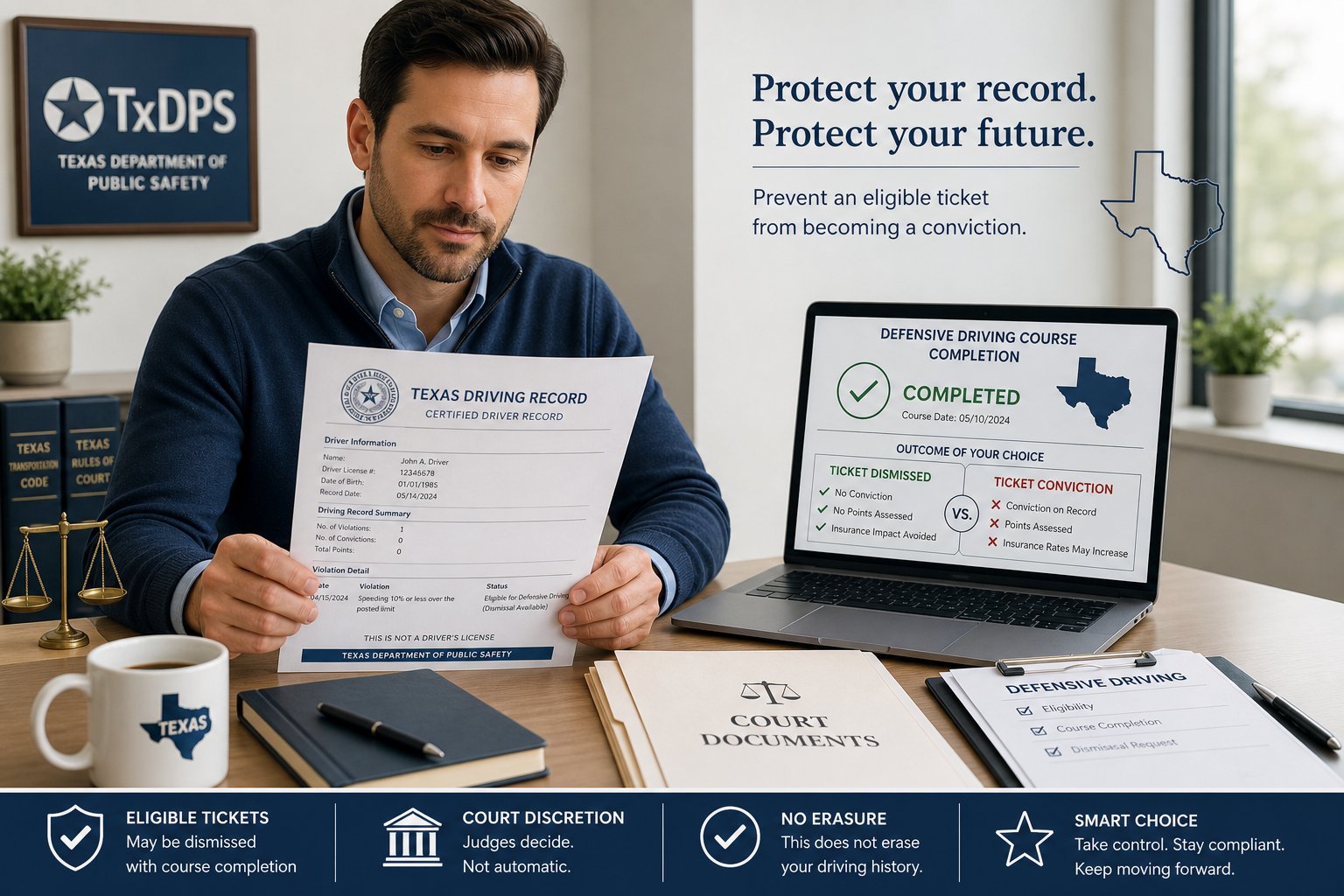
What A Texas Driving Record Is And Why It Matters For Defensive Driving
A Texas driving record is your official motor vehicle record from Texas DPS, also called TxDPS. It can show your license status, traffic convictions, crashes, suspensions, and other history tied to your driver license.
That matters because the court may use your record to decide if you can use a Driver Safety Course (DSC) for dismissal. And in Texas, DSC and defensive driving mean the same TDLR-approved 6-hour course.
If you complete the full process the right way, the result is different from just paying a ticket. Here is the key point:
- If the court approves DSC and later dismisses the case, the ticket is not recorded as a conviction on your TxDPS driving record
- Texas has no points system, so the benefit is simply that no conviction is recorded
- Your record may still show that DSC was used for the dismissal
- If you simply pay the ticket, it is usually treated as a conviction and reported to TxDPS
So, does Texas defensive driving clear record issues? Not in the broad sense. It does not wipe your whole record clean. It does not remove old traffic convictions. It does not change unrelated crashes, suspensions, or prior entries already on file.
What it can do is help prevent one eligible moving violation from becoming a conviction when you follow the court’s process under Texas Code of Criminal Procedure Art. 45.0511. That is a big difference, especially if you want to avoid another conviction on your 3-year record or a certified record you may later order for court, work, or insurance review.
Which Texas Driving Record Type You Need For Ticket Dismissal
For most Texas ticket dismissal cases, you need a Type 3A driving record. This is the record type most courts ask for when you use a defensive driving course for dismissal.
Texas DPS offers more than one record type, but Type 3A is the one commonly tied to defensive driving. It is a certified record that lists crashes and violations, which is why courts often want it with your course certificate.
In plain terms, if the court tells you to send a driving record after approving DSC, Type 3A is usually the right choice. It is also the record Texas DPS marks as usable for a defensive driving course request.
Why does the court want this version?
- It is certified
- It gives a broader history than a simple status record
- It helps the court review eligibility
- It is the record most often named in court instructions for DSC
Some drivers ask if a 3-year record is enough. Usually, no. A 3-year record may be useful for other reasons, but many courts specifically want Type 3A, not just any record from DPS.
Because local court rules can differ, read your court notice closely. If the court says certified driving record, do not guess. Check the court’s instructions before you order. And remember: you must request DSC before the appearance date on the citation. The course does not help with dismissal if you wait too long to ask the court.
How To Order Your Texas Driving Record Online Or By Mail
The fastest way to get your Texas driving record is through the official Texas DPS driver record system at dps.texas.gov. If you need it for a court deadline, online is usually the best option because you can often get the PDF in minutes.
To order online, you will usually need:
- Your Texas driver license or ID number
- Your audit number
- Your date of birth
- The last four digits of your Social Security number
- A credit card
- A device that can open or print a PDF
When you reach the record options, select Type 3A if the record is for a defensive driving dismissal. Texas DPS lists a standard fee for this record, and the amount commonly shown is $10.
If you cannot order online, you can request the record by mail. That means filling out the DPS Driver Record Request form, adding payment, and mailing it to the DPS address listed on the form. Mail requests are slower, often taking about three weeks.
That delay matters. Courts set deadlines, and missing them can cost you the dismissal option.
What To Expect During The Request Process
Online requests are usually simple. You enter your information, pick the record type, review the order, pay, and then download or print the record.
A few practical points help:
- Double-check the audit number before you submit
- Save the PDF right away
- Print a clean copy if your court wants paper documents
- Keep the receipt or confirmation email
Texas DPS does not handle the course approval itself. The Texas Department of Licensing and Regulation (TDLR) approves the course providers at tdlr.texas.gov. DPS handles the driving record. That split causes a lot of confusion, so it helps to keep the roles separate.
How Your Driving Record Fits Into The Texas Defensive Driving Process
Your driving record is one part of a larger court process. It is not the first step, and it is not the only step.
The normal order looks like this:
- Check that the ticket may qualify for DSC dismissal.
- Ask the court for permission before the appearance date on the citation.
- Enroll in a TDLR-approved Driver Safety Course.
- Order your certified Type 3A driving record.
- Finish the 6-hour course and get your certificate.
- Send the required documents to the court by the deadline.
- Wait for the court to dismiss the case.
That order matters. Many drivers focus on the course first, but court approval comes first. If you take the course without permission, the court may not accept it for dismissal.
Once the court approves your request, the driving record helps show the court the background it needs. Then your course certificate and record work together as part of the dismissal file.
After the court dismisses the citation, the result is not the same as a conviction. That is the point many people miss. A dismissed citation through DSC is not entered as a conviction on your TxDPS record, so no points are assessed for that citation. But the record can still reflect that DSC was used.
If you need a course that fits a busy schedule, Driving Logic offers a TDLR-approved Texas DSC you can take on your own time from your phone, tablet, or computer.
Common Questions About Eligibility, Timing, And Course Completion
Most drivers want the short answer. Not every ticket qualifies, and not every driver qualifies every time. Courts usually limit DSC dismissal to eligible moving violations, while more serious offenses are often excluded.
Timing is just as important as eligibility. You must request the Driver Safety Course before the court appearance date listed on the ticket. If you miss that step, the court may treat the case in a different way, and simply taking the course later does not fix that.
A few common questions come up often.
When should you order the record? Usually after the court approves DSC and around the time you take the course. Courts often want a recent Type 3A.
Can you use deferred disposition instead? Maybe, but that is a different process. Deferred disposition usually involves a plea and a probation period. DSC is the 6-hour course route. They are not the same.
Will the court accept a printed PDF? Many courts do, but some have their own filing rules. Always check your court notice.
Does texas defensive driving clear record history? No. It can help stop one eligible ticket from becoming a conviction if the court approves and dismisses it. It does not erase old violations already on your record.
How long do you have to finish? The court sets that deadline. Keep every due date in one place, and submit all required items before time runs out.
How To Keep Your Texas Driving Record Clean After Dismissal
The best way to keep your driving record clean is to avoid new moving violations after the dismissal. One dismissed ticket helps, but new citations can still add traffic convictions to your record if they are not dismissed.
Start with the habits that cause the most trouble:
- Watch your speed, especially in changing speed zones
- Stop fully at stop signs and red lights
- Leave enough space between your car and the one ahead
- Use your turn signal before lane changes and turns
- Put the phone away and avoid distracted driving
Also keep your vehicle and paperwork in order. While equipment or registration issues are not the same as moving violations, they can still create problems if you let them pile up.
It also helps to review your record from time to time through Texas DPS. If you recently completed DSC, checking later can help you confirm the case was handled as expected.
If you still need to complete your course, Driving Logic’s Texas defensive driving course is built for busy drivers who want a simple online option and quick proof of completion.
One last point: keep copies of everything you send the court. That includes your certificate, your Type 3A certified record, and any receipt or filing confirmation.
FAQ
Does a Texas Driver Safety Course clear my driving record?
It prevents an eligible new citation from becoming a conviction, so nothing is added to your record. It does not erase convictions that are already there.
What record do I submit with the course?
Courts generally require a Type 3A certified complete record along with your completion certificate. A certified 3-year (Type 2A) record is not accepted for the course.
Does the course remove points?
There are no points to remove — Texas ended its points program in 2019. The course helps by keeping a conviction off your record entirely.
How often can I use it?
Once every 12 months for an eligible citation, and only when you request it before the appearance date and the court approves.
Conclusion
The fair way to describe a Texas Driver Safety Course is that it prevents rather than repairs: complete it on time for an eligible ticket and no conviction lands on your record, but it will not undo convictions already there. With no points system in Texas, that prevention is the whole value. Use it deliberately on the eligible citation, submit the Type 3A record with your certificate, and you protect a clean record going forward.
If your ticket is eligible and the court approves it, you can complete a TDLR-approved Texas Driver Safety Course online to keep it off your record.
Related Articles
- Your Texas Driving Record: How to Get It and What It Shows
- Texas Defensive Driving for Ticket Dismissal: The Complete Guide
- Texas Type 3A Driving Record: What It Is and How to Get It
- Texas Driving Record Points: Does Texas Still Have a Points System?
Sources
- TDLR — Driver Safety
- Texas Code of Criminal Procedure Art. 45.0511
- Texas DPS — Online Driver Record System
Billy Forte is the owner of Driving Logic, a state-approved driver safety and defensive driving course provider serving Texas and other U.S. states. Driving Logic offers online driver safety, defensive driving, and traffic-ticket courses for drivers handling court, license, and insurance-related requirements.
This article is general information, not legal advice. Texas court rules, TDLR requirements, deadlines, eligibility, and case facts can differ by county and court. Use official Texas court and state sources for current requirements, and consult a qualified Texas attorney for legal guidance specific to your situation.