
Updated November 2026 · Reviewed by Billy Forte
The driving safety course Texas requirements for dismissing a ticket are a Texas license or permit (or active-duty military, military spouse or dependent child status), no course in the 12 months before the offense, no CDL, proof of insurance, and a guilty or no contest plea with your request made by the answer date. The court then gives you 90 days to finish a TDLR-approved course and file your papers. Some tickets never qualify, such as speeding 25 mph or more over the limit or at 95 mph or more.
Key Facts
- Who you must be: a Texas license or permit holder, or an active-duty military member, spouse or dependent child. See the license requirement.
- Your history: no driving safety course completed in the 12 months before the offense date, and no CDL. See the 12-month requirement.
- What you show: proof of insurance, with a plea of guilty or no contest. See the insurance requirement.
- When you ask: on or before the answer date on the citation. See the timing requirement.
- What cannot qualify: two speed levels and a short list of other offenses. See tickets that are left out.
- After the court agrees: 90 days to finish the course and file. See the 90 days.
Driving Safety Course Texas Requirements at a Glance
The requirements come in two groups. Some are about you as a driver. The rest are about what you do with the ticket, and when.
| Requirement | What the law asks | What to check before you ask |
|---|---|---|
| License | A Texas driver license or permit, or active-duty military status as a member, spouse or dependent child | Which state issued your license |
| Past course | No driving safety course completed in the 12 months before the offense date | The date you finished your last course |
| Commercial license | No CDL now, and none on the offense date | Your license class on the day of the stop |
| Insurance | Proof of insurance shown to the court | That you have your proof ready |
| Plea | Guilty or no contest | That you are ready to enter one of those two pleas |
| Timing | A request made on or before the answer date | The answer date printed on your citation |
| The ticket | An offense that Texas law does not leave out | Your speed and the kind of charge |
Every row comes from Chapter 45A of the Code of Criminal Procedure. Each one has its own section below.
Who Sets the Requirements
Texas law sets them, and they are the same in every county. The rules sit in Chapter 45A of the Code of Criminal Procedure, in Arts. 45A.351 to 45A.359. They have been in that chapter since January 1, 2025.
You may still see an older article number on a court form or an old web page. That number is the former home of the same rules. Chapter 45A is the current one, so use it when you look up the law.
Three offices each have a part:
- The court on your citation decides your request and sets its own filing steps.
- TDLR, the Texas Department of Licensing and Regulation, approves the course. Neither Texas DPS nor the Texas Department of Motor Vehicles approves it.
- Texas DPS, the Department of Public Safety, keeps your driving record.
One note on names helps. The law says “driving safety course,” and most drivers say “defensive driving.” In Texas, both names mean the same TDLR-approved course. So the requirements for a Texas defensive driving course are the ones on this page.
Requirement 1: A Texas License or Military Status
Under Art. 45A.352(a), you need a Texas driver license or a Texas permit. A Texas permit counts the same way a Texas license does.
There is one other way to meet this requirement. The law also covers three groups tied to the military:
- an active-duty member of the U.S. military
- the spouse of an active-duty member
- a dependent child of an active-duty member
People in these groups meet the requirement through military status. The law lists them next to Texas license and permit holders.
A driver with a license from another state and no military tie does not meet it. Our guide for out-of-state drivers explains what that driver can ask the court about.
So look at your license before you do anything else. The state that issued it answers the first question.
Requirement 2: No Course in the Past 12 Months
You must not have completed a driving safety course in the 12 months before the offense date. This rule is also in Art. 45A.352(a).
Two details decide how the rule works:
- The clock runs back from the offense date. That is the day of the stop, not the day you ask the court.
- The key word is “completed.” The rule looks at a course you finished.
Here is a simple way to check. Find the offense date on your citation and count back 12 months. A course you completed inside that window means you do not meet this requirement.
Your driving record comes into the process later. After the court grants the course, you file your DPS driving record unless the judge gets it electronically. Texas DPS explains how to order a driver record.
Our guide to how often you can take the course covers the 12-month rule in depth.
Requirement 3: No Commercial Driver License
The driving safety course law does not apply to a driver who holds a commercial driver license, or CDL. It also does not apply to a driver who held a CDL when the offense happened. The rule is Art. 45A.351(c).
Read both halves of that rule:
- Holds. You have a CDL now.
- Held. You had a CDL on the offense date, even if you gave it up later.
The vehicle does not change the answer. A CDL holder who gets a ticket in a family car is still left out. Deferred disposition is closed to that driver as well.
A CDL holder still has to answer the citation on time. Our CDL guide explains the rule and the choices that remain.
Requirement 4: Proof of Insurance
You must show the court proof of insurance. Art. 45A.352 makes it part of asking for the course, so have it ready when you ask.
Courts take requests in different ways. So ask your court how to show your proof for the method you choose. Do this before the answer date, not on it.
Without proof of insurance, you have not met every requirement. Put your proof with your citation so both are in one place.
Requirement 5: A Plea and a Request by the Answer Date
This requirement has two parts, and both are due by the same day.
The plea. You plead guilty or no contest. Those are the two pleas the law names for this option.
The request. You ask the court for the course on or before the answer date on your citation.
Art. 45A.352 lists four ways to make the request:
- In person at the court.
- Through a lawyer.
- By certified mail, postmarked on or before the answer date.
- By the court’s email address or internet portal, if the court allows it.
Two of these come with a condition. Certified mail goes by the postmark, so mail it early enough to get that date stamped. Email and portal requests work only where the court offers them.
A late request changes things. After the answer date, the choice belongs to the court, and the court may say no. So treat the answer date as a firm deadline and call the court right away if it is close.
Our court request guide walks through each method. The deadline guide explains the answer date itself.
Requirement 6: A Ticket That Qualifies
You can meet every driver requirement and still hold a ticket the law leaves out. Check the charge on your citation against the two groups below.
Speed. Art. 45A.352 sets two speed levels that do not qualify:
- speeding 25 mph or more over the limit
- speeding at 95 mph or more
Other offenses. Art. 45A.353 leaves out more. The San Antonio Municipal Court explains them in plain words:
- passing a school bus that is loading or unloading children
- an offense in a construction or work zone with workers present
- leaving the scene of a collision
Serious traffic violations are left out too, and DWI is not eligible.
This page is about the driver’s side of the rules. For the offense side, see our guide to which violations qualify.
A Quick Self-Check Before You Ask
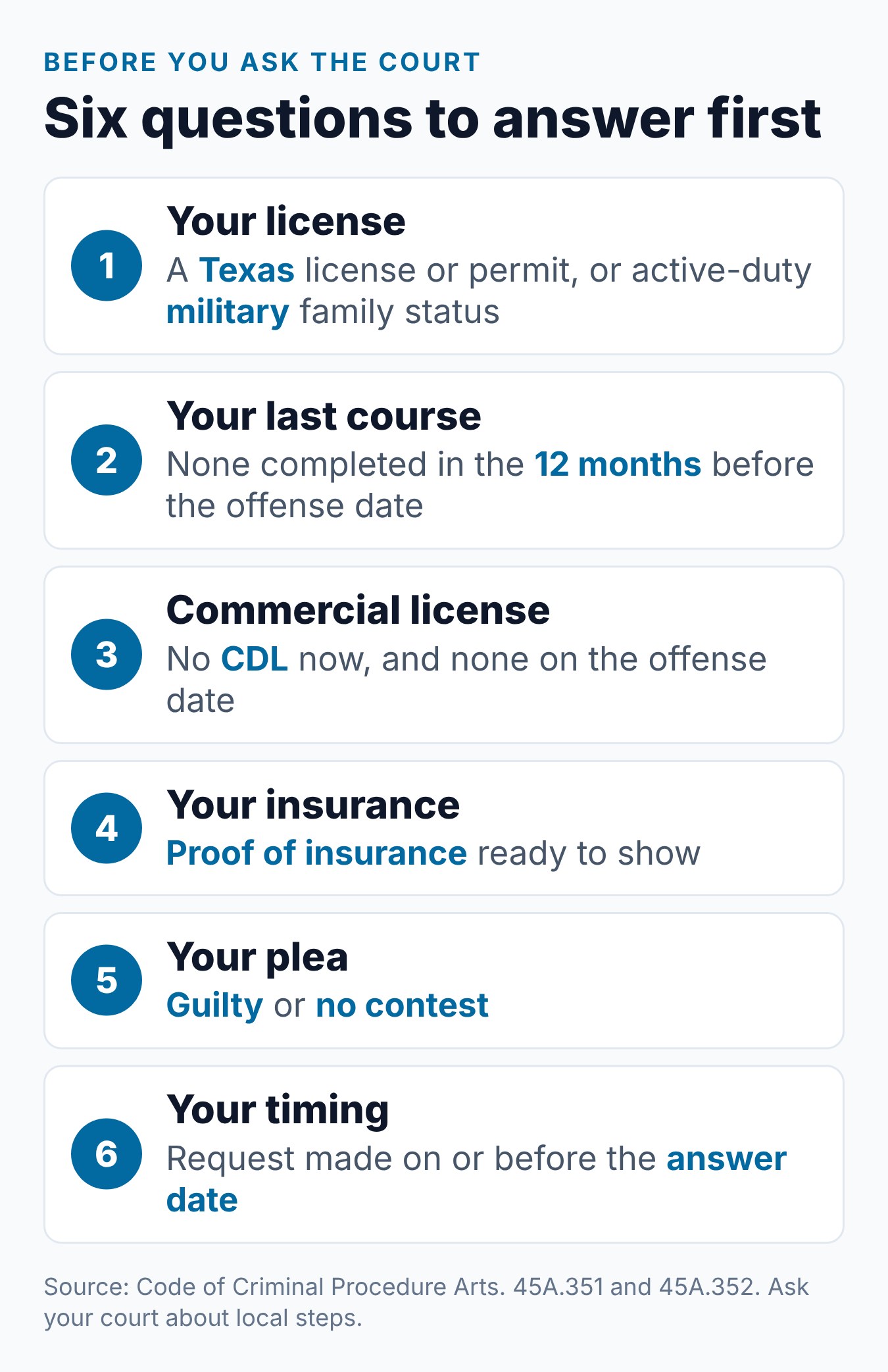
Answer these six questions in order. Stop at the first “no” and call the court about your options.
- Do you hold a Texas license or permit, or have active-duty military status as a member, spouse or dependent child?
- Has it been more than 12 months since you last completed a course, counting back from the offense date?
- Are you free of a CDL, both now and on the offense date?
- Do you have proof of insurance ready to show?
- Are you ready to plead guilty or no contest?
- Is the answer date on your citation still ahead of you?
Six “yes” answers cover the driver’s side. Then check the ticket itself against Requirement 6.
After the Court Says Yes: 90 Days to Finish and File
Meeting the requirements gets you into the process. It does not end the case. After the court grants the course, you have 90 days under Art. 45A.356(a).
In that time you finish a TDLR-approved course. You also file these papers with the court:
- Your certificate of completion. It shows you finished the course.
- Your DPS driving record. You file it unless the judge gets it electronically.
- The required sworn statements. Ask the court which form it uses.
Plan for both jobs, the course and the filing. Ask the court for the exact due date on your case and write it down.
Three of our guides cover these papers. See the certificate guide, the Type 3A driving record guide and the guide to a missed completion deadline.
Is an Online Course Allowed?
Yes, an online course can meet the course requirement. TDLR says on its Taking a Driving Safety Course page that some providers offer the course online. Others require you to attend in person.
The format is not what the law tests. What matters is that TDLR approved the course. An online course and a classroom course from licensed providers are both driving safety courses.
So pick the format that fits your 90 days. Our guide on how to take the course online explains the steps. The TDLR approval guide shows how to check a provider.
What the Court Can Charge
Qualifying is not free. Under Art. 45A.358, the court may charge a reimbursement fee of up to $10.
That fee has a catch. It is not refunded if you do not take the course. So ask for the course only when you plan to finish it.
The course has its own price. The minimum price of a Texas driving safety course is $25, and each court sets its own costs on top of that. Our course cost guide covers the full bill, and your court can give you its exact total.
Local Court Rules Can Add Steps
State law is the base. A court can add its own steps on top, and two city courts show how.
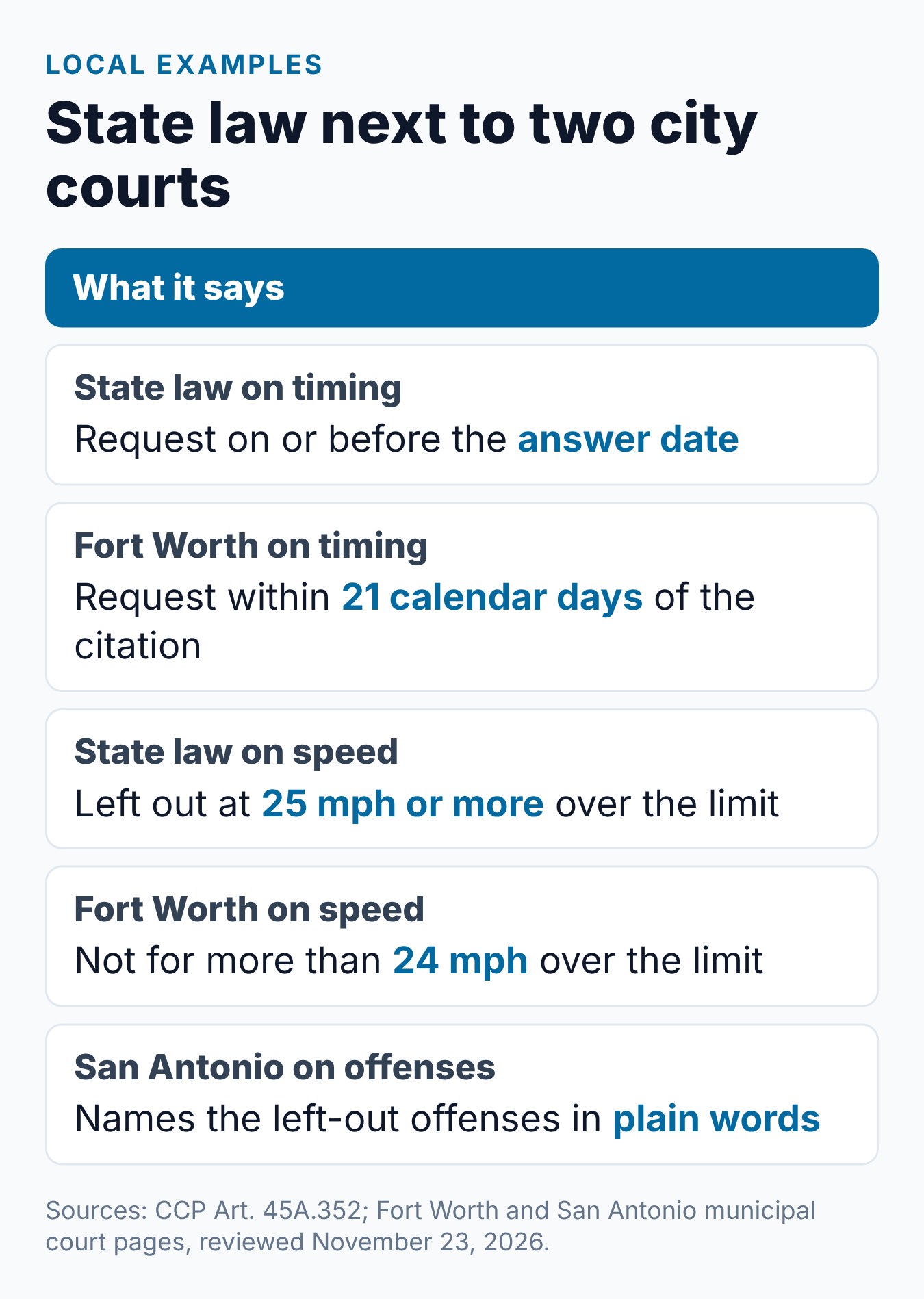
The Fort Worth Municipal Court asks for the request within 21 calendar days of the citation. Its page also says the course is not for speeding more than 24 mph over the limit.
San Antonio’s court page takes a different approach. It lists the left-out offenses in everyday terms, as shown under Requirement 6.
These are examples, not rules for every court. Your court may ask for something else, so read its page or call the clerk before you act.
What We Found on Two Court Pages
The official pages behind this article were reviewed on November 23, 2026. We set the state law next to the Fort Worth and San Antonio court pages. Three things stood out:
- A day count next to a date. State law points to the answer date on the citation. Fort Worth’s page gives a count of 21 calendar days from the citation. A driver in that court needs to know both.
- One speed line, said two ways. State law leaves out speeding 25 mph or more over the limit. Fort Worth says more than 24 mph over. For a speed in whole miles per hour, both land in the same place.
- Plain words help. San Antonio’s page describes the left-out offenses the way a driver would, such as a school bus that is loading or unloading children.
The lesson is to read your own court’s page with your citation in hand. If the two show different dates, ask the clerk which one applies. Do not wait for the later date while you find out.
If You Do Not Meet a Requirement
Missing a requirement does not mean you can ignore the ticket. The answer date still applies to you. What you can ask for depends on which requirement you missed.
- You are past the answer date. A late request is up to the court. Call and ask right away.
- You completed a course in the 12 months before the offense, or your license is from another state. You do not meet the requirements above. Ask the court what choices it offers.
- Your ticket is on the left-out list. You do not have the right to the course for that charge.
- You hold a CDL. The course and deferred disposition are both closed to you.
Deferred disposition is a different way to handle a ticket, with its own rules. It is not the driving safety course. Our deferred disposition guide explains how it works.
A Texas lawyer can explain the choices for your case. This page cannot tell you which one to take.
Common Mistakes to Avoid
Each of these mistakes conflicts with a rule covered above:
- Counting the 12 months from the wrong day. The window runs back from the offense date.
- Thinking a CDL matters only in a truck. The rule covers any vehicle.
- Waiting too long to ask. The request is due on or before the answer date.
- Sending the request by regular mail. The law names certified mail, postmarked by the answer date.
- Assuming every court takes email. Email and portal requests work only if the court allows them.
- Asking the wrong agency about approval. TDLR approves the course, and DPS keeps your record.
- Reading only state law. A court can add steps, as Fort Worth does with its 21 calendar days.
- Stopping when the course ends. You still have papers to file within your 90 days.
How Requirements Can Vary
The driving safety course rules come from Texas law and TDLR and apply statewide. Each justice or municipal court still sets its own fees, filing steps and contact methods, and the facts of your citation decide which options you have.
Laws, fees and court procedures can change. Check your citation, ask the court that handles your case, and use the TDLR and Texas DPS websites for current rules before you act.
Frequently Asked Questions
Who qualifies for a driving safety course in Texas?
A driver with a Texas license or permit, or with active-duty military status as a member, spouse or dependent child. That driver also needs no course in the 12 months before the offense, no CDL, and proof of insurance. The plea and the request are due by the answer date.
Do I need a Texas driver license to qualify?
You need a Texas license or permit unless you are an active-duty military member, a military spouse or a dependent child. A license from another state alone does not meet the requirement.
Can I qualify if I took a course last year?
It depends on the dates. You must not have completed a course in the 12 months before the offense date. Count back from the day of the stop to check.
Do I have to plead guilty?
You plead guilty or no contest. The plea and your request for the course are both due on or before the answer date on your citation.
Can a CDL holder qualify in a personal car?
No. The law does not apply to anyone who holds a CDL or held one when the offense happened. The kind of vehicle does not matter.
Can I take the course online?
Yes, if the provider offers it that way. TDLR says some providers offer the course online, while others require you to attend in person.
How much does the court charge to let me take the course?
The court may charge a reimbursement fee of up to $10, and you do not get it back if you skip the course. Courts set other costs themselves, so ask your court for its total.
Does meeting the requirements dismiss my ticket?
Not by itself. You still have to finish a TDLR-approved course and file your papers within 90 days. The court handles the case from there.
Conclusion
To qualify, you need a Texas license or permit or military status, no course in the 12 months before the offense, no CDL, proof of insurance, and a guilty or no contest plea with a request by the answer date. Your ticket must also be one the law does not leave out, and your court may add local steps. Check your citation and your court’s page first. If you qualify, you can take Driving Logic’s texas driving safety course online.
Related Articles
- Texas Defensive Driving for Ticket Dismissal: The Complete Guide
- What Texas Traffic Violations Qualify for Defensive Driving Dismissal?
- Texas Defensive Driving Court Request: Step by Step
- Texas Defensive Driving Deadline: Request Before the Appearance Date
- Texas 90 Day Defensive Driving Deadline: What Must Be Done
- Texas Court Approved Online Defensive Driving: What It Means
Sources
- Texas Code of Criminal Procedure Chapter 45A (PDF)
- TDLR — Taking a Driving Safety Course
- City of San Antonio Municipal Court — Driver Safety Course
- City of Fort Worth Municipal Court — Driving Safety
- Texas DPS — How to Order Your Driver Record
Billy Forte is the owner of Driving Logic, a state-approved driver improvement course provider serving Texas and other U.S. states.
This article is general information, not legal advice. Texas traffic and driving safety course rules are set by Texas law, TDLR, Texas DPS and each court, and they can change. Check with the court on your citation and the official TDLR and DPS websites for current requirements, and talk to a Texas lawyer about your specific case.