
Updated November 2026 · Reviewed by Billy Forte
Texas court approved online defensive driving means two separate things, and you need both: the court’s permission to take a course for your ticket, and a course from a provider licensed by the Texas Department of Licensing and Regulation (TDLR). Texas courts do not license course providers, so the court approves your request, not the school. Below is how the two halves fit together, how to check an online provider, and what the court gets from you at the end.
Key Facts
- Two approvals: the court grants your request, and TDLR licenses the provider. See what the phrase means.
- Ask on time: the request goes in on or before the answer date on your citation. See the court’s half.
- Online is allowed: TDLR has no special approval process for online courses. See online courses.
- No court list: no official statewide page lists “court approved” courses. Check the provider in TDLR’s search. See how to check.
- Your job at the end: you send the certificate, driving record and affidavit to the court. See what the court receives.
What Texas Court Approved Online Defensive Driving Means
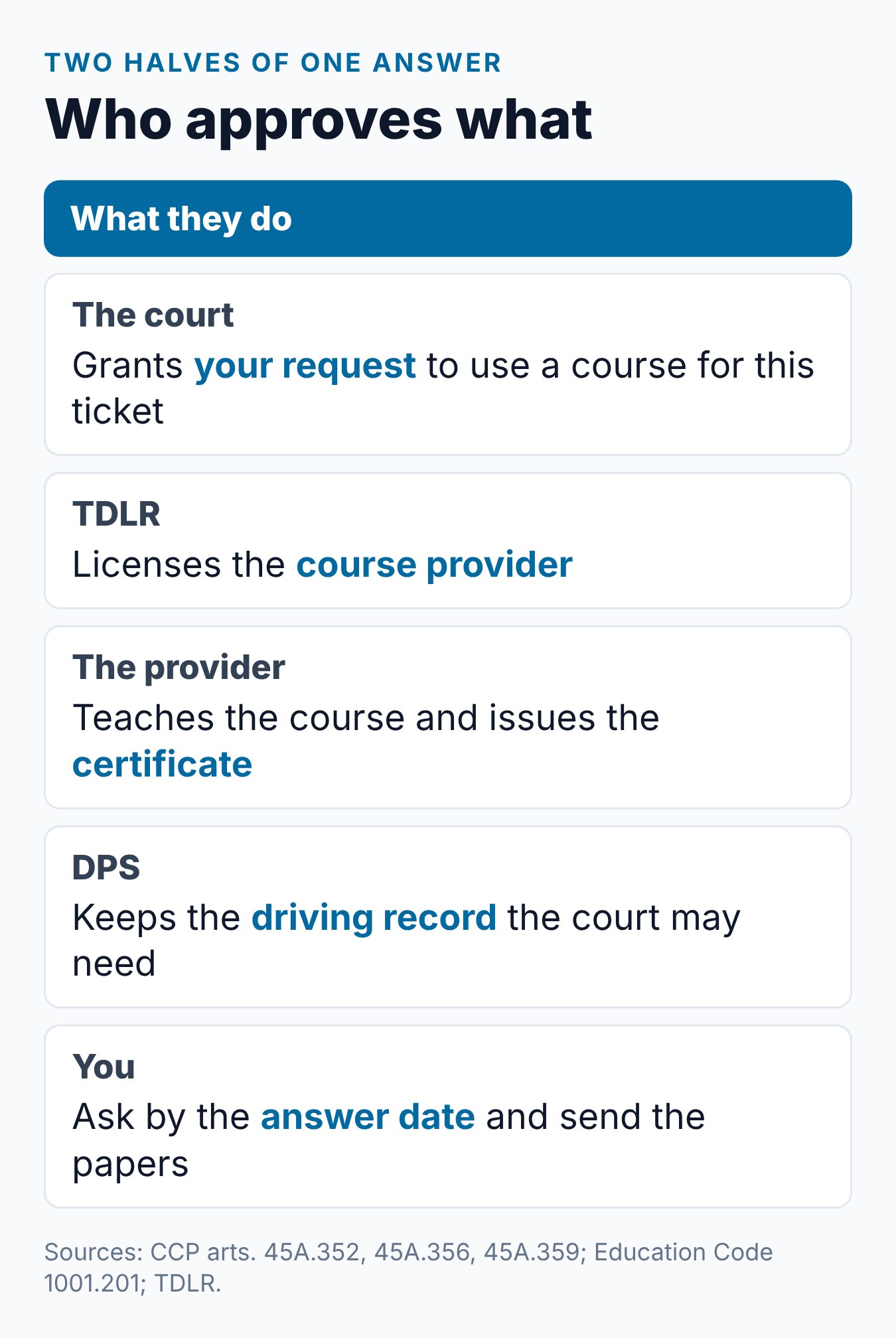
The phrase sounds like a court looked at a course and gave it a stamp. That is not how Texas works. Two different bodies each approve one thing.
The law puts it this way. When a driver qualifies and asks in time, the judge “shall require a defendant to successfully complete a driving safety course approved by the Texas Department of Licensing and Regulation.” That is Code of Criminal Procedure art. 45A.352(a).
So the court decides whether you may use a course for this ticket. TDLR decides who may teach the course. Neither one does the other’s job.
In Texas, a defensive driving course and a driving safety course (DSC) are the same thing. The law says “driving safety course.” Most people search for “defensive driving.” Both words point to the same 6-hour course.
Half One: The Court Approves Your Request
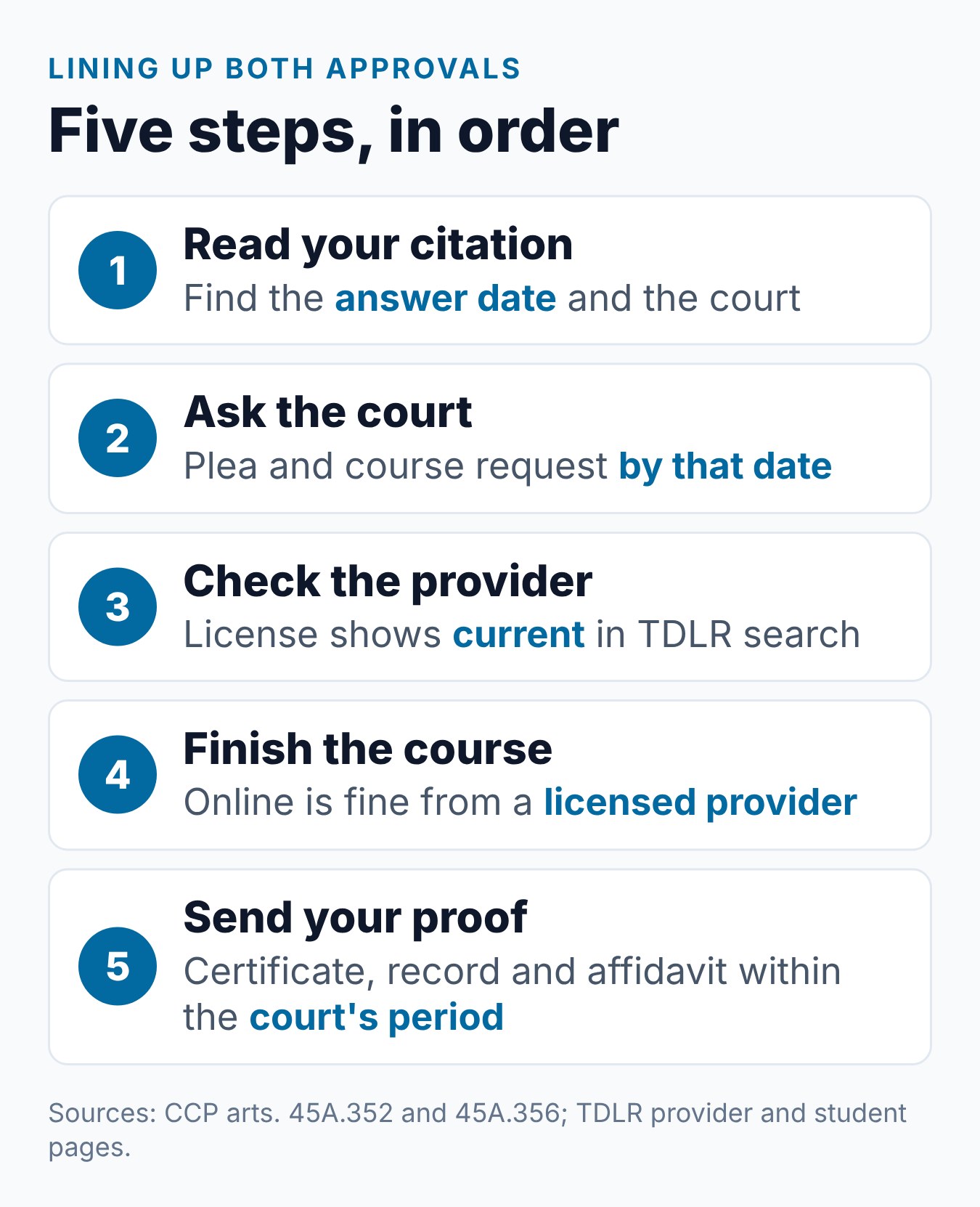
What the court approves is your request. You enter a plea of guilty or no contest and ask to take the course. You do this on or before the answer date on your notice to appear.
Art. 45A.352(a)(4) lists the ways to ask: in person, through a lawyer, or by certified mail, return receipt requested, postmarked by that date.
If the court allows it, you can also use a court e-mail address or online portal. Our Texas Defensive Driving Court Request: Step by Step walks through each method.
Timing matters.
After the answer date, the court may still grant your request before the case is finally decided. Under art. 45A.352(c), though, it does not have to.
TDLR says the same thing from the student’s side. Its Taking a Driving Safety Course page says: “you must first receive notice from the Texas court system that you are eligible to take a defensive driving course to dismiss the ticket.”
Not every driver or ticket qualifies.
For example, a person who holds a commercial driver license, or held one at the time of the offense, cannot use DSC dismissal. Speeding 25 mph or more over the limit is also left out. Our list of eligible violations covers every exclusion.
Half Two: TDLR Licenses the Provider
The second half is about who stands behind the course. Under Education Code 1001.201(a)(3), a person may not provide driving safety courses without a TDLR driving safety provider license.
TDLR’s student page adds: “Any licensed driving safety provider may offer a 6-hour course that can be used for ticket dismissal or insurance discounts.” So the state’s approval is attached to the provider’s license.
Courts do not hand out these licenses. A justice or municipal court does not keep its own list of schools. It relies on TDLR’s license system.
If you want the full picture of the state’s side, read TDLR-Approved Driver Safety Course: What It Means and How to Verify. That article covers the license and certificate tools in depth.
Is an Online Course Court Approved?
Yes, an online course can count, as long as both halves are in place. TDLR does not run a separate track for online classes.
On its Apply for a Driving Safety Provider License page, TDLR tells providers: “There is no special approval process for offering online courses to students.” It goes on: “Any licensed provider may offer online courses, provided that the curriculum and administration thereof meet the requirements established in law and rules.”
TDLR’s curriculum standards set the bar for online delivery. Online courses “must be at least as secure as a traditional classroom course and must contain the same educational objectives.”
So “online” does not mean a weaker version. And “online” does not need its own court approval. What the court cares about is that you asked in time and that you finished a course from a licensed provider.
Why There Is No List of Court Approved Online Courses
Many drivers look for a page that says “these online courses are court approved.” No official statewide page like that exists.
The reason is simple once you see the two halves.
The court approves people, one request at a time. TDLR licenses providers. There is no third step where a court approves a list of websites.
That means the words “court approved” on a website are marketing, not a state approval. They may be meant to say “a licensed course that courts accept.” But only TDLR’s license record shows the state side, and only your court’s answer shows the court side.
A court may still put its own instructions on your paperwork. For example, it may say how and when to turn in your certificate. Read every page the court sends you, and call the court clerk when something is unclear.
How to Check a Provider in TDLR Search
The state’s half is easy to check before you pay. Use TDLR’s Driving Safety Provider Search.
- Find the provider’s name or license number on its website.
- Open TDLR’s Driving Safety Provider Search.
- Search by name or license number.
- Confirm the license status shows as current.
- Make sure the business name matches the site you plan to use.
TDLR says the search is for verifying license status. It is not an endorsement of any provider.
A current license tells you the state side is in place. It does not tell you which course is best.
Here is a worked example: Driving Logic Inc holds TDLR driving safety provider license CP1235. Its status read CURRENT in TDLR’s search on November 25, 2026. You can run the same search for any provider you are thinking about.
What the Court Receives From You
The court’s approval comes with a deadline.
Within the 90-day period the court allows, you give the court three things under art. 45A.356(a) and art. 45A.359:
- The certificate. A uniform certificate of completion of the driving safety course.
- Your driving record. The record kept by the Department of Public Safety (DPS), unless the judge gets it through the state portal.
- An affidavit. A signed statement the law requires with the other papers.
The certificate has a built-in check. Under Education Code 1001.056(d), it must carry an identifying number that lets a court verify it is real.
TDLR also runs a public Validate a Driving Safety Certificate tool. Certificates may take up to 5 days after the issue date to show up there. So a certificate that is not listed on day one is not a sign of a problem.
Sending the certificate is up to you. TDLR’s student page says it is the student’s responsibility.
Our guide to the Texas 90-day deadline explains each item and how long it takes. You can order your record from the DPS driver record page.
What “Court Approved” in an Ad Does Not Tell You
An ad can use any words it likes. Here is what the phrase cannot tell you, based on the official rules above:
- It cannot tell you the court said yes. Only your court can grant your request.
- It cannot replace a license check. Only TDLR’s search shows the provider’s license status.
- It cannot promise a dismissal. The court decides your case. No provider can promise an outcome.
- It cannot change the court’s deadline. Your court sets the date for your papers.
- It cannot send your papers for you. TDLR says sending the certificate is the student’s job.
None of this means a provider using the phrase is unlicensed. It means the phrase is not proof either way. Check the license yourself.
What We Found on the Official Pages
For this article, we read the official sources behind each half in November 2026. We lined up the words each source uses for the course. The pattern was the same every time: the state talks about a license, and the court talks about your request.
| Official source | Word it uses for the course or provider | Who it is about |
|---|---|---|
| Code of Criminal Procedure art. 45A.352(a) | A course “approved by the Texas Department of Licensing and Regulation” | The driver and the judge |
| Education Code 1001.201(a)(3) | A driving safety provider license | The provider |
| TDLR, Taking a Driving Safety Course | “Any licensed driving safety provider” | The student |
| TDLR, Apply for a Provider License | “No special approval process” for online courses | The provider |
| TDLR, Provider Search | A tool to verify license status, not an endorsement | Anyone checking |
In none of these sources does a court approve a course or a provider. The court’s role, in every case, was the driver’s request. That is why the best check for “court approved” is really two checks: your court’s answer and TDLR’s license record.
Common Mistakes to Avoid
Each of these mistakes comes from mixing up the two halves:
- Buying a course before asking the court. TDLR says to get notice from the court first.
- Trusting a badge instead of the search. Look up the provider in TDLR’s search yourself.
- Asking the court to approve a school. The court rules on your request, not on providers.
- Waiting past the answer date. After that date, the course is up to the judge.
- Assuming the provider files for you. Sending the certificate is the student’s responsibility.
- Forgetting the record and affidavit. The certificate alone is not all the court needs.
For the full process from ticket to dismissal, see our ticket dismissal guide.
How Requirements Can Vary
The driving safety course rules come from Texas law and TDLR and apply statewide. Each justice or municipal court still sets its own fees, filing steps and contact methods, and the facts of your citation decide which options you have.
Laws, fees and court procedures can change. Check your citation, ask the court that handles your case, and use the TDLR and Texas DPS websites for current rules before you act.
Frequently Asked Questions
What does court approved defensive driving mean in Texas?
It means two things. The court grants your request to take a course for your ticket, and the course comes from a TDLR-licensed provider.
Is court approved defensive driving in Texas online allowed?
Yes. TDLR says any licensed provider may offer online courses, and there is no special approval process for them.
Does the court approve the online school?
No. Texas courts do not license course providers. The court approves your request, and TDLR licenses the provider.
Is there a list of court approved online courses?
No official statewide page lists “court approved” courses. Use TDLR’s Driving Safety Provider Search to check that a provider’s license is current.
When do I need to ask the court?
Ask on or before the answer date on your citation. After that date, the court may still say yes, but it does not have to.
Will the provider send my certificate to the court?
Do not count on it. TDLR says sending the certificate to the court is the student’s responsibility.
How can the court tell my certificate is real?
Each certificate carries an identifying number the court can use to verify it. TDLR’s validation tool may take up to 5 days after the issue date to show it.
Conclusion
Court approved online defensive driving in Texas is two approvals, not one: the court grants your request, and TDLR licenses the provider. Ask the court by your answer date, check the provider in TDLR’s search, and send the certificate, record and affidavit within the court’s deadline. No course can promise a dismissal, so follow your court’s papers, and once your court has said yes, you can start texas defensive driving online with Driving Logic.
Related Articles
- Texas Defensive Driving for Ticket Dismissal: The Complete Guide
- Texas Defensive Driving Court Request: Step by Step
- Driving Safety Course Texas Requirements: Who Qualifies
- Texas 90 Day Defensive Driving Deadline: What Must Be Done
Sources
- TDLR — Taking a Driving Safety Course
- Texas Code of Criminal Procedure Chapter 45A (PDF)
- Texas DPS — How to Order Your Driver Record
- Texas Education Code Chapter 1001 (PDF)
- TDLR — Apply for a Driving Safety Provider License
- TDLR — Curriculum Standards for Driving Safety Providers
- TDLR — Driving Safety Provider Search
- TDLR — Validate a Driving Safety Certificate
Billy Forte is the owner of Driving Logic, a state-approved driver improvement course provider serving Texas and other U.S. states.
This article is general information, not legal advice. Texas traffic and driving safety course rules are set by Texas law, TDLR, Texas DPS and each court, and they can change. Check with the court on your citation and the official TDLR and DPS websites for current requirements, and talk to a Texas lawyer about your specific case.