
Updated November 2026 · Reviewed by Billy Forte
There is no Texas DMV defensive driving course, because the Texas Department of Motor Vehicles (TxDMV) handles vehicle registration and titles, not driving courses. The Texas Department of Public Safety (DPS) issues driver licenses and keeps driving records, and the course itself comes from private providers licensed by the Texas Department of Licensing and Regulation (TDLR). Your court decides whether you may use the course for a ticket, so the court on your citation is where you start.
Key Facts
- TxDMV: vehicle registration, titles and plates, with no driving course program. See what TxDMV does.
- DPS: driver licenses and records, including the $10.00 Type 3A record a court may ask for. See DPS’s part.
- TDLR: licenses the private providers that teach the 6-hour course. See TDLR’s part.
- The court: gives permission and sets the date the course must be finished by. See the court’s part.
- Who to call: one table sorts each question to the right office. See who to contact.
Is There a Texas DMV Defensive Driving Course?
No, and the DPS pages we read do not offer one or license course providers either. None of the state agency pages we read offers the course.
The course people mean has two official names that point to the same thing. Texas law calls it a driving safety course. TDLR’s Taking a Driving Safety Course page says it is sometimes referred to as a defensive driving class.
The mix-up is easy to understand. Texas splits driver and vehicle work between two agencies, and a third agency licenses the course providers.
No single official page puts all of this side by side. So this article sets each agency’s own page next to the others and shows which job belongs where.
What TxDMV Does
The Texas Department of Motor Vehicles works on vehicles. Its About Us page says it administers motor vehicle programs, including:
- Vehicle registration and titling.
- Vehicle dealer regulation.
- Bus and carrier credentialing.
- Oversize and overweight permits.
- Grants to law enforcement to reduce vehicle burglaries and thefts.
That page lists no driver license program and no driving course program. TxDMV’s site sends driver license renewals to DPS.
TxDMV also says county tax assessor-collectors process registration and title applications. So for plates, a title or a registration sticker, you deal with TxDMV and your county tax office. For a ticket and a course, TxDMV has no role.
What DPS Does in the Defensive Driving Process
Texas.gov’s Driver Licenses, IDs, and Records page says, “The Department of Public Safety (DPS) manages driver-related services in Texas.” That covers driver licenses, IDs and driver records.
TxDOT’s vehicle registrations, titles, and licenses page splits the work the same way. Registration, titles and plates go through TxDMV. Driver licenses and driver records go through DPS.
People who search for a DPS defensive driving course Texas offers will not find one. On the pages we read, DPS plays three smaller parts in the process.
Part One: The Driving Record
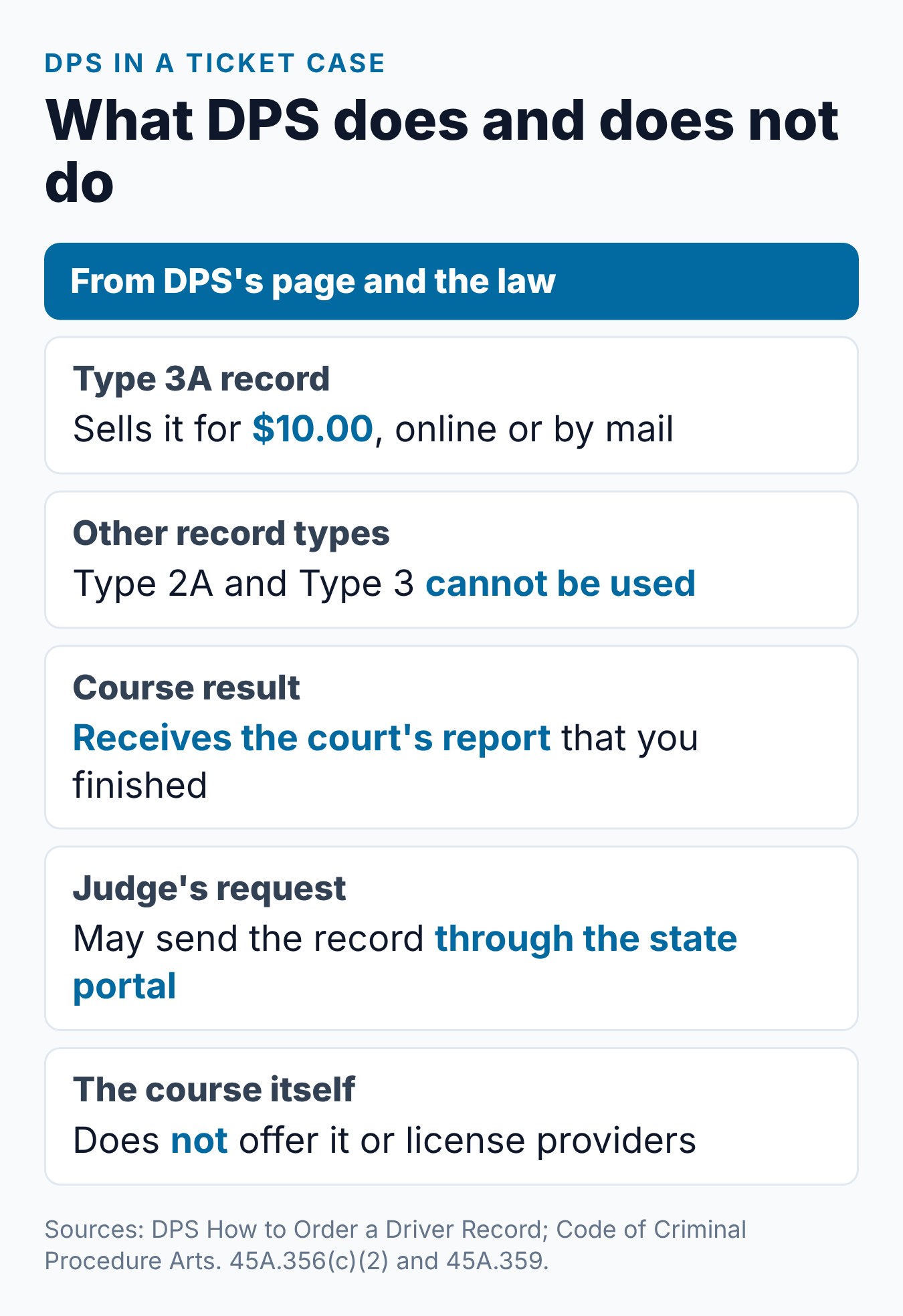
DPS sells the driving record a court may ask for. Its How to Order a Driver Record page lists the Type 3A record, a certified list of all crashes and violations, at $10.00.
DPS says, “This is the only record type that can be used for a defensive driving course (DDC).” It also says the Type 2A and Type 3 records cannot be used.
You order the record online or by mail. DPS says it cannot provide in-person driver record services at any of its locations. If you order by mail, DPS asks you to allow three weeks.
Part Two: Recording the Result
When the court dismisses the charge, DPS gets a report. Article 45A.356(c)(2) of the Code of Criminal Procedure says the court reports to DPS that you completed a driving safety course and the date you did.
That report goes on your driving record. You do not send it to DPS yourself.
Part Three: A Record the Judge Can Request
Article 45A.359 gives judges another path. Instead of taking the record from you, a judge may request it from DPS through the state electronic Internet portal and charge a reimbursement fee for it.
Whether your court does this is up to the court. Ask before you order a record yourself.
So the phrase Texas Department of Public Safety defensive driving describes a narrow role. DPS supplies and updates the record. It does not teach the course, sell it or license the people who do.
What TDLR Does
TDLR is the agency tied to the course itself. The ticket law, Article 45A.352(a), says the judge shall require “a driving safety course approved by the Texas Department of Licensing and Regulation.”
The Education Code adds the license rule. Section 1001.201(a)(3) of Chapter 1001 says a person may not provide driving safety courses without a driving safety provider license.
TDLR’s student page fills in the rest:
- Any licensed provider may offer it. “Any licensed driving safety provider may offer a 6-hour course that can be used for ticket dismissal or insurance discounts.”
- No state pick. TDLR “cannot recommend a specific provider.”
To check a provider, use TDLR’s Driving Safety Provider Search. TDLR says it exists for the sole purpose of verifying license status and is not an endorsement.
What the Court Does
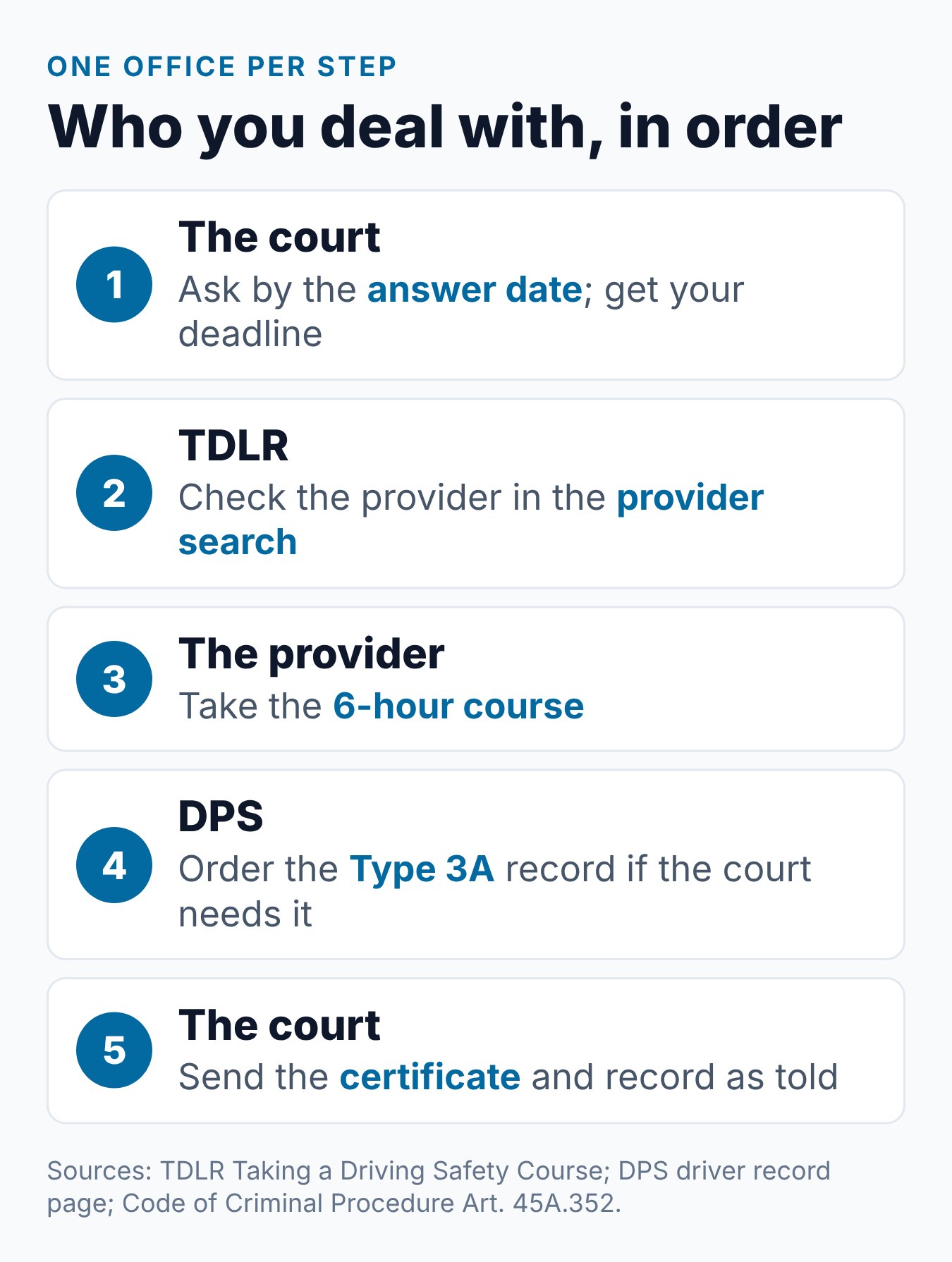
The court on your citation is the office that says yes or no. TDLR’s student page says you must first receive notice from the Texas court system that you are eligible to take the course to dismiss the ticket.
The same page says the court will typically set the date the course must be completed by. Under Article 45A.352(a)(4), you make the request to the court on or before the answer date on your citation. After that date, the court may still allow it, but it does not have to.
Who Is Left Out
Some drivers and charges cannot use the course for dismissal. These include:
- Commercial license holders. Anyone who holds a commercial driver’s license (CDL), or held one at the time of the offense, cannot use dismissal or deferred disposition, in any vehicle.
- High speeds. Going 25 mph or more over the limit, or 95 mph or more.
- Other charges. Passing a school bus, leaving the scene and other crash-duty offenses, work-zone offenses with workers present, serious traffic violations and DWI.
Deferred disposition is a separate court option with its own rules. Our Texas Driver Safety Course (DSC) guide explains who qualifies and walks through the full process.
Who to Contact for Each Step
Each question in a defensive driving case belongs to one office. Use this table to find it:
| Your question | Who answers it | Where |
|---|---|---|
| Is this course provider licensed? | TDLR | Driving Safety Provider Search |
| Which driving record does the court need? | DPS sells it | Type 3A record, online or by mail |
| May I take the course, and by when? | The court on your citation | The court’s own page or clerk |
| What do I pay the court, and where does the certificate go? | The court on your citation | The court’s own page or clerk |
| Registration, title or plates | TxDMV | Your county tax assessor-collector |
Notice that no row sends you to TxDMV for anything about the course. And DPS appears only for the record.
Four Common Situations
Here is how the table plays out in a few everyday cases:
- You got a ticket and want the course. Start with the court on your citation. Ask on or before the answer date, and wait for its notice that you are eligible.
- You want to know if a school is real. Look it up in TDLR’s Driving Safety Provider Search and check its license status.
- The court wants your driving record. Order the Type 3A from DPS online or by mail, unless the court gets it for you.
- Your registration sticker is due. That is a vehicle task for TxDMV and your county tax assessor-collector. It has nothing to do with the course.
Where the Official Sources Stop
Each agency page describes its own work. None of them explains the other agencies’ parts in the course process.
That is why this article uses several pages together: TxDMV’s About Us page, Texas.gov, TxDOT, DPS’s driver record page, TDLR’s student page and provider search, and the state statutes. Each one is the official word on its own agency.
The pages also leave some things to your court. Court fees, filing steps and how to send the certificate are set by each court, so ask yours.
What We Found on the Agency Pages
On November 25, 2026, we read the pages listed in Sources and sorted each task to one office. Here is what stood out:
- No agency page offers a course. TxDMV’s About Us page lists vehicle programs only, and the DPS pages we read do not offer the course or license providers.
- Three pages agree on the split. TxDMV, Texas.gov and TxDOT all place licenses and records with DPS and vehicles with TxDMV.
- DPS draws one firm line. Its record page says the Type 3A is the only record type that can be used for a defensive driving course.
- No page compares all of them. We had to set the agencies’ pages side by side to see the full picture.
The takeaway is simple. Call the court first, check the provider with TDLR, and go to DPS only for the record.
Common Mistakes to Avoid
Each of these comes from an agency page or statute quoted above:
- Contacting TxDMV about a ticket course. TxDMV handles vehicles, not driving courses.
- Looking for a DPS course. DPS supplies the driving record but does not offer the course.
- Ordering the wrong record. DPS says Type 2A and Type 3 records cannot be used.
- Planning to pick up a record in person. DPS says it cannot provide in-person driver record services.
- Mailing a record order at the last minute. DPS asks you to allow three weeks for mail.
- Enrolling before the court says yes. For a ticket, you first need the court’s notice that you are eligible.
How Requirements Can Vary
The driving safety course rules come from Texas law and TDLR and apply statewide. Each justice or municipal court still sets its own fees, filing steps and contact methods, and the facts of your citation decide which options you have.
Laws, fees and court procedures can change. Check your citation, ask the court that handles your case, and use the TDLR and Texas DPS websites for current rules before you act.
Frequently Asked Questions
Does TxDMV offer a defensive driving course?
No. TxDMV handles vehicle registration, titles, dealer regulation and similar vehicle programs. Its About Us page lists no driving course program.
Does DPS offer a defensive driving course?
No. DPS manages driver licenses, IDs and driver records. In a defensive driving case, it sells the Type 3A record and receives the court’s report that you finished the course.
Who approves the course in Texas?
The ticket law calls for a course approved by TDLR. TDLR licenses the private providers, and any licensed provider may offer the 6-hour course.
Which driving record do I need for the court?
DPS says the Type 3A record is the only record type that can be used for a defensive driving course. It costs $10.00 and is ordered online or by mail.
Can the judge get my record instead of me?
Yes, if the court chooses. A judge may request the record from DPS through the state portal and charge a reimbursement fee. Ask your court which way it works.
Who tells me my deadline?
The court on your citation. TDLR says the court will typically set the date the course must be completed by, and you ask on or before the answer date.
Conclusion
There is no TxDMV or DPS course: TxDMV handles vehicles, DPS handles licenses and records, and TDLR licenses the private providers. Our article on the TDLR-approved driver safety course explains that label, and our guide to the Texas Type 3A driving record covers ordering it. Get the court’s yes first, then check the provider in TDLR’s search. When you are ready, see Driving Logic’s defensive driving course texas.
Related Articles
- Texas Driver Safety Course (DSC): The Complete Guide
- Texas Approved Defensive Driving Course: Approved by Whom?
- List of Texas Approved Defensive Driving Courses: TDLR Tool
Sources
- TxDMV — About Us
- Texas.gov — Driver Licenses, IDs, and Records
- TxDOT — Texas vehicle registrations, titles, and licenses
- Texas DPS — How to Order Your Driver Record
- TDLR — Taking a Driving Safety Course
- TDLR — Driving Safety Provider Search
- Texas Code of Criminal Procedure Chapter 45A (PDF)
- Texas Education Code Chapter 1001
- Agency page review: Driving Logic reading of TxDMV, Texas.gov, TxDOT, DPS and TDLR pages, November 25, 2026.
Billy Forte is the owner of Driving Logic, a state-approved driver improvement course provider serving Texas and other U.S. states.
This article is general information, not legal advice. Texas traffic and driving safety course rules are set by Texas law, TDLR, Texas DPS and each court, and they can change. Check with the court on your citation and the official TDLR and DPS websites for current requirements, and talk to a Texas lawyer about your specific case.