
Updated November 2026 · Reviewed by Billy Forte
No state agency names a best TDLR approved driving safety course Texas drivers should take, because the Texas Department of Licensing and Regulation (TDLR) says it “cannot recommend a specific provider.” Every licensed provider’s course must meet the same rules on length, topics, passing mark and certificate. So the best course for you is a licensed one whose delivery, language, time limit and certificate method fit your court’s date and the way you like to learn.
Key Facts
- No official “best”: TDLR cannot recommend a provider, and any licensed provider may offer the 6-hour course. See why there is no state pick.
- Same everywhere: the license, the length, the topics, the 70 percent passing mark and the certificate rules. See what stays the same.
- What differs: delivery, language, lesson style, test format, time limit, certificate delivery and the provider’s own policies. See what can differ.
- License first: confirm the provider’s status in TDLR’s search before you compare anything else. See the checklist.
- Court first for a ticket: get the court’s notice that you are eligible, then pick a course that fits its date. See choosing for a ticket.
Why There Is No State Pick
People search for the best driving safety course Texas offers and expect a ranking. No official one exists. TDLR’s Taking a Driving Safety Course page says plainly that it “cannot recommend a specific provider.”
The same page explains why the choice is wide open. It says: “Any licensed driving safety provider may offer a 6-hour course that can be used for ticket dismissal or insurance discounts.”
So the state’s role ends at the license. Once a provider holds one, its course counts the same as any other licensed provider’s course.
A Quick Word on “Approved”
The ticket law calls it “a driving safety course approved by the Texas Department of Licensing and Regulation” in Article 45A.352(a) of the Code of Criminal Procedure. TDLR licenses the providers and, on its provider license page, tells them that “TDLR does not approve curriculum,” while every course must still meet the requirements in law and rules.
In Texas, “defensive driving” and “driving safety course” also name the same course. Our guide on how to choose a Texas course gives general shopping tips. This article does one narrower job: it separates what state rules make identical from what providers may do differently.
What Is the Same at Every Licensed Provider
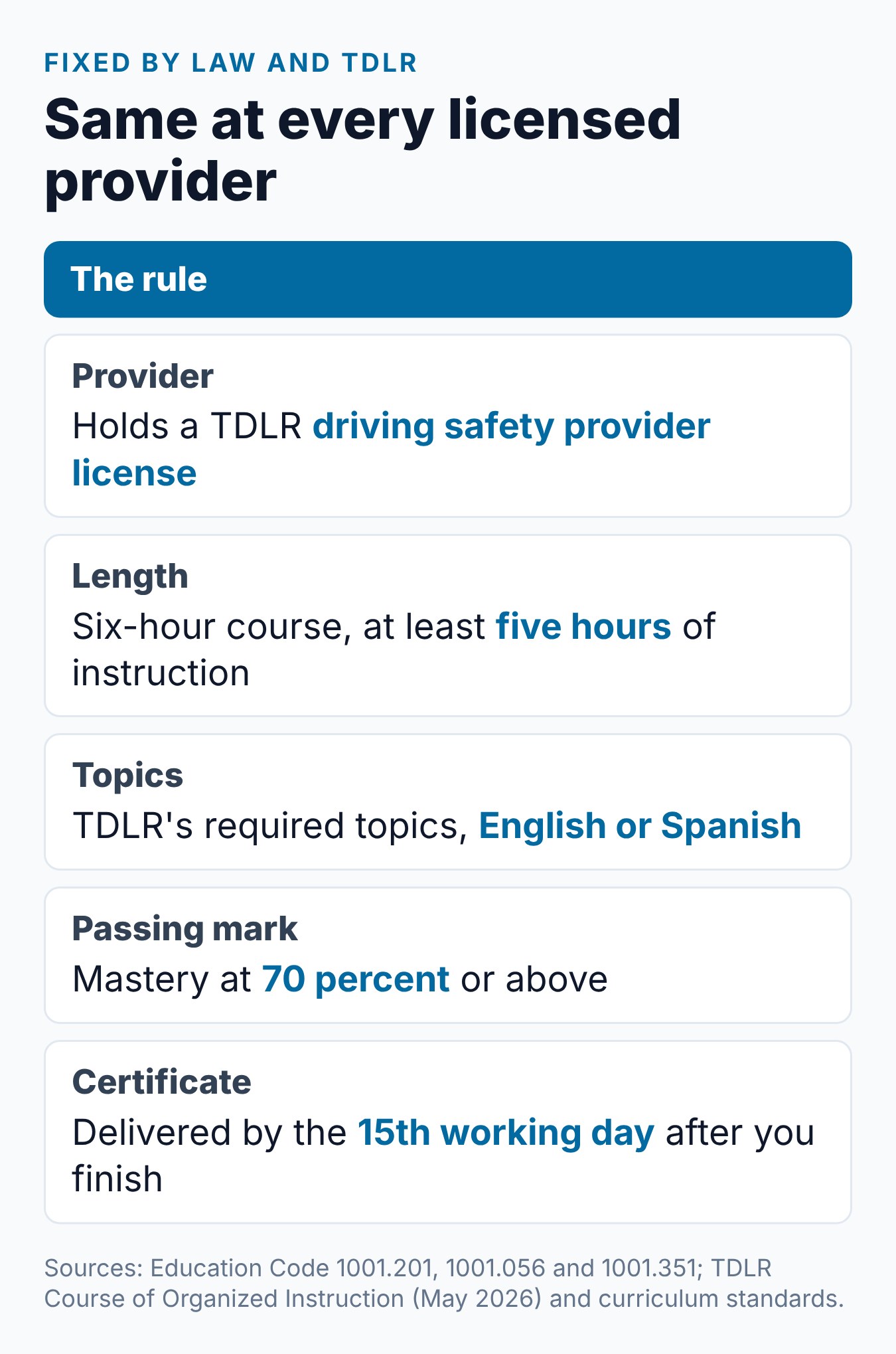
If something is set by law or by TDLR, it cannot make one course better than another. Five things fall in that group.
The license. Section 1001.201(a)(3) of Chapter 1001 of the Education Code says a person may not provide driving safety courses without a driving safety provider license. Every course you compare should come from a business that holds one.
The length. TDLR’s Course of Organized Instruction for Driving Safety, dated May 2026, describes a six-hour course. That holds in a classroom and by an alternative delivery method.
Total instruction time must be at least five hours, not counting breaks.
The topics. Every course must cover the topics in that same TDLR document. TDLR’s curriculum standards also say English and Spanish courses must meet the same standards.
The passing mark. Section 2.3 of the Course of Organized Instruction sets mastery at 70 percent or above. A student shows it on chapter exams or on one comprehensive exam.
The certificate. Section 1001.056(d) of the Education Code calls for a uniform certificate of course completion in the form TDLR requires. It carries an identifying number a court can use to verify it.
How Fast the Certificate Must Arrive
The deadline for the certificate is also set by law, not by the provider. Section 1001.351(a) says the provider must issue and deliver it by mail or by commercial or electronic delivery no later than the 15th working day after you finish the course.
TDLR’s student page puts it in simpler terms. It tells students they should receive the certificate within 14 days.
So no licensed provider may take longer than the law allows. What can differ is the way the certificate reaches you, covered below.
What Can Differ Between Licensed Providers
This is where a real comparison happens. Each item below comes from a TDLR page or Texas law, and each one is left to the provider.
| What can differ | What the official source says | What to ask before you pay |
|---|---|---|
| Delivery | “Some providers offer online courses, while others require you to attend in-person” | Do you teach online, in person or both? |
| Language | Providers may offer Spanish language courses | Is the whole course offered in my language? |
| Who wrote the lessons | Providers may write their own curriculum or get it from third parties | Can I see a sample lesson? |
| Test format | Chapter exams or one comprehensive exam | Which test format do you use? |
| Time to finish | “Providers may require that you complete the course within a specific amount of time” | How long do I have once I start? |
| Certificate delivery | Mail, commercial or electronic delivery | How will my certificate reach me? |
| Policies | Refund policy, schedule of fees and rules given before enrollment | Where can I read your refund policy? |
A few of these need a closer look.
Lesson Style and Language
TDLR’s curriculum standards say providers may develop their own curriculum or obtain it from third-party sources. That is why two courses can look and feel very different, even though the required content is the same.
Language is a real choice too. Providers may offer Spanish language courses, and those must meet the same standards as English ones. Our article on a bilingual Texas defensive driving course covers that choice in depth.
The Provider’s Own Time Limit
Some providers set a window for finishing the course. TDLR’s student page warns that providers may require you to complete the course within a specific amount of time.
That limit is separate from the court’s date. If you have a ticket, make sure the provider’s window and the court’s date both work for you.
Policies You Get Before You Pay
Section 1001.206(b)(2) of the Education Code says a provider must give each student its refund policy, its schedule of fees and its rules before enrollment. Read them. They are one of the clearest ways to tell two licensed providers apart.
Replacement certificates are part of this. TDLR says another copy is free within 30 days of finishing the course if the certificate did not arrive or had a provider error. Outside that, the replacement fee is up to the provider, so ask what it is.
Price differs too. This article does not compare prices. For what the course and the court can cost, see our article on how much defensive driving costs in Texas.
A License-First Checklist
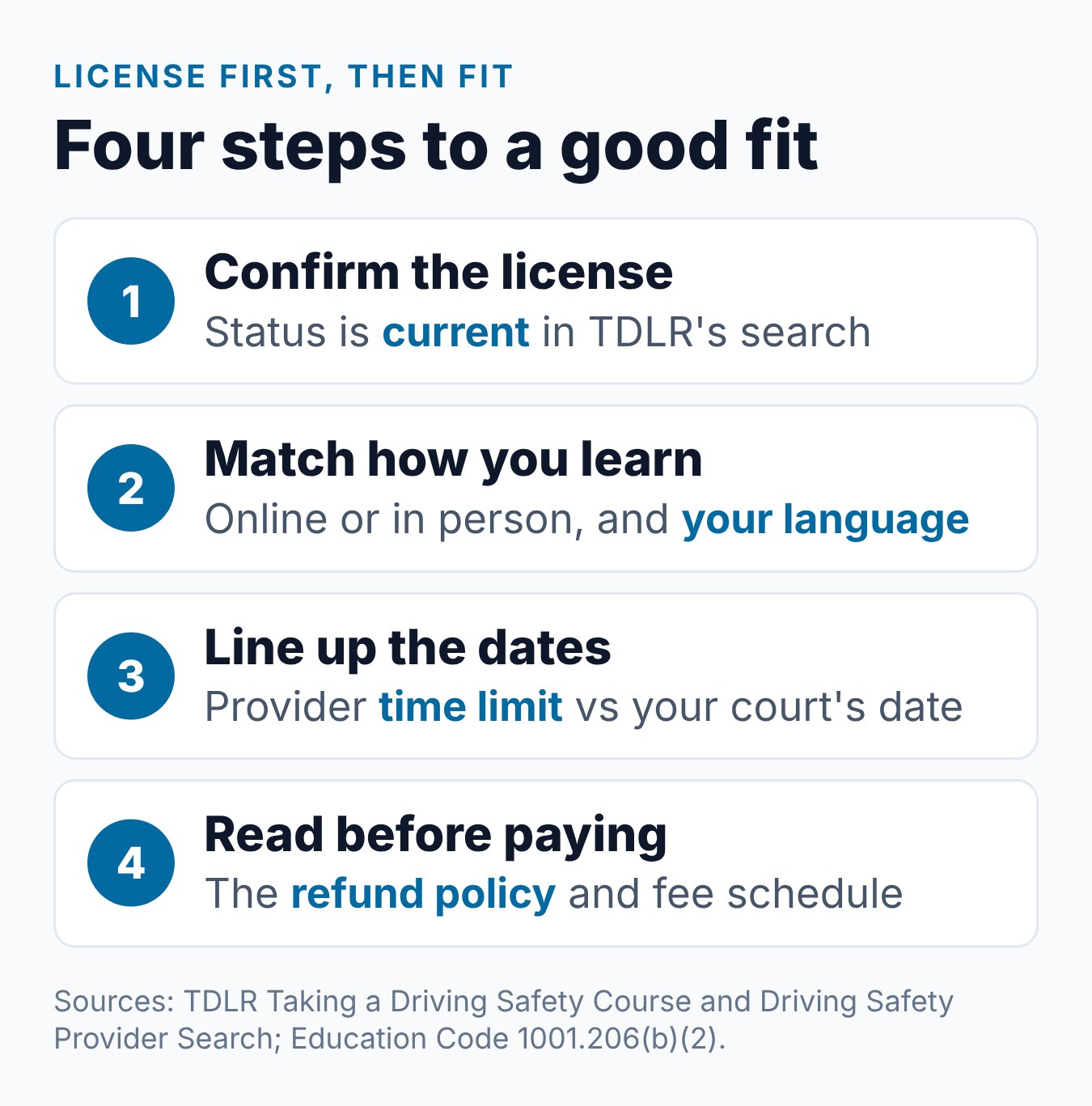
Start with the one check the state does for you, then compare the rest. Use this order:
- Confirm the license. Look the provider up in TDLR’s Driving Safety Provider Search and make sure its license status is current.
- Match the format and language. Ask whether the course is online or in person, and whether it comes in the language you want.
- Line up the dates. Compare the provider’s time limit and certificate delivery with the date your court set.
- Read the refund policy. Read the policies the provider must give you before you pay.
TDLR says its provider search is there to verify license status. It also says inclusion in the list “is not an endorsement, recommendation, or advertising.” Our article on the list of Texas approved defensive driving courses explains how to read each row of that search.
Choosing When a Court Date Is Involved
For a ticket, the court comes before the course. TDLR says you must first receive notice from the Texas court system that you are eligible to take the course to dismiss the ticket.
TDLR also says “the court will typically establish a date that the course must be completed by.” That date is what your choice has to fit.
Ask for the course on or before the answer date on your citation. After that date, the court may still allow it, but it does not have to. Some drivers cannot use the course for dismissal at all, such as anyone who holds a commercial driver’s license (CDL) or held one at the time of the offense.
Deferred disposition is a separate court option with its own rules. The Texas Driver Safety Course (DSC) guide lays out who qualifies and the full process.
Where the Course Rules Come From
Some drivers look for a DMV-approved course. In Texas, driver licenses and records are handled by the Department of Public Safety (DPS), and the provider license comes from TDLR.
That matters when you compare. The license that counts for this course comes from TDLR, so that is the one to check.
What We Found in the Official Sources
On November 25, 2026, we read TDLR’s student page, its curriculum standards, the May 2026 Course of Organized Instruction and the related parts of Texas law. We sorted each rule into “the same everywhere” or “left to the provider.” Here is what stood out:
- The core is locked. The license, the length, the topics, the passing mark and the certificate deadline are all set by law or by TDLR.
- The list of differences is short. Delivery, language, lesson style, test format, time limit, certificate delivery and the provider’s own policies make up almost all of it.
- Nothing official ranks providers. The only state statement on choosing is that TDLR cannot recommend one.
- Language does not lower the bar. Spanish courses must meet the same standards as English ones.
The takeaway: “best” is a fit question, not a quality ranking. Two licensed courses meet the same core rules, so compare the short list of things that can differ.
Common Mistakes to Avoid
Each of these comes from the rules quoted above:
- Looking for a state ranking. TDLR says it cannot recommend a specific provider.
- Paying for a “shorter” course. Every licensed course is the six-hour course described by TDLR.
- Assuming a Spanish course is easier. It must meet the same standards as an English one.
- Ignoring the provider’s time limit. A provider may set its own window to finish.
- Skipping the refund policy. The provider must give it to you before you enroll, so read it.
- Enrolling before the court says yes. For a ticket, get the court’s notice first.
How Requirements Can Vary
The driving safety course rules come from Texas law and TDLR and apply statewide. Each justice or municipal court still sets its own fees, filing steps and contact methods, and the facts of your citation decide which options you have.
Laws, fees and court procedures can change. Check your citation, ask the court that handles your case, and use the TDLR and Texas DPS websites for current rules before you act.
Frequently Asked Questions
Which is the best TDLR approved driving safety course Texas drivers can take?
No agency names one. TDLR says it cannot recommend a specific provider, and any licensed provider may offer the 6-hour course. The best choice is a licensed course that fits your court date, language and learning style.
Are all licensed Texas driving safety courses the same?
The core is the same. The license, the six-hour length, the required topics, the 70 percent passing mark and the certificate rules apply to every licensed provider. Delivery, language, lesson style, test format and policies can differ.
Is an online course as valid as an in-person class?
Yes, if the provider is licensed. TDLR says any licensed provider may offer the 6-hour course for ticket dismissal or insurance discounts, and some providers teach it online. Ask the provider which formats it offers.
Is a Spanish course held to the same standard?
Yes. TDLR’s curriculum standards say English and Spanish courses must meet the same standards. Providers may offer Spanish language courses, so ask before you enroll.
How soon will I get my certificate?
TDLR tells students they should receive it within 14 days. The law requires the provider to issue and deliver it no later than the 15th working day after you finish.
What should I check before I pay?
Confirm the license is current in TDLR’s search. Then check the format, language, time limit, certificate delivery and the refund policy the provider must give you before enrollment.
Conclusion
There is no state-named best TDLR approved driving safety course Texas drivers must use, since TDLR cannot recommend a provider. Every licensed course shares the same core rules, so compare delivery, language, time limit, certificate delivery and policies. Confirm the license first and, for a ticket, get the court’s notice before you enroll. When you are ready, you can see Driving Logic’s texas driving safety course.
Related Articles
- Texas Driver Safety Course (DSC): The Complete Guide
- List of Texas Approved Defensive Driving Courses: TDLR Tool
- Bilingual Texas Defensive Driving Course: English or Spanish
- Texas Approved Defensive Driving Course: Approved by Whom?
- Best Online Defensive Driving Course Texas: How to Choose
Sources
- TDLR — Taking a Driving Safety Course
- TDLR — Course of Organized Instruction for Driving Safety, May 2026 (PDF)
- TDLR — Driving Safety Curriculum Standards
- TDLR — Apply for a Driving Safety Provider License
- TDLR — Driving Safety Provider Search
- Texas Code of Criminal Procedure Chapter 45A (PDF)
- Texas Education Code Chapter 1001
- Texas DPS — How to Order Your Driver Record
- Rule review: Driving Logic sorting of TDLR pages, the May 2026 Course of Organized Instruction and Texas law, November 25, 2026.
Billy Forte is the owner of Driving Logic, a state-approved driver improvement course provider serving Texas and other U.S. states.
This article is general information, not legal advice. Texas traffic and driving safety course rules are set by Texas law, TDLR, Texas DPS and each court, and they can change. Check with the court on your citation and the official TDLR and DPS websites for current requirements, and talk to a Texas lawyer about your specific case.