
Updated November 2026 · Reviewed by Billy Forte
Texas publishes no ranking that names the best online defensive driving course Texas drivers should take, so the best choice is a course from a provider licensed by the Texas Department of Licensing and Regulation (TDLR) that fits your device, your schedule and your court date. TDLR says it “cannot recommend a specific provider,” and any licensed provider may offer the course online with no special approval. Every online course must still be at least as secure as a classroom course and meet the same educational objectives.
Key Facts
- No state ranking: TDLR cannot recommend a provider, and its provider search is “not an endorsement.” See is there a best online course.
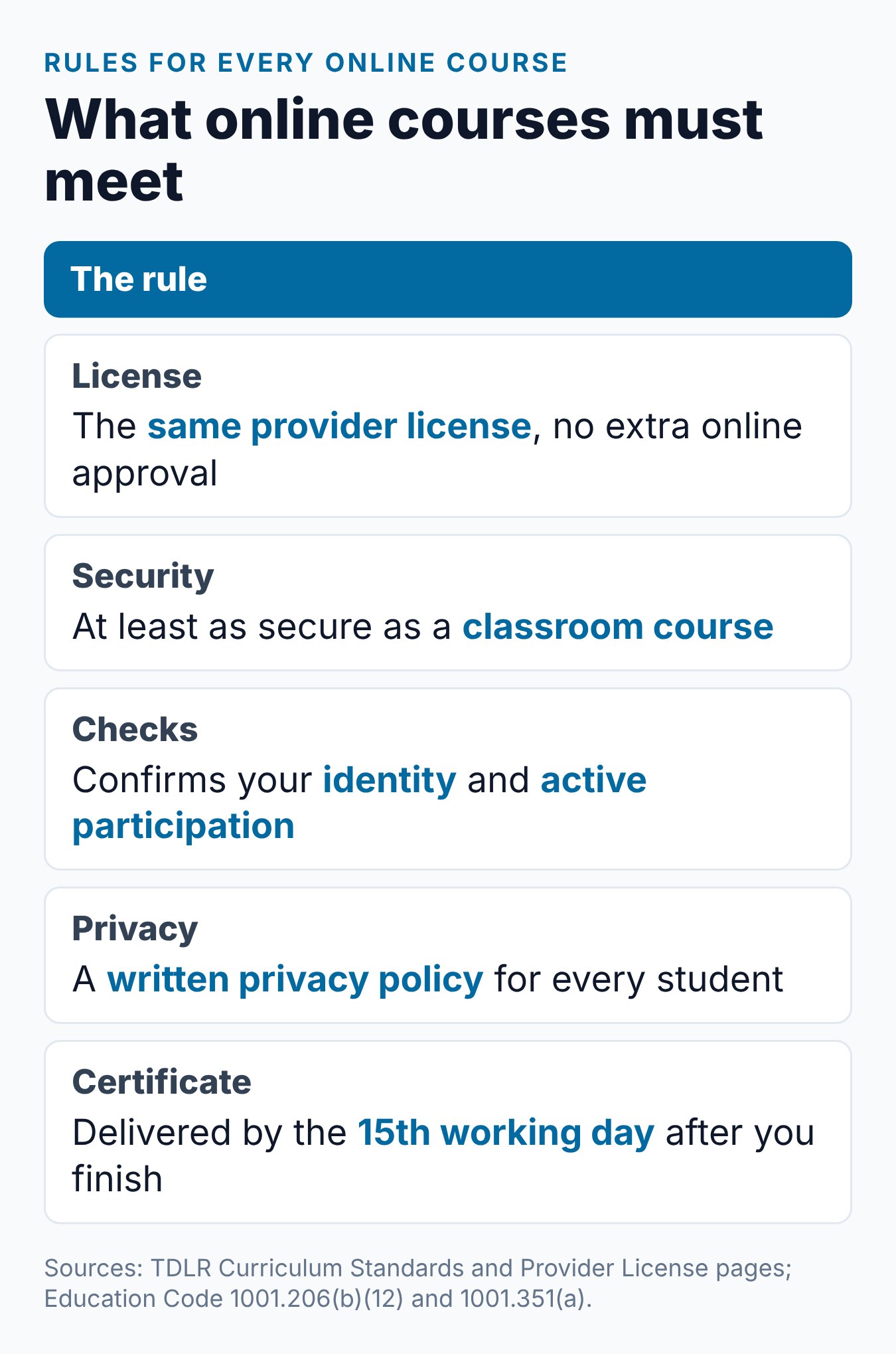
- Same rules online: an online course uses the same provider license and must be as secure as a classroom course. See what every online course shares.
- Checks are built in: the law requires measures that confirm who you are and that you are taking part. See identity and participation checks.
- Fit is the real choice: format, devices, saved progress, certificate delivery and support can differ. See what can differ.
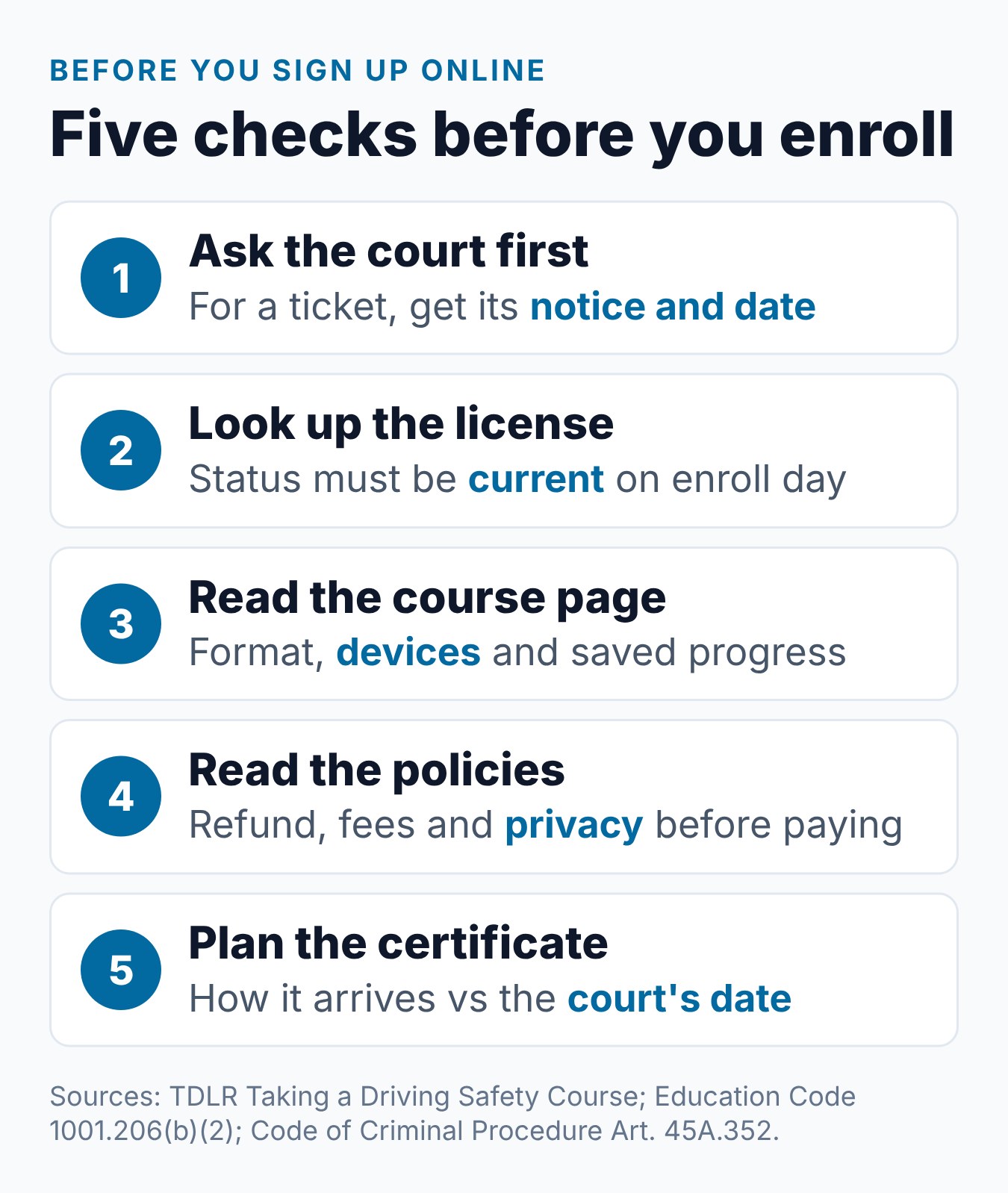
- Court first for a ticket: the court on your citation decides the request and the date to finish. See using an online course for a ticket.
Best Online Defensive Driving Course Texas: Is There One?
No official source names one. TDLR’s page on taking a driving safety course says, “TDLR cannot recommend a specific provider.” The same page says any licensed driving safety provider may offer a 6-hour course for ticket dismissal or insurance discounts.
TDLR’s Driving Safety Provider Search works the same way. TDLR says the list is there only to verify license status. It adds that being on the list “is not an endorsement, recommendation, or advertising.”
So when you look for the best defensive driving course Texas online offers, start with a simple idea. “Best” means the licensed course that fits you, not a winner picked by the state.
In Texas, a defensive driving course and a driving safety course (DSC) are the same class. TDLR’s student page says the driving safety course “is sometimes referred to as a Defensive Driving Class.”
Our article on the best TDLR approved driving safety course in Texas sorts every rule into “the same everywhere” and “left to the provider.” This article does a narrower job. It covers only the online course and the questions to ask before you sign up for one.
What Every Licensed Online Course Shares
An online course is not a lesser version of the classroom course. TDLR’s curriculum standards say providers “may offer the 6-hour driving safety course, either online or in-person.”
The same page sets the bar for online courses. It says they “must be at least as secure as a traditional classroom course and must contain the same educational objectives.” It also points online providers to section 84.504 of TDLR’s rules for special points that apply only to online courses.
The Same License
There is no separate online license for this course. TDLR’s page on how to apply for a driving safety provider license says, “There is no special approval process for offering online courses to students.”
Any licensed provider may teach online if its course and the way it runs the course meet the law and rules. So the license you check for an online course is the same driving safety provider license a classroom provider holds.
The Same Topics
Online or in person, the course must cover the same required topics. TDLR says curriculum must include all required topics and minimum time rules in its Course of Organized Instruction. Providers may write their own lessons or get them from a third party, but the content must meet the same rules either way.
TDLR’s curriculum page for driving safety providers lists required topics from Chapter 1001 of the Education Code. They include alcohol awareness, driving distractions, traffic stops, railroad crossing safety and child passenger safety seats, among others.
The list grows when the law changes. On April 29, 2026, TDLR said it adopted new rules that took effect May 1, 2026. Course content now includes the dangers and penalties of breaking traffic laws in work zones.
The Same Certificate Rules
Every licensed provider must follow the same certificate rules. Section 1001.351(a) of Chapter 1001 of the Education Code says the provider must issue and deliver the certificate no later than the 15th working day after you finish. It may use U.S. mail or commercial or electronic delivery.
TDLR’s student page puts it in plain terms: you should receive the certificate within 14 days. The certificate also carries an identifying number that TDLR, a court or Texas DPS can use to check it, under section 1001.056(d).
Identity and Participation Checks
Online courses have one job a classroom handles on its own: showing that the right person did the work. Texas law covers this directly.
Section 1001.206(b)(12) of the Education Code says a provider must have “adequate testing and security measures for the provider’s method of instruction to validate a student’s identity and active participation.” In short, the course must be able to confirm it is you taking it and that you are actually working through it.
For you, that means a few practical things:
- Take it yourself. The checks are there to confirm the student is the one doing the course.
- Stay with the course. Active participation is part of the rule, so expect the course to check that you are still taking part.
- Ask how it checks. Each provider chooses its own measures, so read how its course confirms who you are before you start.
The exact checks are set out in TDLR’s rules, and each course explains how it handles them. Our guide to the Texas approved 6 hour driving course online walks through how those checks and timers work.
Privacy of Your Information
Because online courses collect personal details, privacy matters. TDLR’s provider license page says providers must “develop and implement rigorous security and privacy protocols” to protect student information, including financial information.
It also says “a written copy of the privacy policy must be made available to all students.” If you can’t find a provider’s privacy policy, ask for it before you enter your information.
What Can Differ Between Online Courses
The rules fix the core of the course. They leave the way it feels to take it up to each provider, and that is where your choice matters.
Each question below is something you can check yourself. None of them ranks a provider. They help you find a licensed course that fits how you learn and the time you have.
Is the Provider Licensed on the Day You Enroll?
A license can expire or change status. TDLR’s student page says it is a good idea to verify the provider’s license status. Use TDLR’s search tool once you find a provider you like.
Check it on the day you sign up, not weeks before. The search shows a status and an expiration date for each license, so you can see whether it is current.
How Is the Course Delivered?
TDLR says you must contact the provider to find out which delivery method it offers. Providers may write their own lessons or get them from a third party, so two online courses can look very different.
Ask whether the lessons are text, video, audio or a mix, and which style keeps you focused. Then look for a sample lesson or a course outline on the provider’s own page.
Which Devices Can You Use?
TDLR’s student page does not list devices for students. Some people want to use a phone, while others prefer a computer with a bigger screen.
Check the provider’s own page for the devices and browsers it supports. If you plan to switch devices, ask whether your work follows you.
Does Your Progress Save?
You may not finish in one sitting. TDLR also notes that providers may require you to complete the course within a specific amount of time.
So ask two questions. Can you stop and pick up where you left off, and how long do you have once you start?
How Will Your Certificate Reach You?
The law allows mail, commercial delivery or electronic delivery. Each provider picks the method it uses, as long as it meets the 15th working day deadline.
If you have a court date, the delivery method matters. TDLR says it is your job to send the certificate to the court or your insurance company.
When Is Support Open, and in What Language?
Online courses can raise questions at odd hours. Check when the provider answers and how you can reach it, such as phone, email or chat.
Language is a real choice too. TDLR says providers may offer Spanish language courses and that they must meet the same standards as English courses. Our article on the bilingual Texas defensive driving course covers that choice.
Online Course Checklist: Where to Check Each Answer
Use this table before you pay. The left column is the question, and the right column is where to find the answer.
| Question to answer | Where to check it |
|---|---|
| Is the provider’s license current today? | TDLR Driving Safety Provider Search |
| Can I use a course for my ticket, and by what date? | The court on my citation |
| Is the course online, and is it text, video or audio? | The provider’s own page |
| Which devices and browsers can I use? | The provider’s own page |
| Does my progress save, and is there a time limit? | The provider’s own page |
| How and when will my certificate arrive? | The provider’s own page |
| When is support open, and in what languages? | The provider’s own page |
| Where are the refund policy, fees and privacy policy? | The provider, before I enroll |
Notice how little of this the state answers for you. TDLR answers only the license question, and the court answers the ticket question. Everything else is in the provider’s own materials, so read them.
Using an Online Course for a Ticket
For a ticket, the court comes before the course. TDLR says you “must first receive notice from the Texas court system” that you are eligible to use the course. You are still responsible for any fines and fees.
Under Article 45A.352 of the Code of Criminal Procedure, you plead guilty or no contest and ask for the course on or before the answer date on your citation. You can ask in person or through a lawyer. You can also send it by certified mail postmarked by that date, or through the court’s e-mail address or online portal if the court allows it.
After that date, the court may still grant the request before your case is final, but it does not have to. Then Article 45A.356 gives you a 90-day period to finish the course and file your papers.
Some drivers cannot use the course for dismissal, whether online or in person:
- Commercial drivers. Anyone who holds a commercial driver’s license (CDL), or held one when the offense happened, is left out under Article 45A.351(c).
- High speeds. Speeding at 95 mph or more, or 25 mph or more over the limit, is left out under Article 45A.352(a)(5).
- A recent course. You must not have completed a course in the 12 months before the date of the offense.
Since September 1, 2025, one course can count for every eligible charge from the same criminal transaction, such as one traffic stop. TDLR announced that change from Senate Bill 296.
Deferred disposition is a different court option with its own rules. The Texas Driver Safety Course (DSC) guide explains who qualifies and how the court process works.
Refunds and Cancellation
Online sign-up takes a few clicks, so read the rules on refunds before you pay. Under section 1001.206(b)(2) of the Education Code, a provider must give you its refund policy, fee schedule and rules before you enroll.
Texas law also gives you a short window to change your mind. Under section 1001.401, you get a full refund if you cancel before midnight of the third day after you sign the enrollment contract. Saturdays, Sundays and legal holidays are not counted.
That window closes if you finish the course or get a failing grade on the course exam. The same section also calls for a full refund if your enrollment came from a misrepresentation in the provider’s ads or by its staff.
The law also bans “erroneous or misleading advertising” by driving safety providers, under section 1001.206(b)(8). So a claim on a course website is the provider’s own claim, not a state finding.
What We Found on the Official Pages
On November 27, 2026, we read TDLR’s student, curriculum, license and provider search pages, Chapter 1001 of the Education Code and Chapter 45A of the Code of Criminal Procedure. We looked for anything that would make one online course officially better than another. Here is what we found:
- No ranking anywhere. The only state statement on choosing is that TDLR cannot recommend a provider.
- No online-only license. Online courses use the same provider license, with no special approval step.
- A higher bar, not a lower one. Online courses must be at least as secure as a classroom course, with the same objectives.
- The search is for status only. TDLR’s provider search showed 524 entries that day, each with a name, license number, status, expiration date and phone number. It has no column for format, rating or price.
The takeaway: you cannot pick an online course from a state list of winners. You pick it by checking the license and then the few things the provider controls. Our guide to the list of Texas approved defensive driving courses explains how to read each row of the search.
Common Mistakes to Avoid
Each mistake below comes from the rules quoted above:
- Trusting a “best” label. TDLR cannot recommend a provider, and its search is not an endorsement.
- Checking the license too early. Look it up on the day you enroll, since status and expiration dates change.
- Enrolling before the court says yes. For a ticket, get the court’s notice first and note its date.
- Skipping the policies. The provider must give you its refund policy, fees and rules before you enroll.
- Letting someone else click through. The course must validate your identity and active participation.
- Waiting on the certificate. It is your job to send it to the court, so know how it will arrive.
How Requirements Can Vary
The driving safety course rules come from Texas law and TDLR and apply statewide. Each justice or municipal court still sets its own fees, filing steps and contact methods, and the facts of your citation decide which options you have.
Laws, fees and court procedures can change. Check your citation, ask the court that handles your case, and use the TDLR and Texas DPS websites for current rules before you act.
Frequently Asked Questions
What is the best online defensive driving course in Texas?
No state agency names one. TDLR says it cannot recommend a specific provider. The best choice is a course from a TDLR-licensed provider that fits your device, schedule and court date.
Is an online course accepted the same as a classroom course?
Yes, if the provider is licensed. TDLR says any licensed provider may offer the course online or in person, and online courses must meet the same objectives. For a ticket, the court still decides your request.
Does an online provider need a special license?
No. TDLR says there is no special approval process for online courses. The provider needs the same driving safety provider license, and its course must meet the law and rules.
How does an online course know it is me?
Texas law requires testing and security measures that validate your identity and active participation. Each course explains its own checks. Plan to take the whole course yourself.
Can I get a refund if I change my mind?
Texas law gives a full refund if you cancel before midnight of the third day after you sign, not counting weekends or legal holidays. That does not apply once you finish the course or fail the exam. Read the provider’s refund policy before you pay.
How fast will I get my certificate from an online course?
TDLR says you should receive it within 14 days. The law says the provider must deliver it no later than the 15th working day after you finish, by mail or commercial or electronic delivery.
Conclusion
No state list names the best online defensive driving course Texas drivers must take, because TDLR cannot recommend a provider. Every licensed online course follows the same license, topics, security and certificate rules, so compare format, devices, saved progress, certificate delivery and support. For a ticket, ask the court first and confirm the provider’s license on the day you enroll. When you are ready, you can see Driving Logic’s online defensive driving course texas page.
Related Articles
- Texas Driver Safety Course (DSC): The Complete Guide
- Best Defensive Driving Course Texas: How to Choose
- Texas Defensive Driving Course Online: How to Take It
- Best TDLR Approved Driving Safety Course Texas: What Differs
- Texas Driving Safety Course Certificate: Proof for Court
- Texas 6hr Defensive Driving Class Online: What to Expect
Sources
- TDLR — Taking a Driving Safety Course
- TDLR — Driving Safety Provider Search
- TDLR — Curriculum Standards for Driving Safety Providers
- TDLR — Apply for a Driving Safety Provider License
- TDLR — Commission Adopts Rules (April 29, 2026)
- TDLR — SB 296 Relating to a Driving Safety Course Dismissal (October 8, 2025)
- Texas Education Code Chapter 1001
- Texas Code of Criminal Procedure Chapter 45A
- Texas Code of Criminal Procedure Chapter 45A (PDF)
- Texas DPS — How to Order Your Driver Record
- Review: Driving Logic reading of TDLR pages, the TDLR provider search and Texas law for online driving safety courses, November 27, 2026.
Billy Forte is the owner of Driving Logic, a state-approved driver improvement course provider serving Texas and other U.S. states.
This article is general information, not legal advice. Texas traffic and driving safety course rules are set by Texas law, TDLR, Texas DPS and each court, and they can change. Check with the court on your citation and the official TDLR and DPS websites for current requirements, and talk to a Texas lawyer about your specific case.