
Updated November 2026 · Reviewed by Billy Forte
There is no single answer to how much is a speeding ticket in the United States: the amount depends on the state, the court named on your ticket, your speed and the place, and courts add costs and fees to the fine. State laws only set the fine rules, such as a $1 to $200 fine range for most Texas traffic offenses and a $20 first-offense fine in Delaware that grows with each mile over the limit. To find the amount for your own ticket, read the court name on the citation and check that court’s website or call its clerk before the date on the ticket.
Key Facts
- No national price: each state writes its own speeding law, and each court adds its own costs. See why there is no single price.
- Your number comes from your court: the citation names the court, and that court gives the total. See how to find your own amount.
- The fine is only one part: state fees, court costs and course fees can be added. See what goes into the total.
- State laws differ a lot: Texas, Arizona and Delaware each set fines in a different way. See three states side by side.
- A course is not a price: some states let you ask the court for a driving course, and the court decides. See course options.
Why There Is No Single Price
People often want one number. The law does not give one. Each state writes its own traffic code, and each code sets fines in its own way.
Some states set a range and let the court pick a number inside it. Others set a base fine and add an amount for each mile over the limit. Some send speeding into a civil system with a cap, and treat very high speeds as a crime.
Then the court adds its part. Court costs and fees sit on top of the fine in many places, and each court can post its own amounts. So the same speed can cost one amount in one county and a different amount in the next.
Four things move the total most:
- The state. Its law sets the fine rules.
- The court. It sets or posts the amount and adds costs.
- The speed. Some laws change the fine for each mile over, or for very high speeds.
- The place. A school crossing or a work zone with workers present can change the charge or the fine.
That is why an online “average” can mislead you. It may mix states, courts and speeds that have nothing to do with your ticket. This article gives no national average and no typical amount for that reason.
How to Find Your Own Amount
Your citation is the starting point. It tells you which court has your case, what you are charged with and when you must answer.
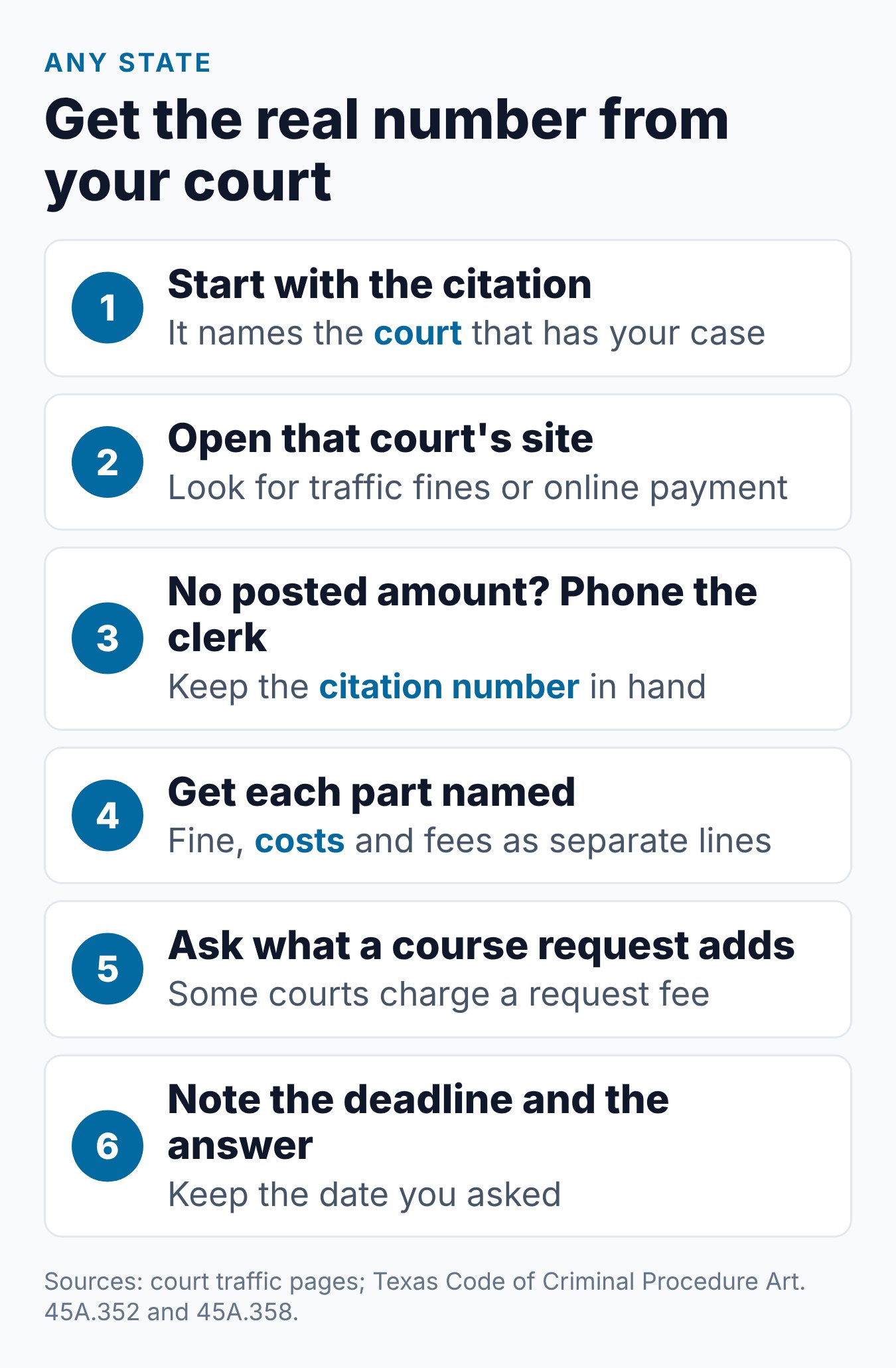
Use these steps:
- Read the citation. Find the court name, the charge, the speed, the posted limit and the answer or appearance date.
- Go to that court’s own website. Look for a fine schedule, a traffic page or a payment page.
- Call the clerk if no amount is posted. Have the citation number or case number ready.
- Ask what the amount includes. Ask for the fine, the court costs and any fees as separate numbers.
- Ask about course or deferral options and their fees. Some courts charge extra to request a course.
- Write down the deadline and what you were told. Note the date you asked and the clerk’s answer.
Two small checks help.
First, confirm that the court on the website is the same court printed on your ticket. Texas, for example, has both municipal courts and justice of the peace courts.
Second, check the date on the court’s page if it shows one. Fine schedules change, and an old page may not be current.
If you lost your ticket, contact the court that serves the place where you were stopped. In Delaware, for example, the Delaware Courts traffic help page gives the Voluntary Assessment Center phone number, 302-739-6911, for a lost ticket.
What Goes Into the Total
The amount you pay is often built from several parts. The law usually calls only one of them the fine.
Here is what can be added, using the state laws read for this article:
- The fine itself. This is the number the speeding law sets or allows.
- State fees on top of the fine. Texas law adds a $50 state traffic fine and a $3 fine in many cases, as explained in the Texas section below.
- Surcharges. Arizona law says the court “shall levy surcharges” in addition to the civil penalty.
- Court costs and other fees. The Delaware Courts page says that when you get a traffic ticket, “there are other fees in addition to the fine.”
- Course request fees. In Texas, a court may charge a fee of not more than $10 to request a driving safety course, in addition to court costs.
Because of this, a fine range in a statute is not the same as your bill. A law that caps a fine at $200 does not mean you pay $200 or less in total. The other parts can come on top.
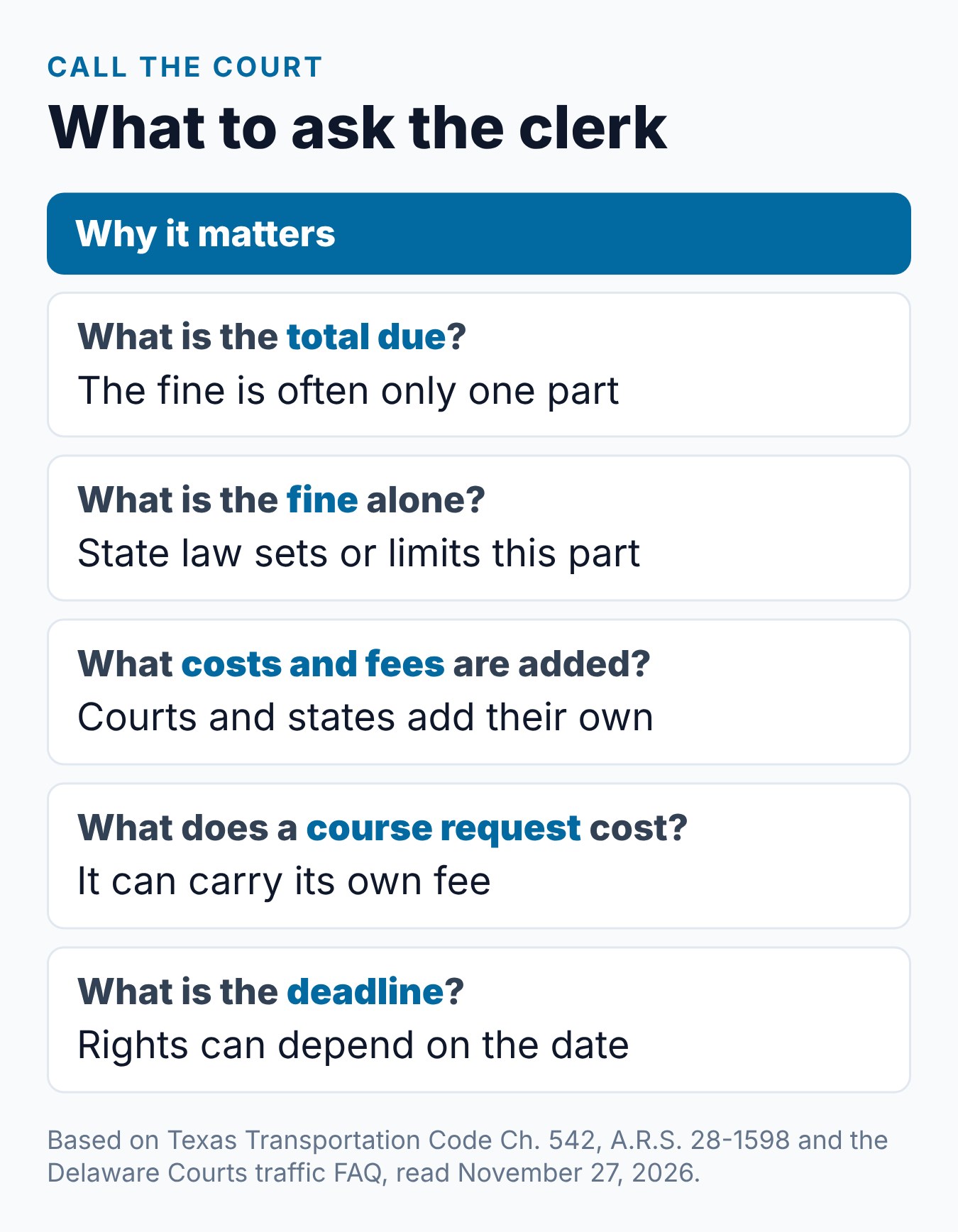
When you call the court, ask for the parts one at a time. Write each number down. Then ask whether the total changes if you pay late, ask for a course or go to court.
Three States Side by Side
For this guide, the speeding and penalty laws of three states were read on their official state websites on November 27, 2026. The table shows how differently they set the amount. It is a comparison of the laws only, not of what any court charges.
| What the law says | Texas | Arizona | Delaware |
|---|---|---|---|
| How the fine is set | A range: $1 to $200 for most traffic offenses (Transportation Code Sec. 542.401) | A civil penalty capped at $250 unless another law says otherwise (A.R.S. 28-1598) | A base fine plus a per-mile amount (21 Del. C. § 4169) |
| Base amount | No set base; the court picks inside the range | No set base; the cap applies | $20 first offense, $25 for a repeat within 24 months |
| Per mile over | Not set by the statute | Not set by the statute | $1 to $3 a mile on a first offense, by speed band |
| Very high speeds | The driving safety course right ends at 25 mph over or 95 mph | More than 20 mph over the posted limit is a class 3 misdemeanor (A.R.S. 28-701.02) | The per-mile rate rises at more than 15 and more than 19 mph over |
| Extra amounts in the law | $50 state traffic fine; $3 fine on conviction | Surcharges the court must add | Other fees in addition to the fine (court page) |
The table shows why one number can’t answer the question. A driver going 10 mph over could face a fine from a range, a capped penalty or a per-mile formula. Only the state line changes.
Texas: What the Law Sets
Texas has no statewide speeding price list. Transportation Code Sec. 542.401 says a person convicted of a traffic misdemeanor with no other penalty “shall be punished by a fine of not less than $1 or more than $200.” Each justice of the peace court and municipal court works inside that range.
Two state amounts can come on top of the court’s fine:
- $50 state traffic fine. Under Sec. 542.4031, a person who pleads guilty or no contest to, or is convicted of, one of these offenses pays $50. The law says it is due at the plea or the conviction, whichever is earlier.
- $3 fine. Under Sec. 542.403, the court orders a person convicted of one of these offenses to pay a $3 fine, “in addition to other costs.”
Work zones raise the range.
Under Sec. 542.404, when workers are present and the ticket says so on its face, the minimum and maximum fines double. For speeding, the zone must also have a sign showing the speed limit.
For more on Texas, Driving Logic has two longer guides.
Texas Speeding Ticket: Costs, Record Impact, and What to Know covers cost and record effects together. Texas speeding ticket cost: what affects the fine explains what moves a Texas fine up or down.
If you want real court numbers for one speed, how much is a 15 over speeding ticket in Texas compares what several Texas courts post.
Arizona: What the Law Sets
Arizona’s basic speed law is A.R.S. 28-701. It says you may not drive faster than is “reasonable and prudent” for the conditions.
Where no other limit applies, it treats speeds above 15 mph approaching a school crossing, 25 mph in a business or residential district and 65 mph in other places as evidence the speed is too high.
A basic speeding ticket under 28-701 is a civil traffic complaint, as A.R.S. 28-701.02 makes clear.
Under A.R.S. 28-1598, a civil penalty under the state’s civil traffic rules “shall not exceed two hundred fifty dollars,” unless another law says otherwise. The same section says the court shall add surcharges on top.
Very high speeds are different.
Under A.R.S. 28-701.02, going more than 20 mph over the posted limit, or more than 35 mph approaching a school crossing, is a class 3 misdemeanor. That is a criminal charge, not a civil one.
The Arizona Supreme Court’s defensive driving FAQ adds one cost point. It says course fees are not the same everywhere: “The fees vary for each jurisdiction.” For a full look at Arizona costs, see Driving Logic’s Arizona speeding ticket cost guide, which explains what changes the total there.
Delaware: What the Law Sets
Delaware puts real numbers in its speeding law.
Under 21 Del. C. § 4169, as it read on November 27, 2026, a first offense carries a $20 fine. A repeat offense within 24 months carries $25.
Then a per-mile amount is added on a first offense:
- More than 5 but less than 16 mph over: $1 for each mile over the limit.
- More than 15 but less than 20 mph over: $2 for each mile over.
- More than 19 mph over: $3 for each mile over.
The per-mile rates are higher for a repeat offense. The code page also notes that a later session law affects how this section applies, so check the current amount with the court.
That fine is not the whole bill. The Delaware Courts traffic help page says other fees are added to the fine.
If your ticket offers a voluntary assessment, you can pay it without going to court. The page says to pay the total in full within 30 days of the date you received the ticket.
For more, see Driving Logic’s Delaware speeding ticket guide, which covers fines, points and your options there.
Other States
Driving Logic has cost guides for these states. Each one covers that state’s own rules:
- Florida speeding ticket cost
- Indiana speeding ticket cost
- Missouri speeding ticket fines
- New Jersey speeding ticket points and fines
- Tennessee speeding ticket costs and points
- Virginia speeding ticket guide
In any other state, start with the court printed on your ticket. To find your state’s motor vehicle agency, use the USA.gov state motor vehicle services page, where you pick your state from a list.
Course Options Are Not Fine Amounts
Some states let a driver ask the court for a driving course after a ticket. The rules are different in every state, and the court decides. A course is never a price tag for the ticket.
Texas. Texas law calls it a driving safety course, and many people call it defensive driving. The Texas Department of Licensing and Regulation (TDLR) approves the course.
Under Code of Criminal Procedure Art. 45A.352, you have a right to it only if you plead guilty or no contest and ask the court on or before the answer date on the citation, among other conditions.
The right does not cover speeding at 95 mph or more, or 25 mph or more over the limit, and the law does not apply to anyone who holds a commercial driver license or held one at the time.
Since September 1, 2025, one course can cover every eligible charge from the same traffic stop, as TDLR explains.
TDLR’s page on taking a driving safety course also says you “will still be responsible for paying any fines and fees related to the ticket.”
Arizona. The Arizona Supreme Court runs a defensive driving program for the state’s courts.
Its FAQ says you may attend if you were cited for a civil moving violation, once every 12 months, and that courts may also allow it for criminal speeding. It says you must finish the course at least 7 days before your court date.
Delaware. The Delaware Division of Motor Vehicles defensive driving page describes approved courses in terms of an insurance discount. It does not describe them as a way to pay or remove a ticket.
The Delaware Courts page describes a separate court program, probation before judgment, which is limited and up to the court.
In every state, a course has its own cost. Ask the court what a course request costs before you decide.
Common Mistakes
These mistakes come straight from how the laws and court pages above work:
- Using another state’s number. A Delaware per-mile fine tells you nothing about a Texas ticket.
- Reading the statute cap as your total. Texas adds $50 and $3 amounts, Arizona adds surcharges, and Delaware adds fees.
- Trusting a friend’s amount. A different court, speed or zone can mean a different number.
- Missing the speed band. In Delaware, the per-mile rate rises at more than 15 and more than 19 mph over.
- Missing the deadline. In Texas, the right to the driving safety course depends on asking by the answer date.
- Assuming a course replaces the fine. TDLR says you still pay the fines and fees related to the ticket.
How Requirements Can Vary
The driving safety course rules come from Texas law and TDLR and apply statewide. Each justice or municipal court still sets its own fees, filing steps and contact methods, and the facts of your citation decide which options you have.
Laws, fees and court procedures can change. Check your citation, ask the court that handles your case, and use the TDLR and Texas DPS websites for current rules before you act.
Frequently Asked Questions
How much is a speeding ticket?
There is no one U.S. amount. It depends on the state law, the court on your ticket, your speed and the place, and courts add costs and fees. Ask the court for the full total.
Where do I find the amount for my ticket?
Look at the court name on your citation. Then check that court’s website for a fine schedule or payment page, or call the clerk with your citation number.
Is the fine the same as what I will pay?
Often not. Texas adds a $50 state traffic fine and a $3 fine in many cases, Arizona adds surcharges, and Delaware’s court page says other fees are added to the fine.
Does speeding in a work zone cost more?
It can. In Texas, the minimum and maximum fines double in a marked work zone when workers are present and the ticket says so. Other states set their own rules.
Can a driving course lower what I pay?
Not as a rule. A course request often has its own fee, and in Texas TDLR says you still pay the fines and fees related to the ticket. Ask the court what it charges before you decide.
What if my state is not covered here?
Start with the court on your ticket. You can find your state’s motor vehicle agency on the USA.gov state motor vehicle services page.
Conclusion
A speeding ticket has no national price, because each state’s law and each court’s costs set the amount. The fastest way to the right number is the court named on your citation, asked for the fine, costs and fees one by one. If your ticket is from Texas and your court allows it, the texas driving safety course page explains how the Driving Logic course works.
Related Articles
- Texas Speeding Ticket: Costs, Record Impact, and What to Know
- Texas Speeding Ticket Cost: What Affects the Fine
- How Much Is a 15 Over Speeding Ticket in Texas? By Court
- Texas Speeding Ticket Options: Pay, Contest, or Take Defensive Driving
Sources
- TDLR — Taking a Driving Safety Course
- Texas Code of Criminal Procedure Chapter 45A (PDF)
- Texas DPS — How to Order Your Driver Record
- Texas Transportation Code Chapter 542
- TDLR — SB 296 Driving Safety Course Dismissal
- Arizona Revised Statutes 28-701
- Arizona Revised Statutes 28-701.02
- Arizona Revised Statutes 28-1598
- Arizona Supreme Court — Defensive Driving FAQ
- Delaware Code Title 21, § 4169
- Delaware Courts — Traffic FAQ, Justice of the Peace Court
- Delaware Division of Motor Vehicles — Defensive Driving Courses
- USA.gov — State Motor Vehicle Services
Billy Forte is the owner of Driving Logic, a state-approved driver improvement course provider serving Texas and other U.S. states.
This article is general information, not legal advice. Texas traffic and driving safety course rules are set by Texas law, TDLR, Texas DPS and each court, and they can change. Check with the court on your citation and the official TDLR and DPS websites for current requirements, and talk to a Texas lawyer about your specific case.