
Updated November 2026 · Reviewed by Billy Forte
A Texas approved defensive driving course is the 6-hour driving safety course from a provider that holds a driving safety provider license from the Texas Department of Licensing and Regulation (TDLR). “State approved,” “TDLR approved” and “certified” all come back to that one license, and anyone can check it in TDLR’s Driving Safety Provider Search. The license is not court permission, so ask the court on your citation before you enroll.
Key Facts
- Who approves: Texas law calls for a course “approved by” TDLR. See what the law says.
- What TDLR issues: a license to the provider, not a stamp on each lesson. See the provider license.
- One license, many labels: state approved, TDLR approved and approved online mean the same thing. See each wording.
- Certified: it is not an official status. The official paper is your certificate of completion. See certified.
- Three-step check: find the name and license number, search TDLR, and confirm the license is active. See the check.
- Court first: a licensed provider is not court permission. See the court’s part.
What a Texas Approved Defensive Driving Course Is
Start with the name. Texas law calls the course a “driving safety course.” TDLR says it is “sometimes referred to as a Defensive Driving Class.” They are the same course.
The Education Code defines it in one line. A driving safety course is “a course of instruction intended to improve a driver’s knowledge, perception, and attitude about driving.” A driving safety provider is “a business that provides a driving safety course.”
Both definitions are in Chapter 1001 of the Education Code. So an approved course is not a special product. It is the standard 6-hour course, given by a business the state has licensed.
One agency matters here, and it is TDLR. Some drivers look for a “DMV approved” course. In Texas, driver licenses and driving records belong to the Department of Public Safety (DPS), and the provider license comes from TDLR.
What the Law Says: Approved by TDLR
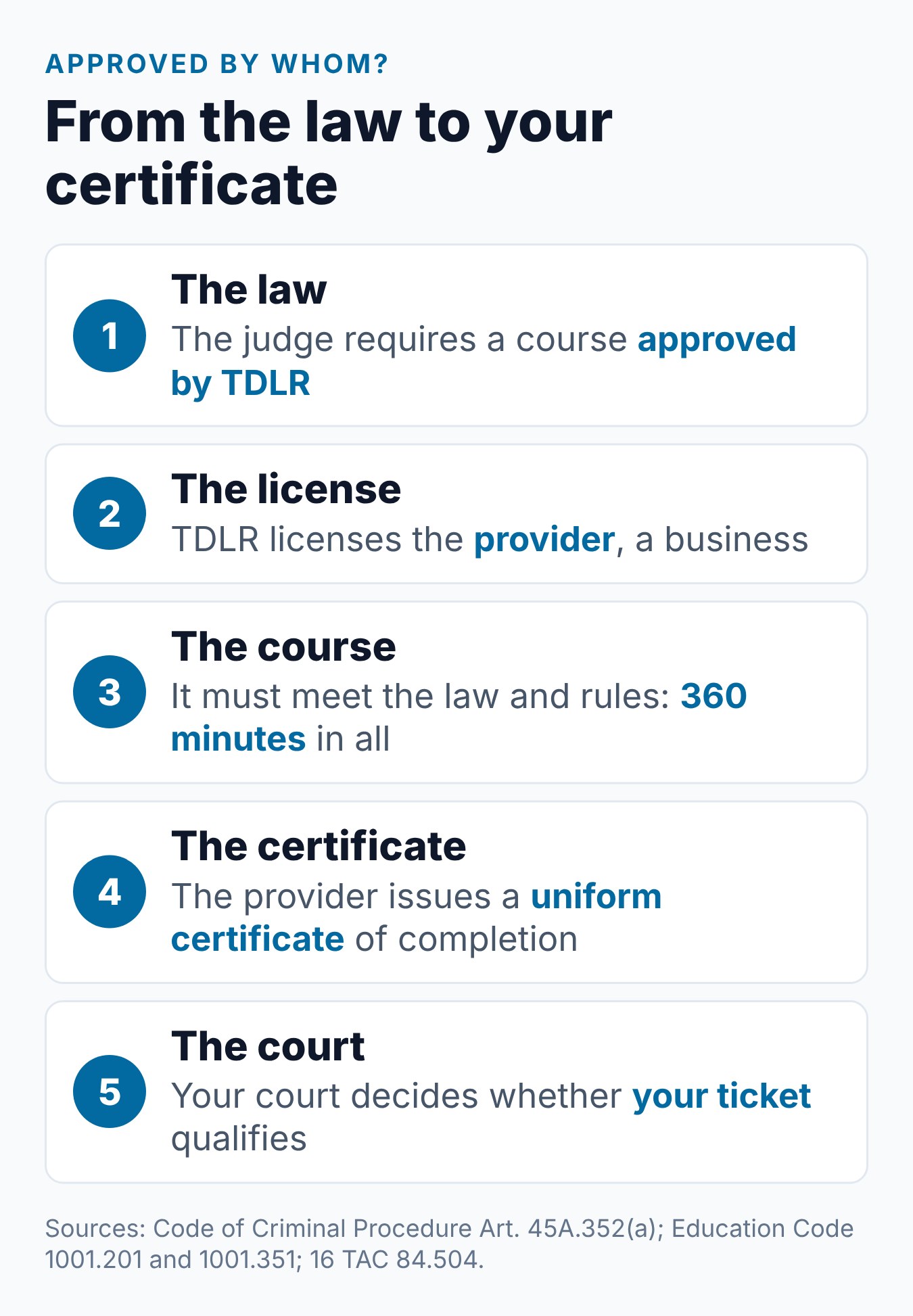
The ticket dismissal law is where the word “approved” comes from. Article 45A.352(a) of the Code of Criminal Procedure says the judge “shall require a defendant to successfully complete a driving safety course approved by the Texas Department of Licensing and Regulation.”
That sentence answers the first half of the question. Approved by whom? By TDLR.
It is not approved by the court. It is not approved by an insurance company. And a school cannot approve itself.
The Education Code uses the same word. Section 1001.351(a) says a provider gives a certificate to a person who successfully completes “an approved driving safety course.”
What TDLR Actually Issues: A Provider License
Here is the part most ads skip. What TDLR hands out is a license to a business.
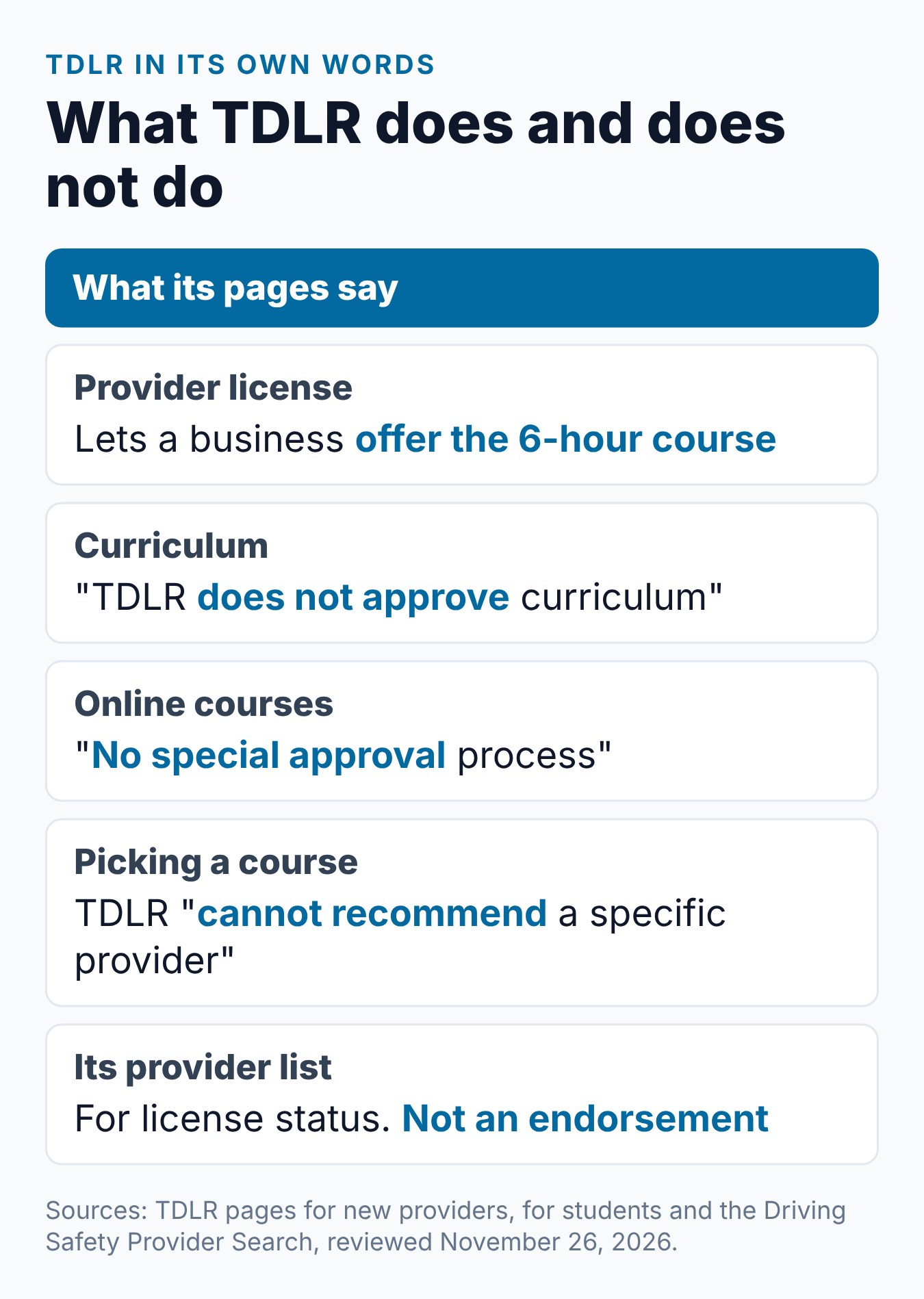
The Education Code says a person may not provide driving safety courses “unless the person holds a driving safety provider license.” That is Section 1001.201(a)(3). TDLR’s page for new providers adds that the license “allows you to offer the 6-hour driving safety course to students.”
The same page, Apply for a Driving Safety Provider License, is blunt about lessons. It says: “TDLR does not approve curriculum. All curriculum offered by your school must meet the requirements established in law and rules.”
Put the two together in plain words. In practice, an “approved” course is a course from a TDLR-licensed provider. TDLR does not hand out a separate approval for each provider’s lessons.
What Stands Behind the License
A license is more than a name on a list. TDLR’s provider page and the Education Code set conditions a business must meet to hold one:
- A bond. A provider must give TDLR a $10,000 surety bond. Section 1001.209 says the bond can be used to pay a refund due a student.
- A Texas presence. A provider must be located in Texas or keep a registered agent in the state.
- A privacy policy. A written copy must be made available to all students.
- A distinct name. A provider may not do business under a name that cannot be told apart from another licensed provider’s name.
None of this ranks one provider above another. It is the floor every licensed provider stands on.
What a Licensed Provider Gives You Before You Enroll
The license also comes with duties to you. Section 1001.206(b)(2) of the Education Code lists what a provider gives each student before enrollment:
- The refund policy.
- The schedule of tuition, fees and other charges.
- The rules on absence, grading, operation and conduct.
- TDLR’s name, mailing address, telephone number and website, so you know where to send a complaint.
If a course site shows none of these before it asks for payment, ask for them. A licensed provider should have them ready.
What Each Wording Means
Course websites use many labels. Each one points back to the same license, or to nothing official at all.
| Wording you see | Who stands behind it | What it means |
|---|---|---|
| Texas approved | TDLR, a state agency | The provider holds a driving safety provider license |
| State approved | TDLR, a state agency | The same license |
| TDLR approved | TDLR | The same license, in the law’s own wording |
| Approved online | TDLR | The same license. No separate online approval exists |
| Certified | No official page uses it as a status | The official paper is the certificate of completion |
The sections below take each wording in turn.
State Approved
Maybe you searched for a state approved defensive driving course Texas drivers can use for a ticket. “State approved” means the provider is licensed by the state agency, TDLR.
There is no second state stamp to look for. The driving safety provider license comes from one agency.
TDLR Approved
People who look for a TDLR approved defensive driving course Texas law describes are using the law’s own wording. Article 45A.352(a) says “approved by” TDLR.
On TDLR’s own pages you will read “licensed” instead. Its student page says: “Any licensed driving safety provider may offer a 6-hour course that can be used for ticket dismissal or insurance discounts.”
Some people shorten the search to Texas Department of Licensing and Regulation defensive driving. The meaning does not change. The agency licenses the provider.
Approved Online
Many drivers want a Texas approved defensive driving course online. There is no separate online approval to find.
TDLR’s provider page says: “There is no special approval process for offering online courses to students.” Any licensed provider may offer online courses, as long as the curriculum and the way it is run meet the law and rules.
TDLR also tells students that some providers offer online courses, while others require you to attend in person. You must contact the provider to find out which one it offers.
Certified
“Certified” sounds official. But no official page we read uses “certified” as a status for a course or for a provider.
The official word is “certificate.” Section 1001.351(a) of the Education Code says a provider issues a “uniform certificate of course completion” to a person who successfully completes the course.
So a certified Texas defensive driving course is, at most, a licensed provider’s course that ends with that certificate. The certificate comes at the end. It is not a badge on the website at the start.
A Three-Step Check Before You Pay
TDLR’s student page says that once you find a provider you like, “it’s a good idea to verify the provider’s license status using our license search tool.” The check is short:
- Find the name and number. An online course must display the driving safety provider’s name and license number. That rule is 16 TAC 84.505(g)(1).
- Look the provider up. Use TDLR’s Driving Safety Provider Search.
- Confirm the license is active.
TDLR says the directory is “provided for the sole purpose of verifying the license status” of providers it regulates. It adds: “Inclusion in this list is not an endorsement, recommendation, or advertising.”
So the search answers one question only. Is this business licensed right now? It does not tell you which course is best.
A Logo Is Not Proof
A seal on a website proves nothing by itself. TDLR’s provider page says its website policies “prohibit the use of the TDLR logo without our prior written consent.”
The same notice covers web addresses. It says TDLR’s own site is the only website authorized to use the lettering “TDLR” within the URL.
The Education Code backs this up in general terms. Section 1001.451 says a person may not “use advertising that is false, misleading, or deceptive.”
So do not count badges. Check the license in the search instead.
After the Course: The Certificate
The certificate is the one official paper in this whole process. Section 1001.056 of the Education Code says TDLR gives each licensed provider course completion certificate numbers.
Each certificate must carry an identifying number. The law says TDLR, a court or DPS may use that number to verify the certificate with the provider.
TDLR’s Driver Education and Safety page also links to a tool named “Validate a Driving Safety Certificate.” It is there for checking a certificate after the course.
Sending the certificate on is your job. TDLR’s student page says it is your responsibility to send it to the court or the insurance company.
The Same Minimum Length for Every Licensed Provider
Approval does not come in sizes. Every licensed provider’s course has the same minimum length.
The rule is 16 TAC 84.504(1)(C). It requires at least 300 minutes of instruction and 360 minutes in total.
TDLR’s Course of Organized Instruction, dated May 2026, calls it a six-hour curriculum. That holds in a classroom and in what TDLR calls an alternative delivery method.
So no licensed provider can offer a course shorter than that minimum. A promise of fewer hours is a reason to check the license again.
A Licensed Provider Is Not Court Permission
A license tells you about the business. It tells you nothing about your ticket.
TDLR’s Taking a Driving Safety Course page puts the court first. It says: “If you plan to use the course for ticket dismissal, you must first receive notice from the Texas court system that you are eligible to take a defensive driving course to dismiss the ticket.”
The same page adds two points:
- Fines and fees. You will still be responsible for paying any fines and fees related to the ticket.
- The deadline. The court will typically establish a date that the course must be completed by.
The dismissal law has its own conditions too. Article 45A.352(a) includes these:
- A license or permit. The defendant has a Texas driver’s license or permit, or is an active-duty military member or that member’s spouse or dependent child.
- No recent course. The defendant has not completed an approved driving safety course in the 12 months before the date of the offense.
- A request on time. The defendant asks on or before the answer date on the notice to appear. The court may still grant a later request.
- Speed limits on the right. Speeding at 95 miles per hour or more, or 25 miles per hour or more over the posted limit, is left out.
Our Texas Driver Safety Course (DSC): The Complete Guide walks through the full process. Confirm your own deadline with your own court.
No provider can promise that a ticket will be dismissed. That decision belongs to the court.
Where the Official Sources Stop
The two main sources do not use the same word, and that confuses people.
The law speaks of an “approved” course. TDLR’s own page says it licenses providers and “does not approve curriculum.” Both statements are official, and both stand.
Read them as two halves of one answer. The law names the agency. The agency explains what it does in practice: it licenses the business, and the business’s course must meet the law and rules.
The sources also leave some things out:
- No ranking. TDLR’s student page says it “cannot recommend a specific provider.”
- No list of single courses. TDLR’s search is about providers and their license status.
- No insurance promise. TDLR says a licensed provider’s course “can be used” for insurance discounts. Your own insurer decides the rest, as our article on a Texas insurance-approved defensive driving course explains.
What We Found on the Official Pages
On November 26, 2026, we read four TDLR pages and two chapters of Texas law. We looked for the exact words that course websites use. Here is what stood out:
- “Approved” is missing from TDLR’s pages. The word does not appear on TDLR’s student page, its provider application page, its provider search page or its Driver Education and Safety page.
- On those pages, approval comes up only to rule it out. The provider page uses “approve” once and “approval” once. Both times it says there is none.
- “Licensed” is TDLR’s word. The student page speaks of “any licensed driving safety provider.”
- “Approved” lives in the law. Chapter 1001 of the Education Code uses the phrase “approved driving safety course” four times. Article 45A.352(a) says “approved by” TDLR.
- “Certified” appears in neither place. We found the word on none of the four TDLR pages and nowhere in Chapter 1001.
Put together, the pattern is simple. The law says approved, the agency says licensed, and no official source we read says certified.
If a Provider Is Not What It Claims
Stop before you pay if you cannot find the provider in TDLR’s search. Ask the provider for its exact name and license number, and search again.
If the answer still does not match, you have somewhere to turn. TDLR’s Driver Education and Safety page has a “Complaints & Enforcement” section with a “File a Complaint” link.
A licensed provider must also give you TDLR’s contact details before you enroll, as noted above. That is how the law makes sure you know where a complaint goes.
Common Mistakes to Avoid
Each of these comes from a rule or page quoted above:
- Looking for a second approval. State approved, TDLR approved and approved online all mean one license.
- Trusting “certified.” It is not a state status. The certificate comes after the course.
- Counting logos. TDLR prohibits use of its logo without written consent. Check the license.
- Reading the search as a ranking. TDLR says inclusion is not an endorsement.
- Hunting for a shorter course. Every licensed course has the same minimum length.
- Paying before the court says yes. For a ticket, you must first get notice that you are eligible.
- Asking the wrong agency. The provider license comes from TDLR, not from DPS.
How Requirements Can Vary
The driving safety course rules come from Texas law and TDLR and apply statewide. Each justice or municipal court still sets its own fees, filing steps and contact methods, and the facts of your citation decide which options you have.
Laws, fees and court procedures can change. Check your citation, ask the court that handles your case, and use the TDLR and Texas DPS websites for current rules before you act.
Frequently Asked Questions
Who approves defensive driving courses in Texas?
TDLR does. Article 45A.352(a) calls for a driving safety course “approved by the Texas Department of Licensing and Regulation.” In practice, TDLR licenses the provider that offers the course.
Is a state approved course different from a TDLR approved course?
No. TDLR is the state agency, so both labels point to the same driving safety provider license. There is no second state approval.
Does an online course need its own approval?
No. TDLR says there is no special approval process for offering online courses. Any licensed provider may offer them if the curriculum and the way it is run meet the law and rules.
What does certified mean for a Texas course?
It is not an official status. No official page we read uses “certified” for a course or a provider. The official paper is the uniform certificate of course completion you get after you finish.
How do I check that a provider is licensed?
Find the provider’s name and license number on its website. Then look it up in TDLR’s Driving Safety Provider Search and confirm the license is active.
Does TDLR say which course is best?
No. TDLR says it cannot recommend a specific provider. It also says inclusion in its provider list is not an endorsement, recommendation, or advertising.
Does a licensed provider mean my ticket will be dismissed?
No. TDLR says you must first receive notice from the Texas court system that you are eligible. You still owe any fines and fees, and the court sets the date.
Conclusion
A Texas approved defensive driving course is a 6-hour course from a provider TDLR has licensed, whatever label the website uses. Check the name and license number in TDLR’s search, and get the court’s yes before you pay. Our article on the TDLR-approved label explains that label and why courts care about it. When you are ready, see Driving Logic’s defensive driving course texas.
Related Articles
- Texas Driver Safety Course (DSC): The Complete Guide
- TDLR-Approved Driver Safety Course: What It Means and How to Verify
- TEA Approved Defensive Driving Course Texas: Who Approves It Now
- Best Defensive Driving Course Texas: How to Choose
- Texas Insurance-Approved Defensive Driving Course: Ask First
- Best TDLR Approved Driving Safety Course Texas: What Differs
- Texas DMV Defensive Driving Course: DMV, DPS or TDLR?
- Cheapest Defensive Driving Course Texas: The Legal Minimum
Sources
- TDLR — Taking a Driving Safety Course
- TDLR — Apply for a Driving Safety Provider License
- TDLR — Driving Safety Provider Search
- TDLR — Driver Education and Safety
- TDLR — Course of Organized Instruction for Driving Safety, May 2026 (PDF)
- Texas Code of Criminal Procedure Chapter 45A (PDF)
- Texas Education Code Chapter 1001
- Texas Register, August 16, 2024 — 16 TAC 84.504 and 84.505
- Texas DPS — How to Order Your Driver Record
- Page review: Driving Logic review of four TDLR pages and two chapters of Texas law, November 26, 2026.
Billy Forte is the owner of Driving Logic, a state-approved driver improvement course provider serving Texas and other U.S. states.
This article is general information, not legal advice. Texas traffic and driving safety course rules are set by Texas law, TDLR, Texas DPS and each court, and they can change. Check with the court on your citation and the official TDLR and DPS websites for current requirements, and talk to a Texas lawyer about your specific case.