
Updated November 2026 · Reviewed by Billy Forte
Texas has no official list that names a Texas insurance-approved defensive driving course, and no state agency approves a course for insurance. Two things decide it: the provider must be licensed by the Texas Department of Licensing and Regulation (TDLR), and your own insurance company decides whether it gives a discount and on what terms. So call your insurer first, and enroll second.
Key Facts
- No state list: no Texas agency publishes courses that insurers accept. See why there is no list.
- Two deciders: TDLR licenses the provider, and your insurer decides the discount. See who decides.
- Call first: five questions settle it before you pay. See the five questions.
- Check the license: TDLR has a search tool for provider licenses. See the license check.
- You send the proof: TDLR says sending the certificate is your responsibility. See the certificate.
- A law protects you: an insurer may not raise your premium because you completed the course. See the protection.
What a Texas Insurance-Approved Defensive Driving Course Is
Drivers use the phrase all the time. The state does not.
In practice, a Texas insurance-approved defensive driving course is a 6-hour driving safety course from a TDLR-licensed provider that your insurer agrees to accept. Both halves matter.
A license without your insurer’s yes earns no discount. Your insurer’s yes means little if the provider has no license.
The course itself is not a special insurance class. TDLR calls it a driving safety course and notes that it is sometimes referred to as a Defensive Driving Class. It is the same course drivers take for a ticket.
One agency point trips people up. TDLR is the agency that licenses driving safety providers. The Texas Department of Public Safety and the Texas Department of Motor Vehicles do not.
There Is No State List
Two state agencies touch this topic. Neither one keeps a list of courses that insurance companies accept.
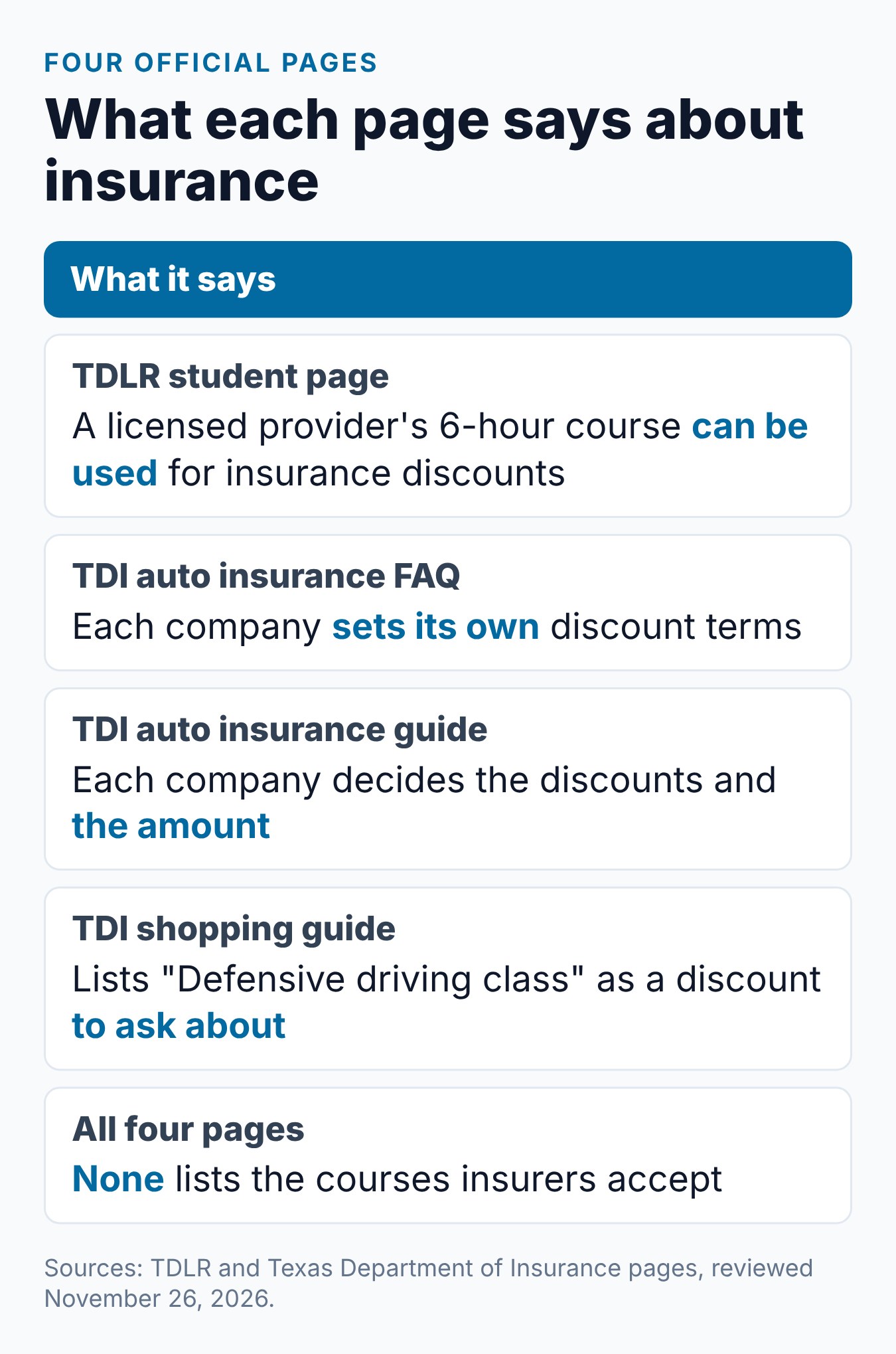
TDLR regulates the course. Its student page, Taking a Driving Safety Course, says: “Any licensed driving safety provider may offer a 6-hour course that can be used for ticket dismissal or insurance discounts.”
Read that sentence closely. It says a licensed provider’s course can be used for insurance discounts. It does not say any insurer must accept it.
The Texas Department of Insurance (TDI) is the state’s insurance department. Its auto insurance FAQ says: “Companies often offer discounts for completing a defensive driving or driver education course. Each company sets its own discount terms.”
So the state gives you two true statements and no list. The gap between them is filled by your own insurance company.
Who Decides a Course Counts
Each part of the question has a different owner. Mixing them up is how drivers end up with a course their insurer will not credit.
| Question | Who decides | Where to check |
|---|---|---|
| Is the provider licensed? | TDLR | TDLR’s provider search |
| Does my company give a discount at all? | Your insurance company | Your agent or company |
| Is an online course accepted? | Your insurance company | Your agent or company |
| Which drivers on the policy qualify? | Your insurance company | Your agent or company |
| What proof is needed, and by when? | Your insurance company | Your agent or company |
| Can the course also dismiss my ticket? | The court | The court on your citation |
Five of the six rows do not belong to the state. That is why the phone call comes before the course.
What TDLR Covers, and What It Leaves Out
TDLR’s student page is short. It covers four things: ticket dismissal, finding a course, completing the course and the certificate of completion.
On finding a course, TDLR is plain. It cannot recommend a specific provider. Some providers offer online courses, while others require you to attend in person, and you must contact the provider to find out which one it offers.
On insurance, the page says very little. It opens by saying a driving safety class is generally required to dismiss a traffic citation or for insurance discounts. Then it leaves the insurance side alone.
Here is what the page does not tell you:
- Which companies give a discount.
- What any company requires.
- How large a discount is.
- How a company wants the certificate.
That is not a flaw in the page. It is about the course and the certificate. It is not about insurance companies’ rules.
What TDI Covers, and What It Leaves Out
TDI comes at it from the other side. It tells you discounts exist and that companies control them.
Three TDI pages mention the course:
- The auto insurance FAQ asks, “Can I get a discount if I take a defensive driving course?” The answer is the two sentences quoted above.
- The auto insurance guide says: “Each company decides what discounts to offer and the amount of the discount.”
- The guide How to shop smart for auto insurance lists “Defensive driving class” among the discounts to ask a company about.
None of the three lists accepted courses. None names a provider. They confirm that the discount is real and that the terms belong to each company.
Our guide to the Texas defensive driving insurance discount explains the discount itself and how insurers set rates.
Five Questions to Ask Before You Enroll
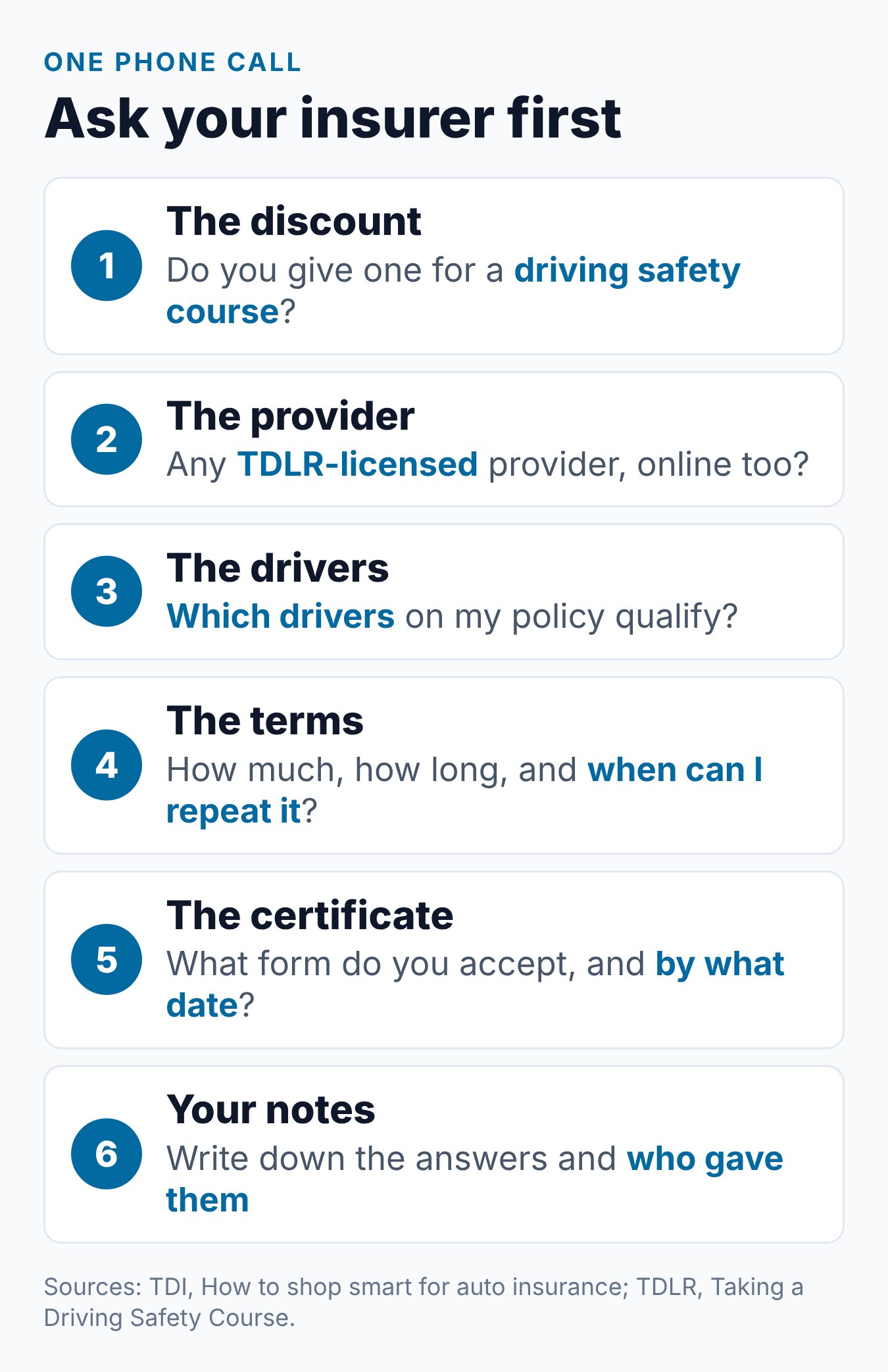
Call your insurance company or your agent before you pay for a course. Each of the five questions below closes one gap the state pages leave open.
1. Do you give a discount for a Texas driving safety course?
Start here, because the answer can be no. TDI says companies often offer this discount. Often is not always.
Use both names when you ask. Say “driving safety course” and “defensive driving.” They are the same course, and the person on the phone may know only one name.
2. Do you accept any TDLR-licensed provider, including online?
This is the heart of the “insurance-approved” question. Ask whether a 6-hour course from any TDLR-licensed driving safety provider counts, and whether an online course counts too.
If the company has its own rules about providers or formats, you want to hear them now. No state page will tell you.
3. Which drivers on the policy can qualify?
A policy often covers more than one driver. Ask who can earn the discount and whether each driver must take the course.
No official page we read gives an age rule or a driver rule. The answer belongs to your company.
4. How much, how long, and when can I repeat it?
Ask three things together: the amount of the discount, how long it lasts, and when you can take the course again to keep it.
We give no numbers here on purpose. TDI says each company decides the amount, and no official page we read sets a length of time.
5. How do you want the certificate, and by what date?
Ask what form the company accepts: the original, a copy, an upload or an e-mail. Then ask for the date it must arrive.
This answer shapes everything you do after the course. Get it before you start.
Write Down the Answers
A phone answer is easy to forget and hard to prove. Write the answers down, and write down who gave them.
A short note is enough. Include:
- The date and time of the call.
- The name of the person you spoke with.
- Whether the company gives the discount.
- Which providers and formats it accepts.
- Which drivers qualify.
- The form of the certificate and the date it is due.
If your company offers chat or e-mail, use it. Then the answers are already in writing.
Insurance Approved Defensive Driving Texas: Reading a Course Website
You may have searched for “insurance approved defensive driving Texas” and then seen those words on a course page. It helps to know what they can and cannot mean.
A provider’s TDLR license is the part you can check, and it matters.
A provider cannot speak for your insurance company. Only your company can say whether it gives a discount, to which drivers and on what terms.
So treat the phrase as a starting point, not as proof. Two checks turn it into an answer:
- The license check, which you do yourself in TDLR’s search.
- The insurer check, which is the phone call above.
Price tells you nothing about either one. A low price does not make a course count for insurance, and a high price does not either.
Verify the License Yourself
The license is the one part the state does settle. You can confirm it in a minute.
TDLR’s student page suggests it. Once you have found a provider you like, it says, it is a good idea to verify the provider’s license status using its license search tool.
The tool is the Driving Safety Provider Search. Look for the provider by name and confirm that its license status is current.
Keep the tool’s purpose in mind. TDLR says the list is for verifying license status and is not an endorsement.
A current license means the provider may offer the course. It says nothing about your insurer.
Our article on what TDLR approval means and how to verify it walks through the search.
Getting the Certificate to Your Insurer
Finishing the course does not finish the job. Your insurer knows nothing until you send proof.
TDLR’s page sets out the basics:
- How it arrives: the certificate of completion must be mailed or sent electronically to you.
- When it arrives: you should receive it within 14 days of completing the course.
- Who sends it on: it is your responsibility to send the certificate of completion to the court and or insurance company.
Which copy should go to the insurer? No official page we read describes a separate insurance copy of the certificate, so we do not claim there is one. Send the form your company asked for in question 5.
Keep a copy for your own records, whatever you send. Our certificate guide covers the document in detail.
If the Certificate Is Late or Wrong
TDLR’s page covers two problems.
If you do not receive your certificate, or it is incorrect because of an error on the provider’s part, you can request another copy at no charge within 30 days of completing the course.
If you lose the certificate yourself, you may request another copy from the provider. The provider may charge a fee for that request.
Mark both dates when you finish: day 14 and day 30. If nothing has arrived by day 14, contact the provider while the free copy is still available.
One Course for a Ticket and for Insurance
Some drivers want both benefits from one course. That can work, but two different deciders are involved.
The court decides the ticket. TDLR says that to use the course for ticket dismissal, you must first receive notice from the Texas court system that you are eligible. It adds that the court will typically establish a date that the course must be completed by.
Your insurer decides the discount. Its date and its proof rules are separate from the court’s.
When both apply, the court’s deadline comes first. Send the court what it requires on time. Then ask your insurer whether a copy of the certificate is enough for the discount.
Ask before you finish the course, not after. If the insurer wants something the court also wants, you need to know while there is still time to plan.
The Law That Protects You
Some drivers worry that telling an insurer about the course could backfire. Texas law speaks to that.
Under article 45A.357(b) of the Code of Criminal Procedure, an insurer may not cancel a motor vehicle insurance policy or increase the premium because the insured completed a driving safety course or had a charge dismissed under the driving safety course law. The text is in Chapter 45A.
The rule is narrow. It is about the course and a dismissal through it. It does not promise a discount, and it does not set one.
If You Have a Question About an Insurance Company
Your company or agent should answer the five questions. If you have a question about an insurance company that they cannot settle, TDI has a help line.
The number is 800-252-3439. TDI prints it at the end of its auto insurance FAQ.
Keep one limit in mind. No state agency approves a course for insurance, and that includes TDI.
What We Found on the Official Pages
On November 26, 2026, we read TDLR’s student page and two TDI pages from top to bottom. We looked for anything that would tell a driver which courses insurers accept. Here is what stood out:
- TDLR’s page mentions insurance three times. Twice it says the course can be used for insurance discounts. Once it says you send the certificate to the insurance company. It names no insurer rule.
- TDI’s FAQ answers the discount question in two sentences. The second one hands the terms to each company.
- TDI’s shopping guide lists five discounts to ask about. “Defensive driving class” is one of them, next to safe driver, low mileage, good student, and automatic payments and going paperless.
- The word “approved” is missing. It does not appear on TDI’s FAQ or on its shopping guide.
- No page lists accepted courses. Not TDLR’s, and not TDI’s.
Put together, the pages show a clean split. TDLR answers for the provider’s license, and your company answers for everything about the discount. No official page sits in between.
Common Mistakes to Avoid
These mistakes all come from skipping one of the two checks:
- Looking for a state list. There is none to find.
- Enrolling before calling. Your company may not give the discount.
- Trusting a label. “Insurance approved” on a website is not your insurer’s answer.
- Skipping the license search. The license is the one part you can verify with the state.
- Asking only “do you give a discount?” Ask about providers, drivers, terms and the certificate too.
- Keeping no notes. Write down the answers and who gave them.
- Assuming the insurer gets the certificate. Sending it is your responsibility.
- Letting day 30 pass. The free replacement copy has a time limit.
- Putting the insurer ahead of the court. If you have a ticket, the court’s deadline comes first.
How Requirements Can Vary
The driving safety course rules come from Texas law and TDLR and apply statewide. Each justice or municipal court still sets its own fees, filing steps and contact methods, and the facts of your citation decide which options you have.
Laws, fees and court procedures can change. Check your citation, ask the court that handles your case, and use the TDLR and Texas DPS websites for current rules before you act.
Frequently Asked Questions
Is there a list of insurance-approved defensive driving courses in Texas?
No. Texas has no official list, and no state agency approves a course for insurance. TDLR licenses providers, and each insurance company sets its own discount terms.
Which Texas defensive driving courses do insurance companies accept?
That is up to each company. TDLR says any licensed driving safety provider may offer a 6-hour course that can be used for insurance discounts. Ask your insurer whether it accepts any licensed provider.
Does an online course count for insurance?
Ask your insurer. TDLR says some providers offer online courses while others require you to attend in person. Whether your company credits an online course is its decision.
How much is the discount?
No official page gives a number. TDI says each company decides what discounts to offer and the amount of the discount. Your company or agent can tell you.
Who sends the certificate to my insurance company?
You do. TDLR says it is your responsibility to send the certificate of completion to the court and or insurance company. Ask the company what form it accepts.
What if my certificate never arrives?
You should receive it within 14 days of completing the course. If you do not, you can request another copy at no charge within 30 days of completing the course.
Can my insurer raise my rate because I took the course?
Not for that reason. Under article 45A.357(b), an insurer may not cancel a policy or increase the premium because the insured completed a driving safety course.
Conclusion
No Texas list names insurance-approved courses, so two checks do the work: a current TDLR license and your own insurer’s yes. Ask the five questions before you enroll, and write down the answers. After the course, send the certificate in the form your company asked for and keep a copy. When you are ready, see Driving Logic’s defensive driving course texas.
Related Articles
- Texas Driver Safety Course (DSC): The Complete Guide
- Texas Defensive Driving Insurance Discount: What to Know
- Texas Driver Safety Course Certificate: What It Is and How to Submit It
- TDLR-Approved Driver Safety Course: What It Means and How to Verify
- Best Defensive Driving Course Texas: How to Choose
- Texas Approved Defensive Driving Course: Approved by Whom?
- Best TDLR Approved Driving Safety Course Texas: What Differs
- Shortest Defensive Driving Course Texas: The 6-Hour Rule
Sources
- TDLR — Taking a Driving Safety Course
- TDLR — Driving Safety Provider Search
- Texas Department of Insurance — FAQ: Auto insurance
- Texas Department of Insurance — Auto insurance guide
- Texas Department of Insurance — How to shop smart for auto insurance
- Texas Code of Criminal Procedure Chapter 45A (PDF)
- Texas DPS — How to Order Your Driver Record
Billy Forte is the owner of Driving Logic, a state-approved driver improvement course provider serving Texas and other U.S. states.
This article is general information, not legal advice. Texas traffic and driving safety course rules are set by Texas law, TDLR, Texas DPS and each court, and they can change. Check with the court on your citation and the official TDLR and DPS websites for current requirements, and talk to a Texas lawyer about your specific case.