
Updated November 2026 · Reviewed by Billy Forte
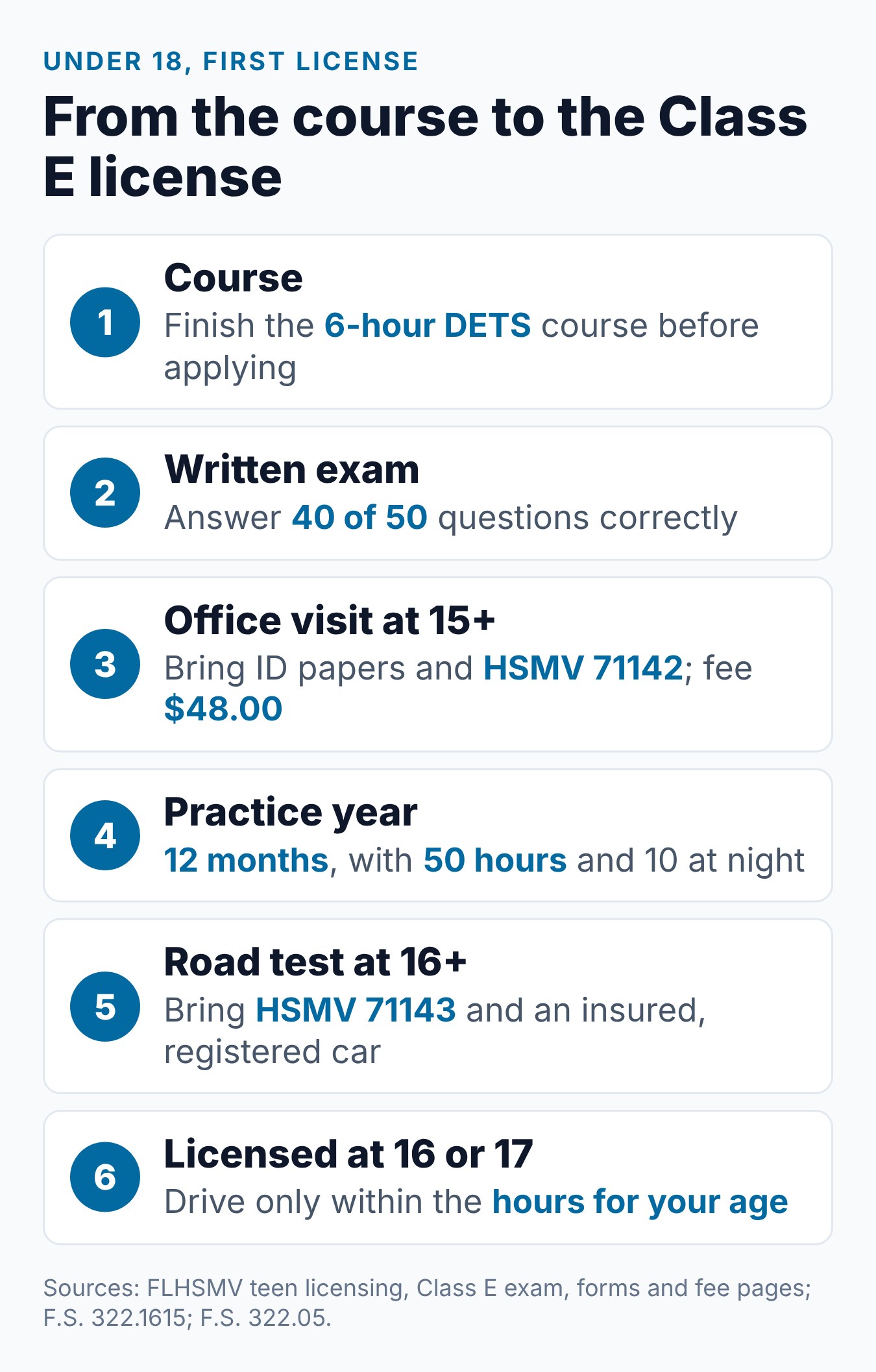
Here is how to get drivers license in Florida as a first-time driver under 18: finish a 6-hour DETS course, get a learner’s license at 15 or older, hold it for 12 months with 50 hours of supervised driving, then pass the driving skills test for a Class E license at 16 or older. At 18 or older, the course is the 4-hour TLSAE, and FLHSMV does not require the 12-month learner’s license period. The steps below are in order, and each one shows the test, form and fee that go with it.
Key Facts
- Step 1 is a course: first-time drivers under 18 finish a 6-hour DETS course before they apply. See the DETS course.
- Learner’s license at 15: pass the vision, hearing and knowledge exams. See the knowledge exam.
- Three forms: HSMV 71142, form 71144 and HSMV 71143 each belong to a different step. See what each step needs.
- 12 months and 50 hours: the practice period comes before the road test. See the learner’s license period.
- Class E license at 16: pass the driving skills test in a vehicle you bring. See the driving skills test.
- Fees: $48.00 for the original Class E license, which includes the learner’s license. See what it costs.
How to Get Drivers License in Florida: The Timeline
A teen’s first Florida license comes in two parts. First comes the learner’s license, which most people call a learner’s permit. Then comes the Class E driver license.
Florida’s agency for both is the Florida Department of Highway Safety and Motor Vehicles, or FLHSMV. Most driver license offices are run by county tax collectors.
The table below shows the six steps in order. The ages, forms and fees come from FLHSMV’s teen licensing page, its Required Forms for Teens page and its fee page.
| Step | What you do | Form for this step | Fee FLHSMV lists |
|---|---|---|---|
| 1 | Finish the 6-hour DETS course | None | Not on FLHSMV’s fee schedule |
| 2 | Pass the Class E Knowledge Exam | Form 71144, only if you test online | $10.00 only for a retest |
| 3 | Visit the office for the learner’s license, age 15 or older | HSMV 71142 | $48.00, plus a possible $6.25 service fee |
| 4 | Drive for 12 months and log 50 hours | None | None |
| 5 | Pass the Class E Driving Skills Test, age 16 or older | HSMV 71143 | $20.00 only for a retest |
| 6 | Drive within the hours for your age | None | None |
Each step has its own section below. The adult path is shorter, and it has its own section near the end.
Step 1: Finish the DETS Course
The first step is a course, not a test. DETS stands for Driver Education Traffic Safety.
FLHSMV’s DETS page states the rule. As of August 1, 2025, anyone under 18 who has never held a driver license from any other state, country or jurisdiction must complete a 6-hour DETS course before applying for a license in Florida.
The course can be taken in person or online. The same page says Driver Education Licensing Assistance Program (DELAP) courses offered by some county school boards may substitute for it, and it tells families to contact the local school board.
Two points keep this step simple:
- Finish it first. FLHSMV’s teen licensing page lists proof of DETS course completion as a requirement for the learner’s license.
- It is not the exam. Finishing the course does not replace the Class E Knowledge Exam in Step 2.
For a teen who wants to take this step online, Driving Logic has a page for its Florida DETS course, linked in the Conclusion.
Step 2: Pass the Class E Knowledge Exam
The knowledge exam is the written test for the learner’s license. Many people call it the permit test.
FLHSMV’s Class E Knowledge Exam and Driving Skills Test page describes it:
- 50 multiple-choice questions about Florida traffic laws, safe driving practices and traffic controls.
- 40 correct answers to pass, which is a score of 80 percent.
The law also requires a vision test and a hearing test for a learner’s license. That rule is in F.S. 322.1615.
Where a Teen Can Take the Exam
FLHSMV lists three ways to take the knowledge exam:
- In person, at a service center.
- Online, through an approved third-party administrator. This option is for applicants under 18.
- At school, in a high school driver education class that takes part in DELAP.
The online option comes with a form. The Parent/Guardian On-line Test Proctoring Form (form 71144) must be completed if the teen took the exam online through a third-party administrator.
It also comes with a catch. FLHSMV says a customer who passes through a third-party administrator may be randomly selected for a mandatory re-test, with no fee and no prior notice.
The Exams Are in English
FLHSMV announced in a news release on January 30, 2026 that all driver license knowledge and skills exams are given only in English from February 6, 2026, without interpreters.
Rules like this can change. Confirm with FLHSMV or your tax collector office before test day.
Our guide to the Florida permit test covers what is on the exam and how to study for it.
Step 3: Visit the Office for Your Learner’s License
A teen must be at least 15 years old to get a learner’s license. This is the step where the paperwork matters most.
Many people call this office the Florida DMV. The agency is FLHSMV, and the office is often your county tax collector.
Documents to Bring
FLHSMV’s What to Bring page for U.S. citizens lists three kinds of proof:
- Identity. An original primary identification document, such as a U.S. birth certificate or a valid U.S. passport.
- Social Security number. Proof of your Social Security number.
- Florida address. Two different proofs of your Florida residential address.
Other document lists apply to people who are not U.S. citizens. Our article on Florida learner’s permit documents goes through the accepted papers one by one.
The Parental Consent Form
An unmarried applicant under 18 needs one more paper. It is the Parental Consent for a Driver Application of a Minor, form HSMV 71142.
Three rules apply to it:
- One signer. One parent or legal guardian signs the form.
- A witness. The signature is notarized, or it is witnessed by a driver license examiner.
- Stepparents. A stepparent may not sign unless they have legally adopted the minor.
Our article on the Florida parental consent form explains who can sign and what the signer agrees to.
The Fee at This Step
FLHSMV’s fee page lists $48.00 for an original Class E license, and it says that amount includes the learner’s license. It also says an additional $6.25 service fee may apply in a tax collector office.
The fee schedule shows the learner’s license and the original Class E license as one $48.00 line, not two. Ask your office what is due at each visit.
Step 4: Drive With Your Learner’s License
This step takes the longest. It has driving rules and practice goals.
The Driving Rules
F.S. 322.1615 sets two rules for a learner’s license:
- A licensed driver beside you. You may drive only with a licensed driver who is at least 21 years old, in the closest seat to the right of the driver.
- Limited hours. You may drive in daylight hours only for the first 3 months. After that, you may drive until 10 p.m.
Our article on Florida learner’s permit restrictions covers these rules in detail.
The Practice Goals
FLHSMV’s teen licensing page and F.S. 322.05 list what must happen before the next step:
- Time. Hold the learner’s license for at least 12 months, or until your 18th birthday, whichever comes first.
- Hours. Complete 50 hours of supervised driving, and 10 of them must be at night.
- Record. Have no moving violation convictions. One moving violation is allowed if adjudication was withheld.
FLHSMV’s teen page links to a Practice Log Sheet for tracking driving time. Use it from the first drive, because an adult certifies the hours in Step 5.
Two of our articles go deeper here. One covers the Florida 50-hour driving requirement. The other covers the learner’s permit holding period.
Step 5: Pass the Driving Skills Test
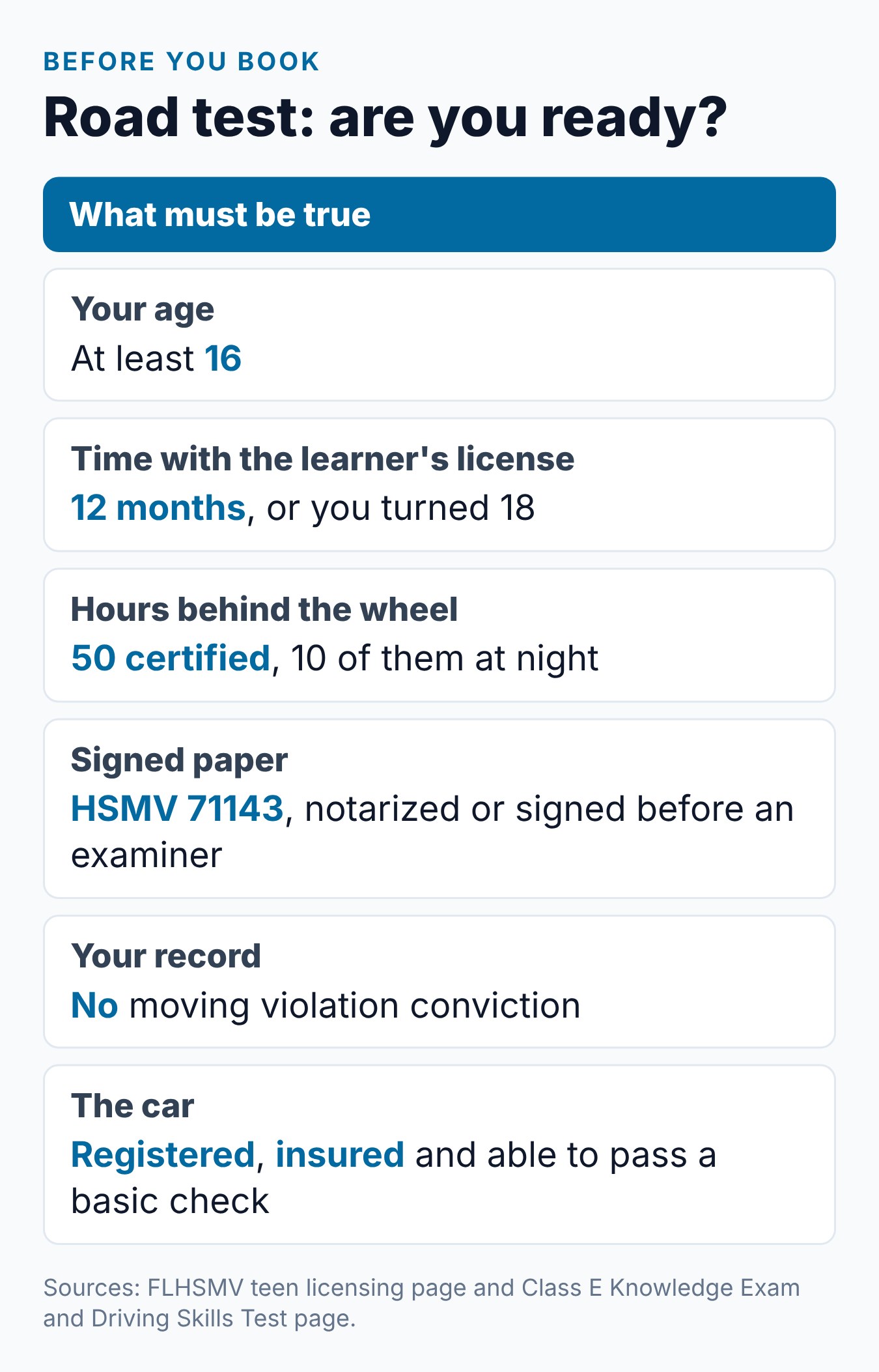
A teen must be at least 16 years old for the Class E license. Two things come first: a signed form and a vehicle for the test.
The Driving Experience Form
The form is the Certification of Driving Experience of a Minor, form HSMV 71143. It certifies the 50 hours, including the 10 at night.
One parent, legal guardian or other responsible adult who is 21 or older signs it. Like the consent form, it is notarized or witnessed by an examiner.
The Test and the Vehicle
The Class E Driving Skills Test is the road test. FLHSMV says it is a series of maneuvers used to determine an applicant’s ability to safely operate a motor vehicle.
You bring the vehicle. FLHSMV says it must have:
- A valid registration.
- Proof of insurance.
- A passing basic inspection by the driver license examiner.
FLHSMV also says no other passengers are permitted during the exam. Our article on the Florida drivers license test lists the maneuvers and the vehicle problems that stop a test.
After a passed test, FLHSMV says customers may surrender their learner’s license at a local service center to receive the Class E driver license.
Step 6: Drive Within the Hours for Your Age
A Class E license at 16 or 17 still has hour limits. FLHSMV’s teen licensing page lists them and cites F.S. 322.16:
- At 16: driving is allowed only between 6 a.m. and 11 p.m.
- At 17: driving is allowed only between 5 a.m. and 1 a.m.
Two exceptions apply at both ages. The limits do not apply when the teen is driving to or from work, or is with a licensed driver who is 21 or older.
Florida calls this system graduated driver licensing. Driving freedom grows in stages, from the learner’s license to the limited hours at 16 and 17. Our guide to the Florida graduated driver license explains each stage and curfew.
If You Are 18 or Older
The adult path uses a different course and skips the wait.
Under F.S. 322.095, each applicant for a driver license who is 18 or older must complete a traffic law and substance abuse education (TLSAE) course. The course has a minimum of 4 hours of content. The statute has two exceptions: a person who has been licensed in another jurisdiction, and a person who completed a Department of Education driver education course.
The timing is different too. FLHSMV says that to qualify for a driver license, a customer must hold the learner’s license for 12 months or must be 18 years old.
Our guide to the first-time Florida driver’s license for adults walks through the adult steps.
What the Whole Process Costs
FLHSMV’s fee page lists four amounts that matter for a first license:
- Original Class E license, including the learner’s license: $48.00.
- Tax collector service fee: $6.25, which may apply in a tax collector office.
- Knowledge exam retest: $10.00.
- Driving skills retest: $20.00.
A teen who passes both tests the first time pays no retest fee. The retest fees are set in F.S. 322.12.
The schedule lists retests only for the two exams. It has no separate line for a first try at the knowledge exam or the driving skills test.
This article lists the state fees on FLHSMV’s schedule only. It does not list course prices or third-party exam prices.
What We Found on FLHSMV’s Teen Pages
On November 26, 2026, we read three FLHSMV teen pages side by side: the teen licensing page, the Class E exam page and the Required Forms for Teens page. Here is what stood out:
- The pages do not name the same course. The teen licensing page lists proof of DETS completion for a learner’s license. The Class E exam page names only TLSAE and does not mention DETS.
- An online exam does not remove the office visit. The teen licensing page says vision and hearing testing is conducted in a service center.
- The three forms are signed the same way. Each is signed in front of a driver license examiner or notarized. Only the form and its purpose change from step to step.
- Documents may be asked for twice. The teen licensing page lists proof of identity, Social Security number and address again for the driver license, if those documents were not provided before.
- The language rule is now on the exam page. It says Class E knowledge examinations are available in English only, which matches the January 30, 2026 release.
The first finding can confuse a family. If the teen is under 18 and has never been licensed, follow the DETS page.
Common Mistakes to Avoid
Each of these mistakes comes from skipping one of the rules above:
- Taking the adult course. A first-time driver under 18 needs the 6-hour DETS course. TLSAE is the course for applicants 18 or older.
- Sending a stepparent to sign. A stepparent may not sign HSMV 71142 unless they have legally adopted the minor.
- Signing a form at home with no notary. The forms are notarized or signed in front of an examiner.
- Forgetting form 71144. It is required when the knowledge exam was taken online through a third-party administrator.
- Skipping the night hours. 10 of the 50 hours must be at night.
- Showing up without proof of insurance. The test vehicle needs a valid registration and proof of insurance.
- Planning on a translator. Exams are given in English only since February 6, 2026.
How Requirements Can Vary
Florida’s course and license rules apply statewide, but some details depend on where you live. Driver license services are often handled by your county tax collector’s office, and each office sets its own appointment process and hours. Some county school boards also offer driver education programs, such as DELAP courses, that can count instead of DETS.
FLHSMV can update course rules, forms, documents, and fees. Check FLHSMV and your county office for current requirements before your appointment.
Frequently Asked Questions
How old do you have to be to get a driver license in Florida?
You must be at least 15 for a learner’s license and at least 16 for a Class E driver license. A teen must also hold the learner’s license for 12 months, or reach age 18, before the Class E license.
What is the first step to get a Florida driver license as a teen?
The first step is the 6-hour DETS course. It is required for anyone under 18 who has never held a driver license from any other state, country or jurisdiction. The course comes before the application.
How many hours do I need to drive before my road test?
A teen needs 50 hours of supervised driving, and 10 of those hours must be at night. A parent, legal guardian or responsible adult who is 21 or older certifies the hours on form HSMV 71143.
How much does a first Florida driver license cost?
FLHSMV lists $48.00 for an original Class E license, which includes the learner’s license. A $6.25 service fee may apply in a tax collector office. Retests cost $10.00 for the knowledge exam and $20.00 for the driving skills test.
Can I take the knowledge exam online?
Yes, if you are under 18. Approved third-party administrators give the exam online, and form 71144 is then required. You may also be randomly selected for a no-fee re-test at the office.
Do I need my parent at the license office?
Not always. A parent or legal guardian can sign HSMV 71142 in front of a driver license examiner, or sign it before a notary ahead of time. FLHSMV’s forms page says a form is notarized when the parent or guardian will not be present.
Do adults follow the same steps?
No. A first-time driver who is 18 or older takes the 4-hour TLSAE course, and FLHSMV does not require the 12-month learner’s license period at 18. Our adult guide covers that path.
Conclusion
A teen’s first Florida license follows six steps: the DETS course, the knowledge exam, the office visit for a learner’s license, 12 months of practice with 50 hours, the driving skills test and then driving within the hours for your age. Keep the three forms straight, and confirm documents and appointments with your tax collector office. The whole path starts with the course. To see that first step, visit Driving Logic’s online Florida DETS course page.
Related Articles
- Florida Learner’s Permit: How to Get It, Requirements, and What It Allows
- Florida Graduated Driver License (GDL): The Three Stages for Teen Drivers
- How to Get a Florida Learner’s Permit Step by Step
- First-Time Florida Driver’s License for Adults: The Complete Process
- Florida 50-Hour Driving Requirement: What Teens Need Before Getting a License
- What Do I Need to Get a Florida Drivers License? By Age
Sources
- FLHSMV — Driver Education Traffic Safety (DETS)
- FLHSMV — Licensing Requirements for Teens, Graduated Driver License Laws and Driving Curfews
- FLHSMV — Class E Knowledge Exam and Driving Skills Test
- FLHSMV — Required Forms for Teens
- FLHSMV — What to Bring, U.S. Citizen
- FLHSMV — Driver License and ID Card Fees
- FLHSMV — Parental Consent Form HSMV 71142
- FLHSMV — Certification of Driving Experience of a Minor, HSMV 71143
- FLHSMV — News release, January 30, 2026: driver license exams in English only
- Florida Statutes — F.S. 322.1615 (DETS)
- Florida Statutes — F.S. 322.05 (Persons not to be licensed)
- Florida Statutes — F.S. 322.095 (TLSAE)
- Florida Statutes — F.S. 322.12 (Examination of applicants)
- FLHSMV — Driver Education Courses
- FLHSMV — TLSAE Course Provider List
Billy Forte is the owner of Driving Logic, a state-approved driver improvement course provider serving Florida and other U.S. states.
This article is general information, not legal advice. Florida licensing requirements, course rules, documents, and fees are set by FLHSMV and Florida law and can change. Use official FLHSMV and Florida statute sources for current requirements before you enroll in a course or visit a driver license office.