
Updated October 2026 · Reviewed by Billy Forte
The Florida learner’s permit holding period is 12 months from the day the permit is issued, or until your 18th birthday if that comes first. You also need to be at least 16, log 50 hours of supervised driving and avoid moving violation convictions before you can get a Class E license. Adults 18 and older don’t need a permit, so no holding period applies to them.
Key Facts
- The rule: Hold the permit 12 months or until 18, whichever comes first. See the rule.
- The clock starts: On the issue date of the permit, not the day you finished DETS or the knowledge exam. See when it starts.
- Earliest license: Permit at 15 means a license at 16 at the earliest. See timing examples.
- What can delay it: A moving violation conviction can mean waiting one year from the conviction date. See delays.
- Adults: No permit and no holding period are required at 18 or older. See the adult rule.
The Florida Learner’s Permit Holding Period Rule
FLHSMV’s teen licensing page says a teen must hold the learner’s license for 12 months, or until 18 if that comes first, before getting a Class E license.
The holding period is one of four conditions that must all be true. The others are being at least 16, having 50 supervised hours certified and having a clean driving record for the year.
Think of the holding period as the minimum, not the target. If the hours or the record aren’t ready, the license waits even after 12 months pass.
Why Florida Has a Holding Period
The holding period is part of Florida’s graduated driver license (GDL) system. It gives a new driver a full year of supervised practice across seasons, weather and daylight changes before driving alone.
It also gives parents time to see how a teen handles different roads. The 50-hour certification at the end is the parent’s sign-off that the practice happened.
When the Clock Starts
The 12 months start on the date the permit is issued. That date is printed on your learner’s license.
These steps do not start the clock:
- Finishing the DETS course
- Passing the knowledge exam online
- Booking your office visit
So a teen who passes everything at 14 and a half still waits until the permit is issued at 15 or later. That’s why many families book the office visit for the 15th birthday or soon after.
Timing Examples by Age
Your age on the issue date decides your earliest license date. These examples assume no violations and that the 50 hours are done on time.
| Age when the permit is issued | Earliest Class E license | Why |
|---|---|---|
| 15 years, 0 months | 16 years, 0 months | 12 months pass and you reach 16 at the same time |
| 15 years, 6 months | 16 years, 6 months | You must hold the permit the full 12 months |
| 16 years, 3 months | 17 years, 3 months | 12 months is the limit, since 18 is further away |
| 17 years, 6 months | 18 years, 0 months | Turning 18 ends the holding period early |
| 17 years, 11 months | 18 years, 0 months | Turning 18 ends it after 1 month |
The last two rows show the “whichever comes first” part. A teen who gets a permit in the second half of age 17 doesn’t wait a full year, because their 18th birthday comes first. The first row is the fastest path for most teens, which is why many families aim to have the permit issued right at 15.
What Must Happen During the Holding Period
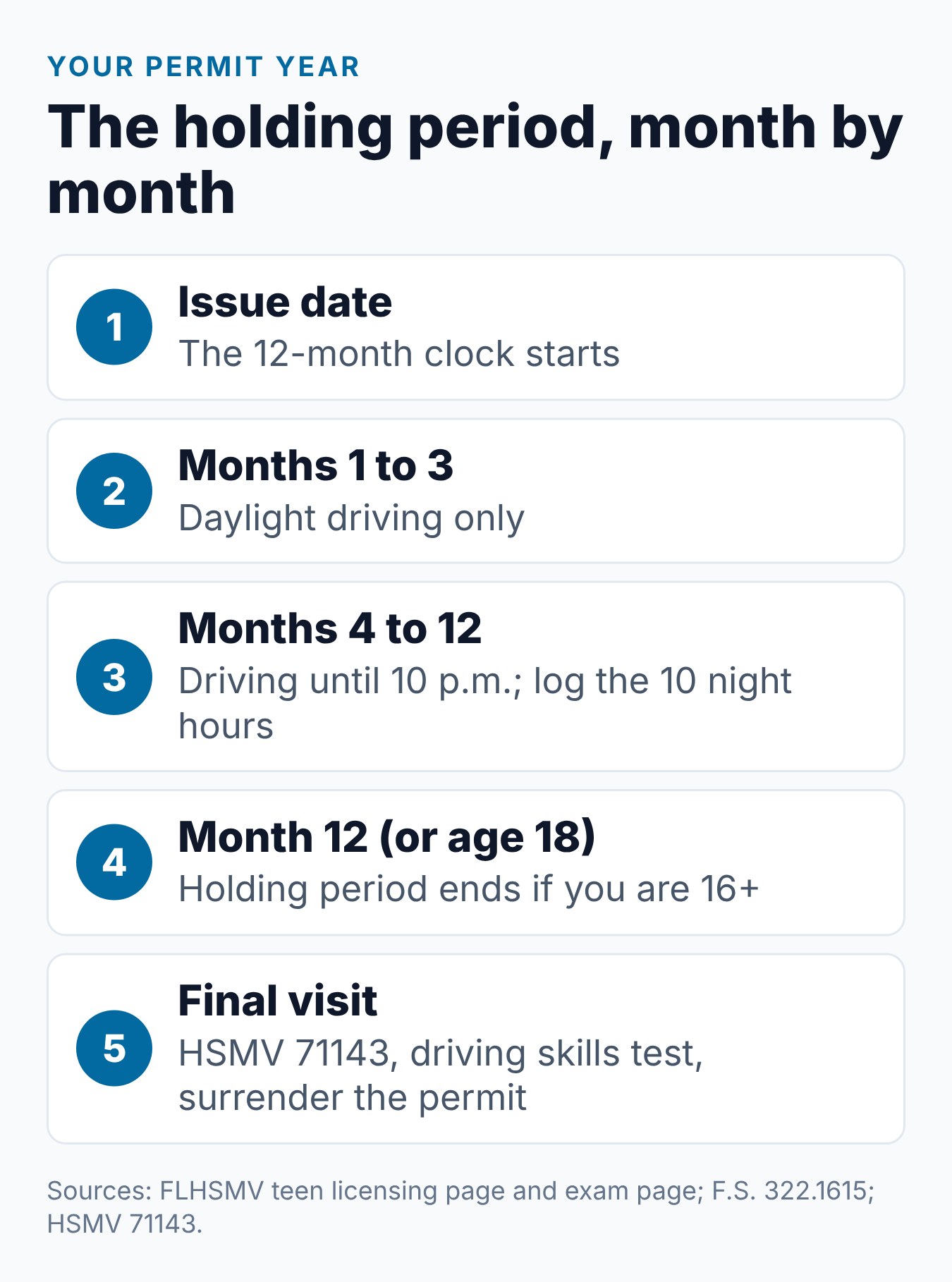
The holding period is your practice year. Three things need to happen before it ends.
50 Hours of Supervised Driving
Teens need at least 50 hours behind the wheel with a licensed driver 21 or older, including 10 at night. A parent, guardian or responsible adult signs HSMV 71143 to certify them.
The form says the hours were driven “during the past 12 months.” Because the first 3 months are daylight only, night hours have to come later. Our 50-hour guide explains how to track them.
A Clean Driving Record
FLHSMV requires no moving violation convictions for one year from the date the permit was issued. One conviction is allowed if adjudication was withheld.
Following the Permit Rules
The supervision and hour limits stay in force the whole time. Breaking them is a moving violation, which can reset your timeline. See our restrictions guide.
What the Holding Period Does Not Require
FLHSMV’s teen page doesn’t list paid driving lessons as a requirement. A parent or any licensed driver 21 or older can supervise all 50 hours.
There’s also no second course during the permit year. DETS is taken once, before the permit. Professional lessons can still help, but they are a choice, not a rule.
What Can Push Your Date Back
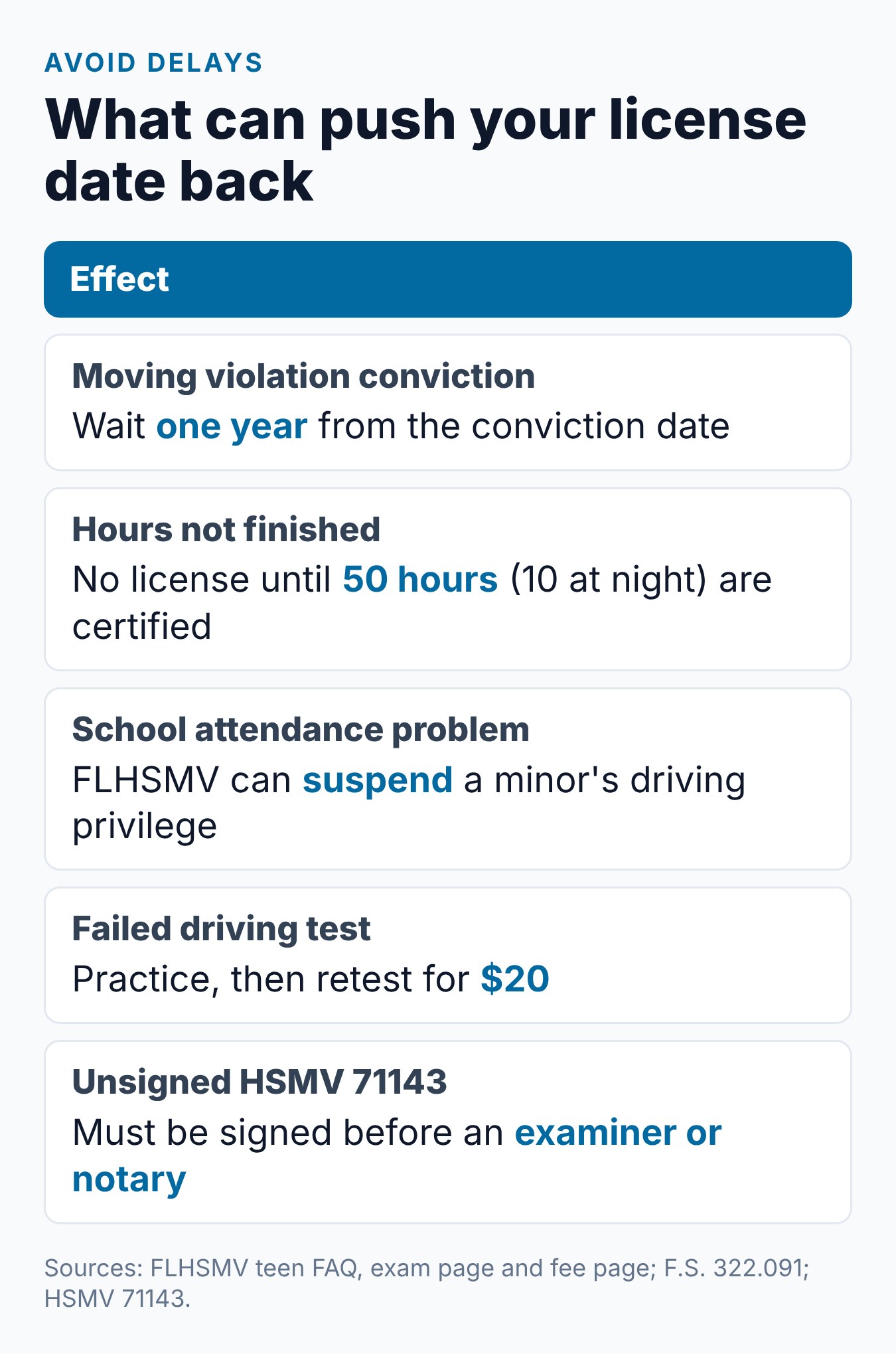
Most delays come from one of these. Each is based on FLHSMV’s rules.
- A moving violation conviction. FLHSMV’s teen FAQ says anyone convicted of a moving violation must wait one year from the conviction date before getting a driver license.
- Hours not finished. The license can’t be issued until the 50 hours, including 10 at night, are certified.
- School attendance problems. Under F.S. 322.091, FLHSMV can suspend a minor’s driving privilege for not meeting attendance rules.
- A failed driving test. FLHSMV says you must study or practice before you retest, and the retest fee is $20.
The conviction rule is the costly one. A conviction in month 10 means waiting one year from that date, so the license could come about 10 months later than planned.
How Withheld Adjudication Works Here
“Adjudication withheld” means the court did not enter a formal conviction, even though a penalty may still apply. FLHSMV allows one moving violation with adjudication withheld during the permit year.
A second one, or any actual conviction, changes the timeline. If you get a ticket, read the court paperwork carefully and keep a copy.
A Month-by-Month Plan for Parents
A little planning keeps the permit year on track. These checkpoints line up with FLHSMV’s rules.
- Day 1: Note the issue date on the permit. Mark the 3-month and 12-month dates on a calendar.
- Months 1 to 3: Daylight practice only. Start the driving log on the first drive.
- Month 4: Night practice can begin, until 10 p.m. Start working toward the 10 night hours.
- Month 6: Check the log. About half of the 50 hours is a good pace.
- Month 10 or 11: Look up your county’s road test booking rules, since slots can fill up.
- Month 12: Sign HSMV 71143 before a notary, or plan for the adult to come to the test.
Pacing matters more than speed. Fifty hours spread over a year is about one hour a week.
Booking the Driving Skills Test
Road tests are scheduled through your county office. The Lee County Tax Collector, for example, offers road tests by appointment only and opens slots on a 30-day rolling basis.
Lee County also notes that driving tests can be taken at FLHSMV-approved third-party testing locations for an extra fee. For a teen under 18, a responsible adult 21 or older must attend the test, or bring HSMV 71143 already notarized.
Book early enough that the test date lands right after your 12-month mark. Booking too early won’t work, because you can’t take the test before the holding period ends.
Reaching the End of the Holding Period
When your 12 months pass (or you turn 18), you are ready for the last steps. FLHSMV’s exam page says you can take the Class E driving skills test once you have held the permit 12 months or are 18.
Here is what to bring for the license:
- Your learner’s license, which you surrender for the Class E license
- HSMV 71143, signed before an examiner or notarized
- A test vehicle with valid registration and proof of insurance that passes a basic inspection
FLHSMV’s FAQ says there’s no fee to move up if you surrender the learner’s license with no name or address change. After that, a 16- or 17-year-old still has overnight hour limits until 18. See our Florida GDL guide.
Teens Moving to Florida With a Permit
FLHSMV’s public pages don’t say whether time held on another state’s learner’s permit counts toward Florida’s 12 months. They also don’t say whether an out-of-state permit can be transferred.
If your teen holds a permit from another state, call your county tax collector before the visit and ask how they handle it. A teen with a valid out-of-state driver license (not a permit) follows the transfer process instead. See our new Florida resident license guide.
Adults and the Holding Period
Adults 18 and older don’t have a holding period. The Palm Beach County Tax Collector says adults are not required to get a learner’s license at all.
Some adults still get a permit to practice. If you do, the supervision and hour rules apply, but you can take the driving test whenever you are ready, because FLHSMV allows the test at 18.
Common Holding Period Mistakes
These come straight from the official rules.
- Counting from the exam date. The clock starts on the permit’s issue date.
- Assuming 12 months is automatic. The hours and the record also have to be in order.
- Waiting until month 11 for night hours. Night practice can start in month 4, so spread it out.
- Treating a ticket as minor. A conviction can add up to a year.
- Forgetting the notary. HSMV 71143 must be signed before an examiner or a notary.
How Requirements Can Vary
Florida’s course and license rules apply statewide, but some details depend on where you live. Driver license services are often handled by your county tax collector’s office, and each office sets its own appointment process and hours. Some county school boards also offer driver education programs, such as DELAP courses, that can count instead of DETS.
FLHSMV can update course rules, forms, documents, and fees. Check FLHSMV and your county office for current requirements before your appointment.
Frequently Asked Questions
How long do you have to hold a learner’s permit in Florida?
12 months from the issue date, or until your 18th birthday if that comes first. You also need 50 supervised hours and a clean record.
Can I get my license at 16 if I got my permit at 15 and a half?
No. You must hold the permit 12 months, so the earliest date is 16 and a half.
What if I turn 18 before 12 months pass?
The holding period ends at 18. FLHSMV lets you take the driving skills test once you are 18.
Does a ticket reset the holding period?
A moving violation conviction means waiting one year from the conviction date before you can get a license. One violation with adjudication withheld is allowed.
Do adults have a holding period in Florida?
No. Adults 18 and older don’t need a learner’s permit, so there is no holding period.
When does the 12-month holding period start?
On the day the permit is issued. Finishing DETS or the knowledge exam does not start it.
Can I take the road test before my 12 months are up?
No, unless you turn 18 first. FLHSMV’s exam page says you must hold the permit 12 months or be 18 to take the driving skills test.
Conclusion
The Florida learner’s permit holding period is 12 months from the issue date, or until 18 if that comes first.
Use that year to log 50 hours, including 10 at night after month 3, and keep your record clean. A single conviction can add up to a year to your wait. Our online Florida DETS course is coming soon.
Related Articles
- Florida Learner’s Permit: How to Get It, Requirements, and What It Allows
- Florida 50-Hour Driving Requirement: What Teens Need Before Getting a License
- Florida Graduated Driver License (GDL): The Three Stages for Teen Drivers
- Florida Learner’s Permit Restrictions: What Teens Can and Can’t Do
Sources
- FLHSMV — Teen Licensing Requirements and Graduated Driver License Laws
- FLHSMV — Class E Knowledge Exam and Driving Skills Test
- FLHSMV — Teen Licensing Frequently Asked Questions
- FLHSMV — Certification of Driving Experience of a Minor, HSMV 71143
- Florida Statutes — F.S. 322.1615 (Learner’s Driver License)
- Florida Statutes — F.S. 322.091 (Attendance Requirements)
- Palm Beach County Tax Collector — New Drivers Aged 18 or Older
- FLHSMV — Driver License and ID Card Fees
Billy Forte is the owner of Driving Logic, a state-approved driver improvement course provider serving Florida and other U.S. states.
This article is general information, not legal advice. Florida licensing requirements, course rules, documents, and fees are set by FLHSMV and Florida law and can change. Use official FLHSMV and Florida statute sources for current requirements before you enroll in a course or visit a driver license office.