
Updated October 2026 · Reviewed by Billy Forte
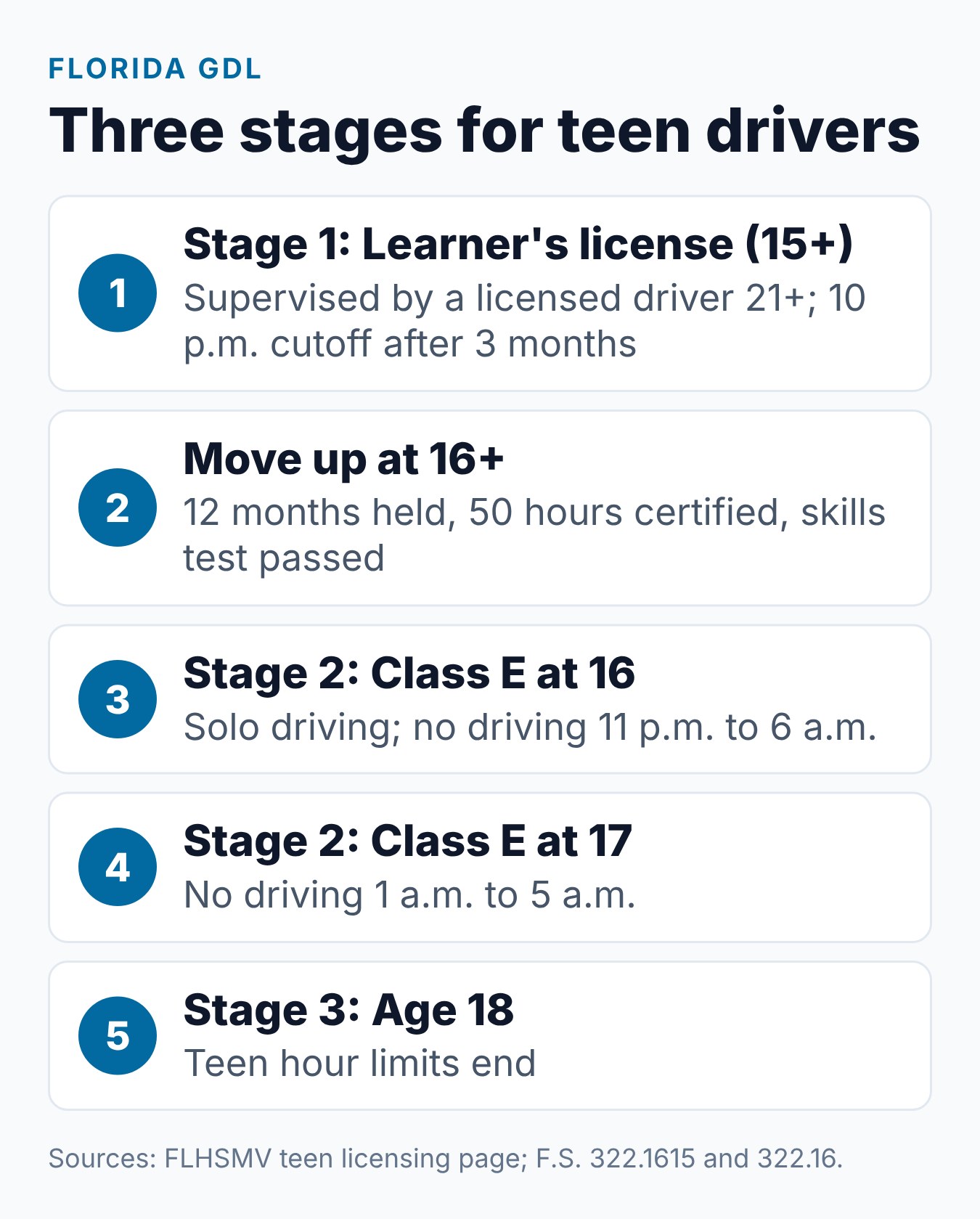
Florida’s graduated driver license (GDL) system gives teens driving privileges in three stages: a learner’s license at 15, a Class E license with hour limits at 16 and 17, and full privileges at 18. Each stage has its own rules, set by FLHSMV and Florida law. The Florida graduated driver license rules cover supervision and driving hours, but not passengers or phones.
Key Facts
- Stage 1: A learner’s license at 15+ with a licensed driver 21+ always in the front seat. See stage 1.
- Stage 2: A Class E license at 16 or 17 with overnight hour limits. See stage 2.
- Stage 3: At 18, the teen hour limits end. See stage 3.
- Not in the law: No teen passenger limit and no teen-only phone rule. See what GDL doesn’t cover.
- Points matter: Six or more points in 12 months can restrict a teen to business-purpose driving. See the points rule.
How the Florida Graduated Driver License System Works
A graduated system gives new drivers more freedom as they gain experience. Florida’s version moves teens from supervised practice to limited solo driving and then to full privileges.
FLHSMV’s teen licensing page lists the rules for each stage. The main laws are F.S. 322.1615 for the learner’s license and F.S. 322.16 for the hour limits on licensed teens.
People also call it the Florida GDL program. Families sometimes say “teen curfew” for the stage 2 hour limits, though the law describes them as license restrictions.
Why Florida Uses a Graduated System
Driving well takes practice that a test can’t fully measure. A graduated system lets teens gain that practice in steps, with the most supervision at the start.
Each stage adds freedom only after the teen meets the rules of the one before. That’s why the stages connect: hours, a clean record and time held all carry forward.
Stage 1: Learner’s License
The first stage starts at 15. Before the learner’s license is issued, the teen finishes DETS (or an approved school course), passes the knowledge, vision and hearing tests and brings a signed HSMV 71142. Our learner’s permit guide covers each requirement.
The learner’s license has three driving rules:
- A licensed driver 21 or older sits in the front passenger seat at all times.
- Daylight driving only for the first 3 months.
- After that, driving is allowed until 10 p.m.
See our restrictions guide for common situations. Stage 1 lasts at least 12 months, or until 18, and includes 50 hours of supervised driving with 10 at night.
Stage 2: Class E License at 16 and 17
The second stage is a full Class E license with hour limits. It’s the first time a teen can drive alone.
Requirements to Move Up
FLHSMV lists these requirements for a Class E license at 16 or 17:
- Be at least 16.
- Hold the learner’s license 12 months, or until 18.
- Have 50 hours of driving, 10 at night, certified on HSMV 71143.
- Have no moving violation convictions for one year from the learner’s license issue date. One is allowed if adjudication was withheld.
- Pass the Class E driving skills test.
Our holding period guide and 50-hour guide explain items 2 and 3 in detail.
The Driving Skills Test
FLHSMV’s exam page lists what the examiner checks. It includes a three-point turn, straight-in parking, parking on a grade, stopping quickly, backing 50 feet and keeping at least a four-second following distance.
You bring your own vehicle. It needs valid registration and proof of insurance, and it must pass a basic inspection. No other passengers may ride along unless an interpreter is needed.
Hour Limits at 16 and 17
F.S. 322.16 sets overnight limits for licensed teens. They differ by age.
| Age 16 | Age 17 | |
|---|---|---|
| No driving between | 11 p.m. and 6 a.m. | 1 a.m. and 5 a.m. |
| Allowed driving window | 6 a.m. to 11 p.m. | 5 a.m. to 1 a.m. |
| Exception 1 | A licensed driver 21+ is in the car | A licensed driver 21+ is in the car |
| Exception 2 | Driving directly to or from work | Driving directly to or from work |
| Penalty | Moving violation, fined under chapter 318 | Moving violation, fined under chapter 318 |
The work exception says “directly” to or from work. A stop at a friend’s house on the way home is not part of that exception. The exception also doesn’t cover school events, sports practice or social plans, so those trips need to fit inside the allowed hours or include a licensed driver 21+.
Stage 3: Full Privileges at 18
The teen hour limits in F.S. 322.16 apply to licensed drivers under 18. On the 18th birthday, they no longer apply.
The license itself doesn’t change class. It’s still a Class E license, now without the teen hour limits. School attendance rules under F.S. 322.091 also apply only to minors.
The points rule in F.S. 322.161 is for drivers 15 through 17 too. After 18, the regular point system still applies, so a clean record keeps mattering. Full privileges mean no teen limits, not a fresh start on tickets already on the record.
Adults who get a first license at 18 or older skip stages 1 and 2. They take TLSAE and the tests, with no permit or holding period required. See our adult first-license guide.
One Teen’s Path Through the Stages
Here is how the stages line up for a teen who moves as fast as the rules allow. The dates are an example only.
- 15th birthday: Learner’s license issued, after DETS and the tests.
- Months 1 to 3: Daylight driving only, with a licensed driver 21+.
- Months 4 to 12: Driving until 10 p.m.; night hours logged.
- 16th birthday: Class E license after the skills test, with no driving 11 p.m. to 6 a.m. (with the two exceptions).
- 17th birthday: The limit shrinks to 1 a.m. to 5 a.m.
- 18th birthday: Teen hour limits end.
A teen who starts later moves through the same stages. Stage 1 still lasts 12 months unless the teen turns 18 first.
What Parents Can Do at Each Stage
The law sets the minimum rules. Parents can add their own house rules on top, and many do.
- Stage 1: Supervise or arrange a qualified 21+ supervisor, keep the driving log and plan night practice for month 4 and later.
- Stage 2: Learn the hour limits for your teen’s age. Talk about passengers and phones, since the law leaves those choices to families.
- Stage 3: Keep talking about safe habits. Points and tickets still affect an 18-year-old’s record.
A written family driving agreement is one way to set expectations. It’s a family choice, not a legal requirement.
Teens Who Move to Florida
A teen with a valid license from another state transfers it at a Florida driver license office. They don’t take DETS. See our new resident guide.
The F.S. 322.16 hour limits apply to any licensed driver under 18, including teens who just moved here. Ask your county office what else applies to an under-18 transfer.
What Florida’s GDL Law Does Not Include
Many websites list teen rules that Florida doesn’t have. Florida’s GDL laws set supervision and hour rules only.
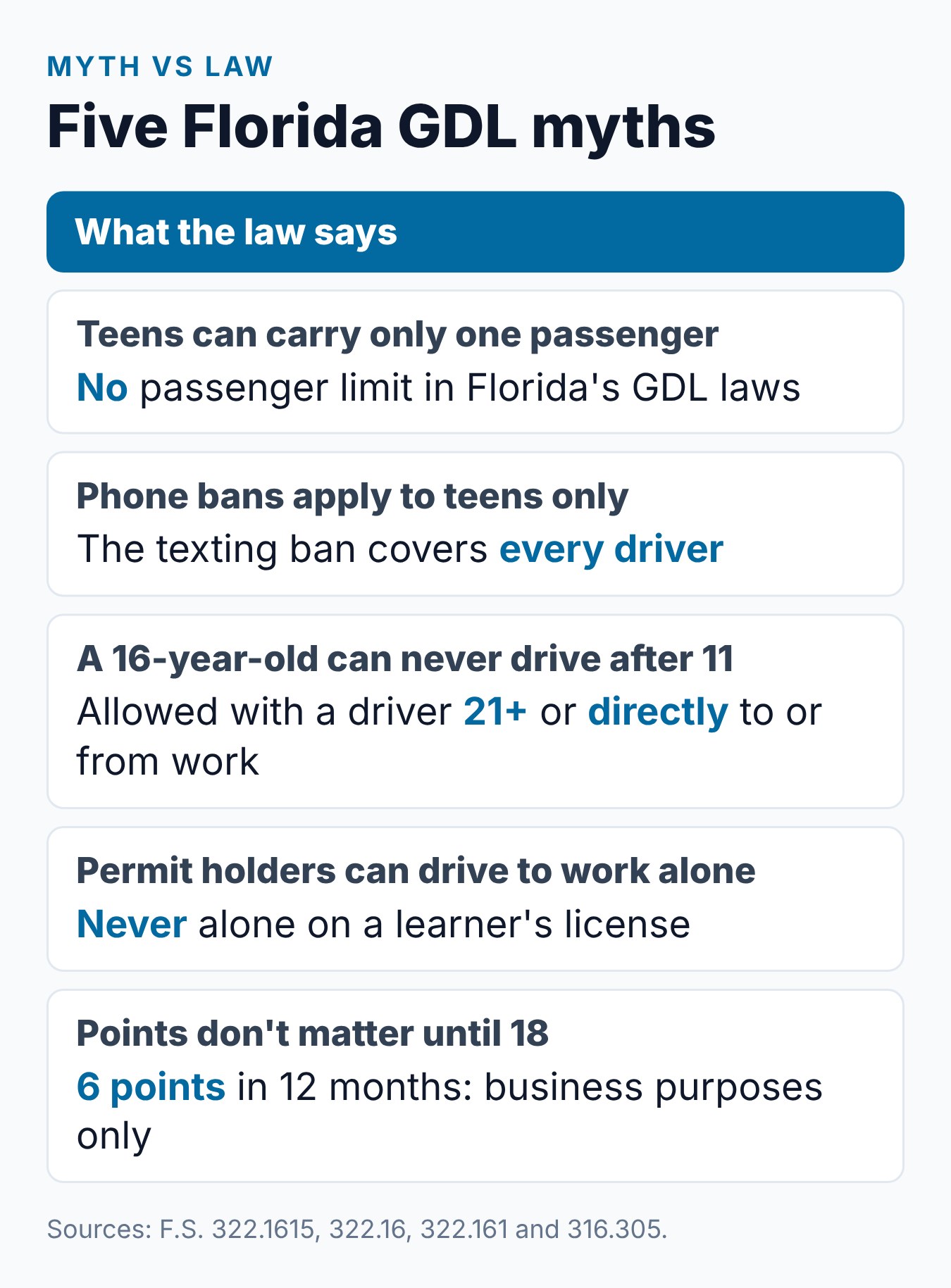
- No teen passenger limit. Neither F.S. 322.1615 nor F.S. 322.16 limits how many passengers a teen may carry.
- No teen-only phone rule. The GDL laws don’t set a phone rule for teens only.
Other laws still apply to every driver, teens included. Florida’s texting law, F.S. 316.305, bans typing or reading messages on a handheld device while driving. Florida’s seat belt law, F.S. 316.614, requires the driver and every passenger under 18 to buckle up.
Points and Teen Drivers
Florida has one more rule just for young licensed drivers. Under F.S. 322.161, a Class E licensee age 15 through 17 who gets six or more points within 12 months is restricted to a license for business purposes only. Parking tickets don’t count toward those points.
The teen must appear before FLHSMV within 10 days of the notice. The restriction is lifted after 1 year if no more points are added, and each new point adds 90 days. It also ends at 18 if there are no other grounds for it.
A business-purposes-only license limits driving to things like work and school. For a teen, that can mean losing most everyday driving.
School Attendance Through 18
Under F.S. 322.091, a minor’s driving privilege depends on meeting school attendance rules, or having a diploma or another listed exemption. This applies in stages 1 and 2.
If FLHSMV is told a teen isn’t in compliance, it sends a notice of intent to suspend. The family has 15 days to show proof or ask for a hardship hearing.
Common GDL Mistakes
These come straight from the official rules.
- Mixing up the stages. The 10 p.m. permit cutoff is not the same as the 11 p.m. limit for a licensed 16-year-old.
- Thinking the work exception applies to permits. It’s only for licensed 16- and 17-year-olds.
- Treating a detour as “to or from work.” The law says directly.
- Believing passenger limits are the law. Florida’s GDL laws don’t set one.
- Ignoring points. Six points in 12 months can restrict a teen to business purposes only.
How Requirements Can Vary
Florida’s course and license rules apply statewide, but some details depend on where you live. Driver license services are often handled by your county tax collector’s office, and each office sets its own appointment process and hours. Some county school boards also offer driver education programs, such as DELAP courses, that can count instead of DETS.
FLHSMV can update course rules, forms, documents, and fees. Check FLHSMV and your county office for current requirements before your appointment.
Frequently Asked Questions
What is the Florida graduated driver license program?
It’s a three-stage system for teen drivers: a learner’s license at 15, a Class E license with hour limits at 16 and 17, and full privileges at 18.
What time can a 16-year-old drive in Florida?
A licensed 16-year-old may drive from 6 a.m. to 11 p.m. Outside those hours, they need a licensed driver 21+ in the car or must be driving directly to or from work.
What time can a 17-year-old drive in Florida?
A licensed 17-year-old may not drive from 1 a.m. to 5 a.m. unless a licensed driver 21+ is along or they are driving directly to or from work.
Does Florida limit teen passengers?
No. Florida’s GDL laws don’t set a teen passenger limit. Every passenger under 18 must still wear a seat belt.
Can a 16-year-old drive to work after 11 p.m. in Florida?
Yes, if they are driving directly to or from work. A stop along the way isn’t covered.
What happens if a teen breaks the GDL hour limits?
F.S. 322.16 says the teen is charged with a moving violation and fined under chapter 318. Points from tickets can add up to a business-purposes-only restriction.
When do GDL restrictions end in Florida?
At 18. The teen hour limits in F.S. 322.16 apply only to licensed drivers under 18.
Do Florida GDL rules apply to adults?
Not the teen parts. Adults 18 and older don’t need a learner’s license, and the overnight hour limits in F.S. 322.16 apply only to drivers under 18.
Conclusion
Florida’s graduated driver license system moves teens through three stages: a supervised learner’s license, a Class E license with overnight limits at 16 and 17, and full privileges at 18.
Know the hour limits for each age, use the work exception only for direct trips and keep points off the record. The law sets no teen passenger limit or teen-only phone rule, but safety laws for all drivers still apply. Our online Florida DETS course is coming soon.
Related Articles
- Florida Learner’s Permit: How to Get It, Requirements, and What It Allows
- Florida Learner’s Permit Restrictions: What Teens Can and Can’t Do
- Florida Learner’s Permit Holding Period: How Long Before a License?
- Florida 50-Hour Driving Requirement: What Teens Need Before Getting a License
Sources
- FLHSMV — Teen Licensing Requirements and Graduated Driver License Laws
- Florida Statutes — F.S. 322.1615 (Learner’s Driver License)
- Florida Statutes — F.S. 322.16 (License Restrictions)
- FLHSMV — Class E Knowledge Exam and Driving Skills Test
- FLHSMV — Teen Licensing Frequently Asked Questions
- Florida Statutes — F.S. 322.091 (Attendance Requirements)
- FLHSMV — Certification of Driving Experience of a Minor, HSMV 71143
- Lee County Tax Collector — First Time Drivers
Billy Forte is the owner of Driving Logic, a state-approved driver improvement course provider serving Florida and other U.S. states.
This article is general information, not legal advice. Florida licensing requirements, course rules, documents, and fees are set by FLHSMV and Florida law and can change. Use official FLHSMV and Florida statute sources for current requirements before you enroll in a course or visit a driver license office.