
Updated October 2026 · Reviewed by Billy Forte
The Florida learner’s permit documents you need are one proof of identity, one proof of your Social Security number and two proofs of your Florida home address. Teens under 18 also need a signed parent consent form (HSMV 71142) and must meet school attendance rules. Bring originals or certified copies, because FLHSMV turns away photocopies for some items.
Key Facts
- Identity: A certified U.S. birth certificate or a valid U.S. passport is most common. Hospital certificates are not accepted. See identity documents.
- Social Security: Your card, a W-2, a pay stub or a 1099 with your full number. See Social Security proof.
- Address: Two Florida address proofs. A teen can use a parent’s with form HSMV 71120. See address proofs.
- Teen extras: HSMV 71142, signed before an examiner or notarized, and school attendance compliance. See teen forms.
- Biggest risk: Copies where a certified record is needed, and names that don’t match. See common mistakes.
Your Florida Learner’s Permit Documents Checklist
Most people call this the list of what to bring to the Florida DMV for a learners permit. In Florida, the licensing agency is FLHSMV, and county tax collectors run most offices.
Here is everything in one place. The sections below explain what counts for each item.
- One proof of identity (original or certified)
- One proof of your Social Security number
- Two proofs of your Florida home address
- HSMV 71142, if you are under 18 and unmarried
- Proof of school attendance compliance, if your county asks for it
- A copy of your DETS certificate, as a backup
- HSMV 71144, if you took the knowledge exam online and your parent won’t come to the office
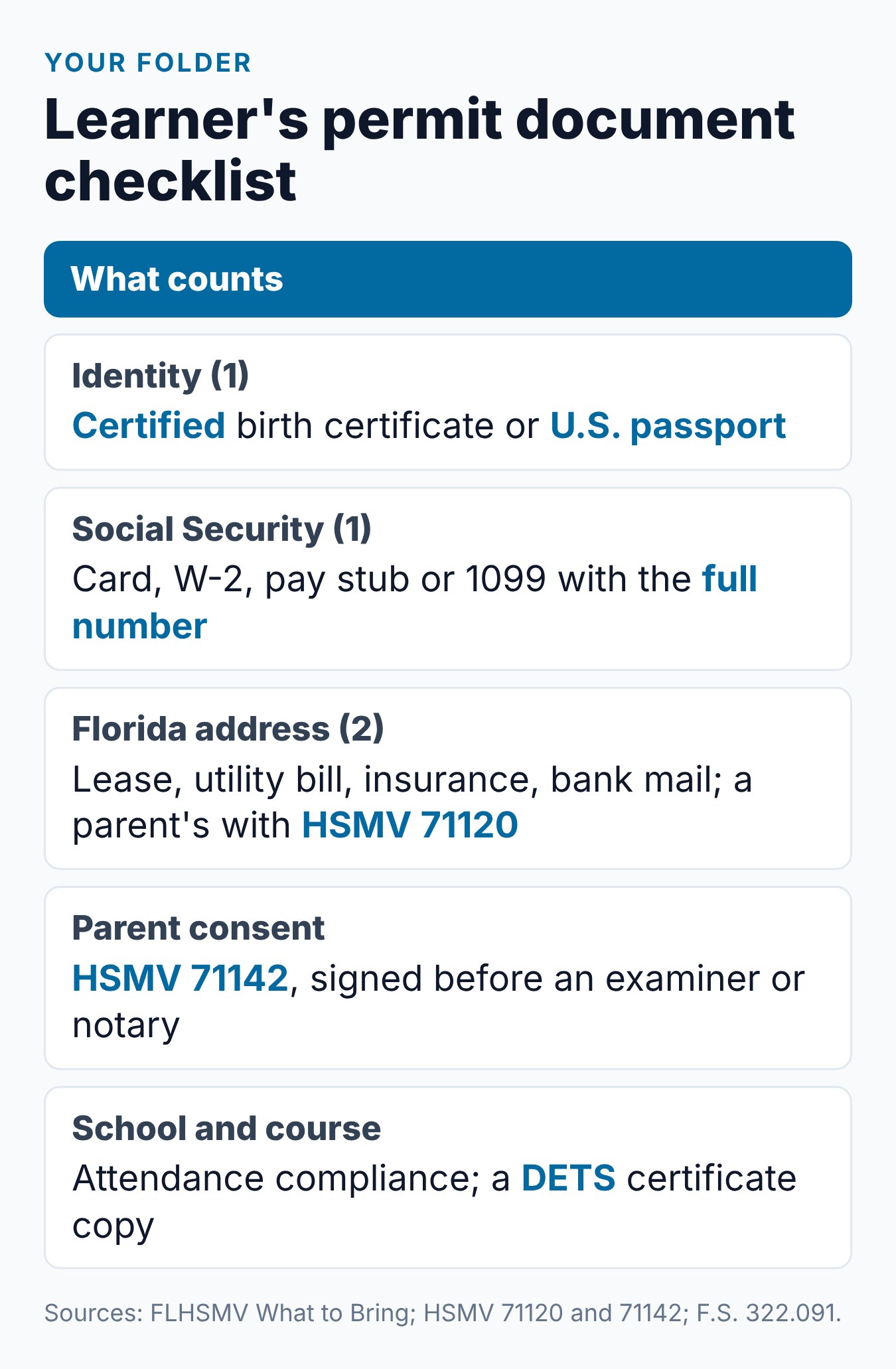
These lists come from FLHSMV’s What to Bring page for U.S. citizens. Non-citizens use a different list on the same FLHSMV site, so pick the page that fits your status.
Proof of Identity
You need one primary document with your full legal name. FLHSMV accepts these for U.S. citizens:
- A U.S. birth certificate, including some U.S. territories and the District of Columbia
- A valid U.S. passport or passport card
- A Consular Report of Birth Abroad
- A Certificate of Naturalization (N-550 or N-570)
- A Certificate of Citizenship (N-560 or N-561)
The birth certificate must be issued by a county health department or a state Bureau of Vital Statistics. FLHSMV says a hospital birth certificate is not a certified document and won’t be accepted.
Puerto Rico birth certificates must have an issue date after July 1, 2010. If yours is older, request a new one before your visit.
How to Get a Certified Birth Certificate
If you only have a hospital copy, order a certified copy before you book the visit. For a Florida birth, that comes from a county health department or Florida’s Bureau of Vital Statistics.
For a birth in another state, order it from that state’s vital records office. Allow time for mail delivery, since a missing birth certificate is one of the few problems you can’t fix at the counter.
Proof of Social Security Number
Bring one original document that shows your full name and full Social Security number. FLHSMV lists these:
- Your Social Security card, with your current name
- A W-2 form that is not handwritten
- A pay check or pay stub
- An SSA-1099
- Any 1099 that is not handwritten
Most teens use their Social Security card. A teen with a job can also use a printed pay stub that shows the full number. If it’s lost, ask the Social Security Administration for a replacement well before your visit.
The name tied to your Social Security number must match the name on your license. If a name was changed, FLHSMV says to wait 24 to 48 hours after updating it with Social Security before you apply.
Two Proofs of Florida Address
You need two documents that show your Florida home address. FLHSMV says printouts are acceptable for these, and a current driver license or ID card can’t be used.
Common choices on FLHSMV’s list include:
- A deed, mortgage, mortgage statement or lease
- A utility bill, or a utility hookup or work order dated within 60 days
- A homeowner or auto insurance policy or bill
- A Florida vehicle registration or title
- School transcript forms for the current school year
- Mail from a bank or from a federal, state, county or city agency
- A W-2 or 1099 form
- A Florida voter registration card
When the Teen Has No Mail
Most 15-year-olds don’t get bills. FLHSMV allows a customer with no documents in their own name to use two proofs of address from a parent, step-parent or legal guardian they live with.
That parent also fills out HSMV 71120, the Certification of Address form. Bring the form and the parent’s two address proofs together.
One school record can help too. A current-year transcript form is on FLHSMV’s list and is often in the teen’s own name.
Other Address Situations
FLHSMV also accepts a letter from a homeless shelter, a transitional service provider or a halfway house. That letter must come with a Certification of Address form.
If your family just moved to Florida, your new lease or a utility hookup order dated within 60 days can help. A Florida vehicle registration or voter card can also count once you have one.
Extra Items for Teens Under 18
Teens need everything above plus a few more items. These come from Florida law and FLHSMV’s teen forms.
Parent Consent Form HSMV 71142
An unmarried applicant under 18 needs HSMV 71142. One parent or legal guardian signs it. The form says all signatures must be notarized or witnessed by an examiner.
So either the parent comes to the office and signs there, or the parent signs before a notary first. A form signed at home with no notary will not work. Our HSMV 71142 guide covers who can sign.
School Attendance Compliance
F.S. 322.091 says a minor can get driving privileges only while meeting school attendance rules, or with a diploma or another listed exemption. Home education programs count.
County offices handle proof in different ways. Check your tax collector’s teen checklist, and ask if a school form is needed.
DETS Completion
Approved DETS providers report completions to FLHSMV electronically. Bring a copy of the certificate anyway, in case the record hasn’t posted when you arrive.
Applicants Who Are Not U.S. Citizens
The lists above are for U.S. citizens. FLHSMV keeps separate What to Bring pages for immigrants and non-immigrants, and those lists differ.
F.S. 322.09 lists the identity papers a minor’s original application can use. Besides a birth certificate or passport, it names a green card, a Department of Homeland Security employment authorization card and proof of nonimmigrant classification. Check FLHSMV’s page for your status before you gather papers.
Other Things to Bring
These aren’t identity documents, but forgetting them can still stall your visit.
- Glasses or contacts for the vision test. The Lee County Tax Collector also accepts an eye report on HSMV 72010 from a Florida-licensed eye doctor.
- Payment for the license fee. See costs in our learner’s permit guide.
- Your reservation details, if your county requires one.
Keep the whole folder after the visit. FLHSMV’s teen page says you must show identity, Social Security and address proofs again for the Class E license unless you already provided them.
Name Changes and Name Matches
Your name should be the same on your identity document, your Social Security record and your application. If it isn’t, you need the legal document that links the names.
FLHSMV’s rules for name changes:
- Bring an original or certified marriage certificate, divorce decree or court order. Photocopies are not accepted.
- Church-issued marriage certificates are not accepted.
- A U.S. passport in your current name removes the need for extra name-change papers.
- Certified copies of marriage certificates and divorce decrees come from the clerk of court in the county where they were filed.
Name changes are rare for teens, but they do happen after an adoption or a court order. Bring the certified order to the visit.
Accepted vs Not Accepted
Many failed visits come down to the wrong version of the right document. This table pairs each common problem with what FLHSMV accepts.
| Not accepted | Bring this instead |
|---|---|
| Hospital birth certificate | Certified birth certificate from a health department or vital statistics office |
| Photocopy of a marriage certificate or court order | Original or certified copy |
| Church-issued marriage certificate | State-recognized marriage certificate |
| Handwritten W-2 or 1099 | A printed W-2 or 1099 |
| Your current license or ID as an address proof | Two other address proofs from FLHSMV’s list |
| Parent consent form signed at home with no notary | Form signed before an examiner or a notary |
Document Mistakes That End a Visit
Each of these comes from FLHSMV’s own rules. Any one can stop the permit from being issued that day.
- Only one address proof. You need two.
- A copy instead of a certified record. Identity and name-change papers must be originals or certified copies.
- Name mismatch. The Social Security name must match the license name.
- No consent form. Teens need HSMV 71142, signed the right way.
- Wrong course. Teens need DETS, not the 4-hour TLSAE.
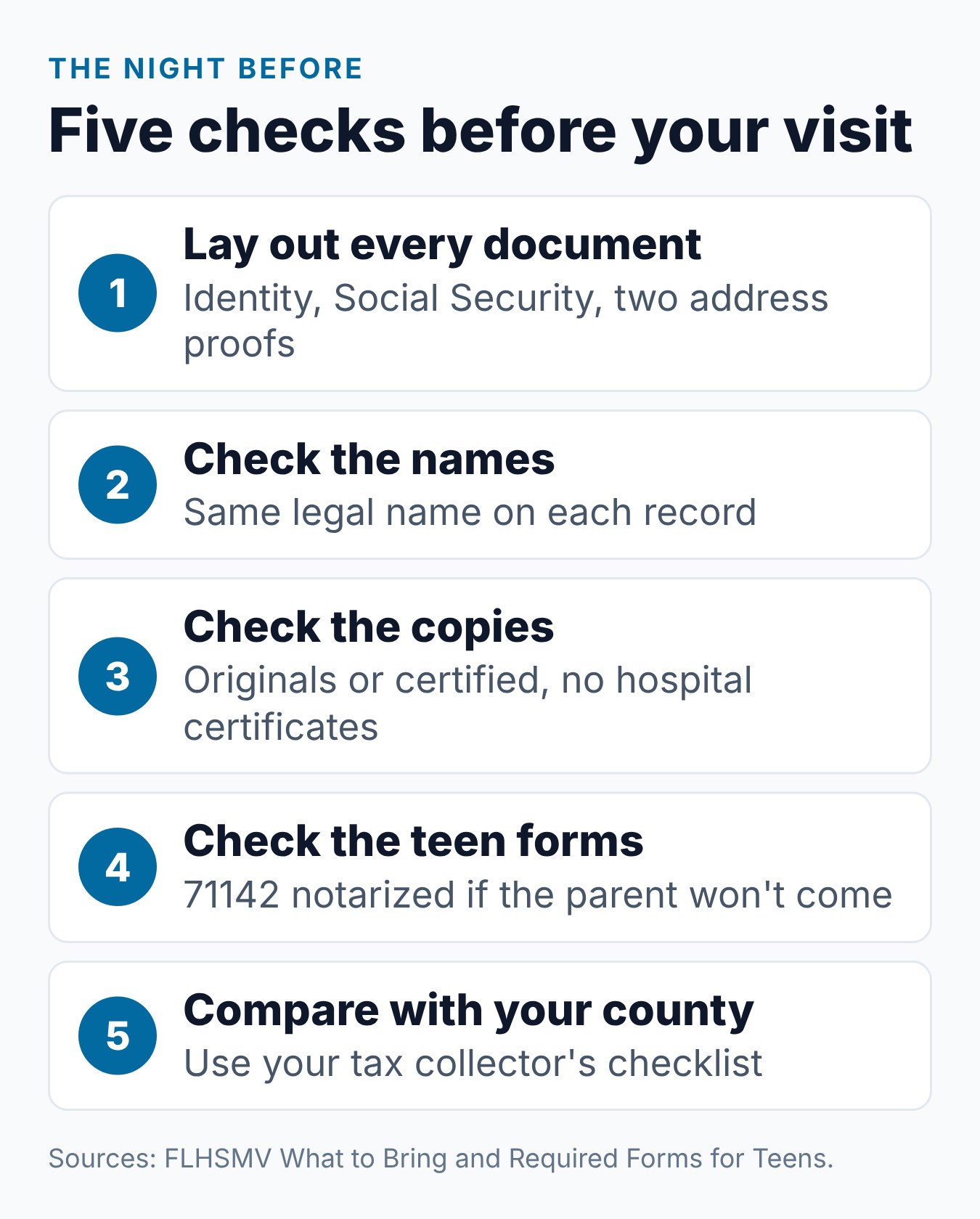
A good habit is to build the folder the night before. Lay out each document, check names and addresses, and compare it with your county’s checklist.
How Requirements Can Vary
Florida’s course and license rules apply statewide, but some details depend on where you live. Driver license services are often handled by your county tax collector’s office, and each office sets its own appointment process and hours. Some county school boards also offer driver education programs, such as DELAP courses, that can count instead of DETS.
FLHSMV can update course rules, forms, documents, and fees. Check FLHSMV and your county office for current requirements before your appointment.
Frequently Asked Questions
What documents do I need for a Florida learner’s permit?
One proof of identity, one proof of your Social Security number and two proofs of your Florida address. Teens under 18 also need HSMV 71142 and school attendance compliance.
Can I use a copy of my birth certificate?
Only a certified copy from a health department or vital statistics office. Hospital birth certificates and plain photocopies are not accepted.
What if my teen has no mail in their name?
The teen can use two address proofs from a parent or legal guardian they live with. The parent also completes form HSMV 71120.
Do I need to bring my DETS certificate?
The provider reports completion electronically, so it may not be required. Bring a copy anyway in case the record hasn’t posted.
Can I show documents on my phone?
FLHSMV says printouts of address documents are acceptable. Identity and name-change documents must be originals or certified copies, so bring the paper versions.
Does the parent need to come to the office?
Not if HSMV 71142 is notarized before the visit. Otherwise, the parent signs it in front of the examiner.
Do I need proof of school attendance?
Florida law requires teens to meet school attendance rules to get and keep driving privileges. Some counties ask for a school form, so check your tax collector’s teen checklist before the visit.
What if my name is different on two documents?
Bring the original or certified document that links the names, such as a court order. FLHSMV does not accept photocopies for name changes, and your Social Security name must match the license name.
Conclusion
Florida learner’s permit documents fall into three groups: identity, Social Security and two address proofs, plus HSMV 71142 and school attendance compliance for teens.
Bring originals or certified copies, make sure names match, and use a parent’s address proofs with HSMV 71120 if needed. Check your county tax collector’s list before you go. Our online Florida DETS course is coming soon.
Related Articles
- Florida Learner’s Permit: How to Get It, Requirements, and What It Allows
- How to Get a Florida Learner’s Permit Step by Step
- Florida Parental Consent Form HSMV 71142: What It Is and How to Get It
Sources
- FLHSMV — What to Bring: U.S. Citizen
- FLHSMV — Certification of Address, HSMV 71120
- FLHSMV — Parental Consent Form HSMV 71142
- FLHSMV — Required Forms for Teens (HSMV 71142, 71143, 71144)
- Florida Statutes — F.S. 322.09 (Application of Minors)
- Florida Statutes — F.S. 322.091 (Attendance Requirements)
- FLHSMV — Driver Education Traffic Safety (DETS) and approved provider list
- Lee County Tax Collector — First Time Drivers
- FLHSMV — Teen Licensing Requirements and Graduated Driver License Laws
Billy Forte is the owner of Driving Logic, a state-approved driver improvement course provider serving Florida and other U.S. states.
This article is general information, not legal advice. Florida licensing requirements, course rules, documents, and fees are set by FLHSMV and Florida law and can change. Use official FLHSMV and Florida statute sources for current requirements before you enroll in a course or visit a driver license office.