
Updated October 2026 · Reviewed by Billy Forte
A Florida learner’s permit is a Class E Learner License that lets a driver age 15 or older practice on the road with a licensed adult 21 or older in the front seat. Teens get one by finishing DETS, passing the knowledge, vision and hearing tests, and bringing documents and a signed parent consent form. Adults 18 and older can get one, but they don’t need it before taking the tests for a full license.
Key Facts
- Who it’s for: Teens 15 to 17 must hold one before a full license. Adults 18+ don’t need one. See who needs one.
- What teens need: DETS, the knowledge exam, vision and hearing tests, documents and HSMV 71142. See the requirements.
- Cost: FLHSMV lists $48 for an original Class E license, which includes the learner’s license. See the costs.
- Rules: A licensed driver 21+ in the front seat at all times, and daylight only for the first 3 months. See the rules.
- Next step: Hold it 12 months or until 18, log 50 hours, then take the driving test. See how you move up.
What a Florida Learner’s Permit Is
Most people say “learner’s permit.” FLHSMV calls it a learner’s license, and the license class is a Class E Learner License. They are the same thing.
It is the first stage of Florida’s graduated driver license (GDL) system. Teens start with supervised practice, move to a Class E license with hour limits at 16 and 17, and lose those limits at 18. Our Florida GDL guide walks through all three stages.
The legal rules come from F.S. 322.1615. That law sets the minimum age of 15, the tests, the driver education course and the supervision rules.
Many people still call the office “the DMV.” In Florida, the agency is FLHSMV (Florida Department of Highway Safety and Motor Vehicles), and most local driver license offices are run by county tax collectors.
Who Needs a Florida Learner’s Permit
Your age and your license history decide your path. Here is the short version for each group.
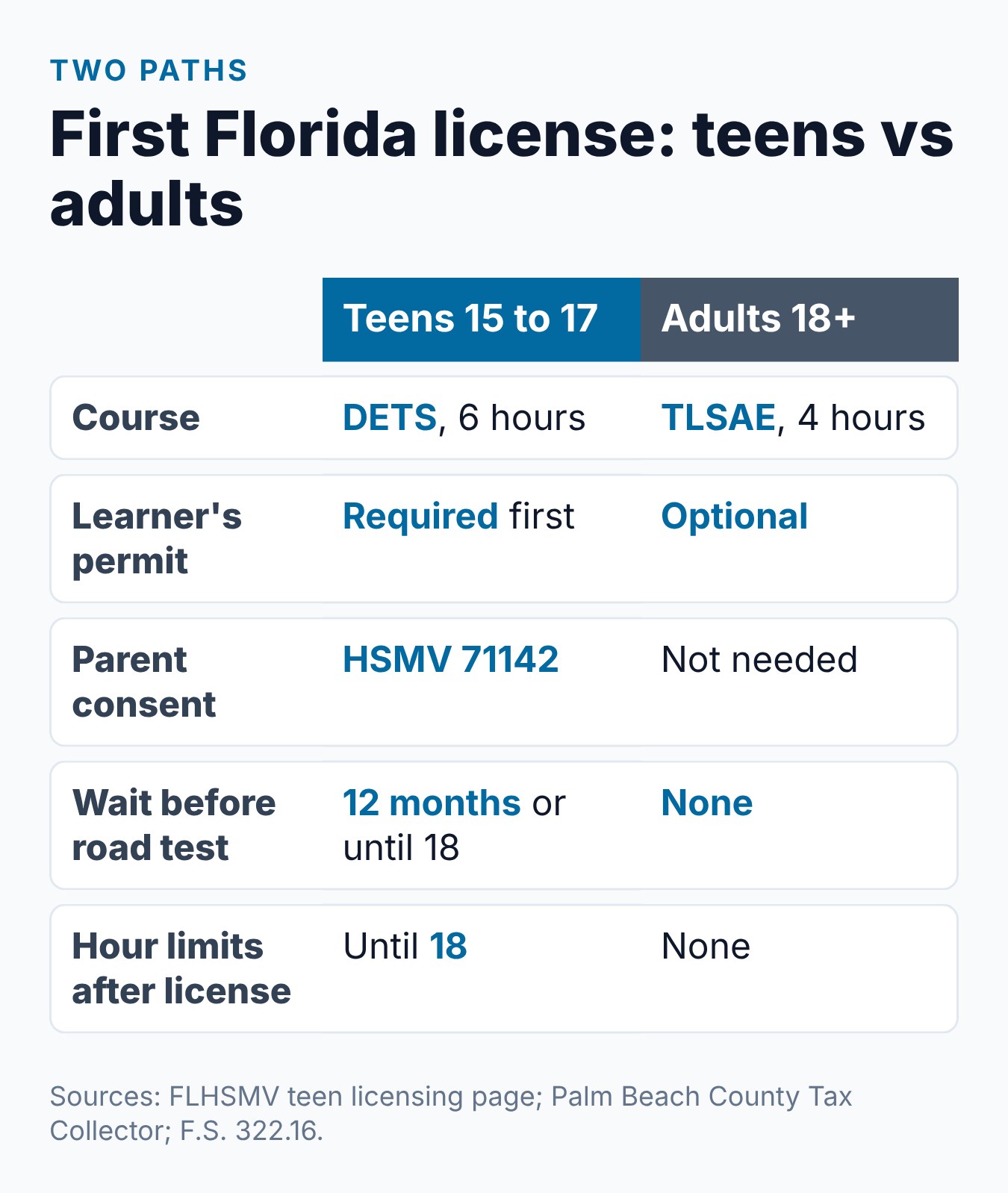
- Teens 15 to 17 who have never had a license: You need a learner’s permit first. You can’t go straight to a full license.
- Adults 18 and older who have never had a license: A learner’s permit is optional. The Palm Beach County Tax Collector says adults are not required to get one. You take TLSAE and the tests for a full Class E license.
- People with a valid license from another state: You transfer that license. You don’t start over with a permit.
Some adults still choose a permit so they can practice legally before the road test. If that’s you, the same supervision rules apply while you hold it. Our first-time adult license guide covers the full adult process.
If you just moved here, see our new Florida resident license guide. It explains the 30-day rule and when DETS or TLSAE does not apply.
Florida Learner’s Permit Requirements for Teens
Teens must meet every item below before the office can issue the permit. Each one has its own guide if you need more detail.
- Age 15 or older. You can finish the course and the knowledge exam earlier, but the permit can’t be issued before 15.
- Driver education. Complete the 6-hour DETS course, or an approved school course (1900300, 1900310 or a qualifying DELAP course). DETS has been required since August 1, 2025.
- Class E knowledge exam. Pass the 50-question test with at least 40 correct.
- Vision and hearing tests. These are done at the driver license office, as required by F.S. 322.1615.
- Documents. Bring proof of identity, proof of your Social Security number and two proofs of your Florida address. See our document checklist.
- Parent consent. An unmarried teen under 18 needs a parent or legal guardian to sign HSMV 71142.
- School attendance. Florida law ties a minor’s driving privilege to school attendance.
For the order to do these in, and where to take each test, use our step-by-step permit guide.
Where You Take the Knowledge Exam
You have two choices. You can test at a driver license office, or online through an approved third-party provider if you are under 18.
FLHSMV’s exam page says any applicant under 18 can test online. A parent must sign a proctoring form for an online test.
Since February 6, 2026, Florida gives driver license knowledge and skills exams in English only. Some older FLHSMV pages still list other languages, so plan for English.
How School Attendance Affects a Permit
F.S. 322.091 says a minor is eligible to drive only while meeting school rules. That means being enrolled and meeting attendance rules, or having a diploma, a GED or another listed exemption.
The rule doesn’t end when the permit is issued. If FLHSMV is told a teen isn’t in compliance, it sends a notice of intent to suspend. The family then has 15 days to show proof or ask for a hardship hearing.
The Lee County Tax Collector warns that 15 or more unexcused absences in 90 days can make a teen ineligible. Ask your county office if you need to bring a school form.
What a Florida Learner’s Permit Costs
The state fee is the biggest cost. These are the fees FLHSMV lists on its fee page and teen FAQ.
| Item | Fee |
|---|---|
| Original Class E license (includes the learner’s license) | $48.00 |
| Tax collector service fee (may apply) | $6.25 |
| Knowledge exam retest | $10.00 |
| Driving skills retest | $20.00 |
| Moving up to a Class E license later | No fee if you surrender the learner’s license with no name or address change |
The DETS course is a separate cost, paid to the course provider. Online knowledge exams through third-party providers also charge their own fees.
What the Permit Lets You Do
A learner’s permit lets you drive only with supervision. The rules come straight from F.S. 322.1615.
- Who rides with you: A licensed driver age 21 or older must sit in the front passenger seat at all times.
- First 3 months: You may drive in daylight hours only.
- After 3 months: You may drive until 10 p.m.
- Driving alone: Never allowed on a learner’s permit.
The supervising driver doesn’t have to be a parent. F.S. 322.1615 only requires a person 21 or older with a valid license for the type of vehicle you are driving. A grandparent, an older sibling who is 21 or a family friend can qualify.
Breaking these rules counts as a moving violation under Florida law. A conviction can also delay your full license. Our learner’s permit restrictions guide explains each rule and common situations.
How Long You Hold the Permit
Teens must hold the permit for 12 months, or until their 18th birthday if that comes first. Our holding period guide gives timing examples by age.
During that time, you log at least 50 hours of supervised driving, including 10 hours at night. A parent, guardian or responsible adult 21 or older signs a form to certify the hours. See our 50-hour driving guide for how to track them.
From Learner’s Permit to a Full License
A teen 16 or older can apply for a Class E license once these are true, per FLHSMV’s teen licensing page:
- The learner’s permit has been held 12 months, or the teen is 18.
- The 50 hours (10 at night) are certified on HSMV 71143.
- There are no moving violation convictions in the year after the permit was issued. One is allowed if adjudication was withheld.
- The teen passes the Class E driving skills test.
After that, a 16- or 17-year-old still has hour limits under F.S. 322.16. At 16, no driving from 11 p.m. to 6 a.m. unless a licensed driver 21+ is along or you are driving to or from work. At 17, the same rule applies from 1 a.m. to 5 a.m.
What Happens If You Turn 18 First
The holding period is 12 months or until your 18th birthday, whichever comes first. So a teen who gets a permit at 17 and a half does not have to wait a full year.
At 18, FLHSMV’s exam page says you can take the driving skills test. The teen hour limits under F.S. 322.16 also no longer apply once you are 18.
Common Mistakes With a Florida Learner’s Permit
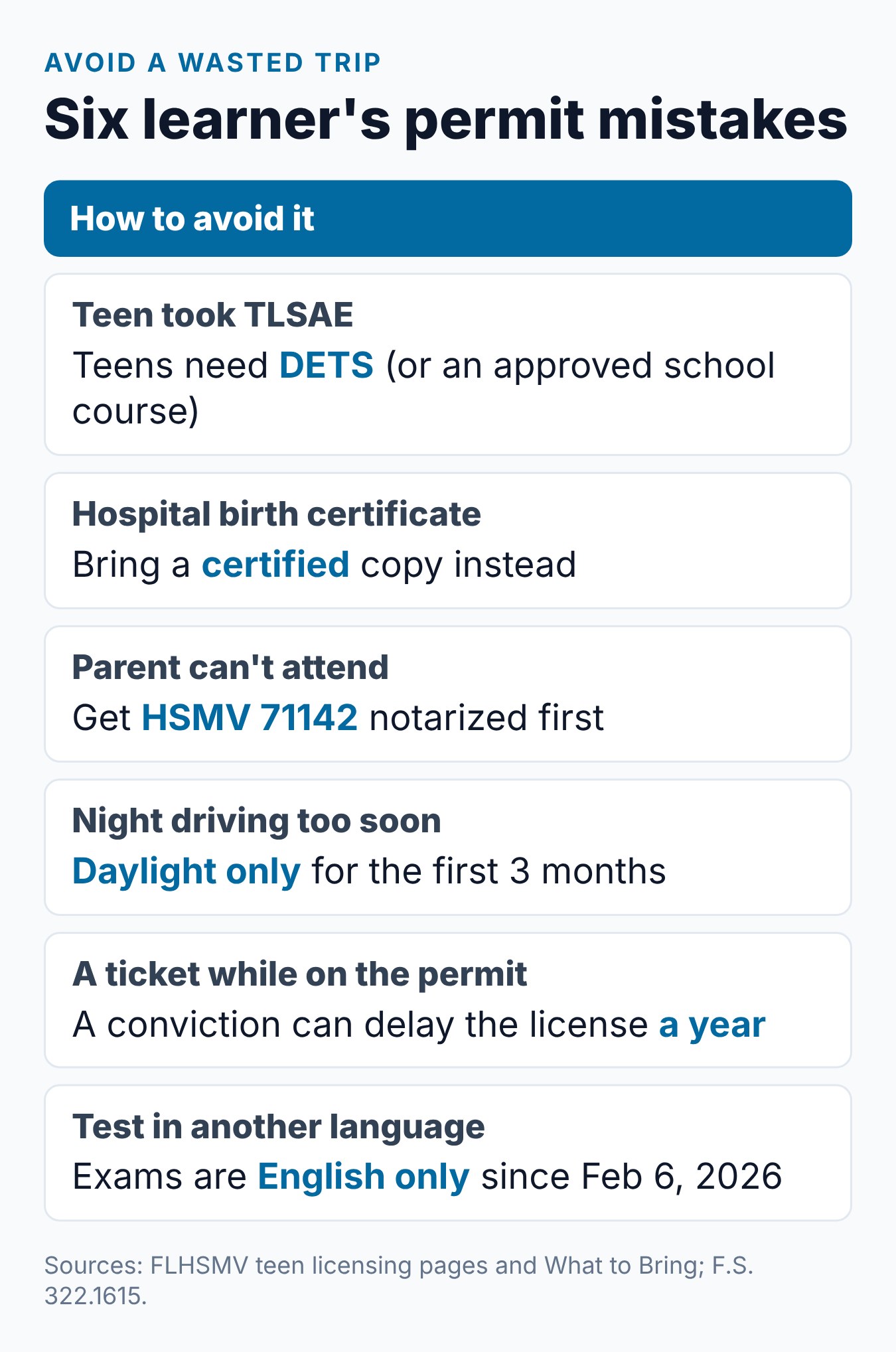
These mistakes come straight from the official rules. Each one can cost a trip to the office or months of waiting.
- Taking TLSAE instead of DETS. TLSAE no longer meets the teen requirement for courses finished on or after August 1, 2025.
- Bringing a hospital birth certificate. FLHSMV does not accept it as a certified document.
- Missing the parent. If a parent can’t come, HSMV 71142 must be notarized before the visit.
- Night driving too early. Night practice isn’t allowed in the first 3 months, so the 10 night hours must come later.
- Getting a ticket. A moving violation conviction can push back the full license by a year.
- Expecting a test in another language. Exams are in English only since February 6, 2026.
How Requirements Can Vary
Florida’s course and license rules apply statewide, but some details depend on where you live. Driver license services are often handled by your county tax collector’s office, and each office sets its own appointment process and hours. Some county school boards also offer driver education programs, such as DELAP courses, that can count instead of DETS.
FLHSMV can update course rules, forms, documents, and fees. Check FLHSMV and your county office for current requirements before your appointment.
Frequently Asked Questions
What is a Florida learner’s permit?
It is a Class E Learner License. It lets a driver 15 or older practice with a licensed driver 21 or older in the front passenger seat.
How old do you have to be to get a learner’s permit in Florida?
You must be at least 15. You can complete DETS and the knowledge exam before then, but the permit is issued at 15 or older.
Do adults need a learner’s permit in Florida?
No. Adults 18 and older can take TLSAE and the tests for a full Class E license without holding a permit first. Some choose one to practice legally.
How much is a learner’s permit in Florida?
FLHSMV lists $48 for an original Class E license, which includes the learner’s license. Most tax collector offices also add a $6.25 service fee.
Can I drive alone with a Florida learner’s permit?
No. A licensed driver 21 or older must sit in the front passenger seat every time you drive.
How long do I have to keep my learner’s permit?
Teens hold it for 12 months, or until 18 if that comes first. They also need 50 hours of supervised driving, 10 at night.
Can I take the permit test online in Florida?
Yes, if you are under 18. You test through an approved third-party provider, and a parent signs a proctoring form.
Conclusion
A Florida learner’s permit is the first step for teens 15 to 17, and an optional one for adults.
Teens need DETS, the knowledge, vision and hearing tests, documents, HSMV 71142 and school attendance compliance, then 12 months and 50 hours of supervised driving. Use the guides linked above for each step, and check with your county office before you go. Driving Logic is a state-approved driver improvement course provider, and our online Florida DETS course is coming soon.
Related Articles
- How to Get a Florida Learner’s Permit Step by Step
- Florida Learner’s Permit Documents: What to Bring
- Florida Learner’s Permit Restrictions: What Teens Can and Can’t Do
- Florida Learner’s Permit Holding Period: How Long Before a License?
- Florida Parental Consent Form HSMV 71142: What It Is and How to Get It
- Florida 50-Hour Driving Requirement: What Teens Need Before Getting a License
- Florida Graduated Driver License (GDL): The Three Stages for Teen Drivers
- First-Time Florida Driver’s License for Adults: The Complete Process
- New Florida Resident Driver’s License: How to Get Yours
Sources
- FLHSMV — Teen Licensing Requirements and Graduated Driver License Laws
- FLHSMV — Class E Knowledge Exam and Driving Skills Test
- FLHSMV — Teen Licensing Frequently Asked Questions
- FLHSMV — Required Forms for Teens (HSMV 71142, 71143, 71144)
- FLHSMV — Driver License and ID Card Fees
- Florida Statutes — F.S. 322.1615 (Learner’s Driver License)
- Florida Statutes — F.S. 322.16 (License Restrictions)
- Florida Statutes — F.S. 322.095 (TLSAE)
- FLHSMV — Driver Education Traffic Safety (DETS) and approved provider list
- Lee County Tax Collector — First Time Drivers
- Palm Beach County Tax Collector — New Drivers Aged 18 or Older
- Hillsborough County Tax Collector — Driver License Exams in English Only Beginning February 6
- FLHSMV — New Florida Residents
Billy Forte is the owner of Driving Logic, a state-approved driver improvement course provider serving Florida and other U.S. states.
This article is general information, not legal advice. Florida licensing requirements, course rules, documents, and fees are set by FLHSMV and Florida law and can change. Use official FLHSMV and Florida statute sources for current requirements before you enroll in a course or visit a driver license office.