
Updated October 2026 · Reviewed by Billy Forte
The Florida DETS course is a 6-hour, FLHSMV-approved Driver Education Traffic Safety course that teens under 18 must complete before they apply for their first Florida driver license, starting with the learner’s license. It became required on August 1, 2025, and it applies to anyone under 18 who has never held a driver license from any state or country. Adults 18 and older do not take DETS; they still take the separate 4-hour TLSAE course under F.S. 322.095.
Key Facts
- Who needs it: Florida applicants under 18 who have never held a license anywhere. See who must take it.
- Length and format: At least 6 hours, from an FLHSMV-approved provider. See how it works online.
- Final exam: 40 questions, and you need 80% (32 correct) to pass. See the exam rules.
- Price and terms vary: Four national online courses we checked listed $19.95 to $36, with different retake rules. See the comparison.
- Not TLSAE: TLSAE is the 4-hour course for adults 18 and older. See DETS vs. TLSAE.
- After DETS: You still need the knowledge exam, vision and hearing tests, and a signed HSMV 71142 parental consent form. See the next steps.
What Is the Florida DETS Course?
DETS stands for Driver Education Traffic Safety. It is a teen driver education course approved by the Florida Department of Highway Safety and Motor Vehicles (FLHSMV). It must last at least 6 hours.
It must also meet or exceed Florida’s Department of Education standards for Driver Education/Traffic Safety–Classroom (course 1900300). You can read the full rule on FLHSMV’s DETS page.
DETS is for new teen drivers. FLHSMV says that anyone under 18 who has never held a driver license from any state, country, or jurisdiction must complete the 6-hour DETS course before applying for a license in Florida. For most teens, that first license is the learner’s license, which many people call a learner’s permit.
Here is who usually needs DETS:
- Teens ages 14 to 17 planning to get a first Florida learner’s license
- Teens who have never held a license from another state or country
- Teens who did not finish an approved school driver education course that counts instead (more on that below)
You must be at least 15 to get a learner’s license under F.S. 322.1615. The law does not set a minimum age to start the course, so each provider sets its own. See Can You Start the Florida DETS Course at 14? for details.
DETS is one step, not the whole process. It does not give you a permit by itself. After you pass, you move on to the knowledge exam, the vision and hearing tests, and your visit to a driver license office.
Who Is Exempt, and How the TLSAE Transition Worked
Not every teen has to take DETS. FLHSMV lists a few groups the rule does not affect. It also set a short transition period for teens who finished TLSAE before the change.
The DETS rule does not apply to teens who:
- Transfer a valid out-of-state license to Florida
- Already held a Florida learner’s license before August 1, 2025
Some school courses can also count instead of DETS. FLHSMV names these:
- Florida Department of Education Traffic Safety–Classroom courses 1900300 and 1900310
- Some county school board DELAP driver education courses
If your teen takes driver education at school, ask the school or the county school board if that course qualifies. This can save you from paying for a course you do not need.
Teens under 18 who finished a TLSAE course before August 1, 2025, could use that certificate for one year after completion. That window has now closed for everyone: any such certificate expired by July 31, 2026, at the latest. A TLSAE certificate earned on or after August 1, 2025, does not meet the teen requirement unless the teen is in one of the approved school courses above.
DETS vs. TLSAE: Which Course Fits Your Age?
DETS and TLSAE are two different courses for two different age groups. They are not interchangeable. Your age decides which one you need.
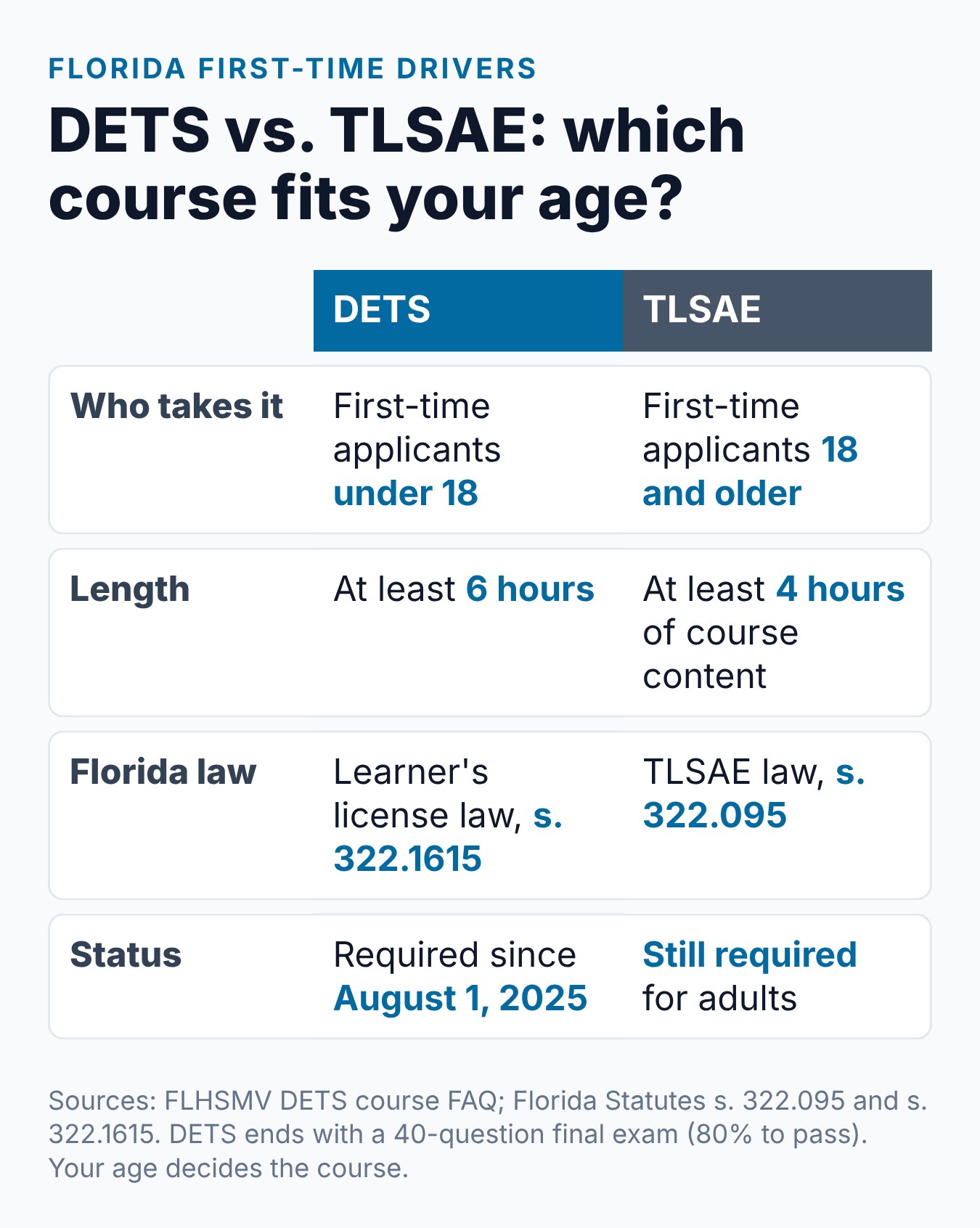
- DETS: at least 6 hours, for first-time applicants under 18. FLHSMV approves the course, and it ends with a final exam.
- TLSAE: a minimum of 4 hours of course content, for first-time applicants 18 and older. It is required under F.S. 322.095. Many people call it the drug and alcohol course.
Florida did not get rid of TLSAE. It is still required for adults 18 and older who are getting a Florida license for the first time. Only the teen requirement changed.
The full story of the change is in Florida DETS vs TLSAE: What Changed and Who Needs Which Course.
Some websites call DETS the “6-hour drug and alcohol course.” That name causes mix-ups, because the 4-hour TLSAE is also called the drug and alcohol course. Read Florida 6-Hour Drug and Alcohol Course: Is It the Same as DETS? before you buy a course with that name.
If you are close to your 18th birthday, check your plans carefully. The course you need depends on your age when you apply. When in doubt, check with FLHSMV or your county tax collector’s driver license office before you buy a course.
What the Course Covers and How the Final Exam Works
Each approved provider builds its own lessons. But every DETS course must meet or exceed Florida’s Department of Education classroom standards (course 1900300). So the core topics are similar from one provider to the next.
The course 1900300 standards include topics like these:
- Florida traffic laws, road signs, signals, and pavement markings
- Right-of-way and sharing the road with trucks, buses, trains, bikes, and pedestrians
- Defensive driving and spotting hazards early
- DUI, Zero Tolerance, and Implied Consent laws, plus how alcohol and drugs affect driving
- Distracted and drowsy driving, including Florida’s texting law
- Florida’s graduated driver license (GDL) rules for young drivers
- What to do after a crash, plus driving in bad weather
The course runs at least 6 hours. Many online courses let you stop and come back later. See How Long Is the Florida DETS Course and How Is It Structured? for how the time works.
At the end, you take a final exam. According to the FLHSMV DETS FAQ, the exam has 40 questions and you need 80% (32 correct) to pass.
A provider may allow up to three attempts, and each provider sets its own retake policy within that limit. More on the exam is in Florida DETS Course Final Exam: What to Expect.
When you pass, you earn a completion certificate. Approved providers report completions to FLHSMV through the Driver Improvement Certificate Issuance System (DICIS). See Florida DETS Course Certificate: What It Is and How to Use It for what to do with it.
How to Complete the Florida DETS Course Online
FLHSMV allows DETS to be taught online or in person. Every provider on FLHSMV’s approved list delivers the course online. You can work from home on a computer, tablet, or phone, at a pace that fits school and other activities.
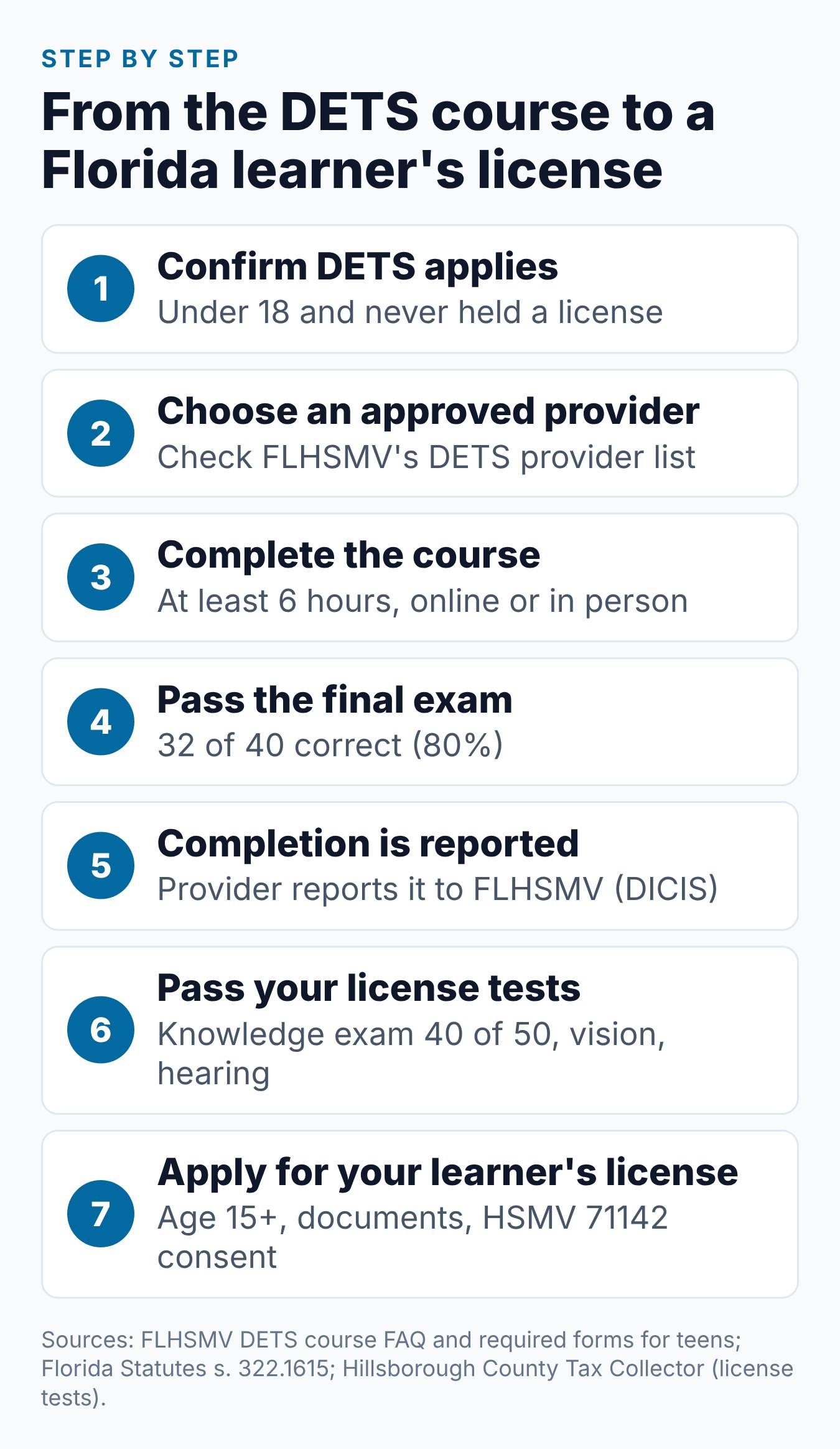
In short: confirm DETS applies, pick an FLHSMV-approved course, finish at least 6 hours of lessons, pass the final exam, and save your certificate. Online does not mean shortcut, since the 6-hour minimum and the final exam still apply.
For each step in detail, including how lesson timers work and tips for studying at home, see Florida DETS Course Online: How the 6-Hour Program Works.
How to Choose an Approved DETS Provider
FLHSMV posts the list of approved providers on its DETS page. On October 19, 2026, that list named four providers, and all four delivered the course online. Start there, because taking an unapproved course can mean taking DETS again.
You may notice something confusing. Several well-known online schools that sell a DETS course do not appear by name on FLHSMV’s list. FLHSMV’s provider application asks how a provider authorizes contracted driver improvement schools, so a school’s brand name and the approved provider’s name may not match.
That does not mean a school is approved. It means you need to ask one question before you pay: “Which FLHSMV-approved provider’s DETS course do you use?”
Then confirm that provider is on FLHSMV’s list. If the school cannot answer, choose another one. For more help, read FLHSMV-Approved DETS Course: What It Means and How to Verify Your Provider.
Be careful with sites that promise an “instant” DETS course. The course must last at least 6 hours, so no legitimate course can be finished instantly.
What We Found Comparing Four Online DETS Courses
Florida does not set one statewide price for DETS. When we reviewed the public course pages of four large national online schools on October 19, 2026, list prices ranged from $19.95 to $36, and one school added an $8 certificate and handling fee.
Retake rules differed the most. Two schools gave three exam attempts and a free course restart, while one said you must buy the course again after a failed exam. So the cheapest list price is not always the cheapest total.
FLHSMV’s DETS FAQ also lists a $3.00 certificate cost, so ask whether the price includes it. See the school-by-school table, extra fees and retake costs in Florida DETS Course Cost: What to Expect.
Common DETS Mistakes and How to Avoid Them
These mistakes come straight from FLHSMV’s rules and the course terms above. Each one can cost a family time, money, or a second trip to the driver license office.
- Buying the 4-hour TLSAE course for a teen. TLSAE completed on or after August 1, 2025, does not meet the teen requirement. Check that the course says DETS and 6 hours.
- Counting on an old TLSAE certificate. Teen TLSAE certificates from before August 1, 2025, were good for one year, and they have all expired.
- Not checking who stands behind the course. If a school is not on FLHSMV’s list by name, ask which approved provider’s course it uses.
- Skipping the retake policy. Some schools give three free attempts. Others make you buy the course again.
- Missing extra fees. Look for a certificate or handling fee before checkout.
- Letting access expire. If a school sets a time limit, plan to finish before it runs out.
- Bringing the wrong person to sign the consent form. A step-parent may not sign form HSMV 71142 unless they have legally adopted the teen.
- Showing up without a notarized form. If the signing parent cannot come to the office, the form must be notarized first.
- Treating DETS as the permit test. DETS is a course. The 50-question knowledge exam is a separate test.
After DETS: Getting Your Learner’s License
Passing DETS clears one step. You still need to apply for your Class E learner’s license. Here is what comes next for most teens.
Be at least 15. Florida law sets 15 as the minimum age for a learner’s license.
Pass the knowledge exam. The Class E knowledge exam has 50 questions about Florida traffic laws and road signs. You need 40 correct (80%) to pass.
Teens can take the exam at a driver license office or online through a third-party administrator. For an online exam, a parent or guardian must complete the HSMV 71144 proctoring form.
Pass the vision and hearing tests. You need 20/40 vision or better in each eye and both eyes, with or without corrective lenses.
Bring a signed parental consent form. Teens need the Parental Consent Form, HSMV 71142. A parent or legal guardian signs it in front of a driver license examiner, or has it notarized if they cannot attend.
FLHSMV lists all three teen forms on its required forms for teens page.
Bring the right documents. Plan to bring proof of identity, your Social Security number, and two proofs of your residential address. Teens must also meet Florida’s school attendance requirement.
Check the current document list with FLHSMV or your county tax collector before your visit.
Follow the learner’s license rules. A learner must always drive with a licensed driver who is 21 or older in the front passenger seat.
For the first 3 months, you may drive only during daylight hours. After that, you may drive until 10 p.m.
Later, when you apply for your driver license, a parent or guardian certifies on form HSMV 71143 that you have at least 50 hours of driving, including 10 hours at night. For the full checklist, see Florida DETS Course Next Steps: What Happens After You Finish. Parents can also read Florida DETS Course for Teens: What Parents Need to Know.
How Requirements Can Vary
Florida’s course and license rules apply statewide, but some details depend on where you live. Driver license services are often handled by your county tax collector’s office, and each office sets its own appointment process and hours. Some county school boards also offer driver education programs, such as DELAP courses, that can count instead of DETS.
FLHSMV can update course rules, forms, documents, and fees. Check FLHSMV and your county office for current requirements before your appointment.
Frequently Asked Questions
Who has to take the Florida DETS course?
Anyone under 18 who has never held a driver license from any state, country, or jurisdiction must complete DETS before applying for a Florida license. Teens transferring a valid out-of-state license, and teens who held a Florida learner’s license before August 1, 2025, are not affected.
How long is the Florida DETS course?
DETS lasts at least 6 hours. Many online courses let you stop and resume, so you can finish it over several sessions.
Is there a final exam?
Yes. The DETS final exam has 40 questions, and you need 80% (32 correct) to pass. Providers may allow up to three attempts.
How much does the Florida DETS course cost?
Florida does not set one price. Four national online courses we checked on October 19, 2026, listed prices from $19.95 to $36, and one added an $8 certificate and handling fee.
Can I take TLSAE instead of DETS if I am under 18?
Generally, no. A TLSAE course completed on or after August 1, 2025, does not meet the teen requirement unless you are in an approved school course such as FDOE 1900300, 1900310, or a qualifying DELAP course.
Is the DETS course the same as the permit test?
No. DETS is a 6-hour course. The learner’s license knowledge exam is a separate 50-question test, and you need 40 correct answers to pass it.
Can I take DETS online?
Yes. FLHSMV says DETS can be delivered in person or online, and every provider on its approved list was online as of October 19, 2026. Confirm that the course you buy uses an approved provider.
What do I do after I finish DETS?
Your provider reports your completion to FLHSMV. Then you take the knowledge exam and the vision and hearing tests, bring your documents and a signed HSMV 71142 parental consent form, and apply for your learner’s license once you are at least 15.
Conclusion
The Florida DETS course is the required first step for new drivers under 18, and it must come from an FLHSMV-approved provider. Before you pay, check the course name, the approved provider behind it, the retake policy, and any extra fees. Adults 18 and older still take the separate 4-hour TLSAE course. Driving Logic is a state-approved driver improvement course provider, and our online Florida DETS course is coming soon.
Related Articles
- Florida DETS Course Online: How the 6-Hour Program Works
- Florida DETS vs TLSAE: What Changed and Who Needs Which Course
- How Long Is the Florida DETS Course and How Is It Structured?
- Florida DETS Course Cost: What to Expect
- Florida DETS Course Certificate: What It Is and How to Use It
- Florida DETS Course Final Exam: What to Expect
- FLHSMV-Approved DETS Course: What It Means and How to Verify Your Provider
- Florida DETS Course for Teens: What Parents Need to Know
- Can You Start the Florida DETS Course at 14? Age Requirements Explained
- Florida DETS Course Next Steps: What Happens After You Finish
- Florida 6-Hour Drug and Alcohol Course: Is It the Same as DETS?
Sources
- FLHSMV — Driver Education Traffic Safety (DETS) and approved provider list
- FLHSMV — DETS Course Frequently Asked Questions
- FLHSMV — Driver Education Courses
- FLHSMV — Required Forms for Teens
- FLHSMV — Parental Consent Form HSMV 71142
- Florida Statutes — F.S. 322.1615 (Learner’s Driver License)
- Florida Statutes — F.S. 322.095 (TLSAE)
- Hillsborough County Tax Collector — Class E Learner Driver License
- CPALMS — Driver Education/Traffic Safety-Classroom (#1900300)
- Course comparison: Driving Logic review of the public Florida DETS course pages of four national online schools, October 19, 2026.
Billy Forte is the owner of Driving Logic, a state-approved driver improvement course provider serving Florida and other U.S. states.
This article is general information, not legal advice. Florida licensing requirements, course rules, documents, and fees are set by FLHSMV and Florida law and can change. Use official FLHSMV and Florida statute sources for current requirements before you enroll in a course or visit a driver license office.