
Updated October 2026 · Reviewed by Billy Forte
The Florida DETS course final exam has 40 questions, and you need 80% (32 correct) to pass. A provider may allow up to three attempts, and passing is what earns your completion certificate. It is a separate test from the 50-question knowledge exam you take for your learner’s license.
Key Facts
- Length: 40 questions at the end of the 6-hour course. See the exam basics.
- Passing score: 80%, which is 32 correct answers. See the scoring.
- Attempts: A provider may allow up to three, and each school sets its own retake rule. See what happens if you fail.
- Topics: Florida traffic laws, safe driving, impaired driving, and teen license rules. See what it covers.
- Not the permit test: The learner’s license knowledge exam is a separate 50-question test. See the difference.
Florida DETS Course Final Exam Basics
Every approved DETS course ends with a final exam. FLHSMV describes it in its DETS course FAQ:
| Exam detail | What FLHSMV says |
|---|---|
| Number of questions | 40 |
| Passing score | 80%, or 32 correct |
| Attempts | The provider may allow up to three |
| Where you take it | Inside the DETS course, after the lessons |
| What passing earns | Your course completion, reported to FLHSMV |
The exam comes after you finish the course lessons, which must add up to at least 6 hours. You cannot take the final first and skip the lessons.
Each provider writes its own exam questions, based on the same state standard. So the exact questions and format differ from one course to another.
What the Exam Covers
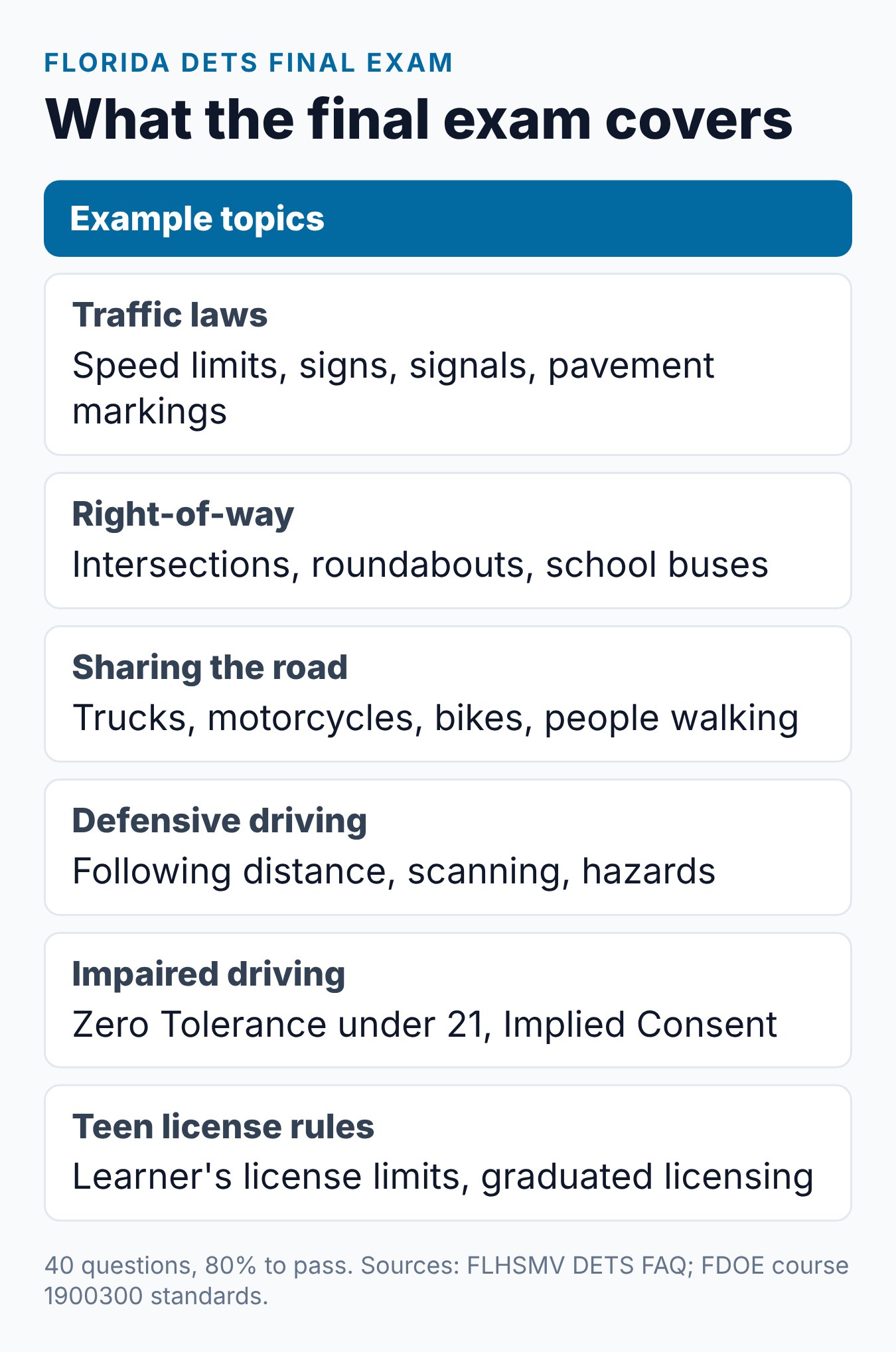
Every DETS course must meet or exceed Florida’s Department of Education standards for Driver Education/Traffic Safety–Classroom (course 1900300). The final exam tests the material in your course, so expect questions on topics like these:
- Traffic laws: Speed limits, signs, signals, and pavement markings
- Right-of-way: Intersections, roundabouts, school buses, and emergency vehicles
- Sharing the road: Trucks, motorcycles, bicycles, and people walking
- Defensive driving: Following distance, scanning, and hazard spotting
- Impaired driving: Alcohol, drugs, Florida’s Zero Tolerance law for drivers under 21, and Implied Consent
- Distractions: Phones, passengers, and drowsy driving
- Teen license rules: Learner’s license limits and Florida’s graduated driver license rules
- Emergencies: What to do after a crash and how to drive in bad weather
Questions often test the “why” behind a rule, not only the rule itself. For example, a question may ask why you increase following distance in rain.
The impaired driving topics deserve extra attention. They cover how alcohol and drugs slow reaction time and judgment, and what Florida’s laws say about drivers under 21. These ideas also show up again on the knowledge exam.
How to Prepare for the Final Exam
The best preparation happens during the course, not in a rush at the end. These habits help most students pass on the first try:
- Take the lesson quizzes seriously. They show which topics you need to review.
- Keep a short note sheet. Write down numbers, like speed limits in school zones and learner’s license hours.
- Review weak topics before the exam. Reread any lesson where you missed quiz questions.
- Rest before you start. Do not take the exam right after a long session.
- Read every answer choice. Many wrong answers look close to the right one.
Some providers sell practice questions or bundle them with the course. They can help, but the course lessons are the main source for the exam.
A Simple Study Plan
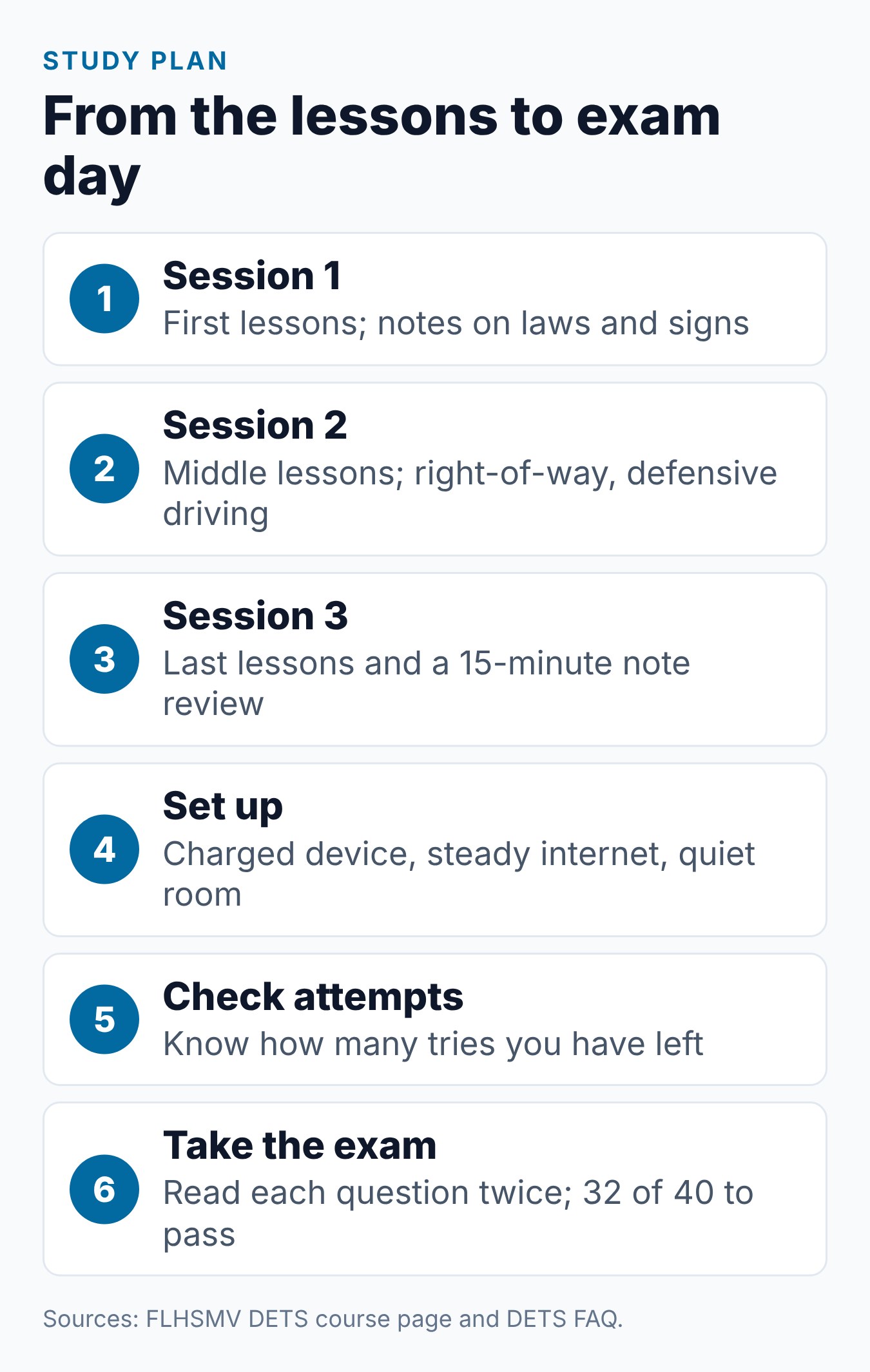
If your teen splits the course into three sessions, a plan like this works well:
- Session 1: First third of the lessons, with notes on traffic laws and signs.
- Session 2: Middle lessons, with notes on right-of-way and defensive driving.
- Session 3: Last lessons, a 15-minute note review, then the final exam.
Short, focused sessions help students remember more than one long session.
What Happens If You Fail
FLHSMV says a provider may allow up to three attempts to pass. What happens after a failed attempt depends on the school.
We reviewed the course pages of four national online schools on October 19, 2026. Their retake rules were very different:
| School | What the course page said about failing the final exam |
|---|---|
| School A | Three attempts, then a free course restart |
| School B | You must buy the course again after a failed exam |
| School C | Three attempts, with free course retakes |
| School D | Retakes allowed, number not stated |
Retake rules can change your total cost more than the course price does. Read the rules before you buy. Our Florida DETS Course Cost: What to Expect article compares the full costs.
If you fail an attempt, do not jump right back in. Review the lessons you struggled with, then try again when you feel ready.
If your course shows which questions or topics you missed, use that list as your study guide. If it does not, look back at the lesson quizzes where you struggled. Spend most of your review time on those topics, then take the next attempt when you can explain each rule in your own words.
Practice Questions on Teen License Rules
The exact exam questions differ by provider, but teen license rules show up in most courses. Try these practice questions. Each answer comes from FLHSMV’s teen licensing rules.
1. During the first three months, when may a learner’s license holder drive?
Answer: Only during daylight hours. After three months, they may drive until 10 p.m.
2. Who must be with a learner’s license holder while driving?
Answer: A licensed driver who is 21 or older, sitting in the front passenger seat.
3. How long must a teen hold a learner’s license before getting a driver license?
Answer: 12 months, or until age 18, whichever comes first.
4. How many hours of supervised driving must be certified before a teen driver license?
Answer: At least 50 hours, including 10 hours at night.
5. What hours may a 16-year-old with a driver license drive alone?
Answer: Between 6 a.m. and 11 p.m., unless driving to or from work or with a licensed driver 21 or older.
6. What hours may a 17-year-old with a driver license drive alone?
Answer: Between 5 a.m. and 1 a.m., with the same exceptions.
These rules also appear on the learner’s license knowledge exam. Learning them now helps twice.
On Exam Day
A calm start makes a real difference. Use this short checklist before you click “begin”:
- Use a reliable device with a charged battery and a steady internet connection.
- Pick a quiet room and silence phone alerts.
- Review your note sheet for 10 to 15 minutes.
- Check how many attempts you have left and what happens if you fail.
- Read each question twice before you choose an answer.
If the exam freezes or your connection drops, contact the provider’s support team before you try again. They can tell you whether the attempt counted.
After You Pass
When you pass the final exam, your course is complete. The provider reports your completion to FLHSMV through the Driver Improvement Certificate Issuance System (DICIS), according to the FLHSMV FAQ.
You also get a completion certificate. Save a copy and check that the student’s name and birth date are correct. Read Florida DETS Course Certificate: What It Is and How to Use It for what to do next.
DETS Final Exam vs. the Permit Knowledge Exam
Many families mix up these two tests. They are separate, and you must pass both.
| DETS final exam | Learner’s license knowledge exam | |
|---|---|---|
| Where | Inside your DETS course | At a driver license office, or online through a third-party administrator |
| Questions | 40 | 50 |
| Passing score | 80% (32 correct) | 80% (40 correct) |
| What it unlocks | Your DETS completion | Part of the learner’s license requirements |
| Extra form for online testing | None | HSMV 71144, signed by a parent or guardian, for teens who test online |
The knowledge exam details come from county offices like the Hillsborough County Tax Collector. The online testing form is listed on FLHSMV’s required forms for teens page.
Some people call the knowledge exam “the DMV test.” In Florida, it is part of the FLHSMV licensing process, often given at a county tax collector’s office.
How DETS Helps With the Knowledge Exam
The two tests cover a lot of the same ground. Both ask about Florida traffic laws, road signs, and safe driving.
So studying for the DETS final also prepares you for the knowledge exam. Keep your DETS notes and review them again before your learner’s license appointment.
Common Final Exam Mistakes
Most students who fail the first time make one of these mistakes:
- Rushing through lessons to finish fast, then guessing on the exam
- Taking the exam when tired at the end of a long session
- Skipping the lesson quizzes, which point out weak topics
- Misreading questions that include words like “not” or “except”
- Using up attempts quickly without reviewing in between
Each of these is easy to fix with a little planning. Study in short sessions, review weak spots, and take the exam when you are fresh.
Tips for Parents
Parents can help without sitting through all 6 hours. Try these simple steps:
- Check the retake rule before the teen starts the final exam.
- Ask your teen to explain one rule from each session, like who has the right-of-way at a four-way stop.
- Quiz with road signs during car rides.
- Make sure the teen is rested on exam day.
These small check-ins help the material stick for both the DETS final and the knowledge exam.
How Requirements Can Vary
Florida’s course and license rules apply statewide, but some details depend on where you live. Driver license services are often handled by your county tax collector’s office, and each office sets its own appointment process and hours. Some county school boards also offer driver education programs, such as DELAP courses, that can count instead of DETS.
FLHSMV can update course rules, forms, documents, and fees. Check FLHSMV and your county office for current requirements before your appointment.
Frequently Asked Questions
How many questions are on the Florida DETS final exam?
The DETS final exam has 40 questions. FLHSMV describes it in its DETS course FAQ.
What score do you need to pass the DETS final exam?
You need 80%, which means at least 32 correct answers out of 40.
How many times can you take the DETS final exam?
A provider may allow up to three attempts. Each school sets its own rule, so check before you buy.
Is the DETS final exam the permit test?
No. The learner’s license knowledge exam is a separate 50-question test, and you need 40 correct to pass it.
What happens if I fail the DETS final exam three times?
It depends on the provider. One school we checked offers a free course restart, and another requires buying the course again.
Is the DETS final exam timed?
FLHSMV does not set a time limit for the final exam in its FAQ. Each provider designs its own exam, so check the course instructions before you start.
Can I use my notes during the DETS final exam?
Each provider sets its own exam rules. Read the instructions on the exam page, and study as if notes are not allowed.
Does passing the final exam give me a learner’s license?
No. Passing completes DETS. You still need the knowledge exam, vision and hearing tests, a signed HSMV 71142, and to be at least 15.
Conclusion
The Florida DETS course final exam has 40 questions, and you need 80% to pass.
Providers may allow up to three attempts, but retake rules vary a lot between schools. Study during the course, review weak topics, and save your certificate when you pass. Driving Logic is a state-approved driver improvement course provider, and our online Florida DETS course is coming soon.
Related Articles
- Florida DETS Course: The Complete Guide for Teens Under 18
- Florida DETS Course Certificate: What It Is and How to Use It
- How Long Is the Florida DETS Course and How Is It Structured?
- Florida DETS Course Cost: What to Expect
Sources
- FLHSMV — Driver Education Traffic Safety (DETS) and approved provider list
- FLHSMV — DETS Course Frequently Asked Questions
- CPALMS — Driver Education/Traffic Safety-Classroom (#1900300)
- FLHSMV — Required Forms for Teens
- Hillsborough County Tax Collector — Class E Learner Driver License
- Course comparison: Driving Logic review of the public Florida DETS course pages of four national online schools, October 19, 2026.
Billy Forte is the owner of Driving Logic, a state-approved driver improvement course provider serving Florida and other U.S. states.
This article is general information, not legal advice. Florida licensing requirements, course rules, documents, and fees are set by FLHSMV and Florida law and can change. Use official FLHSMV and Florida statute sources for current requirements before you enroll in a course or visit a driver license office.