
Updated October 2026 · Reviewed by Billy Forte
Your Florida DETS course next steps are to check your certificate, gather your documents, get the HSMV 71142 consent form signed, and pass the knowledge exam and vision and hearing tests. You can then apply for a learner’s license once you are at least 15. This guide covers each step in order, plus the learner’s license year that comes after.
Key Facts
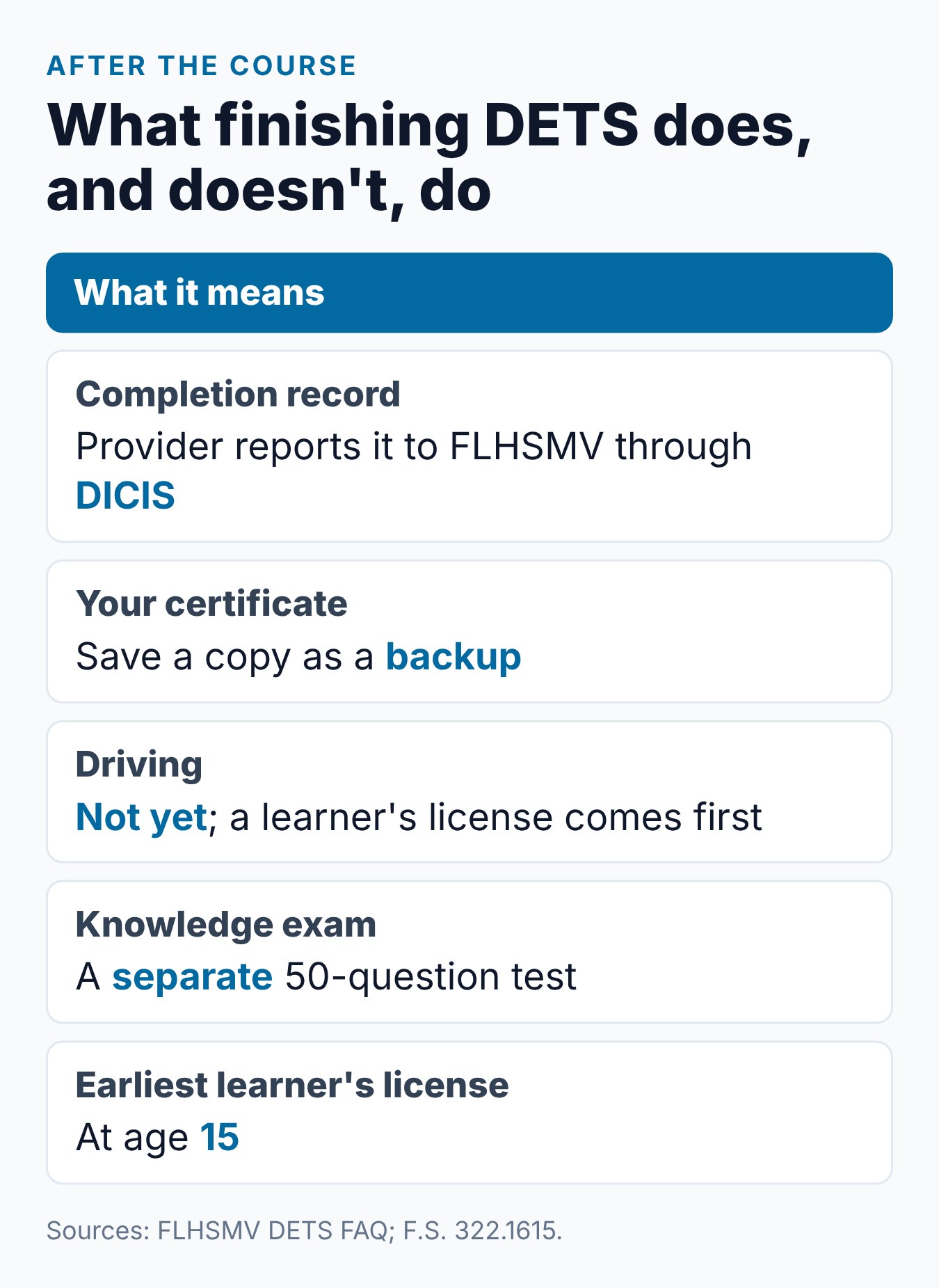
- Your completion: The provider reports it to FLHSMV through DICIS, and you keep a copy. See step 1.
- Documents: Proof of identity, Social Security number, and two proofs of address. See step 3.
- Consent: A parent or guardian signs HSMV 71142 in front of an examiner, or has it notarized. See step 4.
- Knowledge exam: 50 questions, and you need 40 correct. See step 5.
- After the learner’s license: 12 months, 50 hours of practice, then a driver license at 16. See the year ahead.
Florida DETS Course Next Steps at a Glance
- Check your certificate and save a copy.
- Confirm you are at least 15, or plan for that date.
- Gather your documents: identity, Social Security number, and two proofs of address.
- Get HSMV 71142 signed by a parent or legal guardian.
- Pass the knowledge exam, at an office or online through a third-party administrator.
- Visit a driver license office for the vision and hearing tests.
- Pay the fee and get your learner’s license.
The steps are simple, but small mistakes cause most delays. The sections below explain each one.
Step 1: Check Your Certificate
When you pass the 40-question final exam, your course is complete. According to the FLHSMV DETS FAQ, approved providers report completions through the Driver Improvement Certificate Issuance System (DICIS).
Even so, download and save your certificate. Check these details right away:
- Name: Matches your identity documents exactly
- Date of birth: Correct
- Course: Says DETS or Driver Education Traffic Safety, not TLSAE
- Completion date: The day you passed
If anything is wrong, contact the provider before your office visit. Read Florida DETS Course Certificate: What It Is and How to Use It for more.
Step 2: Confirm Your Age
Under F.S. 322.1615, a learner’s license is available to applicants who are at least 15. If you finished DETS at 14, you will wait until your 15th birthday to apply.
Use that time to study for the knowledge exam and gather documents. Your teen cannot drive yet, even with the DETS certificate.
Step 3: Gather Your Documents
Florida offices follow REAL ID document rules. The Hillsborough County Tax Collector lists what teens need for a Class E learner’s license:
- Proof of identity, such as a birth certificate or passport
- Proof of Social Security number, if one was issued
- Two proofs of residential address
- School attendance compliance, which applies to applicants under 18
Each county office posts its own document details, so check your county’s website before you go. Ask whether the office needs originals or certified copies.
Step 4: Get HSMV 71142 Signed
Teens under 18 who are not married need a parent or legal guardian to sign the Parental Consent Form, HSMV 71142. FLHSMV explains the rules on its required forms for teens page:
- In person: The parent signs in front of a driver license examiner or agent.
- If the parent can’t attend: The form must be signed in front of a notary first.
- Step-parents: They may not sign unless they have legally adopted the teen.
- Married or emancipated teens: Show a certified marriage certificate or court order instead.
- Teens in licensed out-of-home care: A foster parent, group home representative, or guardian ad litem may sign.
The person who signs takes responsibility for the teen’s driving. Download the form as HSMV 71142.
Step 5: Pass the Knowledge Exam
The Class E knowledge exam has 50 questions on Florida traffic laws and road signs. You need 40 correct (80%) to pass.
You have two ways to take it:
| At a driver license office | Online | |
|---|---|---|
| Where | Your county office | Through a third-party administrator |
| Extra form | None | HSMV 71144, completed by a parent or guardian |
| Form signing | Not needed | In front of an examiner, or notarized |
Your DETS lessons cover a lot of the same material. Review your notes on signs, right-of-way, and teen license rules before the exam.
Some people call this “the DMV test.” In Florida, it is part of the FLHSMV licensing process, usually given at county tax collector offices.
Step 6: Visit a Driver License Office
Most Florida counties handle driver license services through the county tax collector’s office. Some offices, like Hillsborough County’s, offer appointments online, so check your county’s site.
At the visit, expect these steps:
- Document check, including your DETS completion on record
- Consent form, signed in front of the examiner if a parent is with you
- Vision test, with 20/40 or better in each eye and both eyes, with or without corrective lenses
- Hearing test
- Knowledge exam, if you did not pass it online
Bring glasses or contacts if you need them to see clearly.
Step 7: Pay the Fee and Get Your Learner’s License
There is a state fee for the learner’s license, paid at the office. Check your county tax collector’s website for the current amount and accepted payment types.
Once you pay and pass the tests, you receive your Class E learner’s license. You can now drive, with restrictions.
Keep the license with you every time you drive. Your supervising driver should also carry a valid license.
After You Get Your Learner’s License
The learner’s license comes with rules. FLHSMV lists them on its teen licensing page:
| Rule | Detail |
|---|---|
| Supervisor | A licensed driver 21 or older in the front passenger seat |
| First 3 months | Daylight driving only |
| After 3 months | Driving allowed until 10 p.m. |
| Holding period | 12 months, or until age 18, whichever comes first |
| Practice | 50 hours, including 10 at night |
To move to a driver license at 16, you also need:
- No moving violation convictions for one year from the learner’s license issue date, with one exception if adjudication was withheld
- A passing Class E driving skills test
- Form HSMV 71143, where a parent, guardian, or responsible adult over 21 certifies your 50 hours
Start a practice driving log on your first day. FLHSMV links a practice log sheet on its teen licensing page.
Spread the 50 hours across the whole year. Practice in daylight first, then add night driving, rain, highways, and busy parking lots as your skills grow. Ten of the hours must be at night, so plan those once the daylight-only period ends.
How to Prepare for the Knowledge Exam
The knowledge exam is the step most likely to need a second try. A little preparation goes a long way:
- Start with your DETS notes. Road signs, right-of-way, and speed rules show up on both tests.
- Read FLHSMV’s Florida driver license handbook. It covers the traffic laws and road signs you will be tested on.
- Take practice tests. Focus on the questions you miss, not the ones you already know.
- Learn the teen license rules. Questions about learner’s license limits are common.
- Study in short sessions. Twenty to thirty minutes at a time works better than one long cram.
Plan to take the exam when you feel ready, not just when you turn 15. If you take it online, set aside a quiet time and make sure a parent can complete HSMV 71144.
Tips for the Office Visit
A little planning makes the visit faster and less stressful:
- Book ahead if your office offers appointments.
- Bring every document in one folder, including your DETS certificate copy.
- Bring the parent or guardian who will sign HSMV 71142, or bring the notarized form.
- Wear glasses or contacts if you need them for the vision test.
- Check the payment options your office accepts before you go.
- Arrive early so you have time to check in.
If something is missing, ask the staff what you need to bring next time. Write it down so you only need one more trip.
Common Delays After DETS
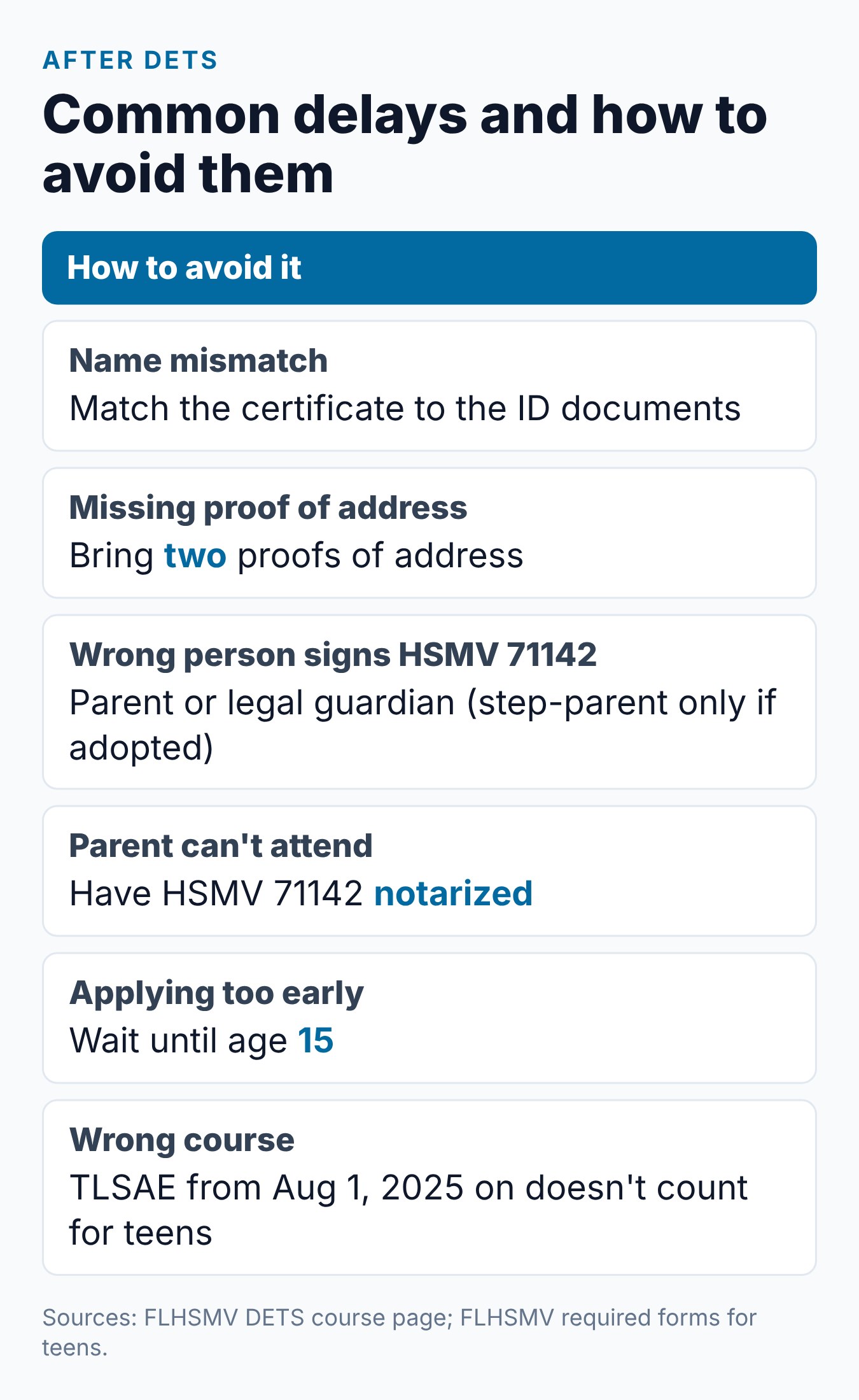
Most delays come from preventable problems:
- Name mismatch between the certificate and identity documents
- Missing proof of address, since two are required
- Wrong person signing HSMV 71142, such as a step-parent who has not adopted the teen
- No notary when the parent cannot attend
- Applying before 15
- Wrong course, such as a TLSAE certificate from on or after August 1, 2025
If the office cannot find your completion, show your certificate copy and call your provider. Ask them to confirm the date they reported it.
What Changes If You Are 18 or Older
DETS is only for applicants under 18. If you are 18 or older and getting a first Florida license, you take the 4-hour TLSAE course instead.
Adults also skip the parental consent form and the teen license limits. If you are close to 18, compare both paths before you buy a course.
A Simple Checklist
Print or save this list before your office visit:
- DETS certificate copy, checked for errors
- Proof of identity
- Proof of Social Security number
- Two proofs of residential address
- HSMV 71142, signed in front of the examiner or notarized
- HSMV 71144, if you took the knowledge exam online
- Glasses or contacts, if needed
- Payment for the learner’s license fee
With these in hand, most teens finish the visit in one trip. For the full path, see our Florida DETS Course: The Complete Guide for Teens Under 18 and the parent guide, Florida DETS Course for Teens: What Parents Need to Know.
How Requirements Can Vary
Florida’s course and license rules apply statewide, but some details depend on where you live. Driver license services are often handled by your county tax collector’s office, and each office sets its own appointment process and hours. Some county school boards also offer driver education programs, such as DELAP courses, that can count instead of DETS.
FLHSMV can update course rules, forms, documents, and fees. Check FLHSMV and your county office for current requirements before your appointment.
Frequently Asked Questions
What do I do after I finish the Florida DETS course?
Save and check your certificate, gather your documents, get HSMV 71142 signed, pass the knowledge exam and vision and hearing tests, and apply for a learner’s license at 15 or older.
Does the provider send my DETS completion to FLHSMV?
Yes. Approved providers report DETS completions through DICIS. Keep your own copy as a backup.
Do I need an appointment at the driver license office?
It depends on your county. Many county tax collector offices offer online appointments, so check your county’s website.
Can I take the knowledge exam online after DETS?
Yes, through a third-party administrator. A parent or guardian must complete HSMV 71144 for an online exam.
How long until I can get my driver license?
You must hold the learner’s license for 12 months or until 18, and be at least 16, before applying for a driver license.
What if I fail the knowledge exam?
Study the topics you missed and try again. Ask your county office or the online test administrator about retake rules and any fees.
Do I need to bring my DETS certificate to the office?
Your provider reports your completion to FLHSMV. Bringing a copy is still a good backup in case of a question.
What if I am 18 or older?
You take the 4-hour TLSAE course instead of DETS. Adults do not need the parental consent form.
Conclusion
Your Florida DETS course next steps are to check your certificate, gather documents, get HSMV 71142 signed, and pass the knowledge, vision, and hearing tests. Then you apply for a learner’s license at 15 or older and start logging your 50 practice hours. Driving Logic is a state-approved driver improvement course provider, and our online Florida DETS course is coming soon.
Related Articles
- Florida DETS Course: The Complete Guide for Teens Under 18
- Florida DETS Course Certificate: What It Is and How to Use It
- Florida DETS Course for Teens: What Parents Need to Know
Sources
- FLHSMV — Driver Education Traffic Safety (DETS) and approved provider list
- FLHSMV — DETS Course Frequently Asked Questions
- FLHSMV — Required Forms for Teens
- FLHSMV — Parental Consent Form HSMV 71142
- FLHSMV — Teen Licensing Requirements and Graduated Driver License Laws
- Florida Statutes — F.S. 322.1615 (Learner’s Driver License)
- Hillsborough County Tax Collector — Class E Learner Driver License
Billy Forte is the owner of Driving Logic, a state-approved driver improvement course provider serving Florida and other U.S. states.
This article is general information, not legal advice. Florida licensing requirements, course rules, documents, and fees are set by FLHSMV and Florida law and can change. Use official FLHSMV and Florida statute sources for current requirements before you enroll in a course or visit a driver license office.