
Updated October 2026 · Reviewed by Billy Forte
Florida DETS vs TLSAE comes down to age: first-time applicants under 18 take the 6-hour DETS course, and first-time applicants 18 and older take the 4-hour TLSAE course. The change took effect on August 1, 2025, when DETS replaced TLSAE for teens. TLSAE was not removed, and adults still need it.
Key Facts
- The rule: Under 18 takes DETS, and 18 and older takes TLSAE. See the rule.
- Length: DETS is at least 6 hours, and TLSAE is at least 4 hours. See the side-by-side table.
- What changed: Before August 1, 2025, Florida teens took TLSAE. See the timeline.
- Old TLSAE certificates: Teen TLSAE certificates from before August 1, 2025, were good for one year, and those windows have now closed. See the transition rules.
- Mix-ups: A teen who takes TLSAE after August 1, 2025, usually has to take DETS too. See common mistakes.
The One Rule That Decides It
You do not need to compare course features to choose between DETS and TLSAE. Florida decides it by your age when you apply for your first license.
- Under 18 and never licensed anywhere: You need DETS (Driver Education Traffic Safety).
- 18 or older and never licensed: You need TLSAE (Traffic Law and Substance Abuse Education).
FLHSMV explains the teen rule on its DETS course page. The adult course comes from F.S. 322.095, the Florida law that created TLSAE.
Many people call TLSAE “the drug and alcohol course.” Some websites also call DETS “the 6-hour drug and alcohol course,” which causes confusion. If you see that name, read Florida 6-Hour Drug and Alcohol Course: Is It the Same as DETS? before you buy anything.
Florida DETS vs TLSAE Side by Side
| DETS | TLSAE | |
|---|---|---|
| Full name | Driver Education Traffic Safety | Traffic Law and Substance Abuse Education |
| Who takes it | First-time applicants under 18 | First-time applicants 18 and older |
| Minimum length | At least 6 hours | At least 4 hours |
| Standard it follows | Meets or exceeds FDOE course 1900300 | Required under F.S. 322.095 |
| Final exam | 40 questions, 80% to pass | Set by the course |
| Delivery | Online or in person | Online or in person, from approved providers |
| Status | Required for teens since August 1, 2025 | Still required for adults |
The biggest difference is depth. DETS has to meet or exceed the standards Florida uses for school driver education classes, so it covers more than TLSAE. It also has a set final exam that FLHSMV describes in its DETS FAQ.
What Each Course Covers
Both courses teach traffic laws and the dangers of driving after alcohol or drugs. DETS goes further because it follows the classroom standards for Florida driver education (course 1900300).
DETS topics include:
- Florida traffic laws, signs, signals, and pavement markings
- Right-of-way and sharing the road with trucks, buses, bikes, and pedestrians
- Defensive driving and spotting hazards
- DUI, Zero Tolerance, and Implied Consent
- Distracted and drowsy driving
- Florida’s graduated driver license rules for teens
- Crash steps and bad-weather driving
TLSAE focuses on Florida traffic laws and how alcohol and drugs affect a driver. It is shorter because it is written for adults getting a first license, not for new teen drivers.
What Changed in 2025
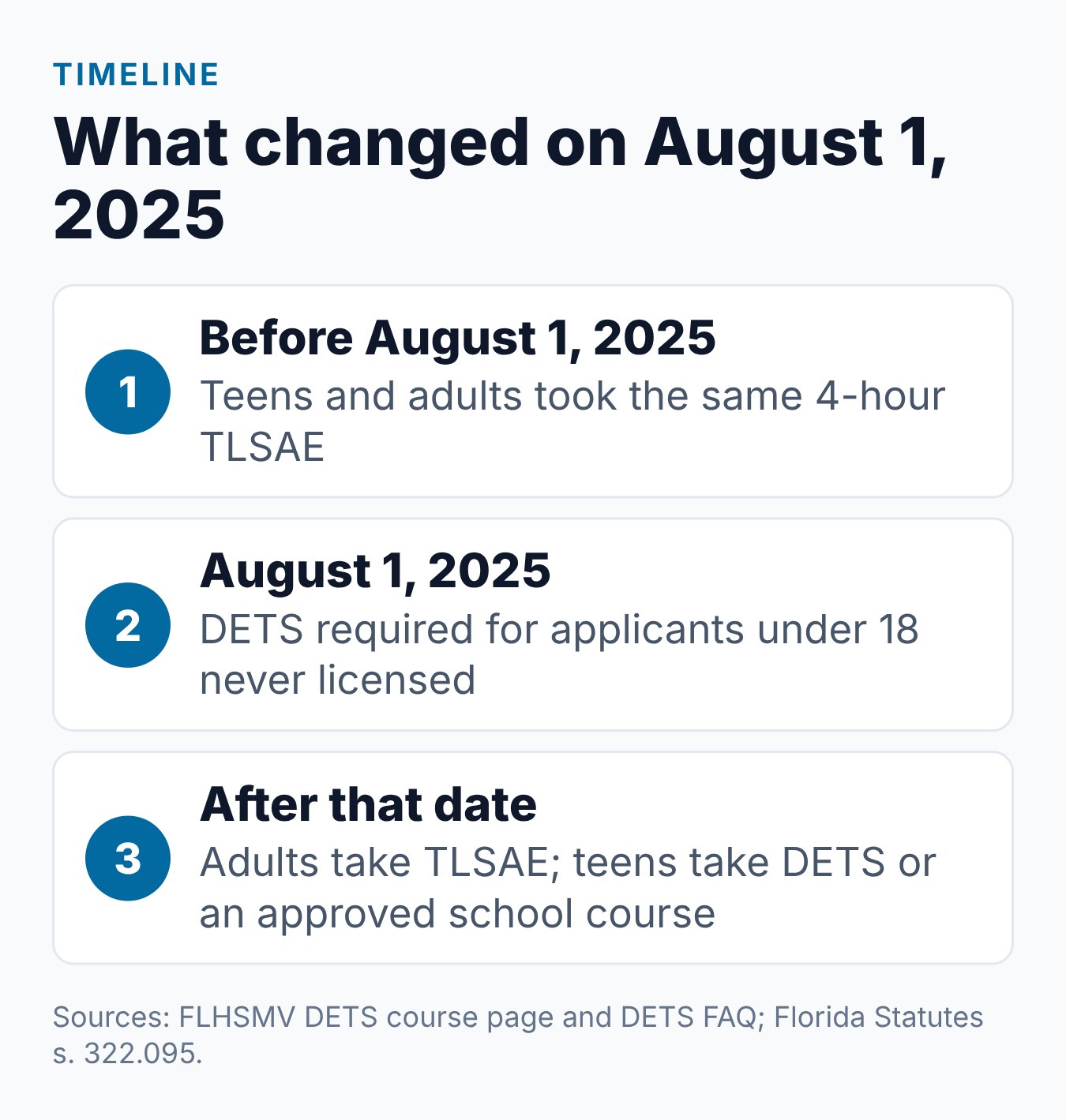
Before the change, Florida teens and adults took the same 4-hour TLSAE course before their first license. Florida then created DETS for teens, with a 6-hour minimum and a school-based standard.
Here is the timeline in plain terms:
- Before August 1, 2025: Teens took TLSAE.
- August 1, 2025: DETS became required for applicants under 18 who had never held a license.
- After that date: Adults kept taking TLSAE, and teens took DETS.
FLHSMV also named school options that count instead of DETS. They include Florida Department of Education courses 1900300 and 1900310 and some county school board DELAP courses.
What About a TLSAE Course a Teen Already Took?
FLHSMV set a transition rule based on when the course was completed:
- Completed before August 1, 2025: The teen could use the TLSAE certificate for one year from the completion date.
- Completed on or after August 1, 2025: It does not meet the teen requirement, unless the teen is in an approved school course (1900300, 1900310, or a qualifying DELAP course).
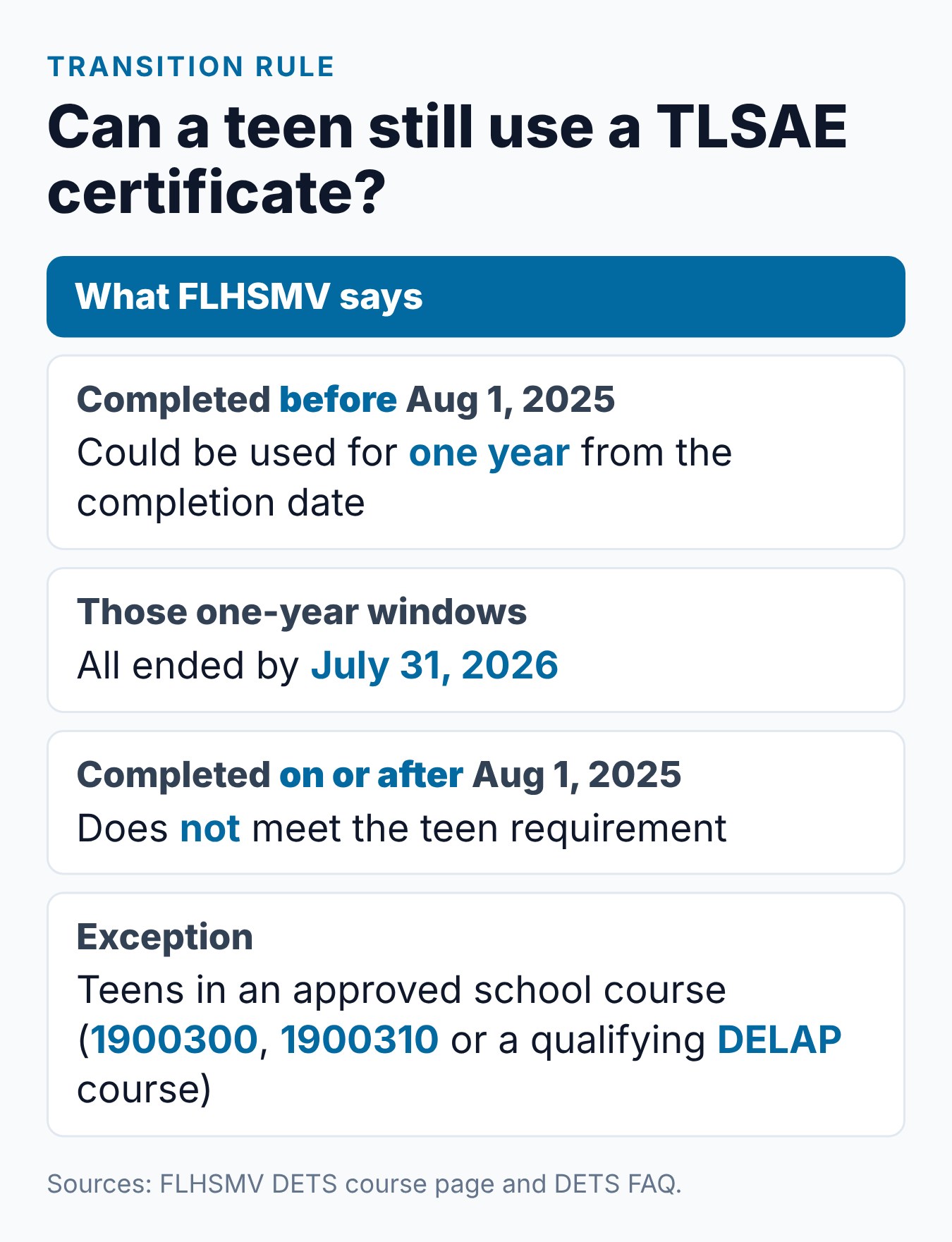
Every one-year window has now ended. The last pre-August 2025 certificates expired by July 31, 2026. So a teen who still needs a first license should plan on DETS.
Who Needs Which Course: Real Situations
Most families fit one of these cases:
| Situation | Course needed |
|---|---|
| A 15-year-old applying for a first learner’s license | DETS |
| A 17-year-old who has never held a license | DETS |
| A 19-year-old getting a first Florida license | TLSAE |
| A 16-year-old moving to Florida with a valid license from another state | Neither DETS nor TLSAE, per FLHSMV’s exemption for transfers |
| A teen who held a Florida learner’s license before August 1, 2025 | Not affected by the DETS rule |
| A teen in a qualifying school driver education course | School course may count instead of DETS |
If you are close to your 18th birthday, think about timing. The course you need depends on your age when you apply. A 17-year-old who applies before turning 18 needs DETS, and an 18-year-old needs TLSAE.
What Comes After Each Course
Neither course gives you a license by itself. Each one is the first step, and the next steps depend on your age.
After DETS (teens under 18):
- Be at least 15 to apply for a learner’s license under F.S. 322.1615.
- Pass the knowledge exam, which has 50 questions, and you need 40 correct.
- Pass the vision and hearing tests.
- Bring a signed parental consent form, HSMV 71142, plus identity and address documents.
- Drive with a licensed adult 21 or older while you hold the learner’s license.
After TLSAE (adults 18 and older):
- Bring your identity and address documents to a driver license office.
- Pass the knowledge exam and the vision and hearing tests.
- Complete any driving skills test FLHSMV requires for your license type.
Your provider reports your course completion to FLHSMV, so the office can see it. It is still smart to keep a copy of your certificate.
How the Two Courses Feel Different
The courses share a subject, but they are built for different readers. That changes how they teach.
DETS is built for brand-new teen drivers. It assumes the student has never driven alone.
So it spends more time on basics like scanning the road, managing space around the car, and reading signs. It also covers Florida’s graduated license rules, which limit when teens can drive.
TLSAE is built for adults. Many adults taking it have ridden in cars for years and may have driven in another country. The course focuses on Florida traffic law and the risks of impaired driving.
The final steps also differ. DETS ends with a 40-question final exam that you must pass with 80%. TLSAE providers follow their own approved course design.
What the Change Means for Parents
If you have an older child who got a license before August 2025, the process may look different now. That older child likely took the 4-hour TLSAE. A younger teen now takes the 6-hour DETS course instead.
Plan for the extra time. Six hours fits well into two or three short sessions after school or on a weekend.
Also plan for the parental consent form. A parent or legal guardian signs HSMV 71142 in front of a driver license examiner, or has it notarized ahead of time. Our Florida DETS Course: The Complete Guide for Teens Under 18 covers each step after DETS.
Questions to Ask Before You Pay
A course provider should answer these questions clearly. If it cannot, pick another one.
- Is this the 6-hour DETS course or the 4-hour TLSAE course?
- Which FLHSMV-approved provider’s course is this?
- How many final exam attempts do I get?
- Is there an extra certificate or handling fee?
- How long do I have to finish?
- Will my completion be reported to FLHSMV, and when?
These answers matter more than the price. A cheap course is not a bargain if it is the wrong one for your age.
Mistakes That Cost Families Time
The two courses have similar names on many websites, so mix-ups happen. Watch for these:
- Buying TLSAE for a teen. It will not count for an applicant under 18 who completed it after August 1, 2025.
- Buying DETS for an adult. Adults 18 and older need TLSAE.
- Trusting a course name alone. Check the hours and the age group, not only the title.
- Relying on an old TLSAE certificate. Teen certificates from before August 1, 2025, have expired.
- Skipping the approval check. Use FLHSMV’s approved DETS list or its TLSAE provider list.
People often say they are taking “the DMV course.” In Florida, these courses are approved by FLHSMV, and county tax collector offices handle many license visits. Use the course name, hours, and age group to pick the right one.
How to Check Before You Buy
A quick four-part check prevents most problems:
- Age: Under 18 means DETS. Eighteen or older means TLSAE.
- Hours: DETS is at least 6 hours. TLSAE is at least 4 hours.
- Approval: Find the provider on the matching FLHSMV list.
- Terms: Read the retake rules, the time limit, and any extra fees before you pay.
If any of these checks fail, stop and pick a different course. Fixing the wrong course later costs more time than checking now.
For the full DETS process, read our Florida DETS Course: The Complete Guide for Teens Under 18. For timing details, see How Long Is the Florida DETS Course and How Is It Structured?.
How Requirements Can Vary
Florida’s course and license rules apply statewide, but some details depend on where you live. Driver license services are often handled by your county tax collector’s office, and each office sets its own appointment process and hours. Some county school boards also offer driver education programs, such as DELAP courses, that can count instead of DETS.
FLHSMV can update course rules, forms, documents, and fees. Check FLHSMV and your county office for current requirements before your appointment.
Frequently Asked Questions
What is the difference between DETS and TLSAE in Florida?
DETS is the 6-hour course for first-time applicants under 18. TLSAE is the 4-hour course for first-time applicants 18 and older.
Did DETS replace TLSAE?
Only for teens. Since August 1, 2025, applicants under 18 take DETS, while adults 18 and older still take TLSAE.
Can a 17-year-old take TLSAE instead of DETS?
Generally, no. A TLSAE course completed on or after August 1, 2025, does not meet the teen requirement unless the teen is in an approved school course.
Is TLSAE still required for adults?
Yes. Florida still requires TLSAE for first-time license applicants 18 and older under F.S. 322.095.
Does an old TLSAE certificate still count for a teen?
No. Teen TLSAE certificates completed before August 1, 2025, were good for one year, and all of those windows have closed.
Is DETS harder than TLSAE?
DETS is longer and more detailed because it follows Florida’s school driver education standards. It also ends with a 40-question final exam that requires 80% to pass.
Can I take DETS or TLSAE online?
Yes. Both courses are offered online by approved providers. Check the matching FLHSMV provider list before you pay.
Which course do I need if I move to Florida with a license?
FLHSMV says teens transferring a valid out-of-state license are not affected by the DETS rule. Check FLHSMV’s rules for adult transfers before your appointment.
Conclusion
The Florida DETS vs TLSAE choice depends on your age when you apply. Teens under 18 take the 6-hour DETS course, and adults 18 and older still take the 4-hour TLSAE. Check the hours, the age group, and FLHSMV approval before you buy. Driving Logic is a state-approved driver improvement course provider, and our online Florida DETS course is coming soon.
Related Articles
- Florida DETS Course: The Complete Guide for Teens Under 18
- Florida 6-Hour Drug and Alcohol Course: Is It the Same as DETS?
- How Long Is the Florida DETS Course and How Is It Structured?
Sources
- FLHSMV — Driver Education Traffic Safety (DETS) and approved provider list
- FLHSMV — DETS Course Frequently Asked Questions
- FLHSMV — Driver Education Courses
- Florida Statutes — F.S. 322.1615 (Learner’s Driver License)
- Florida Statutes — F.S. 322.095 (TLSAE)
- FLHSMV — Approved TLSAE Course Providers
- CPALMS — Driver Education/Traffic Safety-Classroom (#1900300)
Billy Forte is the owner of Driving Logic, a state-approved driver improvement course provider serving Florida and other U.S. states.
This article is general information, not legal advice. Florida licensing requirements, course rules, documents, and fees are set by FLHSMV and Florida law and can change. Use official FLHSMV and Florida statute sources for current requirements before you enroll in a course or visit a driver license office.