
Updated October 2026 · Reviewed by Billy Forte
The Florida 50-hour driving requirement means a teen must drive at least 50 hours with a licensed driver 21 or older, including 10 hours at night, before getting a Class E license. A parent, guardian or responsible adult 21 or older then certifies those hours on form HSMV 71143. FLHSMV offers a practice log sheet to help you track them.
Key Facts
- The rule: 50 hours of supervised driving, at least 10 at night. See the rule.
- Night hours: Can’t start until month 4, because the first 3 months are daylight only. See the night-hour timing.
- Tracking: Use FLHSMV’s practice log sheet or your own log. See how to track.
- Certifying: An adult 21+ signs HSMV 71143 before an examiner or a notary. See the form.
- Pace: About 1 hour a week over a year reaches 50 hours. See the weekly pace.
What the Florida 50-Hour Driving Requirement Is
FLHSMV’s teen licensing page lists 50 hours of driving experience, including 10 at night, as a condition for a Class E license at 16 or 17. The law behind it is F.S. 322.05(3), which the certification form cites.
Every hour must follow the learner’s permit rules. That means a licensed driver 21 or older in the front passenger seat, and no driving outside the allowed hours.
The 50 hours are a minimum. Nothing stops a family from driving more, and many skills take more than 50 hours to feel easy.
Why Florida Requires Supervised Hours
The 50 hours are part of Florida’s graduated driver license (GDL) system. The idea is that new drivers build skill with an experienced adult beside them before they drive alone.
The night-hour rule exists because driving after dark is different. Many people search for the Florida 50 hours driving requirement as just a number, but the night hours are the part that needs planning.
Who Must Complete It
The 50 hours apply to teens under 18 who are moving from a learner’s permit to a Class E license. FLHSMV calls the form the Certification of Driving Experience of a Minor, so it’s a teen rule.
- Teens 16 and 17: Must certify 50 hours to get a Class E license.
- Adults 18 and older: Don’t need a permit or the 50-hour certification.
- New residents with a valid out-of-state license: Transfer the license instead. See our new resident guide.
Who Can Supervise the Hours
Under F.S. 322.1615, the supervising driver must be 21 or older, hold a valid license for the vehicle and sit in the front passenger seat. It doesn’t have to be a parent.
Grandparents, aunts and uncles, older siblings 21 or older and family friends can all supervise. Hours with any qualified driver count toward the 50. For the full list of permit rules, see our restrictions guide.
Do Driving Lesson Hours Count?
Paid lessons aren’t required. If a family chooses them, time with an instructor who is 21 or older, holds a valid license and sits in the front seat meets the same supervision rule.
Just add those drives to your log like any other. The adult who signs HSMV 71143 is certifying the total, so they should know about every hour on the log.
The 10 Night Hours
This is the part many families plan wrong. For the first 3 months after the permit is issued, F.S. 322.1615 allows daylight driving only.
So no night hours can be logged in months 1 to 3. After that, driving is allowed until 10 p.m., which is when night practice becomes possible.
- Months 1 to 3: Daylight hours only. Log day hours.
- Months 4 to 12: Night driving allowed until 10 p.m. Log the 10 night hours here.
- After 10 p.m.: No driving on a permit, so no hours can be logged.
It gets dark earlier in winter. If your months 4 to 12 include winter, night practice is easier to fit in well before the 10 p.m. cutoff.
A Realistic Weekly Pace
Fifty hours sounds like a lot until you spread it out. This table shows the weekly pace for different time frames.
| If you spread the 50 hours over | Weekly pace needed |
|---|---|
| 12 months (52 weeks) | About 1 hour |
| 9 months (39 weeks) | About 1 hour 20 minutes |
| 6 months (26 weeks) | About 2 hours |
| 3 months (13 weeks) | About 4 hours |
Even the fastest pace has a limit. The 10 night hours can’t happen before month 4, and the permit must be held 12 months anyway.
Finishing early doesn’t shorten the holding period. See our holding period guide.
One Way to Split Day and Night Hours
Here is simple math for a teen who holds the permit a full 12 months. It’s one option, not a rule.
- 40 day hours over 12 months: a little under 1 hour a week.
- 10 night hours over months 4 to 12: about 1 night hour a month.
Front-load day hours a bit in months 1 to 3, since that’s all you can do then. Then add a night drive or two each month once month 4 starts.
How to Track the Hours
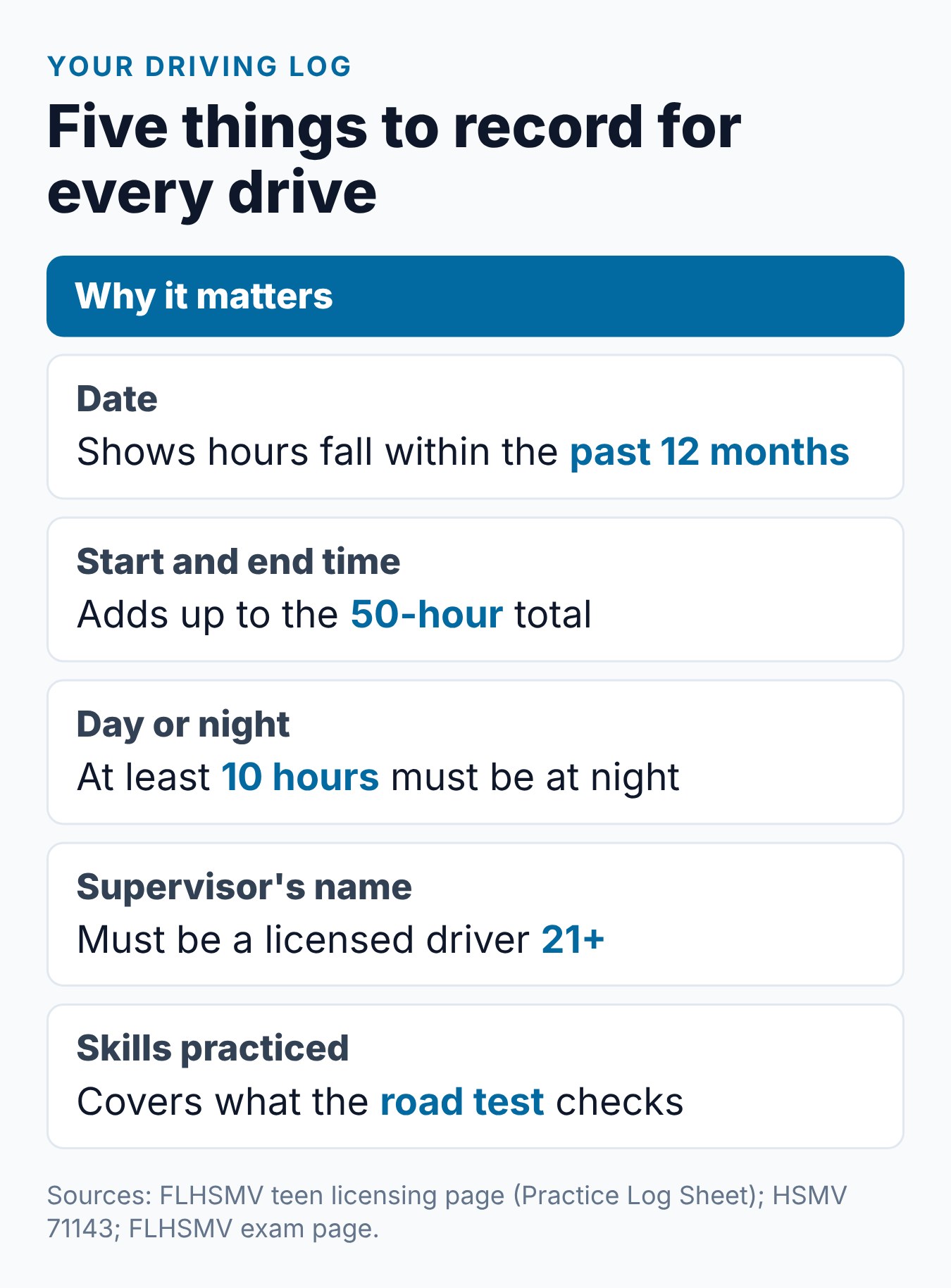
FLHSMV’s teen page says driving experience can be tracked with its Practice Log Sheet. You can also keep your own log in a notebook or an app, as long as it’s complete and honest.
Write down each drive right after it ends. These five items make the log useful:
- The date
- Start and end time, or total minutes
- Day or night
- The supervising driver’s name
- The skills practiced
Keep a running total for day hours and night hours, and check it at the end of each month so there are no surprises near the 12-month mark. When the night total reaches 10 and the overall total reaches 50, you have met the minimum.
The log isn’t turned in to FLHSMV. The certification form is. But a written log makes the signature on the form accurate, and it helps if questions come up.
What to Practice in 50 Hours
Practice should prepare the teen for the road test and for driving alone. FLHSMV’s exam page lists what the driving skills test checks.
- Three-point turns
- Straight-in parking and parking on a grade
- Stopping quickly
- Backing up 50 feet
- Stop signs, traffic signals, signaling and turning
- Passing, staying in your lane and a following distance of at least four seconds
- Yielding right-of-way and approaching crossings
Build these skills in steps. Start in an empty lot, then quiet streets, then busier roads. Save highways, heavy traffic and night drives for after the basics feel steady.
Florida weather is part of real driving. Practice in rain with your supervisor so the first rainy drive isn’t a solo one. The same goes for glare, heavy traffic and unfamiliar roads, so add each of these before the hours run out.
Making Each Practice Drive Count
Hours alone don’t make a safe driver. A drive with a goal teaches more than a drive with no plan.
- Pick one skill per drive. For example, left turns at busy lights or parking on a hill.
- Repeat the road test moves. Do a few three-point turns and quick stops each week.
- Talk after the drive. Spend two minutes on what went well and what to try next time.
- Change the setting. Mix neighborhoods, main roads, parking lots, rain and night.
Certifying the Hours on HSMV 71143
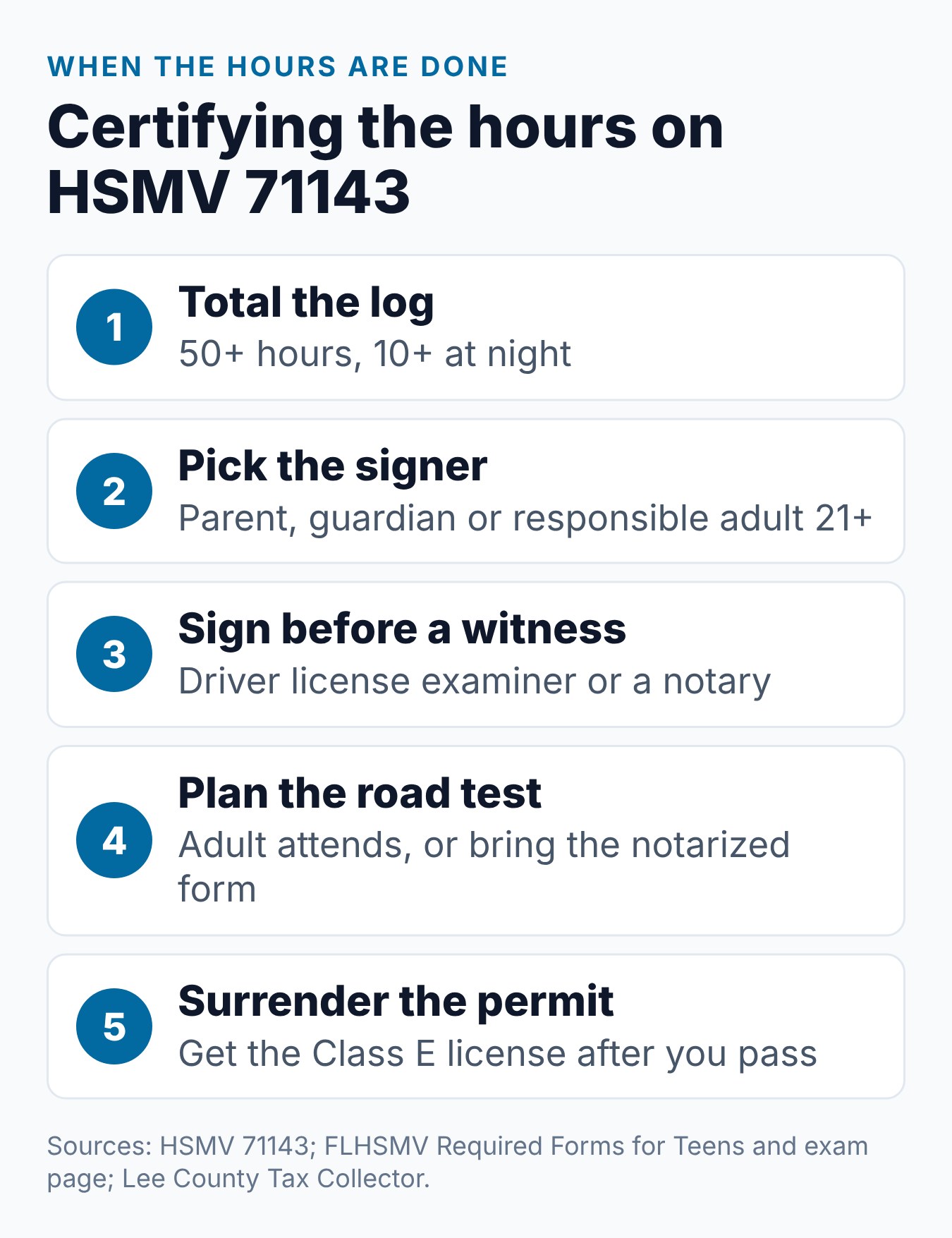
When the hours are done, an adult signs HSMV 71143, the Certification of Driving Experience of a Minor. Here is what the form says:
- One parent, legal guardian or other responsible adult 21 or older signs it.
- It certifies the teen drove at least 50 hours in the past 12 months, 10 of them at night.
- All signatures must be notarized or witnessed by an examiner.
FLHSMV’s Required Forms for Teens page lists it as required for a minor to get a driver license. The Lee County Tax Collector says an adult 21+ must attend a teen’s road test, or the teen brings HSMV 71143 already notarized.
Note the “past 12 months” wording. Hours driven before the permit was issued don’t count, since driving without a permit isn’t allowed.
After the 50 Hours
Finishing the hours is one of four conditions for a Class E license. The others are holding the permit 12 months (or until 18), having no moving violation convictions in that year and passing the driving skills test.
The test vehicle must have valid registration and proof of insurance and pass a basic inspection. After the teen passes, they surrender the learner’s license for a Class E license. Our Florida GDL guide covers the hour limits that apply at 16 and 17.
What If the Hours Aren’t Done at 12 Months?
The teen keeps practicing under the permit rules until the hours are finished. There’s no rule that the license must be issued right at 12 months.
The Class E license just waits. The adult should sign HSMV 71143 only once the log shows at least 50 hours, including 10 at night, in the past 12 months.
Common 50-Hour Mistakes
These come straight from the official rules.
- Planning night hours for month 1. Months 1 to 3 are daylight only.
- Driving after 10 p.m. to log night time. It breaks the permit rules, and those hours shouldn’t count.
- A supervisor under 21. The supervising driver must be 21 or older.
- No log until the end. Estimating from memory makes the certification less accurate.
- Signing HSMV 71143 at home. It must be notarized or signed before an examiner.
How Requirements Can Vary
Florida’s course and license rules apply statewide, but some details depend on where you live. Driver license services are often handled by your county tax collector’s office, and each office sets its own appointment process and hours. Some county school boards also offer driver education programs, such as DELAP courses, that can count instead of DETS.
FLHSMV can update course rules, forms, documents, and fees. Check FLHSMV and your county office for current requirements before your appointment.
Frequently Asked Questions
What is the 50-hour driving requirement in Florida?
Teens must drive at least 50 hours with a licensed driver 21 or older, including 10 hours at night, before getting a Class E license. An adult certifies the hours on HSMV 71143.
Who can sign the 50-hour form in Florida?
A parent, legal guardian or another responsible adult 21 or older. The signature must be notarized or witnessed by an examiner.
Do I have to turn in a driving log?
FLHSMV requires the HSMV 71143 certification, and it offers a practice log sheet to track hours. Keep your log in case questions come up.
When can my teen start the 10 night hours?
After the first 3 months of the permit. Until then, permit holders may drive in daylight only, and the cutoff after that is 10 p.m.
Can hours with a grandparent count?
Yes, if the grandparent is 21 or older, has a valid license and sits in the front passenger seat.
Does finishing 50 hours early let my teen get a license sooner?
No. The teen must still hold the permit 12 months, or until 18, before getting a Class E license.
Do adults need 50 hours of driving in Florida?
No. The 50-hour certification is for minors. Adults 18 and older don’t need a permit or the certification.
Conclusion
The Florida 50-hour driving requirement asks teens to log 50 supervised hours, including 10 at night, before a Class E license.
Plan day hours early, save night hours for month 4 and later, and keep a simple log. When the hours are done, have an adult 21+ sign HSMV 71143 before an examiner or a notary. Our online Florida DETS course is coming soon.
Related Articles
- Florida Learner’s Permit: How to Get It, Requirements, and What It Allows
- Florida Learner’s Permit Holding Period: How Long Before a License?
- Florida Learner’s Permit Restrictions: What Teens Can and Can’t Do
- Florida Graduated Driver License (GDL): The Three Stages for Teen Drivers
Sources
- FLHSMV — Teen Licensing Requirements and Graduated Driver License Laws
- FLHSMV — Certification of Driving Experience of a Minor, HSMV 71143
- FLHSMV — Required Forms for Teens (HSMV 71142, 71143, 71144)
- FLHSMV — Class E Knowledge Exam and Driving Skills Test
- Florida Statutes — F.S. 322.1615 (Learner’s Driver License)
- Lee County Tax Collector — First Time Drivers
- FLHSMV — Teen Licensing Frequently Asked Questions
Billy Forte is the owner of Driving Logic, a state-approved driver improvement course provider serving Florida and other U.S. states.
This article is general information, not legal advice. Florida licensing requirements, course rules, documents, and fees are set by FLHSMV and Florida law and can change. Use official FLHSMV and Florida statute sources for current requirements before you enroll in a course or visit a driver license office.