
Updated October 2026 · Reviewed by Billy Forte
Florida learner’s permit restrictions are short but strict: a licensed driver 21 or older must sit in the front passenger seat every time you drive, and you may never drive alone. For the first 3 months you may drive in daylight only, and after that until 10 p.m. These rules last until you earn a Class E license, which takes at least 12 months for most teens.
Key Facts
- Supervision: A licensed driver 21 or older in the front passenger seat, on every trip. See the supervision rule.
- First 3 months: Daylight hours only. See the time limits.
- After 3 months: Driving allowed until 10 p.m. See the time limits.
- Breaking a rule: It’s treated as a moving violation, and a conviction can delay your license. See the penalties.
- When they end: When you get a Class E license, usually at 16 or later. See when the rules end.
Why Florida Limits New Drivers
Florida uses a graduated driver license (GDL) system. New drivers get more freedom in steps, starting with supervised practice and moving to solo driving later.
The permit stage keeps an experienced adult in the car while a new driver learns. The daylight-only months come first because driving after dark is harder for someone just starting out.
Florida Learner’s Permit Restrictions at a Glance
Florida’s learner’s permit rules come from one law, F.S. 322.1615. It sets three limits on every permit holder.
- Who rides with you. A driver 21 or older with a valid license sits in the seat closest to your right.
- When you drive. Daylight only for 3 months from the issue date, then until 10 p.m.
- Driving alone. It’s never allowed while you hold a learner’s permit.
FLHSMV’s teen licensing page lists the same rules. They apply on every public road in Florida, on every trip, no matter how short.
Rule 1: A Licensed Driver 21 or Older Beside You
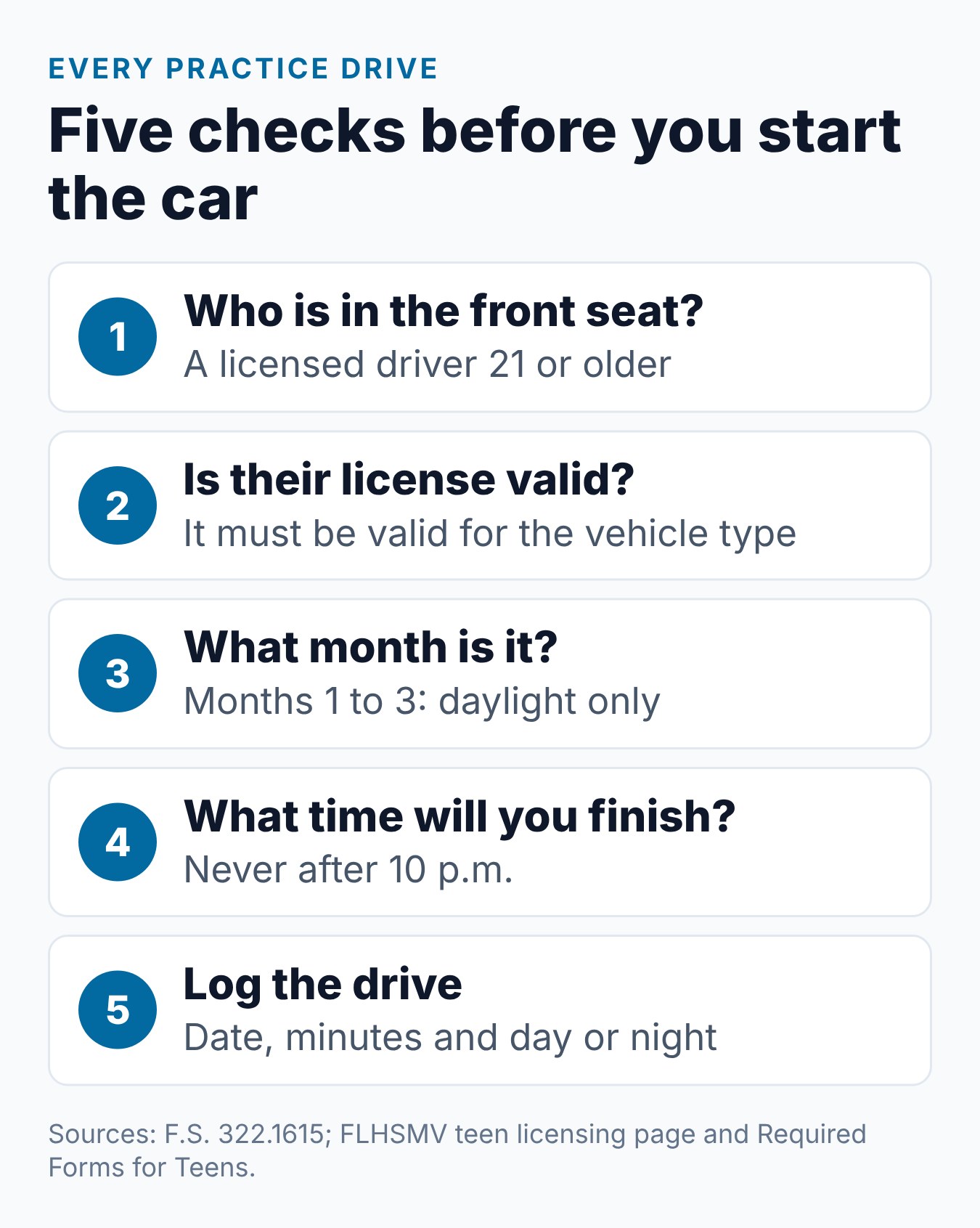
The law says the supervising driver must hold a valid license for the type of vehicle you are driving, be at least 21 and sit in the closest seat to your right. In a car, that’s the front passenger seat.
The supervisor doesn’t have to be a parent. Any adult who meets all three conditions qualifies.
| Possible supervisor | OK under F.S. 322.1615? |
|---|---|
| Parent, 21+, with a valid license | Yes |
| Grandparent, 21+, with a valid license | Yes |
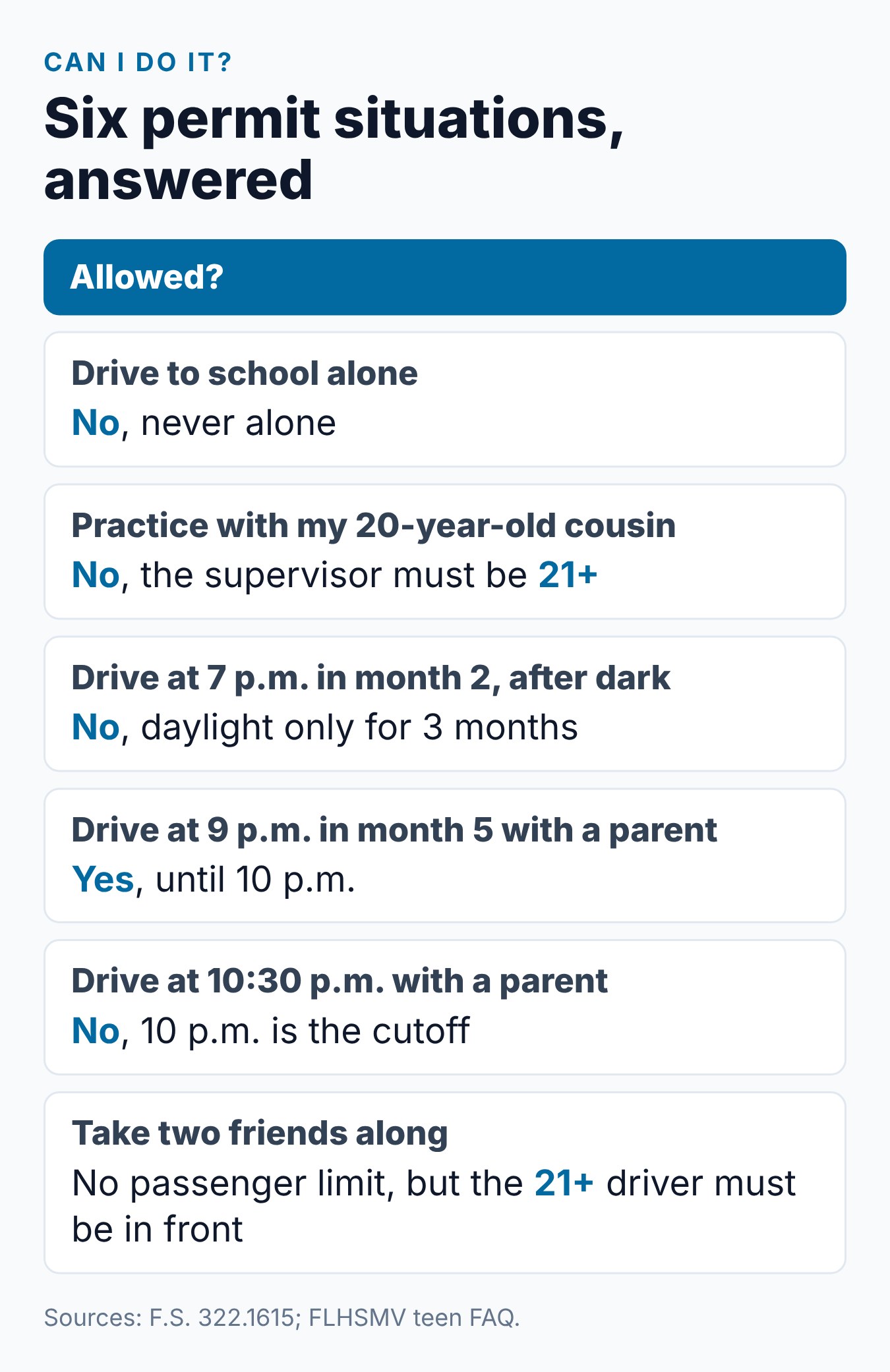
| Older sibling who is 20 | No, must be 21 or older |
| Adult 21+ in the back seat | No, must be in the front passenger seat |
| Adult 21+ whose license is suspended | No, the license must be valid |
A common question is whether a teen can drive to school alone on a permit. FLHSMV’s teen FAQ answers it directly: no. The licensed driver 21 or older must be in the front passenger seat at all times.
There is also no work exception for permit holders. The work exception you may hear about applies to licensed 16- and 17-year-olds, not to permits.
Rule 2: Daylight First, Then Until 10 p.m.
For the first 3 months after the permit is issued, you may drive during daylight hours only. After 3 months, you may drive until 10 p.m.
The 3 months count from the issue date on your permit, not from your birthday or the day you passed the test. Here is how that works with a sample date:
- Permit issued March 10: Daylight only through June 9.
- Starting June 10: Driving allowed until 10 p.m., still with a licensed driver 21+.
- Any day, after 10 p.m.: No driving on a learner’s permit.
The law doesn’t list exact clock times for “daylight.” Sunset changes through the year, so plan practice drives to end well before dark during the first 3 months.
Why This Matters for Your 50 Hours
Teens must log 50 hours of supervised driving, including 10 hours at night, before a Class E license. Because the first 3 months are daylight only, all 10 night hours have to come later.
For a teen who holds the permit a full 12 months, that leaves about 9 months to log night hours. Our 50-hour driving guide explains how to track and certify them.
Passengers and Vehicles
F.S. 322.1615 doesn’t set a passenger limit for permit holders. The only passenger it requires is the supervising driver in the front seat. Every passenger under 18 still needs a seat belt under Florida’s seat belt law, so you can’t carry more riders than you have belts for them.
Fewer riders still makes sense while you learn. Other teens in the car can pull your attention from the road, and your supervisor has to be able to watch and help.
The permit is a Class E learner’s license, for cars and other Class E vehicles. The Lee County Tax Collector notes that learner’s license holders can’t ride motorcycles, mopeds or go-peds.
Other Florida Laws That Apply to Permit Holders
The permit rules aren’t the only ones that apply. A learner’s permit is a driver license, so the laws for every driver apply to you too.
- Carry your permit. F.S. 322.15 says a licensee must have the license in immediate possession while driving and show it to an officer on request.
- Buckle up. Florida’s seat belt law, F.S. 316.614, requires the driver and every passenger under 18 to wear a seat belt. Front-seat passengers 18 and older must buckle up too.
- No texting. F.S. 316.305 bans typing or reading texts, e-mail and messages on a handheld device while driving. It applies to every driver, not just teens.
A ticket under any of these laws can still hurt you. Seat belt and first texting tickets are nonmoving violations, but a second texting violation within 5 years is a moving violation.
Tips for the Supervising Driver
The adult in the front seat has a real job, not just a ride. These habits help you follow the law and build the teen’s skills.
- Bring your own license. The law requires a valid license, so carry it every trip.
- Plan around the clock. Months 1 to 3 are daylight only, so schedule practice early enough to finish before dark.
- Track every drive. Write down the date, minutes and whether it was day or night. You’ll need the totals for the HSMV 71143 certification.
- Save night hours for later. Night practice can start in month 4, and it must end by 10 p.m.
- Mix the roads. Use quiet streets first, then busier roads, highways and parking lots as skills grow.
What Happens If You Break a Rule
Driving alone, driving with someone under 21, or driving outside the allowed hours breaks the permit law. F.S. 322.1615 says these are punished as a moving violation under Florida’s traffic penalty law.
The bigger cost is time. To get a Class E license, FLHSMV requires no moving violation convictions for one year from the date the permit was issued. One conviction is allowed if adjudication was withheld.
FLHSMV’s teen FAQ adds that anyone convicted of a moving violation must wait one year from the conviction date before getting a driver license. So a ticket in month 10 could push your license date out by many months.
Do Adults With a Permit Follow the Same Rules?
Yes. Adults 18 and older don’t need a learner’s permit, but some get one to practice before the road test.
F.S. 322.1615 applies its supervision and hour rules to “the holder of a learner’s driver license” with no age limit. So an adult permit holder also needs a licensed driver 21+ in the front seat, daylight-only driving for 3 months and a 10 p.m. cutoff after that.
The teen-only parts don’t apply to adults. There’s no 12-month holding period, no 50-hour certification and no HSMV 71142 for an adult. Our adult first-license guide explains that path.
Permit Rules vs Licensed Teen Rules
Permit rules and the rules for licensed teens are often mixed up. A licensed 16- or 17-year-old can drive alone, but only during certain hours under F.S. 322.16.
| Rule | Learner’s permit | Class E license, age 16 | Class E license, age 17 |
|---|---|---|---|
| Drive alone | Never | Yes, during allowed hours | Yes, during allowed hours |
| Late-night limit | No driving after 10 p.m. (daylight only for 3 months) | No driving 11 p.m. to 6 a.m. | No driving 1 a.m. to 5 a.m. |
| Exceptions to the time limit | None | Licensed driver 21+ along, or driving to or from work | Licensed driver 21+ along, or driving to or from work |
Our Florida GDL guide explains how the stages connect.
When the Restrictions End
Permit restrictions end when you get a Class E driver license. FLHSMV says a teen can apply at 16 or older after:
- Holding the permit 12 months, or until 18
- Logging 50 hours of supervised driving, 10 at night, certified on HSMV 71143
- Having no moving violation convictions in that year (one allowed if adjudication was withheld)
- Passing the Class E driving skills test
Our holding period guide shows the earliest license date for different permit ages.
Common Permit Rule Mistakes
Each of these comes from the official rules. All of them can lead to a moving violation.
- A quick trip alone. No exception exists for school, work or short errands.
- A supervisor who is 18 to 20. The law requires 21 or older.
- Supervisor in the back seat. The supervisor must sit in the seat closest to your right.
- Dusk drives in month 1. Daylight only means finishing before dark.
- Driving at 10:15 p.m. After month 3, the cutoff is still 10 p.m.
- Assuming the work exception applies. It’s only for licensed 16- and 17-year-olds.
How Requirements Can Vary
Florida’s course and license rules apply statewide, but some details depend on where you live. Driver license services are often handled by your county tax collector’s office, and each office sets its own appointment process and hours. Some county school boards also offer driver education programs, such as DELAP courses, that can count instead of DETS.
FLHSMV can update course rules, forms, documents, and fees. Check FLHSMV and your county office for current requirements before your appointment.
Frequently Asked Questions
What are the restrictions on a Florida learner’s permit?
A licensed driver 21 or older must sit in the front passenger seat every time. You may drive in daylight only for the first 3 months, then until 10 p.m.
Can I drive alone with a learner’s permit in Florida?
No. There are no exceptions for school, work or short trips.
Can my 18-year-old brother supervise me?
No. The supervising driver must be at least 21 and hold a valid license.
What time can I drive with a learner’s permit in Florida?
In the first 3 months, daylight hours only. After that, until 10 p.m., always with a licensed driver 21 or older.
Is there a passenger limit on a Florida learner’s permit?
F.S. 322.1615 doesn’t set one. It only requires the supervising driver in the front seat.
What happens if I get a ticket on my learner’s permit?
It’s a moving violation. A conviction can mean waiting one year from the conviction date before you can get a license, unless adjudication was withheld for your only violation.
When do learner’s permit restrictions end?
When you get a Class E license. Licensed 16- and 17-year-olds still have overnight hour limits until 18.
Conclusion
Florida learner’s permit restrictions come down to three rules: a licensed driver 21+ in the front seat, daylight only for 3 months, then no driving after 10 p.m.
Following them keeps your record clean, and a clean record keeps your license date on track. Plan night practice for after month 3 so the 10 night hours fit in your holding period. Our online Florida DETS course is coming soon.
Related Articles
- Florida Learner’s Permit: How to Get It, Requirements, and What It Allows
- Florida Graduated Driver License (GDL): The Three Stages for Teen Drivers
- Florida 50-Hour Driving Requirement: What Teens Need Before Getting a License
- Florida Learner’s Permit Holding Period: How Long Before a License?
Sources
- Florida Statutes — F.S. 322.1615 (Learner’s Driver License)
- FLHSMV — Teen Licensing Requirements and Graduated Driver License Laws
- FLHSMV — Teen Licensing Frequently Asked Questions
- Florida Statutes — F.S. 322.16 (License Restrictions)
- Lee County Tax Collector — First Time Drivers
Billy Forte is the owner of Driving Logic, a state-approved driver improvement course provider serving Florida and other U.S. states.
This article is general information, not legal advice. Florida licensing requirements, course rules, documents, and fees are set by FLHSMV and Florida law and can change. Use official FLHSMV and Florida statute sources for current requirements before you enroll in a course or visit a driver license office.