
Updated October 2026 · Reviewed by Billy Forte
To get a first-time Florida driver’s license as an adult 18 or older, you take the 4-hour TLSAE course, pass the Class E knowledge exam and a vision test, then pass the driving skills test. You also bring proof of identity, your Social Security number and two Florida address proofs. Adults don’t need a learner’s permit first, and they don’t take DETS, which is only for teens.
Key Facts
- Course: The 4-hour TLSAE (Traffic Law and Substance Abuse Education) course. See the course step.
- No permit needed: Adults can go straight to the tests for a full Class E license. See why.
- Tests: Knowledge exam (40 of 50 correct), vision test and a driving skills test in your own vehicle. See the tests.
- Language: Exams are in English only since February 6, 2026. See exam tips.
- Cost: FLHSMV lists $48 for an original Class E license; a $6.25 service fee may apply. See the costs.
Who Follows These Steps
These steps are for adults 18 and older who have never held a driver license anywhere. That includes people who never learned to drive, people who grew up without a car and people new to driving in the U.S.
Two groups follow different steps:
- Teens 15 to 17: They take DETS and must hold a learner’s permit first. See our learner’s permit guide.
- People with a valid license from another state: They transfer it and don’t take TLSAE. See our new Florida resident guide.
Do Adults Need a Learner’s Permit?
No. The Palm Beach County Tax Collector says adults 18 and older are not required to get a learner’s license. The Lee County Tax Collector says the same.
Some adults still choose one. A learner’s license lets you practice on public roads with a licensed driver 21 or older, which is the legal way to practice on public roads before you’re licensed.
If you get one, the same supervision and hour rules from F.S. 322.1615 apply: a licensed driver 21+ in the front seat, daylight only for 3 months, then until 10 p.m. Adults don’t have a 12-month holding period or 50-hour certification, so you can take the road test when you’re ready.
The Steps for a First-Time Florida Driver’s License
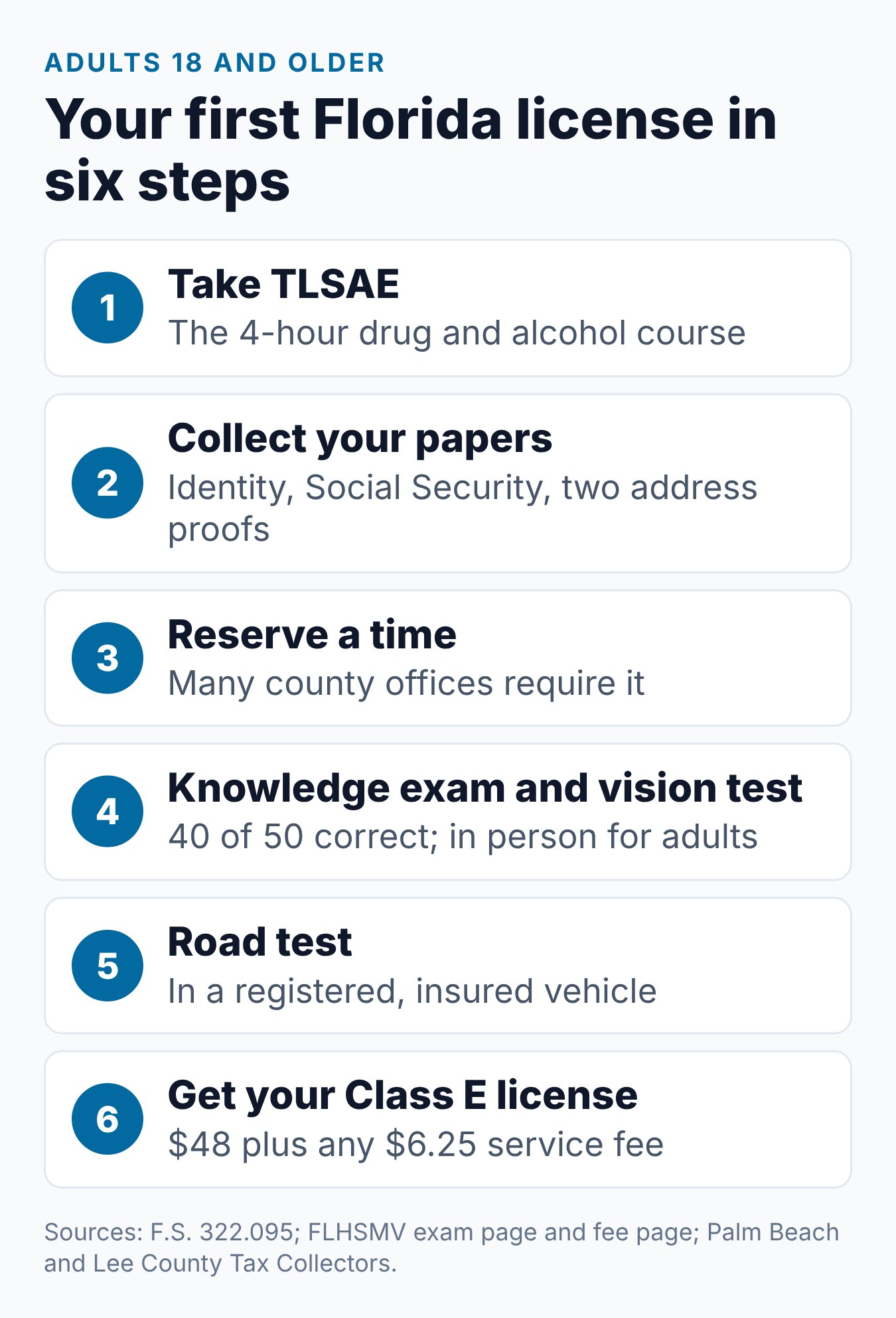
Here is the full order. Each step is explained below.
- Take the 4-hour TLSAE course.
- Gather your documents.
- Book a visit at your county driver license office.
- Pass the knowledge exam and the vision test.
- Pass the driving skills test.
- Pay the fee and get your Class E license.
Step 1: Take the TLSAE Course
F.S. 322.095 requires first-time applicants to complete TLSAE before a license is issued. It’s a 4-hour course on Florida traffic laws and the effects of alcohol and drugs on driving.
People also call it the drug and alcohol course or the 4-hour course. Both mean TLSAE.
Use a provider on FLHSMV’s approved TLSAE provider list. The Lee County Tax Collector notes TLSAE can be taken online or in person.
Don’t take DETS. It’s the 6-hour course for teens under 18 and doesn’t replace TLSAE for adults. Our DETS vs TLSAE guide explains the difference.
Step 2: Gather Your Documents
FLHSMV’s What to Bring page for U.S. citizens asks for three kinds of proof:
- Identity: For example, a certified U.S. birth certificate or a valid U.S. passport. Hospital birth certificates aren’t accepted.
- Social Security number: Your card, a W-2, a pay stub or a 1099 with your full number.
- Two Florida address proofs: For example, a lease, a utility bill, an insurance policy or mail from a bank or a government agency.
If your name changed by marriage, divorce or court order, bring an original or certified copy of that document. Photocopies aren’t accepted. Non-citizens use a different FLHSMV list for their status.
If you once held a license in another state that has since expired, your case is different from a true first-timer. The Pasco County Tax Collector says a written or road test may be required when an out-of-state license is expired. F.S. 322.095 also doesn’t require TLSAE for an applicant who “has been licensed in another jurisdiction,” so ask your county office which steps apply to you before you book.
Step 3: Book a Visit
Driver license services are run by county tax collectors in most counties. People often call the office “the DMV,” but the licensing agency is FLHSMV.
The Palm Beach County Tax Collector requires a reservation for all in-person visits. The Lee County Tax Collector requires appointments for knowledge and driving tests at its service centers. Check your own county’s site before you go.
Bring these to the visit:
- Your identity, Social Security and two address documents
- A copy of your TLSAE completion record, as a backup. FLHSMV uses the electronic record your course provider reports, and paper certificates aren’t accepted for licensing.
- Glasses or contacts, if you wear them
- Payment for the license fee
- A registered, insured vehicle if your road test is the same day
Step 4: Pass the Knowledge Exam and Vision Test
The Class E knowledge exam has 50 multiple-choice questions on traffic laws, safe driving and traffic signs. You need 40 correct to pass, per FLHSMV’s exam page.
Adults take it at a driver license office or with an approved provider in person. FLHSMV’s teen FAQ says you must be under 18 to take the knowledge exam online.
The vision test is done at the office. The Lee County Tax Collector also accepts a vision report on HSMV 72010 from a Florida-licensed eye doctor. Bring your glasses or contacts if you wear them.
Getting Ready for the Knowledge Exam
FLHSMV says the exam covers Florida traffic laws, safe driving practices and traffic controls. All three come from the Florida Driver License Handbook.
Read the handbook first, then use practice questions to find weak spots. Pay extra attention to signs, right-of-way and speed limits, since those show up across all three topic areas.
Exam Language
Since February 6, 2026, Florida gives driver license knowledge and skills exams in English only. The Palm Beach County Tax Collector adds that outside translation services are no longer allowed.
Study from the official Florida Driver License Handbook on the FLHSMV site. If English isn’t your first language, give yourself extra time.
Step 5: Pass the Driving Skills Test
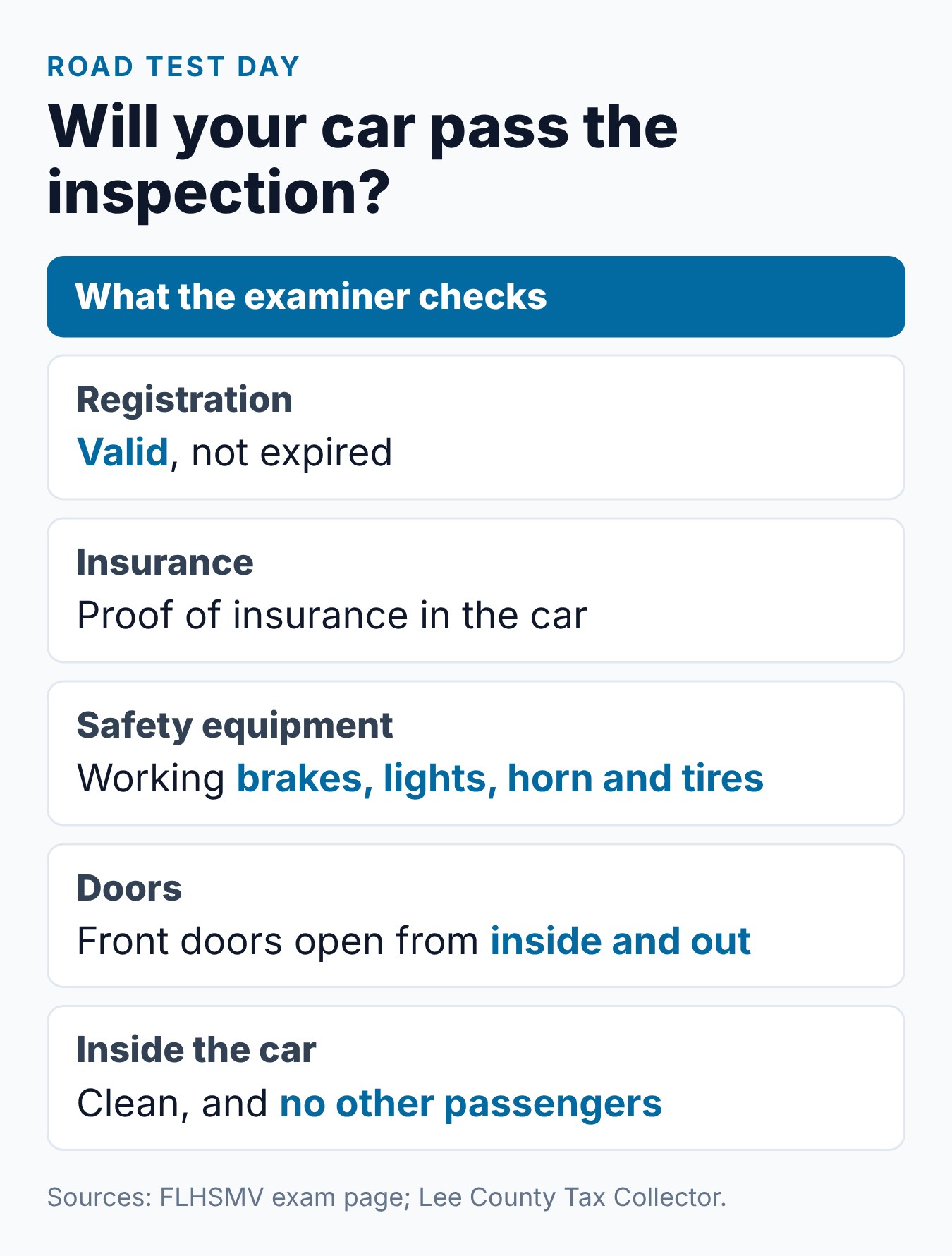
The driving skills test shows you can control the vehicle and follow traffic laws. FLHSMV lists what the examiner checks:
- A three-point turn and straight-in parking
- Parking on a grade and stopping quickly
- Backing 50 feet
- Stop signs, traffic signals, signaling and turning
- Yielding right-of-way, passing and staying in your lane
- A following distance of at least four seconds
You bring the vehicle. It must have valid registration and proof of insurance and pass a basic inspection. No other passengers may ride along unless an interpreter is needed.
The Lee County Tax Collector notes that driving tests can also be taken at FLHSMV-approved third-party testing locations for an extra fee.
How to Practice Before the Road Test
You can’t legally drive alone on public roads without a license. To practice on the road, get a learner’s license and drive with a licensed driver 21 or older in the front seat.
Use that time to rehearse the test moves. Practice three-point turns, backing in a straight line, parking on a slope and quick stops in a safe place. Then add busier roads, so lane changes and following distance feel natural.
A professional driving school is another option. It isn’t required, but it can help adults who have never driven before. Ask whether the school’s instructors can also give you practice on the same maneuvers the examiner checks, so your lesson time lines up with the test.
If You Fail a Test
You can try again. FLHSMV says that after a failed driving test you must study or practice before you retest.
Retests have a fee: $10 for the knowledge exam and $20 for the driving skills test, plus any service fee. Book the retest through your county office the same way you booked the first visit.
Step 6: Pay and Get Your License
Once you pass, you pay the fee and get your Class E license. At 18 or older, there are no teen hour limits, so you can drive alone at any time of day.
If you held a learner’s license while you practiced, you surrender it at the office when the Class E license is issued.
The Palm Beach County Tax Collector says adults qualify for an unrestricted license with no major traffic convictions in the previous 12 months.
After You’re Licensed
Carry your license whenever you drive. F.S. 322.15 requires you to have it with you and show it to an officer on request.
Tickets now add points to your record, the same as for any Florida driver. A clean first year helps keep your license in good standing.
What It Costs
FLHSMV’s fee page lists $48 for an original Class E license. An extra $6.25 service fee may apply at a tax collector office.
If you fail a test, FLHSMV lists $10 for a knowledge retest and $20 for a driving skills retest. TLSAE is a separate cost paid to the course provider, and third-party road tests charge their own fees.
Mistakes That Delay Adult Applicants
These come straight from the official rules.
- Taking DETS instead of TLSAE. Adults need the 4-hour TLSAE.
- Planning to test online. Online knowledge exams are for applicants under 18.
- A test vehicle that fails inspection. Broken lights, brakes or an expired tag can stop the test.
- A hospital birth certificate. FLHSMV needs a certified copy.
- Bringing a translator to the exam. Exams are English only, and outside translation isn’t allowed.
- Practicing with no license. If you want to practice on public roads, get a learner’s license first.
How Requirements Can Vary
Florida’s course and license rules apply statewide, but some details depend on where you live. Driver license services are often handled by your county tax collector’s office, and each office sets its own appointment process and hours. Some county school boards also offer driver education programs, such as DELAP courses, that can count instead of DETS.
FLHSMV can update course rules, forms, documents, and fees. Check FLHSMV and your county office for current requirements before your appointment.
Frequently Asked Questions
What do adults need for a first Florida driver’s license?
The 4-hour TLSAE course, documents for identity, Social Security and two Florida addresses, and passing scores on the knowledge, vision and driving tests.
Do adults need a learner’s permit in Florida?
No. Adults 18 and older can apply for a Class E license without a learner’s permit. Some get one to practice legally first.
Do adults have to take the drug and alcohol course in Florida?
Yes, first-time applicants take the 4-hour TLSAE course. People with a valid license from another state don’t.
Can adults take the Florida knowledge test online?
No. FLHSMV says you must be under 18 to take the Class E knowledge exam online.
How much is a first-time driver’s license in Florida?
FLHSMV lists $48 for an original Class E license, plus a $6.25 service fee that may apply. TLSAE and any third-party test fees are extra.
Can I take the Florida driving test in Spanish?
No. Since February 6, 2026, Florida gives driver license exams in English only.
Do I need my own car for the road test?
Yes. You bring a vehicle with valid registration and proof of insurance that passes a basic inspection.
Conclusion
A first-time Florida driver’s license for adults takes six steps: TLSAE, documents, a booked visit, the knowledge and vision tests, the road test and the fee.
Adults don’t need a learner’s permit or DETS, but a permit is the legal way to practice first. Check your county office’s reservation rules and study in English. Our online Florida TLSAE course is coming soon.
Related Articles
- Florida Learner’s Permit: How to Get It, Requirements, and What It Allows
- New Florida Resident Driver’s License: How to Get Yours
- Florida 6-Hour Drug and Alcohol Course: Is It the Same as DETS?
- Florida DETS vs TLSAE: What Changed and Who Needs Which Course
Sources
- FLHSMV — Approved TLSAE Course Providers
- Florida Statutes — F.S. 322.095 (TLSAE)
- Palm Beach County Tax Collector — New Drivers Aged 18 or Older
- Lee County Tax Collector — First Time Drivers
- Pasco County Tax Collector — New Florida Residents
- FLHSMV — Class E Knowledge Exam and Driving Skills Test
- FLHSMV — Teen Licensing Frequently Asked Questions
- FLHSMV — What to Bring: U.S. Citizen
- FLHSMV — Driver License and ID Card Fees
- Hillsborough County Tax Collector — Driver License Exams in English Only Beginning February 6
- Florida Statutes — F.S. 322.1615 (Learner’s Driver License)
Billy Forte is the owner of Driving Logic, a state-approved driver improvement course provider serving Florida and other U.S. states.
This article is general information, not legal advice. Florida licensing requirements, course rules, documents, and fees are set by FLHSMV and Florida law and can change. Use official FLHSMV and Florida statute sources for current requirements before you enroll in a course or visit a driver license office.