
Updated November 2026 · Reviewed by Billy Forte
The Florida learner’s permit course depends on your age: a first-time driver under 18 needs the 6-hour Driver Education Traffic Safety (DETS) course, and a first-time driver 18 or older needs the 4-hour Traffic Law and Substance Abuse Education (TLSAE) course. Both courses can be taken online or in a classroom. “Learner’s permit course” is the phrase people search, while FLHSMV calls the credential a learner’s license and the courses DETS and TLSAE.
Key Facts
- Under 18: the 6-hour DETS course, required since August 1, 2025. See the course for teens.
- 18 or older: the 4-hour TLSAE course, often called the drug and alcohol course. See the course for adults.
- Some teens skip DETS: transfers, older learner’s licenses and school courses. See who does not need DETS.
- Old TLSAE certificates: they no longer work for an unlicensed teen. See old certificates.
- Online is allowed: FLHSMV lists authorized providers and how each delivers the course. See taking it online.
- Not the permit test: the Class E Knowledge Exam is a separate step. See the course is not the test.
Which Florida Learner’s Permit Course Fits You
Florida has no course with “learner’s permit” in its official name. The state agency is the Florida Department of Highway Safety and Motor Vehicles, or FLHSMV. It uses two course names, and your age picks one.
Three terms help you read the official pages:
- Learner’s license. This is FLHSMV’s name for what most people call a learner’s permit.
- DETS. Driver Education Traffic Safety, the 6-hour course for first-time drivers under 18.
- TLSAE. Traffic Law and Substance Abuse Education, the 4-hour course for first-time drivers 18 or older.
So the question “which permit course do I need” has a short answer. Under 18, look for DETS. At 18 or older, look for TLSAE.
Our article on Florida DETS vs TLSAE compares the two courses side by side and explains what changed in 2025. This article stays on a different question: which course applies to you, and who does not need DETS at all.
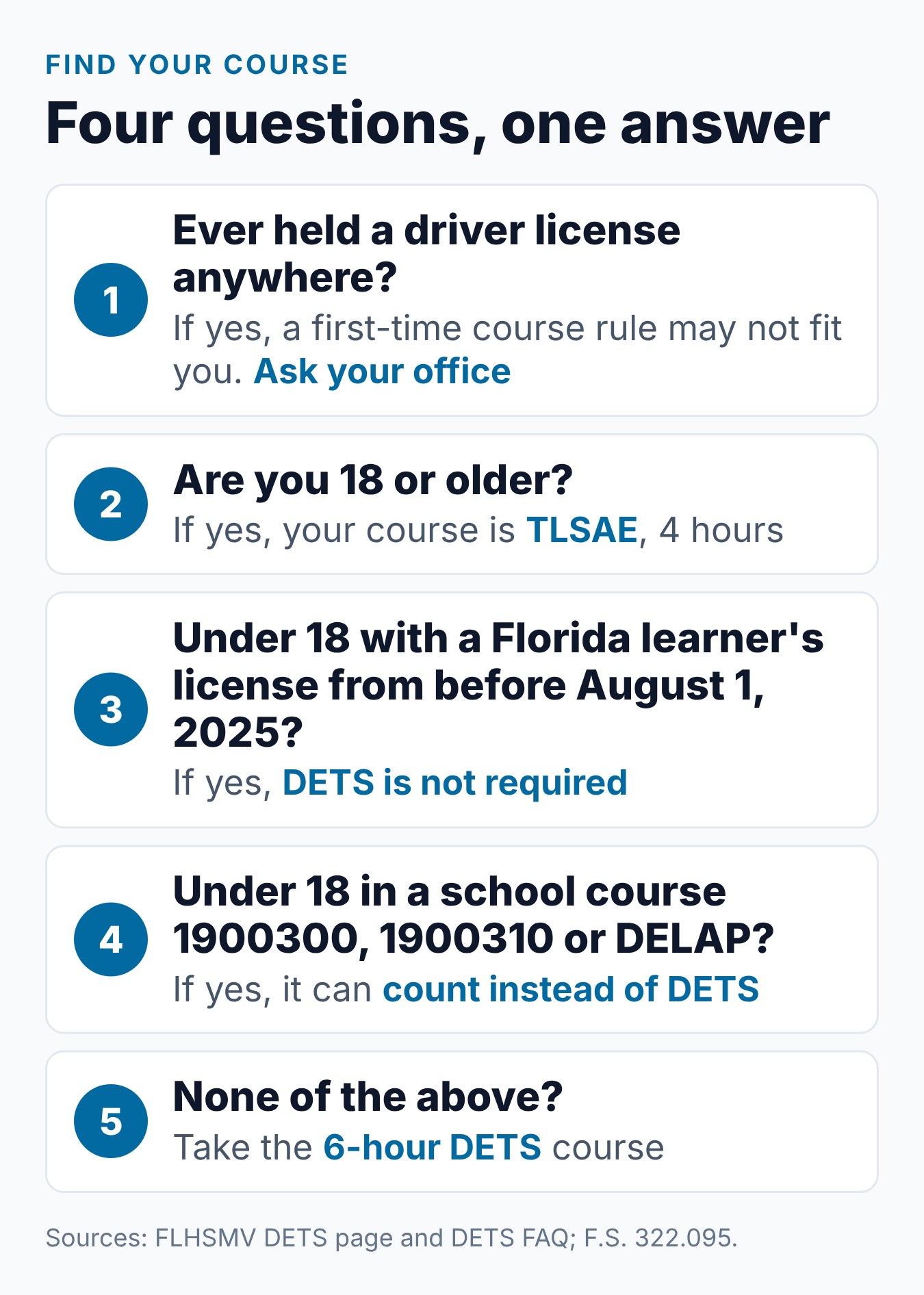
Under 18: The 6-Hour DETS Course
FLHSMV’s DETS page states the rule for teens. As of August 1, 2025, anyone under 18 who has never held a driver license from any other state, country or jurisdiction must complete a 6-hour DETS course before applying for a license in Florida.
The law behind it is F.S. 322.1615. It does two things:
- It sets the age. The minimum age for a learner’s license is 15.
- It sets the course standard. The applicant needs a department-approved driver education course. That course must meet or exceed the Department of Education’s Driver Education/Traffic Safety-Classroom 1900300 course description.
FLHSMV’s teen licensing page lists proof of DETS course completion among the requirements for a learner’s license. So the course comes before the office visit.
The DETS page says the course can be delivered in person or online. Our pillar guide to the Florida DETS course covers the course itself from start to finish.
18 or Older: The 4-Hour TLSAE Course
Adults take a different course. Many people call it the drug and alcohol course.
F.S. 322.095 says each applicant for a driver license who is 18 or older must complete a TLSAE course. The course must have a minimum of 4 hours devoted to course content.
The same statute lists two exceptions:
- Licensed elsewhere. The applicant has been licensed in another jurisdiction.
- School course. The applicant has completed a Department of Education driver education course.
FLHSMV’s teen licensing FAQ says customers may complete TLSAE online or in a classroom setting.
One more rule matters at 18. FLHSMV’s Class E exam page says that to qualify for a driver license, a customer must hold a learner’s license for 12 months or must be 18 years old. So the 12-month learner’s license period is not required at 18 or older.
Adults should confirm their own steps with FLHSMV or their county tax collector office. Our guide to the Florida drug and alcohol course covers TLSAE in full.
Who Does Not Need the DETS Course
Not every teen has to take DETS. FLHSMV’s DETS page and its DETS FAQ describe two groups who are outside the rule and three school courses that can stand in for it.
| Situation | Does the teen take DETS? |
|---|---|
| Transferring a valid out-of-state license | No. The rule covers teens who have never held a license |
| Got a Florida learner’s license before August 1, 2025 | No. The requirement began on that date |
| Took FDOE Traffic Safety Classroom course 1900300 | No. It is a substitute |
| Took FDOE Traffic Safety Classroom course 1900310 | No. It is a substitute |
| Took a DELAP course from a county school board | No. It may substitute for DETS |
| Holds only a TLSAE certificate, under 18 and unlicensed | Yes. The certificate no longer counts |
FDOE is the Florida Department of Education. DELAP is the Driver Education Licensing Assistance Program, which some county school boards offer.
A school course is not automatic. FLHSMV tells families to contact the local school board for more information, so ask the school which course your teen is taking.
Teens who move to Florida with a license have their own steps. Our article on a new Florida resident driver’s license explains them.
Old TLSAE Certificates No Longer Work for Teens
Before August 1, 2025, teens took TLSAE. FLHSMV gave those teens a grace period, and that period is over.
Here is how the rule worked, from the DETS page:
- Before the change. A teen who completed TLSAE before August 1, 2025 could use that certificate for one year after the completion date.
- Today. Every one of those certificates is now more than one year old.
- After the change. A TLSAE course completed on or after August 1, 2025 does not meet the requirement for someone under 18.
The result is simple. An unlicensed teen under 18 needs DETS, even with a TLSAE certificate in hand.
Our article on the Florida 6-hour drug and alcohol course explains why the old course name still shows up in searches.
The Online Florida Learner’s Permit Course
Yes, you can take the online Florida learner’s permit course from home. FLHSMV’s DETS page says the course can be delivered in person or online.
The same page lists every authorized provider in three columns:
- Name. The provider’s name.
- Delivery Method. How the provider gives the course, such as Internet or classroom.
- Contact Information. A phone number and a link to the provider’s website.
Check that list before you pay for any course. A course from a provider that is not on the list is not an authorized DETS course.
This article does not name providers or list prices. Our article on the Florida DETS course online explains how the online course works.
The Course Test
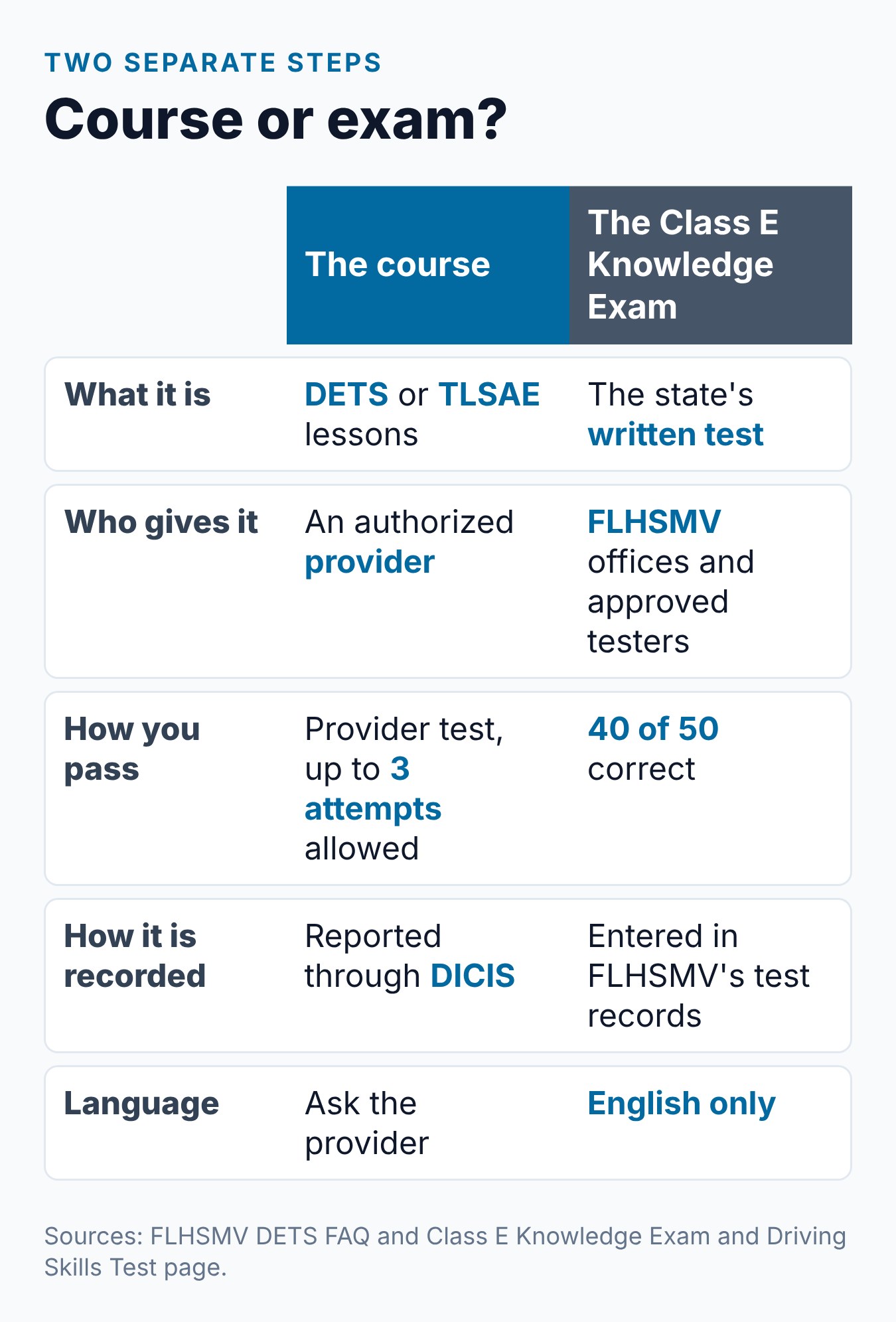
The DETS course ends with a test from the provider. FLHSMV’s DETS FAQ says the course provider may allow up to three attempts to pass it.
That is the only state rule this article gives for the course test. Ask your provider how its test works.
After the Course: How FLHSMV Gets Your Completion
You do not carry a paper certificate to the office. The provider sends the record for you.
Three facts explain the hand-off:
- Who reports it. The provider reports the completion to FLHSMV through the Driver Improvement Certificate Issuance System, called DICIS. The DETS FAQ describes this.
- How long it takes. FLHSMV’s Driver Improvement Schools page says to allow 24 to 72 hours for school completions to be posted.
- No paper. The same page says FLHSMV does not accept paper certificates for any licensing purpose.
Plan around the posting time. Finishing the course the night before an appointment may be too late.
Our article on Florida DETS course next steps covers what to do after the record posts.
The Course Is Not the Permit Test
Finishing DETS or TLSAE does not give you a learner’s license. The Class E Knowledge Exam is a separate step.
FLHSMV’s Class E exam page says the exam has 50 multiple-choice questions, and a customer must answer 40 correctly, or score 80 percent, to pass. Since February 6, 2026, FLHSMV gives driver license exams in English only.
Our guide to the Florida permit test covers the exam. For the full order of steps from course to license, see how to get a drivers license in Florida.
What We Found on FLHSMV’s DETS Provider List
On November 26, 2026, we read FLHSMV’s DETS page and counted the Delivery Method column. Here is what the list showed that day:
- 27 authorized providers were listed.
- All 27 listed Internet delivery. No provider on the list was classroom only.
- 2 of the 27 also listed a classroom. A family that wants an in-person DETS course has few choices on the state list.
- 2 of the 27 also listed an app.
- The page showed no prices. It gives a name, a delivery method, a phone number and a website link for each provider.
Two things follow for a family. Online is the usual way this course is offered, so ask a provider directly if you want a classroom session. A school course through the local school board is the other in-person route.
The list can change at any time. Count it again on the day you choose a course.
Common Mistakes to Avoid
Each mistake below comes from one of the rules above:
- Picking the course by its nickname. “Permit course” and “drug and alcohol course” are search phrases. Look for DETS under 18 and TLSAE at 18 or older.
- Buying TLSAE for a teen. A TLSAE course completed on or after August 1, 2025 does not meet the requirement for someone under 18.
- Counting on an old certificate. The one-year window for older TLSAE certificates has passed.
- Skipping the provider list. FLHSMV lists every authorized DETS provider. Check it first.
- Assuming a school class counts. Only certain courses substitute. Ask the local school board.
- Waiting for a paper certificate. FLHSMV does not accept paper certificates for any licensing purpose.
- Booking the office too soon. Allow 24 to 72 hours for the completion to post.
- Treating the course as the exam. The Class E Knowledge Exam is separate.
How Requirements Can Vary
Florida’s course and license rules apply statewide, but some details depend on where you live. Driver license services are often handled by your county tax collector’s office, and each office sets its own appointment process and hours. Some county school boards also offer driver education programs, such as DELAP courses, that can count instead of DETS.
FLHSMV can update course rules, forms, documents, and fees. Check FLHSMV and your county office for current requirements before your appointment.
Frequently Asked Questions
What course do I need for a Florida learner’s permit?
It depends on your age. A first-time driver under 18 needs the 6-hour DETS course. A first-time driver 18 or older needs the 4-hour TLSAE course.
Is the learner’s permit course the same as the drug and alcohol course?
Only for adults. The drug and alcohol course is TLSAE, the 4-hour course for applicants 18 or older. Teens under 18 who have never been licensed take the 6-hour DETS course instead.
Can I take the Florida learner’s permit course online?
Yes. FLHSMV says the DETS course can be delivered in person or online, and customers may complete TLSAE online or in a classroom setting. FLHSMV’s DETS page shows each provider’s delivery method.
Does my teen need DETS if they already took TLSAE?
Yes, if the teen is under 18 and has no license. A TLSAE certificate from before August 1, 2025 was good for one year, and that year has passed. A TLSAE course taken on or after that date does not meet the rule for someone under 18.
Does a high school driver education class count?
It can. Florida Department of Education Traffic Safety Classroom courses 1900300 and 1900310 are substitutes, and DELAP courses from some county school boards may substitute too. Contact the local school board to confirm.
How many times can I take the course test?
FLHSMV’s DETS FAQ says the course provider may allow up to three attempts to pass the test. Ask your provider for its own test details.
Do I get a certificate to bring to the office?
The provider reports your completion to FLHSMV through DICIS. FLHSMV says to allow 24 to 72 hours for it to post, and it does not accept paper certificates for any licensing purpose.
Conclusion
The Florida learner’s permit course is DETS for first-time drivers under 18 and TLSAE for first-time drivers 18 or older. Check whether a transfer, an older learner’s license or a school course takes your teen out of the DETS rule, then allow time for the completion to post before the office visit. The course is one step, and the Class E Knowledge Exam is the next. To see the teen course, visit Driving Logic’s online Florida DETS course page.
Related Articles
- Florida DETS Course: Do Adults Need It? Who Takes TLSAE
- Florida DETS vs TLSAE: What Changed and Who Needs Which Course
- Florida DETS Course Online: How the 6-Hour Program Works
- Florida DETS Course Next Steps: What Happens After You Finish
- Florida 6-Hour Drug and Alcohol Course: Is It the Same as DETS?
- DETS Test Florida: Course Exam vs. the Permit Test
Sources
- FLHSMV — Driver Education Traffic Safety (DETS)
- FLHSMV — DETS Course Frequently Asked Questions
- FLHSMV — Driver Improvement Schools
- FLHSMV — Class E Knowledge Exam and Driving Skills Test
- FLHSMV — Licensing Requirements for Teens, Graduated Driver License Laws and Driving Curfews
- FLHSMV — Teen licensing Frequently Asked Questions
- FLHSMV — News release, January 30, 2026: driver license exams in English only
- Florida Statutes — F.S. 322.1615 (DETS)
- Florida Statutes — F.S. 322.095 (TLSAE)
- FLHSMV — Driver Education Courses
- FLHSMV — TLSAE Course Provider List
- FLHSMV — Parental Consent Form HSMV 71142
Billy Forte is the owner of Driving Logic, a state-approved driver improvement course provider serving Florida and other U.S. states.
This article is general information, not legal advice. Florida licensing requirements, course rules, documents, and fees are set by FLHSMV and Florida law and can change. Use official FLHSMV and Florida statute sources for current requirements before you enroll in a course or visit a driver license office.