
Updated November 2026 · Reviewed by Billy Forte
The best DETS course Florida parents can choose is one that appears on FLHSMV’s list of authorized DETS providers, fits how the teen learns, and is clear about its fees, its test and when it reports the completion. The Florida Department of Highway Safety and Motor Vehicles (FLHSMV) approves DETS courses, but it does not rank them. So compare providers on what the state pages say, not on advertising, using the 10 checks below.
Key Facts
- No state ranking: FLHSMV approves DETS providers but lists no pass rates, prices or “top” picks. See what best can mean.
- Check 1 is the state list: a course only counts if its provider is on FLHSMV’s DETS list. See the checklist.
- DETS, not TLSAE: for a teen under 18, a TLSAE course finished on or after August 1, 2025 does not count. See check 2.
- The state certificate costs $3.00: FLHSMV’s FAQ gives that amount. See fees.
- Half the answers come from the provider: state pages settle 5 of the 10 checks. See what we found.
What “Best” Can and Cannot Mean
Parents search for the best course because they want to pick once and pick right. That is a fair goal. But in Florida, “best” has limits that are worth knowing first.
No official page ranks DETS providers, lists pass rates or compares prices. FLHSMV approves a course or it does not, and every course on its list meets the same state rules.
So “best” cannot mean “rated number one by the state.” No such rating exists. Be careful with any site that claims to be the state’s top pick.
What “best” can mean is the course that fits your teen and is open about the details. That comes down to three things:
- It counts. The provider is on FLHSMV’s list, and the course is DETS.
- It fits. The format suits how your teen learns.
- It is clear. You know the fees, the test rules and when the completion is reported before you pay.
The checklist below turns those three ideas into 10 short checks. Each one names the official page behind it.
The Best DETS Course Florida Checklist
Work through the checks in order. The first three decide whether a course counts at all. The rest help you choose between courses that do.
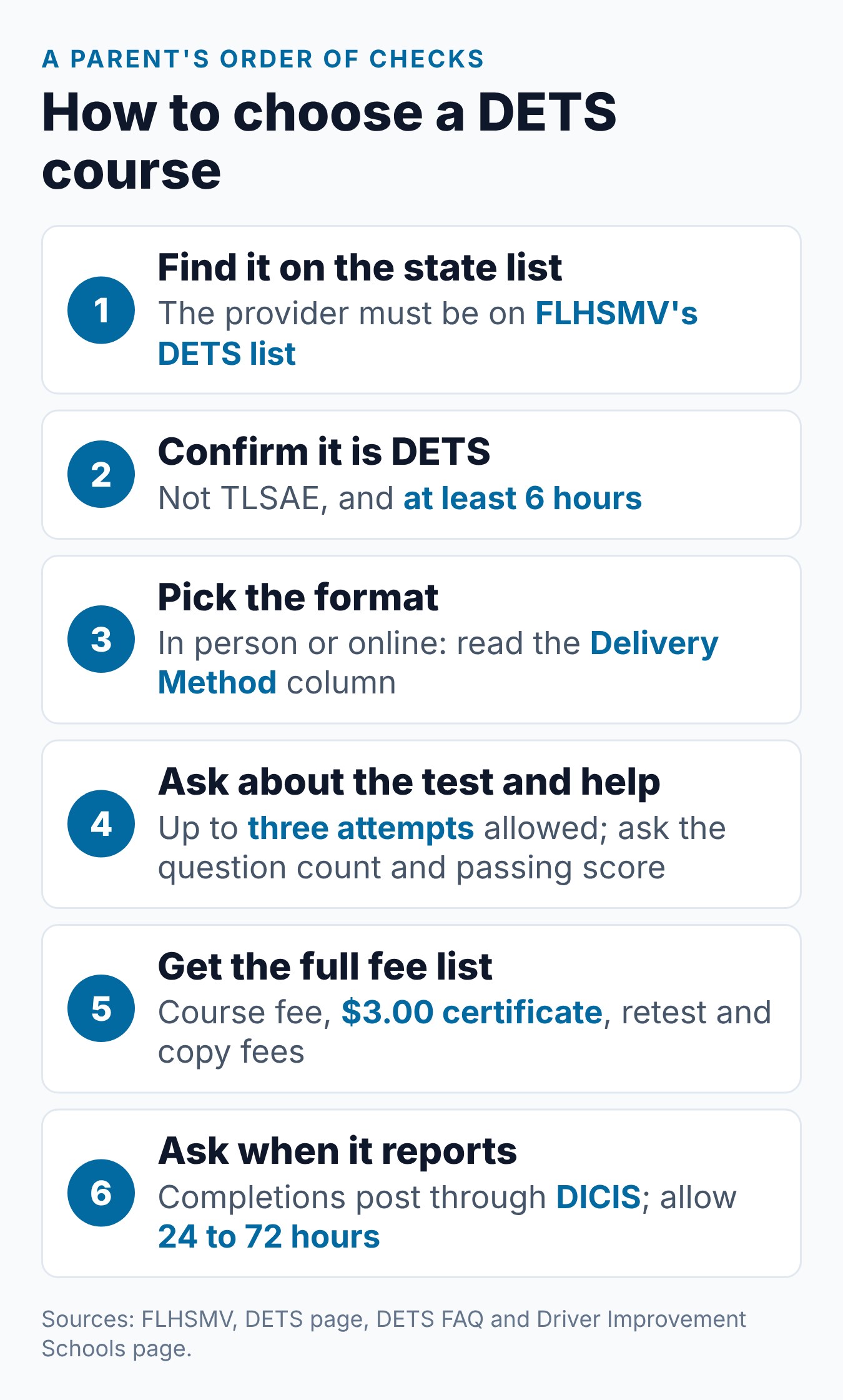
Check 1: The Provider Is on the State List
Start with the rule itself. As of August 1, 2025, anyone under 18 who has never held a driver license from any other state, country or jurisdiction must finish a 6-hour DETS course before applying for a license in Florida.
The law behind it is F.S. 322.1615(1)(c). It calls for a driver education course approved by the department.
FLHSMV’s DETS page lists all authorized providers. The table has three columns: Name, Delivery Method and Contact Information. If a provider is not on that table, its course is not shown as authorized.
Our guide to an FLHSMV-approved DETS course explains how to verify a provider, including when a school’s brand name is not the name on the list.
Check 2: It Is DETS, Not TLSAE
TLSAE is the Traffic Law and Substance Abuse Education course. Many parents know it as the drug and alcohol course. It is a different course from DETS.
FLHSMV’s DETS FAQ is direct on this point. For someone under 18, a TLSAE course completed on or after August 1, 2025 does not meet the requirement.
Approval does not carry over either. A provider approved for TLSAE must submit a new course application to offer DETS. So a school’s TLSAE approval tells you nothing about its DETS course.
Check 3: The Course Is at Least 6 Hours
The course must last at least 6 hours. It must also meet or exceed the Department of Education’s 1900300 course description. Both rules come from the DETS FAQ and F.S. 322.1615.
That makes this check easy. A course that promises to be done in less time is not the required course. Words like “instant” or “1 hour” are a reason to close the page.
Check 4: The Format Fits Your Teen
FLHSMV says the course can be delivered in person or online. The Delivery Method column on the state list shows how each provider gives it.
Some teens focus well alone at a screen. Others do better in a room with a teacher. Pick the format your teen will actually finish, then look only at providers whose Delivery Method matches it.
For how the online version runs, see Florida DETS Course Online: How the 6-Hour Program Works.
Check 5: The Test Rules Are Clear
The DETS FAQ says a course provider may allow up to three attempts to pass the test. The state pages do not give a number of questions or a passing score.
That leaves three questions for the provider:
- How many questions are on the test?
- What score passes?
- What happens after a failed attempt?
A clear provider answers all three before you pay. Our article on the Florida DETS course final exam covers the test itself in more depth.
Check 6: Your Teen Can Reach a Trained Person
Online does not mean on your own. FLHSMV’s FAQ says instructor qualification and training rules apply to online courses too. It also says staff who answer students’ questions must be trained in and familiar with the course.
So ask how your teen can reach someone with a question. Ask when that help is open. A course with no clear way to ask for help is harder to finish, even if it is approved.
Check 7: You Know When the Completion Is Reported
Providers report DETS completions to FLHSMV through the Driver Improvement Certificate Issuance System, or DICIS. That electronic record is what the license office looks for.
FLHSMV’s Driver Improvement Schools page says to allow 24 to 72 hours for school completions to be posted. It also says FLHSMV does not accept paper certificates for any licensing purpose.
So ask the provider one plain question: “When do you report a completion after my teen passes?” Then plan the license office visit after that window. Our article on the Florida DETS course certificate explains the record in more detail.
Check 8: The Full Fee List
This article names no course prices. Prices change, and the state does not set them. What the state pages do say is still useful.
FLHSMV’s DETS FAQ says DETS has the same certificate requirements as ADI, BDI and TLSAE. It says the cost of the certificate will be $3.00.
The FAQ points to the TLSAE rules, so here is what the TLSAE law, F.S. 322.095, says about fees:
- A $3 assessment fee. The school collects it from each person who attends.
- No forced certificate purchase. A course provider may not require any student to purchase a course completion certificate.
- Every fee disclosed. Providers shall disclose all fees and shall not charge fees that are not clearly listed during registration.
Those are the TLSAE rules that FLHSMV’s FAQ points to. Use them as your standard when you ask a DETS provider for its full fee list:
- the course fee
- the state certificate fee
- any retest fee
- any fee for a copy of the certificate
For what families have seen in course prices, see Florida DETS Course Cost: Fees, Retakes and What to Check.
Check 9: The Course Language
FLHSMV’s DETS pages do not address course language. If your teen reads more easily in another language, ask the provider before you pay.
Check 10: Whether Your School Offers a Course
Some teens never need a private course. FLHSMV says a Florida Department of Education Traffic Safety Classroom course (1900300 or 1900310) may take the place of DETS.
The same is true of a Driver Education Licensing Assistance Program (DELAP) course offered by some county school boards. Ask your local school board whether your teen’s school has one. If it does, it may be the simplest choice of all.
What We Found on the State Pages
We matched each of the 10 checks to the official pages behind it. We used FLHSMV’s DETS page, its DETS FAQ, its Driver Improvement Schools page, F.S. 322.1615 and F.S. 322.095, as read on November 25, 2026. The result is simple: the state answers half of the checklist, and the provider has to answer the other half.
The state settles five checks on its own. These are fixed rules, the same for every course:
- whether the provider is on the list (check 1)
- whether the course is DETS and not TLSAE (check 2)
- the 6-hour minimum (check 3)
- whether a format is allowed (check 4)
- whether a school course can stand in for DETS (check 10)
Five checks are left to the provider. The state sets an outer rule, but only the provider can give you its own answer:
- the test: providers may allow up to three attempts, but the state gives no question count or passing score (check 5)
- help: the state says staff must be trained, but not when they are available (check 6)
- reporting: the state gives a 24 to 72 hour window to post, but not when each provider sends the record (check 7)
- fees: the state names a $3.00 certificate, but not the course price (check 8)
- language: the state pages do not address it (check 9)
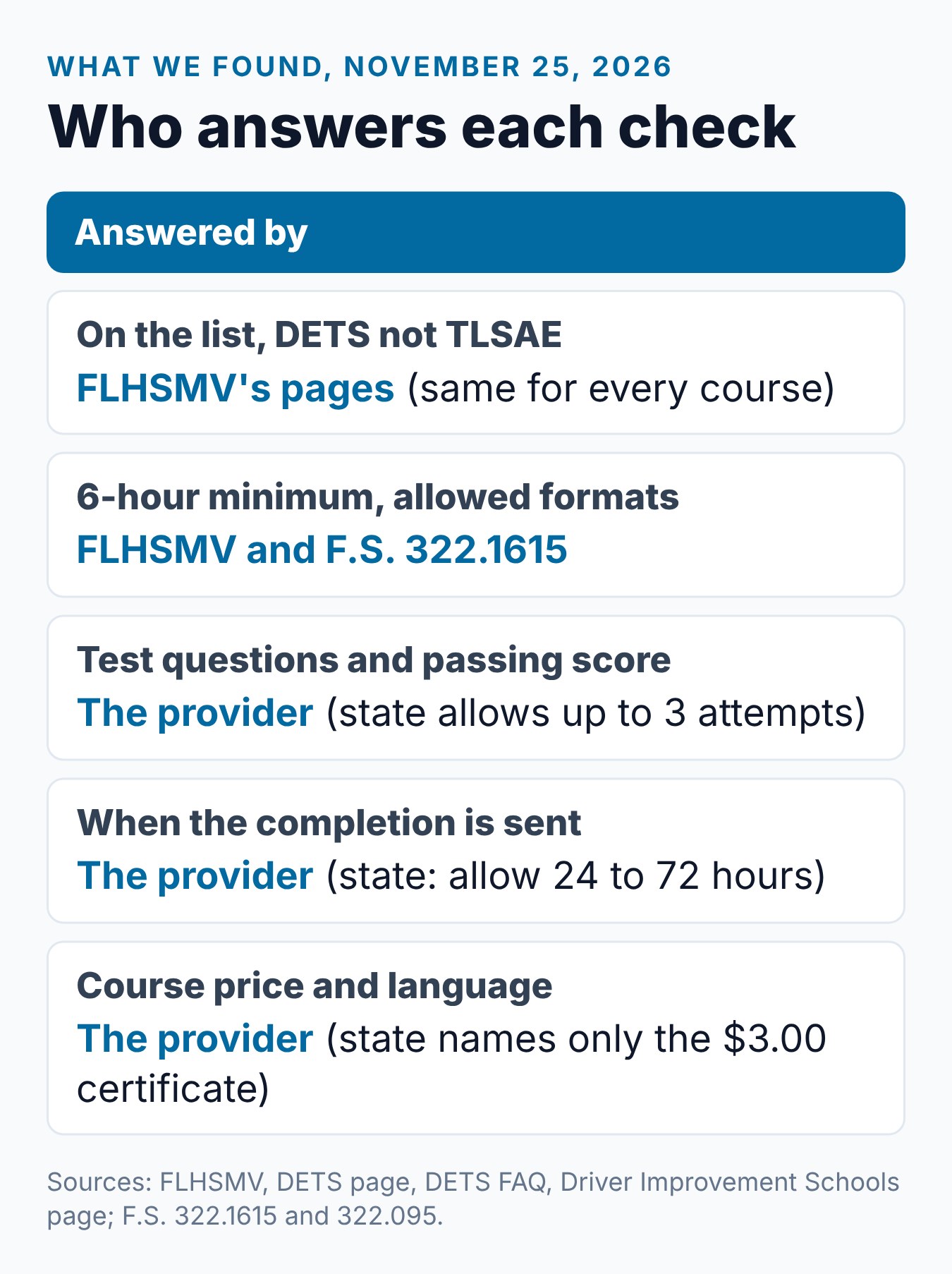
This split is the real answer to “which course is best.” Every course on the list already meets the fixed rules, so the first group of checks cannot set one approved course above another. The differences between approved courses are all in the last five. That is where a clear provider stands out from an unclear one.
One more thing stood out. The DETS rules on fees live partly in another course’s law. The DETS FAQ sends you to the TLSAE certificate rules, so the clearest fee standard a parent can point to is the one in F.S. 322.095.
Common Mistakes When Choosing a DETS Course
These mistakes come straight from the rules above:
- Trusting a “best” badge. No official page ranks DETS providers.
- Starting from an ad. Start from FLHSMV’s list and use its Contact Information column.
- Buying TLSAE for a teen. A TLSAE course finished on or after August 1, 2025 does not count for someone under 18.
- Picking a short course. DETS is at least 6 hours.
- Paying before seeing every fee. Ask for the course fee, the certificate fee, any retest fee and any copy fee first.
- Booking the office visit too soon. Allow 24 to 72 hours for the completion to post.
- Relying on a printout. FLHSMV does not accept paper certificates for any licensing purpose.
- Skipping the school board. A school course may stand in for DETS.
How Requirements Can Vary
Florida’s course and license rules apply statewide, but some details depend on where you live. Driver license services are often handled by your county tax collector’s office, and each office sets its own appointment process and hours. Some county school boards also offer driver education programs, such as DELAP courses, that can count instead of DETS.
FLHSMV can update course rules, forms, documents, and fees. Check FLHSMV and your county office for current requirements before your appointment.
Frequently Asked Questions
What is the best DETS course in Florida?
The best course is one on FLHSMV’s list of authorized DETS providers that fits your teen and is clear about fees, the test and reporting. FLHSMV approves courses but does not rank them. Every listed course meets the same state rules.
Does Florida rank DETS courses or post pass rates?
No. No official page ranks DETS providers, lists pass rates or compares prices. Be careful with any site that says it is the state’s top choice.
Is an online DETS course as good as an in-person one?
FLHSMV allows both formats, and both must meet the same rules. The FAQ says training rules for instructors apply to online courses too. Choose the format your teen is most likely to finish.
How much is the state certificate fee for DETS?
FLHSMV’s DETS FAQ says the cost of the certificate will be $3.00. Course prices are set by each provider. Ask for the full fee list before you pay.
How many times can my teen take the DETS test?
The DETS FAQ says a provider may allow up to three attempts to pass. The state does not publish a question count or passing score. Ask the provider for its rules.
How long after the course will FLHSMV have the record?
FLHSMV says to allow 24 to 72 hours for school completions to be posted. Providers report DETS completions through DICIS. Ask your provider when it sends the record.
Can a school course count instead of DETS?
Yes, in some cases. A Department of Education Traffic Safety Classroom course (1900300 or 1900310), or a DELAP course from some county school boards, may substitute for DETS. Ask your local school board.
Conclusion
The best DETS course in Florida is not a ranking, because the state does not rank courses. It is an approved course on FLHSMV’s list that fits your teen and answers the five questions only a provider can answer: the test, help, reporting, fees and language. Run the same 10 checks on every course you look at, this one included. To see how one course lays out those details, visit Driving Logic’s online Florida DETS course page.
Related Articles
- Florida DETS Course: Do Adults Need It? Who Takes TLSAE
- FLHSMV-Approved DETS Course: What It Means and How to Verify Your Provider
- Florida DETS Course Cost: Fees, Retakes and What to Check
- Florida DETS Course Final Exam: What to Expect
Sources
- FLHSMV — Driver Education Traffic Safety (DETS) and list of authorized providers
- FLHSMV — DETS Course Frequently Asked Questions
- FLHSMV — Driver Improvement Schools
- FLHSMV — Driver Education Courses
- Florida Statutes — F.S. 322.1615 (learner’s driver license)
- Florida Statutes — F.S. 322.095 (TLSAE course and fees)
Billy Forte is the owner of Driving Logic, a state-approved driver improvement course provider serving Florida and other U.S. states.
This article is general information, not legal advice. Florida licensing requirements, course rules, documents, and fees are set by FLHSMV and Florida law and can change. Use official FLHSMV and Florida statute sources for current requirements before you enroll in a course or visit a driver license office.