
Updated November 2026 · Reviewed by Billy Forte
No official Florida page lists a 4-hour drug and alcohol course Florida free of charge: the Florida Department of Highway Safety and Motor Vehicles (FLHSMV) lists approved private providers, not a state-run course. Florida law also has every school collect a $3 assessment fee from each person who attends, on top of the regular course fee. So an approved course costs something, unless you are exempt from taking it at all.
Key Facts
- No free course on official pages: FLHSMV’s list shows providers, delivery methods and contacts, with no prices. See what the official list shows.
- A $3 fee in the law: every school collects it from each student, in addition to the course fee. See the fee rules.
- A free offer checklist: four questions built from the statute. See the checklist.
- Who pays nothing: people who do not need the course. See who is exempt.
- State fees remain: the license and retest fees are not part of any course price. See the state fees.
Is a 4-Hour Drug and Alcohol Course Florida Free? What the List Shows
The course is called Traffic Law and Substance Abuse Education, or TLSAE. Many people know it as the drug and alcohol course. It is for first-time drivers 18 and older.
FLHSMV does not run the course itself. Its TLSAE page lists approved private providers. Each line shows a name, a delivery method and contact information.
On November 27, 2026, that list showed 34 approved providers. Every one of them listed Internet as a delivery method, and 12 also listed Classroom. Seven noted other or additional languages.
What the list does not show is just as useful:
- no prices
- no free course
- no state-run class
So the official answer is narrow. FLHSMV tells you which courses are approved. It does not tell you what any of them cost.
How to Use the List
The list is the one place to confirm that a course counts. Use it in this order:
- Match the name. Find the exact provider name the website or ad uses. A similar name is not a match.
- Check the delivery method. If you want to study online, make sure the line says Internet.
- Use the listed contact. Call the phone number on FLHSMV’s list, not only the one in an ad, and ask for the total price.
- Note the language. Some lines say other or additional languages are available, if you need that.
A provider that is not on the list is not approved, whatever it charges. Keep a note of the date you checked.
Four Fee Rules in Florida Law
The course is governed by s. 322.095, Florida Statutes. Four parts of it deal with money. Together they explain why “free” is hard to find.
Rule 1: The $3 Assessment, Subsection 4
The school collects $3 from each person who attends a course, in addition to the regular course fee.
The provider sends it to FLHSMV to get a unique completion certificate number for the student.
Rule 2: Certificates Are Optional, Subsection 10
A provider may not make any student buy a course completion certificate. If it sells paper or electronic certificates, it must say clearly that buying one is optional.
It must also say that the only valid certificate is the electronic one in the state system, and that paper ones are not accepted for licensing.
Rule 3: All Fees Disclosed, Subsection 11
Providers and schools must disclose every fee tied to the course. They may not charge a fee that was not clearly listed during registration.
Rule 4: Free Reporting, Subsection 12
The provider sends your completion to FLHSMV within 5 days. That submission is free of charge to you.
What the Four Rules Mean for a Free Search
The first rule is the key one for a free search. A course with a $0 price still has a $3 assessment behind it, and the law puts the job of collecting it on the school. No official page read for this article says whether a provider may cover that $3 itself.
The other three rules protect you after you sign up. You can’t be forced to buy a certificate.
You can’t be charged a fee that was hidden at registration. And you never pay to have your completion sent to FLHSMV. A free offer that breaks any of these is not following Florida law.
A Checklist for Any Free Offer
Ads for a free or very cheap course are easy to find. These four questions come straight from the rules above. Ask them before you give a site your time or your card.
- Is the provider on FLHSMV’s approved TLSAE list? Check the list right before you start.
- What is the total at checkout, including the $3 assessment? Look at the last screen, not the ad.
- Is any certificate purchase marked optional? The law says it must be.
- Is reporting to FLHSMV included at no charge? The law says it must be free to you.
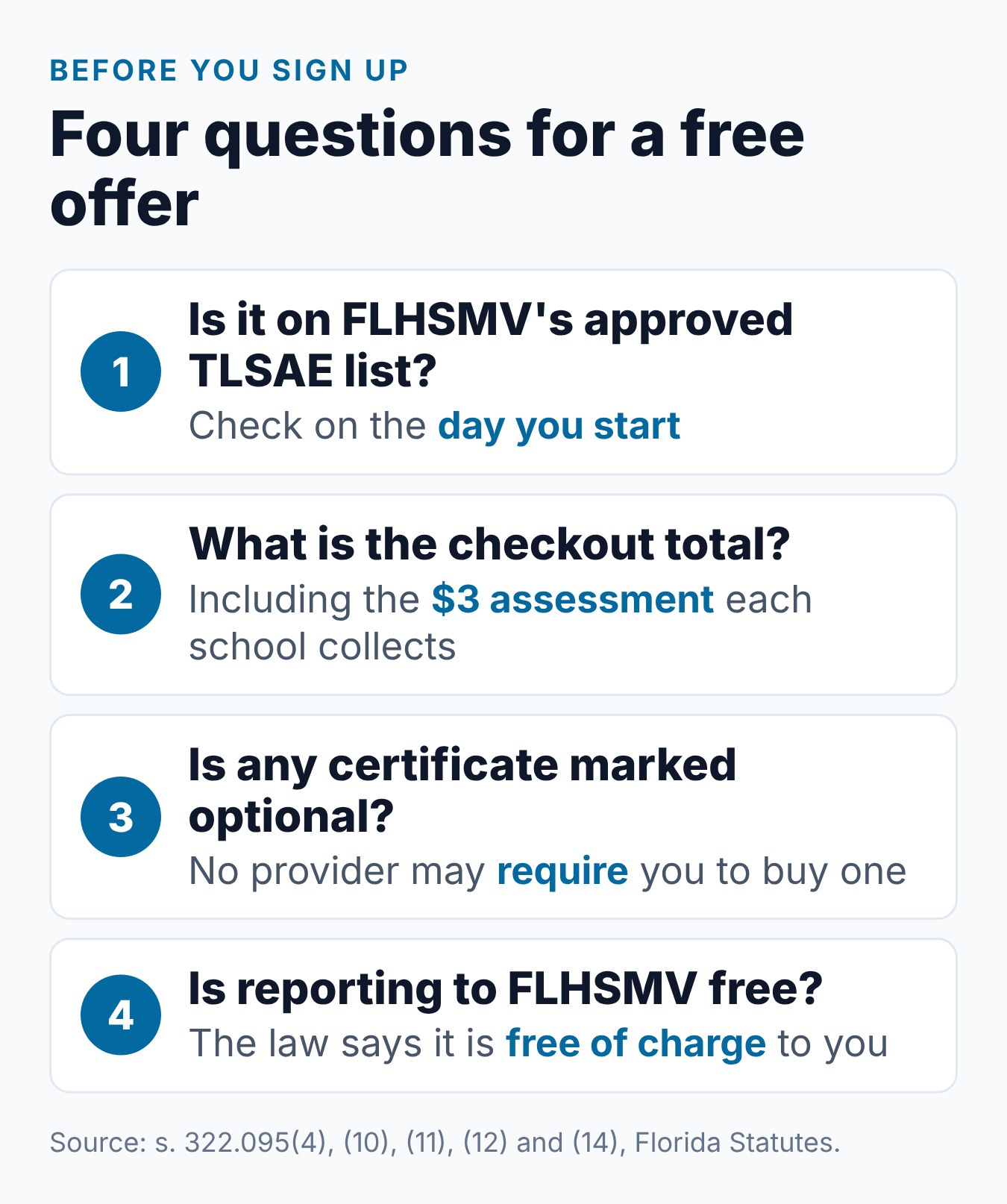
If any answer is no, or you can’t find it, stop there. A course that fails the first question does not count at all.
Why an Unapproved Course Is Never Free
A free course that FLHSMV has not approved does not meet the requirement. You would finish it and still need an approved one.
The law sets this up in two places. Under s. 322.095(2), the department must approve the course. Under s. 322.095(14), the department shall not accept certificates from students who take a course after it has been suspended or revoked.
That second rule is why timing matters. A provider can be on the list one month and off it the next. Check the list on the day you start, not the day you saw the ad.
Tlsae Course Online Free: What “Online” Covers
Many searches pair “free” with “online.” The online part is real. The free part is not shown on any official page.
The approved list shows Internet as a delivery method, so the course can be taken online. That is all FLHSMV’s list says about it. It still shows no price for any online course.
Do not mix up the course with the license exam. FLHSMV’s Class E Knowledge Exam page offers online testing only to applicants under 18. Adults take the knowledge exam in person, and FLHSMV says the exam is given in English only.
For how online and classroom formats compare, see Florida TLSAE course online.
What “4-Hour” Means for a Cheap Course
A low price does not shorten the course. Under s. 322.095(9), a course needs at least 4 hours of content, and no more than 30 minutes of breaks count toward that time.
So a cheap offer that promises to finish much faster is a warning sign. The time rule is the same for every approved provider, whatever it charges.
Who Pays Nothing Because They Skip the Course
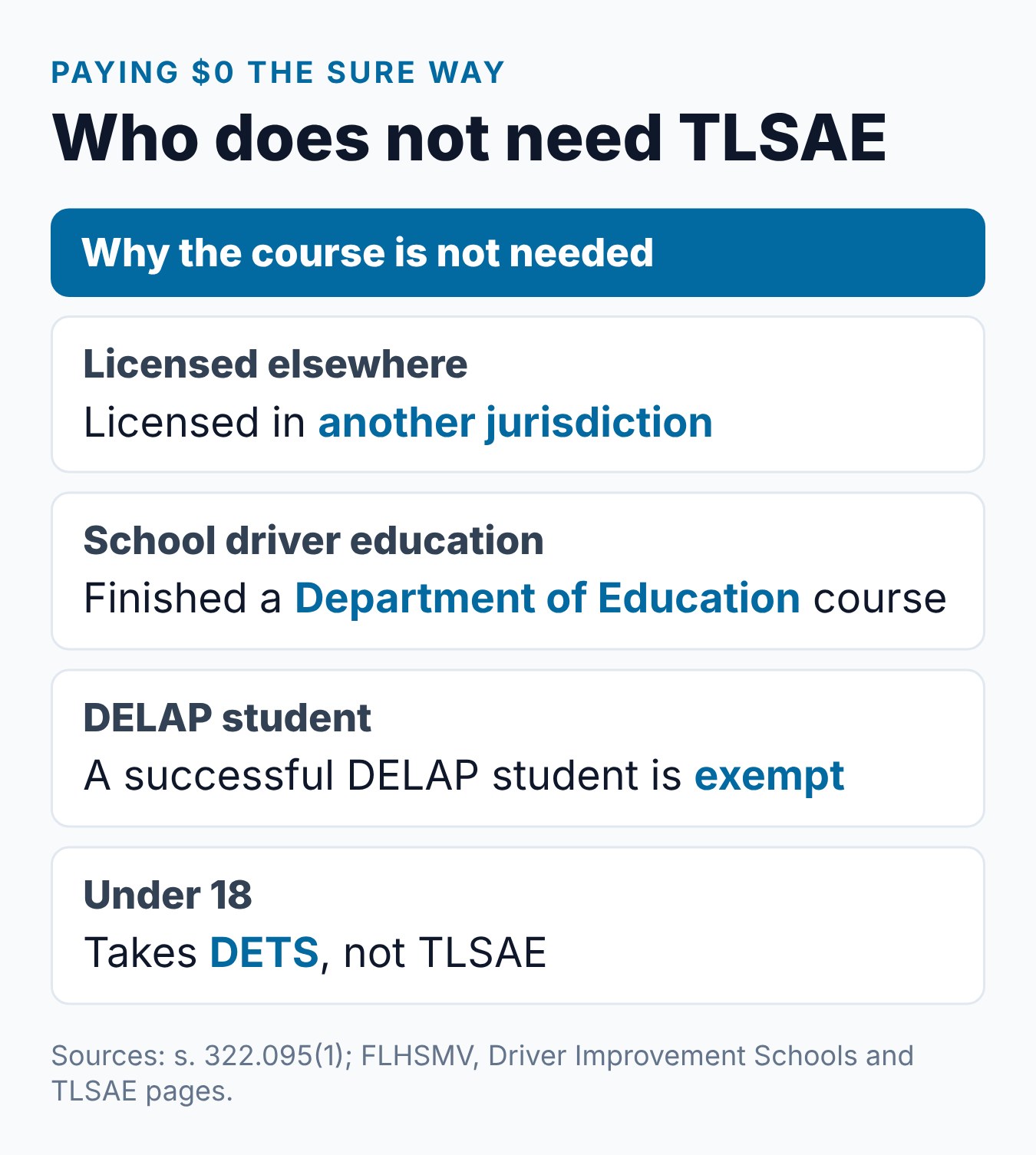
The only sure way to pay $0 for TLSAE is to not need it. The statute and FLHSMV name these groups.
Licensed somewhere else. Under s. 322.095(1), an applicant who has been licensed in another jurisdiction does not have to take the course.
Department of Education driver education. The same subsection exempts an applicant who has satisfactorily completed a Department of Education driver education course.
DELAP students. FLHSMV’s Driver Improvement Schools page says the Driver Education Licensing Assistance Program (DELAP) and high school driver education classes teach the drug and alcohol training. It says a successful DELAP student is exempt from taking TLSAE.
The TLSAE page adds that DELAP courses offered by some county school boards may substitute for the requirement, and to contact the local school board.
The official pages do not say whether a school charges for those classes. So this article does not call them free.
Under 18. Teens do not take TLSAE at all. FLHSMV says all first-time drivers under 18 must take the DETS course instead.
State Fees the Course Price Does Not Cover
Even the lowest-priced approved course is only one part of the bill. FLHSMV’s fee schedule lists these state fees. None of them is part of a course price.
| State fee | Amount on FLHSMV’s fee page |
|---|---|
| Original Class E license, learner’s license included | $48.00 |
| Extra service fee that may apply in a tax collector office | $6.25 |
| Knowledge exam retest, if needed | $10.00 |
| Driving skills retest, if needed | $20.00 |
Retests apply only if you need them. The service fee depends on where the credential is issued.
For what the course itself tends to cost across providers, see the cost guide, Florida Drug and Alcohol Course Cost: Is There a Free Option?.
What the Official Pages Do Not Say
This review read s. 322.095 and FLHSMV’s TLSAE, Driver Improvement Schools, Fees and Class E exam pages. Some questions about “free” have no answer there:
- what any provider charges
- whether any provider discounts the course to zero
- whether anyone else, such as an employer or a program, may pay the fee for a student
- whether a school charges for DELAP or high school driver education
This article does not guess at any of these. If a provider says its course is free, ask it to show the total in writing before you start.
Common Mistakes to Avoid
These come from the rules above:
- Trusting the ad, not the checkout. The total, with the $3 assessment, is what counts.
- Buying a certificate you don’t need. Only the electronic record is valid for licensing.
- Taking a course that is not on the list. It does not count, even at no cost.
- Starting before checking the list. A suspended course’s certificates are not accepted.
- Paying when you are exempt. Check the exemptions first.
- Signing a teen up for TLSAE. First-time drivers under 18 take DETS.
How Requirements Can Vary
Florida’s course and license rules apply statewide, but some details depend on where you live. Driver license services are often handled by your county tax collector’s office, and each office sets its own appointment process and hours. Some county school boards also offer driver education programs, such as DELAP courses, that can count instead of DETS.
FLHSMV can update course rules, forms, documents, and fees. Check FLHSMV and your county office for current requirements before your appointment.
Frequently Asked Questions
Is there a free 4-hour drug and alcohol course in Florida?
No official Florida page lists one. FLHSMV lists approved private providers with no prices, and the law has each school collect a $3 assessment from every student.
What is the $3 TLSAE fee?
It is an assessment the school collects from each person who attends, in addition to the course fee. The provider sends it to FLHSMV to get a completion certificate number for you.
Do I have to buy a TLSAE certificate?
No. A provider may not require it, and any certificate it sells must be marked optional. Only the electronic record in the state system is valid for licensing.
Can I take the TLSAE course online?
Yes. Every provider on FLHSMV’s list on November 27, 2026, showed Internet as a delivery method. The list shows no prices.
Who does not have to pay for TLSAE?
People who do not need it: those licensed in another jurisdiction, those who finished a Department of Education driver education course, and successful DELAP students. Teens under 18 take DETS instead.
Does reporting my completion cost extra?
No. The law says the provider’s submission to FLHSMV is free of charge to the student and must be made within 5 days.
Conclusion
A free 4-hour drug and alcohol course does not appear on any official Florida page, and the $3 assessment in the law applies to every student who attends. Check the provider list, the checkout total and the exemptions before you pay anything. To see how one course lays out its details, visit the drug and alcohol course florida page.
Related Articles
- Florida Drug and Alcohol Course (TLSAE): The Complete Guide for Adults
- Florida Drug and Alcohol Course Cost: Is There a Free Option?
- How to Get an FLHSMV-Authorized TLSAE Course in Florida
- Florida TLSAE Course Online: How to Take It and What It Covers
- Florida 4 Hour Drug and Alcohol Course: Who Needs It
Sources
- FLHSMV — Driver Education Courses
- FLHSMV — First-Time Florida Driver
- Florida Statutes — F.S. 322.1615 (DETS)
- Florida Statutes — F.S. 322.095 (TLSAE)
- FLHSMV — TLSAE Course Provider List
- FLHSMV — Driver Improvement Schools
- FLHSMV — Fees
- FLHSMV — Class E Knowledge Exam & Driving Skills Test
Billy Forte is the owner of Driving Logic, a state-approved driver improvement course provider serving Florida and other U.S. states.
This article is general information, not legal advice. Florida licensing requirements, course rules, documents, and fees are set by FLHSMV and Florida law and can change. Use official FLHSMV and Florida statute sources for current requirements before you enroll in a course or visit a driver license office.