
Updated October 2026 · Reviewed by Billy Forte
An FLHSMV-authorized TLSAE course is a drug and alcohol course that the Florida Department of Highway Safety and Motor Vehicles has approved under F.S. 322.095. Only an approved course counts toward your first license, so checking before you pay matters. The best place to start is FLHSMV’s approved TLSAE provider list.
Key Facts
- Where to check: FLHSMV’s approved TLSAE provider list. See how to use it.
- Brand names: Some schools sell an approved provider’s course under their own name. See how to match them.
- Fees: Approved providers must disclose all fees. See the fee check.
- Reporting: Approved providers report your completion electronically within 5 days. See the reporting check.
- Suspensions: Courses taken after a provider’s suspension or revocation aren’t accepted. See why timing matters.
What an FLHSMV-Authorized TLSAE Course Is
F.S. 322.095 says FLHSMV must approve TLSAE courses, including online courses. A provider has to be approved and certified before it can offer the course to anyone.
Before approval, FLHSMV reviews the course materials, a presentation by the provider and the provider’s plan for overseeing its instructors. The provider must also show it owns the course or has written permission to use it.
Approval doesn’t end there. FLHSMV reviews changes to Florida’s major traffic laws each year, and providers must update their courses when FLHSMV asks. A provider that misses the 90-day deadline has its approval suspended.
Why It Matters
An unapproved course doesn’t count. If you take one, you’ll have spent the time and money and still need an approved TLSAE course before your license.
Approval also gives you protections the law builds in. Approved providers must disclose their fees, report your completion for free and let you finish at no extra cost if their own error stops you.
An unapproved site doesn’t have to follow those rules. If something goes wrong, you may have no way to get your completion reported, which leaves you starting over with a new course.
A Quick Example
Say Jordan is 22 and finds an ad for a first-time driver course from a school with a catchy brand name. Jordan checks FLHSMV’s list and doesn’t see that name.
Instead of giving up, Jordan emails the school and asks which approved provider’s course it sells. The school names a provider, and Jordan finds that provider on FLHSMV’s list.
Jordan then checks the fees, reads the exam and reporting rules and checks the list once more on the day of purchase. That’s the whole process, and it takes less time than the course itself.
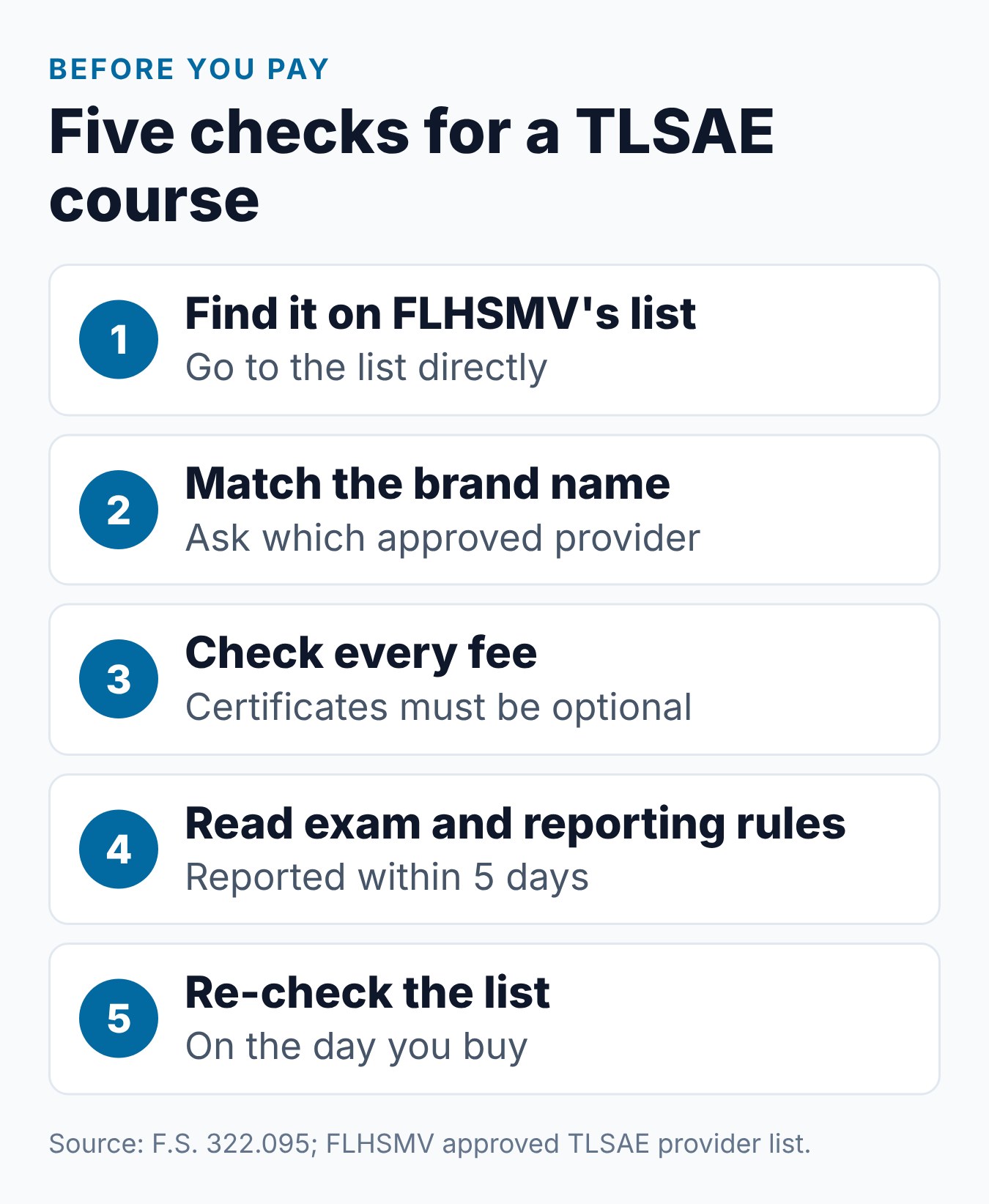
Step 1: Start With FLHSMV’s Approved List
FLHSMV posts an approved TLSAE provider list on its TLSAE page. That list is your source of truth.
Go to the list directly instead of following a link from an ad. Then look for the provider or school you’re thinking about. Search for both the brand name you saw and any company name in the site’s footer or terms page.
If you find it, move on to the next checks. If you don’t, don’t buy yet.
Step 2: Match the School to an Approved Provider
This part can be confusing. Some schools sell an approved provider’s course under their own brand name, so the name on the website may not be the name on FLHSMV’s list.
That doesn’t mean the course is fake. It means you need one more answer: which approved provider’s course does this school use?
Ask the school directly. A legitimate school should be able to tell you, and you can then find that provider on FLHSMV’s list.
Step 3: Check the Fees Up Front
F.S. 322.095 requires providers to disclose all course fees. They can’t add fees during registration that they didn’t disclose.
The law also says providers can’t make you buy a completion certificate. Any certificate they sell has to be clearly marked as optional.
So before you pay, look for:
- The full course price
- Any certificate, processing or retake fees
- Whether each extra fee is required or optional
Schools collect a $3 assessment fee from each student for the state, which may be part of the price. Our article on the Florida drug and alcohol course cost lists prices we found in an October 20, 2026 review.
Step 4: Read the Exam and Reporting Rules
Approved courses have to include at least 4 hours of content, not counting breaks. Three of the four providers we reviewed on October 20, 2026 list a final exam, set by the provider.
Look for the provider’s rules on the final exam. You want to know the number of questions, the passing score and whether retakes are allowed.
Then check what the provider says about reporting. Under the law, approved providers submit your completion to FLHSMV’s Driver Improvement Certificate Issuance System within 5 days at no charge. Only that electronic record is valid for licensing.
Step 5: Check Again Right Before You Pay
FLHSMV can suspend or revoke a provider. Under F.S. 322.095, certificates from courses taken after a suspension or revocation are not accepted.
So a provider that was on the list months ago may not be approved now. Check the list again on the day you buy, not just when you first start shopping.
This takes a minute and protects the hours you’re about to spend on the course.
It’s also worth saving a screenshot of the list entry with the date. If a question ever comes up about your course, you’ll have a record that the provider was approved when you bought it.
Warning Signs
Be careful if a course site shows any of these:
- You can’t match it to FLHSMV’s list, and the school won’t say which approved provider it uses.
- It says the course takes less than 4 hours. The law requires at least 4 hours of content.
- It requires you to buy a certificate. The law says certificates must be optional.
- Fees appear late in checkout that weren’t shown before.
- It promises an online permit test for adults. FLHSMV’s teen FAQ says online knowledge exams are for applicants under 18 only.
- It sells TLSAE to a 17-year-old. Since August 1, 2025, teens under 18 take the 6-hour DETS course instead.
One warning sign isn’t always proof of a problem. But if you see more than one, choose a different provider.
Searching Under Other Names
Many people search for a “drug and alcohol course Florida DMV.” Florida’s licensing agency is actually FLHSMV, and most driver license offices are run by county tax collectors.
That matters when you search. A site that calls itself a “DMV course” may or may not be approved, so the FLHSMV list is still the place to check.
FLHSMV doesn’t sell the course itself. It approves the providers that do, so you buy from a provider and FLHSMV receives your completion record.
Online or Classroom
FLHSMV approves both online and classroom TLSAE courses. Both count the same for licensing as long as the provider is approved.
The law requires classroom courses to be held in places that are free of distractions and reasonably accessible. If you choose a classroom, ask about the location before you pay.
Online courses let you work at your own pace. Our guide to the Florida TLSAE course online explains how they work.
What Approved Providers Must Do
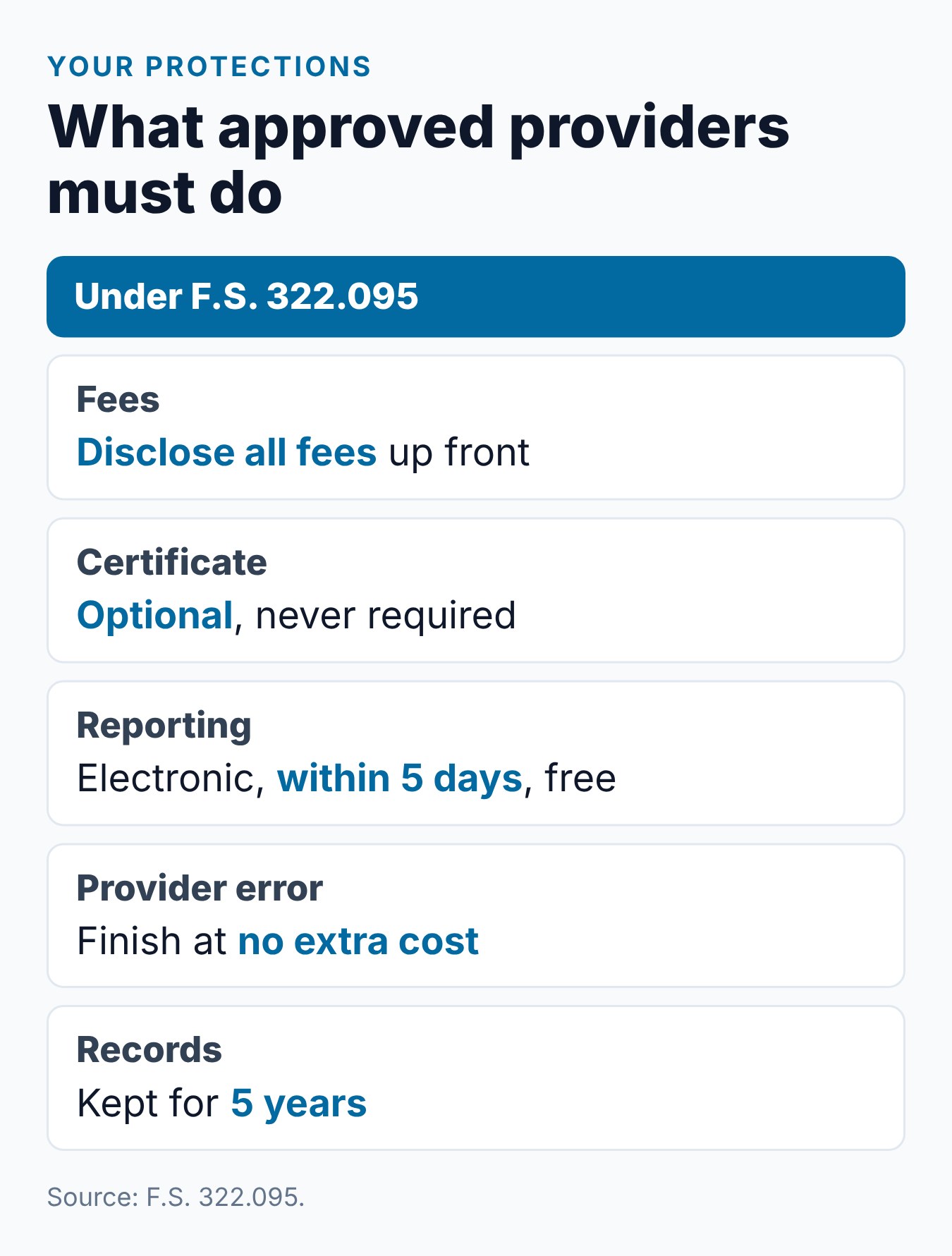
F.S. 322.095 gives you several protections when you choose an approved provider:
- Disclose all fees before you pay
- Not require a certificate purchase
- Report your completion electronically within 5 days, at no charge
- Let you finish at no extra cost if you couldn’t complete the course because of the provider’s or school’s error
- Keep course records for 5 years and make them available to FLHSMV
The law also limits who can teach. A person convicted within the past 5 years of a drug-related or DUI offense, a felony, fraud or a crime that directly threatens student safety can’t be an instructor.
How FLHSMV Holds Providers Accountable
FLHSMV doesn’t just approve courses and walk away. Every 5 years, it studies how well each delivery method works, looking at DUI citations, moving violations or crashes.
A course that fails that study has to stop being offered right away. FLHSMV can also deny, suspend or revoke a provider for breaking the rules, and it can fine a provider $1,000 to $5,000 per violation.
For you, the takeaway is simple. An approved provider is one FLHSMV is actively watching.
If Something Goes Wrong
Even with an approved provider, problems can happen. Here’s what to do:
- Your record isn’t on file after 5 days. Contact the provider and ask when it reported your completion.
- A detail is wrong. Ask the provider to correct it before your office visit.
- The site failed and you couldn’t finish. Ask the provider to let you complete the course, since the law covers provider errors.
- You think the course wasn’t approved. Check FLHSMV’s list and ask the school which approved provider it uses.
Keep your receipt, your completion email or screenshot and any messages with the provider. Our article on the Florida drug and alcohol course certificate covers record problems in more detail.
Who Doesn’t Need a TLSAE Course
Before you shop, make sure you need TLSAE at all. The law exempts people licensed in another jurisdiction and people who completed a Department of Education driver education course.
If you’re under 18, you need DETS, not TLSAE. If you’re 18 or older and neither exemption fits, an FLHSMV-authorized TLSAE course is your first step toward a license.
Common Mistakes
These are the mistakes that cost people the most:
- Buying from an ad without checking the list. Go to FLHSMV’s list first.
- Assuming a brand name is unapproved. Ask which approved provider’s course it uses.
- Checking the list once, months before buying. Check again on the day you pay.
- Paying for a certificate you don’t need. The electronic record is free and is the one that counts.
- Thinking FLHSMV sells the course. It approves providers but doesn’t sell TLSAE itself.
How Requirements Can Vary
Florida’s course and license rules apply statewide, but some details depend on where you live. Driver license services are often handled by your county tax collector’s office, and each office sets its own appointment process and hours. Some county school boards also offer driver education programs, such as DELAP courses, that can count instead of DETS.
FLHSMV can update course rules, forms, documents, and fees. Check FLHSMV and your county office for current requirements before your appointment.
Frequently Asked Questions
How do I know if a TLSAE course is FLHSMV-approved?
Check FLHSMV’s approved TLSAE provider list. If a school’s name isn’t there, ask which approved provider’s course it uses.
Can a school sell an approved course under another name?
Yes. Some schools sell an approved provider’s course under their own brand. Ask which approved provider it uses.
Does FLHSMV sell the TLSAE course?
No. FLHSMV approves providers, and the providers sell the course online or in a classroom.
What happens if my provider is suspended?
Certificates from courses taken after a provider’s suspension or revocation are not accepted. Check the list right before you pay.
Is an online TLSAE course approved the same way as a classroom course?
Yes. F.S. 322.095 covers online and classroom courses, and both count once FLHSMV approves them.
Is the Florida drug and alcohol course the same as TLSAE?
Yes. “Drug and alcohol course” is the common name, and TLSAE is the official one. FLHSMV approves it either way.
Conclusion
An FLHSMV-authorized TLSAE course is one FLHSMV has approved under F.S. 322.095, and only an approved course counts for your license.
Start with FLHSMV’s approved list, ask which approved provider a branded school uses and check the list again right before you pay. Then read the fee, exam and reporting rules. Our online Florida TLSAE course is coming soon.
Related Articles
- Florida Drug and Alcohol Course (TLSAE): The Complete Guide for Adults
- Florida Drug and Alcohol Course Cost: Is There a Free Option?
- Florida Drug and Alcohol Course Certificate: What It Is and What to Do With It
Sources
- FLHSMV — Approved TLSAE Course Providers
- Florida Statutes — F.S. 322.095 (TLSAE)
- FLHSMV — First-Time Florida Driver
- FLHSMV — Class E Knowledge Exam and Driving Skills Test
- FLHSMV — Teen Licensing Frequently Asked Questions
Billy Forte is the owner of Driving Logic, a state-approved driver improvement course provider serving Florida and other U.S. states.
This article is general information, not legal advice. Florida licensing requirements, course rules, documents, and fees are set by FLHSMV and Florida law and can change. Use official FLHSMV and Florida statute sources for current requirements before you enroll in a course or visit a driver license office.