
Updated October 2026 · Reviewed by Billy Forte
Your Florida drug and alcohol course certificate is the electronic completion record your TLSAE provider sends to FLHSMV after you pass. Florida law gives providers 5 days to report it, at no charge to you. Only that electronic record counts for your license, so a paper copy is just a backup.
Key Facts
- Form: An electronic record in FLHSMV’s Driver Improvement Certificate Issuance System. See how it works.
- Timing: Providers report within 5 days, for free. See the timeline.
- Paper: Paper certificates aren’t accepted for licensing. See why to keep a copy anyway.
- Buying one: Providers can’t make you buy a certificate. See the rule.
- Problems: If it’s missing after 5 days or a detail is wrong, contact your provider. See what to do.
What the Certificate Is
You may picture a course certificate as a printed page you carry to the office. For TLSAE, that’s not how it works.
F.S. 322.095 says only the electronic certificate in FLHSMV’s Driver Improvement Certificate Issuance System is valid for licensing. The law also says paper certificates are not accepted.
So the official “TLSAE certificate” is this electronic record. It shows FLHSMV that you finished an approved course before your license application.
Think of it like a digital receipt that lives in FLHSMV’s system instead of your wallet. You never hold the official version, but the office can see it when you apply.
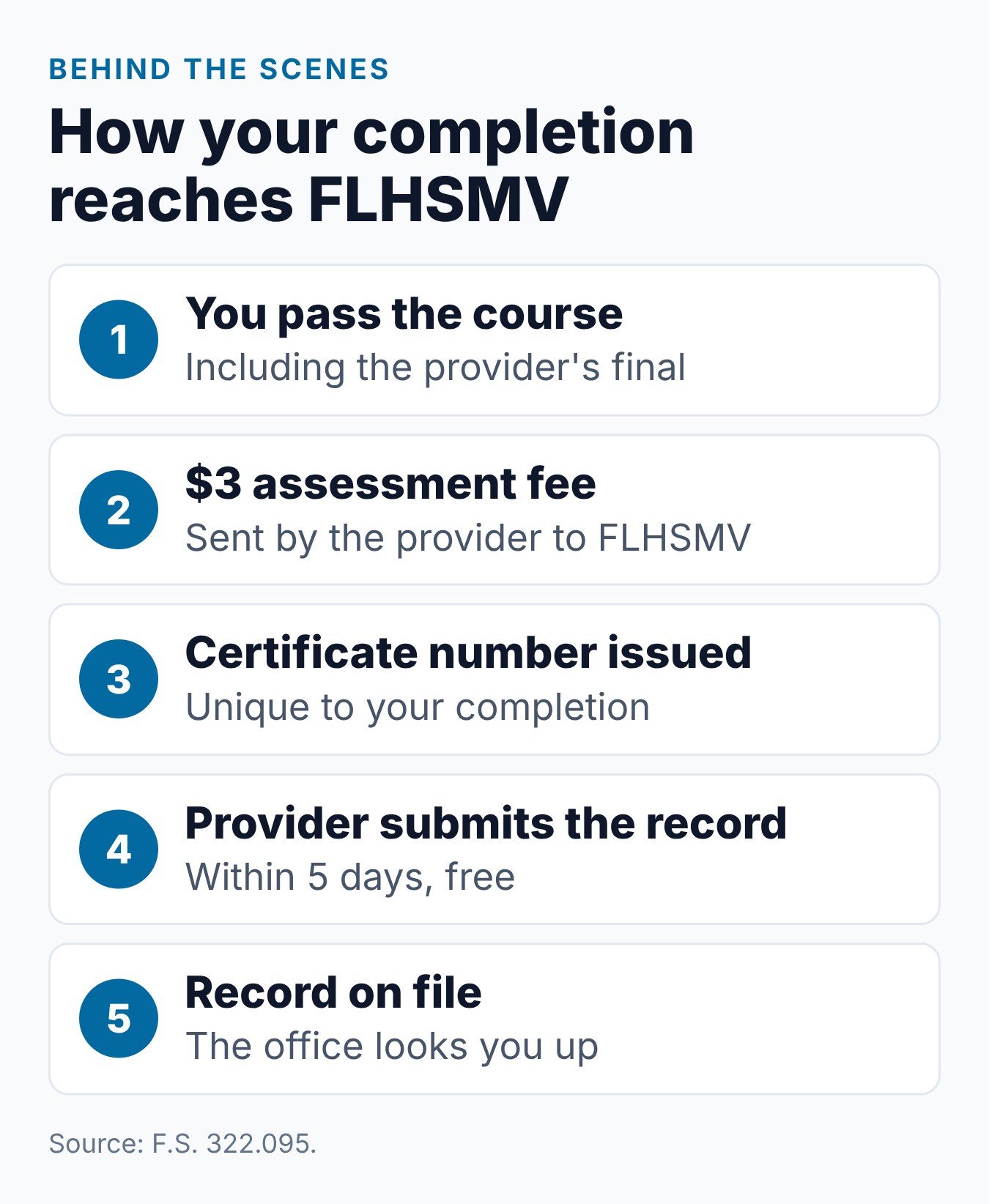
How Your Completion Reaches FLHSMV
The process runs in the background once you pass:
- You finish the course and pass the final exam.
- The school collects a $3 assessment fee as part of your purchase. The provider sends it to FLHSMV.
- FLHSMV issues a unique certificate number for your completion.
- The provider submits your completion to the Driver Improvement Certificate Issuance System within 5 days.
- Your record is on file when the office looks you up.
You don’t pay extra for step 4. The law says providers must submit completion data at no charge to the student.
What a Printed Copy Is Good For
A printed or saved copy can’t replace the electronic record. It can still help in a few ways:
- Proof of your finish date if the record is late
- Your provider’s name and contact details if you need to call them
- Your name and birth date as entered, so you can spot a typo
- Peace of mind at the office if staff ask questions
If your provider shows a completion page or sends an email when you pass, save a screenshot or keep the email. Either one works as your backup.
Bring your backup to the office if you like, but don’t count on it. Staff check FLHSMV’s records, not your paper.
Do You Have to Buy a Certificate?
No. F.S. 322.095 says providers can’t require students to buy a completion certificate.
Some providers still sell a paper or electronic copy. If they do, the law says it must be clearly marked as optional.
So if a checkout page adds a “certificate fee” as a required step, read it closely. Look for an option to skip it, and remember that your electronic record is sent for free either way. Our article on the Florida drug and alcohol course cost covers the other fee rules.
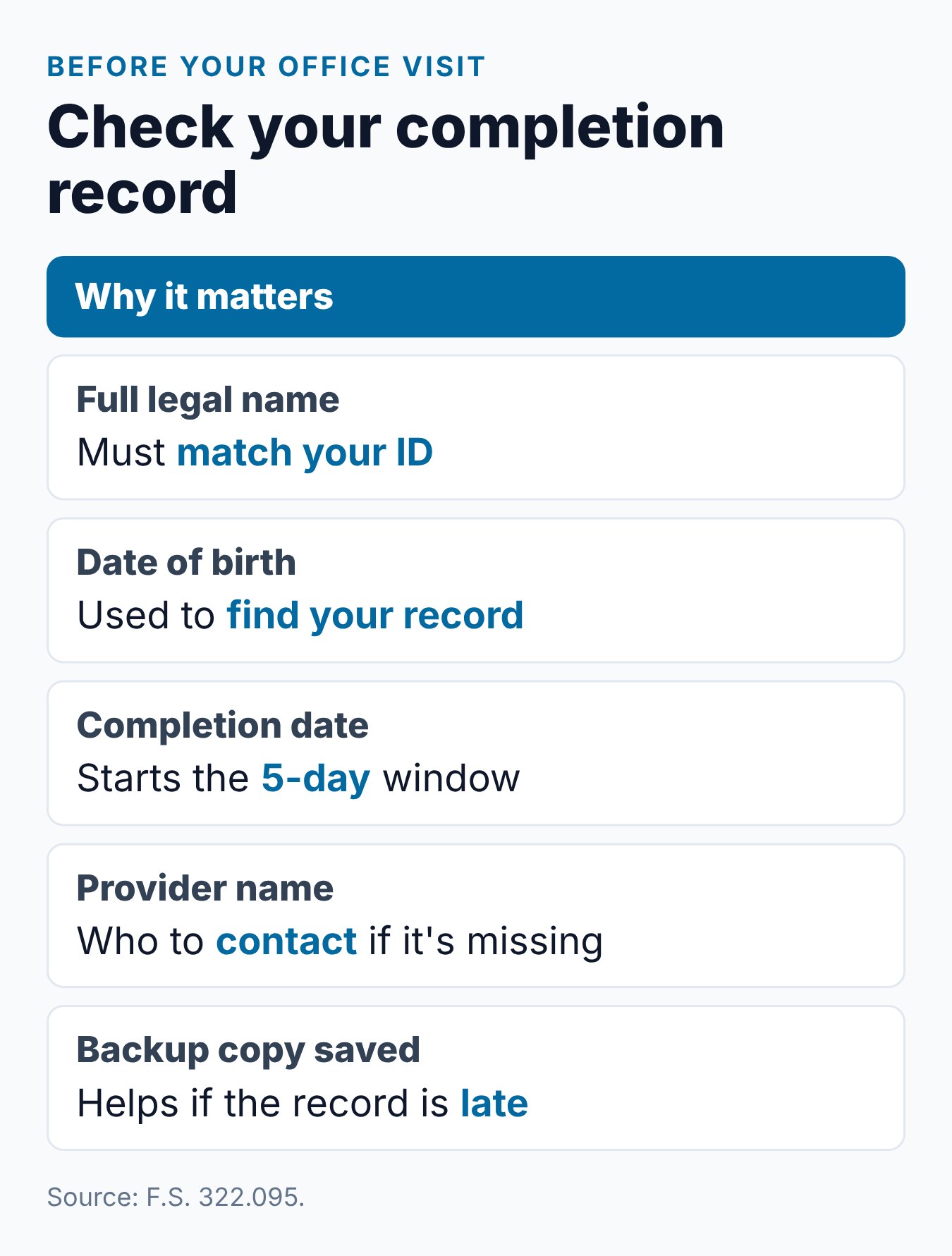
What to Check on Your Record
Mistakes are easiest to fix early. When you finish, look over what you entered in your course account:
- Full legal name, spelled the same as on your identity document
- Date of birth
- Any ID number the provider asked for, if it requested one
- Your completion date
- The provider’s name, so you know who to contact
A mismatch can slow things down at the office. The name on your identity document is the one FLHSMV will use, so your course record should match it.
If Your Record Is Missing or Wrong
Give the provider the full 5 days. If the record still isn’t on file after that, or a detail is wrong, follow these steps:
- Contact your provider first. It’s the one that submits the record, so it’s also the one that can resend or correct it.
- Share your backup copy. Your finish date and account details help them find you.
- Ask when they reported it. Write down the date they give you.
- Check with your county office before your visit. That can save a wasted trip.
The law also covers provider mistakes. If you couldn’t finish because of the provider’s or school’s error, the provider must let you complete the course at no extra cost.
Typos and Name Changes
A small typo can cause a big delay. If you spot one, tell your provider right away and ask how it corrects records it already reported.
If your legal name changed recently, such as after a marriage, use the name on the identity document you’ll bring to the office. If you already finished under an old name, ask your provider before your visit how to fix the record.
Don’t take the course again just to fix a typo. Ask your provider to correct its report first, since a second course means paying twice.
Online and Classroom Records Work the Same Way
It doesn’t matter how you took the course. F.S. 322.095 applies the same reporting rules to online and classroom providers.
Either way, the provider submits your completion to FLHSMV within 5 days and can’t charge you for it. Either way, only the electronic certificate counts.
If you took a classroom course, ask the instructor or school how you’ll get a backup copy.
Keeping Your Own Records
Providers must keep course records for 5 years and make them available to FLHSMV. You should keep your own too, at least until your license is in hand.
A simple folder works well:
- Your backup copy or completion email
- Your provider’s name, website and phone number
- The date you finished
- Any messages about corrections or reporting
If anything goes wrong months later, this folder has everything you or the office needs.
How Long a Completion Lasts
You may wonder whether a TLSAE completion expires. We didn’t find an official FLHSMV or statute source that sets a validity period for adults.
Some provider pages mention a time limit. Those aren’t official, so don’t rely on them.
If you finished the course more than a year ago and haven’t gotten your license yet, ask your county driver license office whether your completion is still on file and accepted. That’s the safest way to know before you book your exam.
If Your Provider Was Suspended
FLHSMV can suspend or revoke a TLSAE provider. Under F.S. 322.095, certificates from courses taken after a provider’s suspension or revocation are not accepted.
A course you finished before the suspension isn’t affected by that rule. The problem only comes up when someone takes a course after the provider lost its approval.
That’s why the best time to check FLHSMV’s approved TLSAE provider list is right before you pay. Our guide on how to get an FLHSMV-authorized TLSAE course shows what to look for.
Your Office Visit After TLSAE
Once your completion is on file, you’re ready for the office. You don’t need to bring the certificate, but you do need the documents FLHSMV lists for a first license.
FLHSMV’s what to bring page lists these for U.S. citizens:
- Proof of identity, such as a certified U.S. birth certificate or a valid U.S. passport
- Proof of your Social Security number
- Two documents that show your Florida residential address
Then you take the tests. Adults take the 50-question Class E knowledge exam in person and need 40 correct to pass, then the vision test and the driving skills test. Our guide to the first-time adult license process covers each step.
Questions to Ask Your Provider
Ask these before you buy, or right after you finish:
- When do you report completions to FLHSMV, and how will I know it’s done?
- Is your certificate fee optional, and what do I get if I skip it?
- How do I fix a typo in my name or birth date?
- Who do I contact if my record isn’t on file after 5 days?
- Can I download a free copy of my completion for my records?
Clear answers are a good sign. A provider that can’t explain its reporting process may not be the best choice.
A Simple Timeline
Here’s how the certificate fits into a typical schedule:
- Day 1: Finish the course and save your backup copy.
- Days 1 to 5: Your provider reports the completion to FLHSMV.
- After day 5: Confirm the record is on file if you’re unsure.
- Next: Book your knowledge exam and gather your documents.
Booking your office visit about a week after you finish keeps you clear of the reporting window. If you’re in a hurry, ask your provider when it usually reports.
Who Doesn’t Need a TLSAE Certificate
Not every new Florida driver will have a TLSAE record. The law exempts people who were licensed in another jurisdiction and people who completed a Department of Education driver education course.
Teens under 18 also won’t have one. Since August 1, 2025, they take the 6-hour DETS course instead.
If you’re not sure whether you need TLSAE, ask your county office before you buy a course.
Common Certificate Mistakes
Avoid these mix-ups:
- Treating a printout as proof. Only the electronic record counts.
- Paying for a certificate you don’t need. Providers can’t require one.
- Using a nickname in the course account. Match your identity document.
- Going to the office the day you finish. Allow up to 5 days for reporting.
- Trusting an unofficial expiration date. Ask your county office instead.
- Taking a course after a provider’s approval ended. Check the approved list before you pay.
How Requirements Can Vary
Florida’s course and license rules apply statewide, but some details depend on where you live. Driver license services are often handled by your county tax collector’s office, and each office sets its own appointment process and hours. Some county school boards also offer driver education programs, such as DELAP courses, that can count instead of DETS.
FLHSMV can update course rules, forms, documents, and fees. Check FLHSMV and your county office for current requirements before your appointment.
Frequently Asked Questions
What is the Florida drug and alcohol course certificate?
It’s the electronic TLSAE completion record your provider sends to FLHSMV’s Driver Improvement Certificate Issuance System. Only that record is valid for licensing.
Do I need to bring my TLSAE certificate to the office?
No. FLHSMV uses the electronic record, and paper certificates aren’t accepted. A copy is still a handy backup.
How long does it take for my TLSAE to show up?
Providers must report your completion within 5 days, at no charge.
Do I have to pay for my TLSAE certificate?
No. Providers can’t require you to buy one. Any certificate they sell must be marked as optional.
What if my TLSAE record is missing?
Wait the full 5 days, then contact your provider. It submits the record, so it can resend or fix it.
Does a TLSAE completion expire?
We didn’t find an official source that sets a validity period for adults. If you finished more than a year ago, ask your county office.
Is my certificate valid if my provider was suspended?
Certificates from courses taken after a provider’s suspension or revocation aren’t accepted. Check FLHSMV’s approved list before you pay.
Conclusion
Your Florida drug and alcohol course certificate is an electronic record that your provider sends to FLHSMV within 5 days, and paper copies aren’t accepted for licensing.
Save a backup, check that your name and birth date match your ID and contact your provider if anything is missing. Then book your knowledge, vision and road tests. Our online Florida TLSAE course is coming soon.
Related Articles
- Florida Drug and Alcohol Course (TLSAE): The Complete Guide for Adults
- Florida TLSAE Course Online: How to Take It and What It Covers
- First-Time Florida Driver’s License for Adults: The Complete Process
Sources
- Florida Statutes — F.S. 322.095 (TLSAE)
- FLHSMV — Approved TLSAE Course Providers
- FLHSMV — First-Time Florida Driver
- FLHSMV — What to Bring: U.S. Citizen
- FLHSMV — Class E Knowledge Exam and Driving Skills Test
- FLHSMV — Teen Licensing Frequently Asked Questions
Billy Forte is the owner of Driving Logic, a state-approved driver improvement course provider serving Florida and other U.S. states.
This article is general information, not legal advice. Florida licensing requirements, course rules, documents, and fees are set by FLHSMV and Florida law and can change. Use official FLHSMV and Florida statute sources for current requirements before you enroll in a course or visit a driver license office.