
Updated October 2026 · Reviewed by Billy Forte
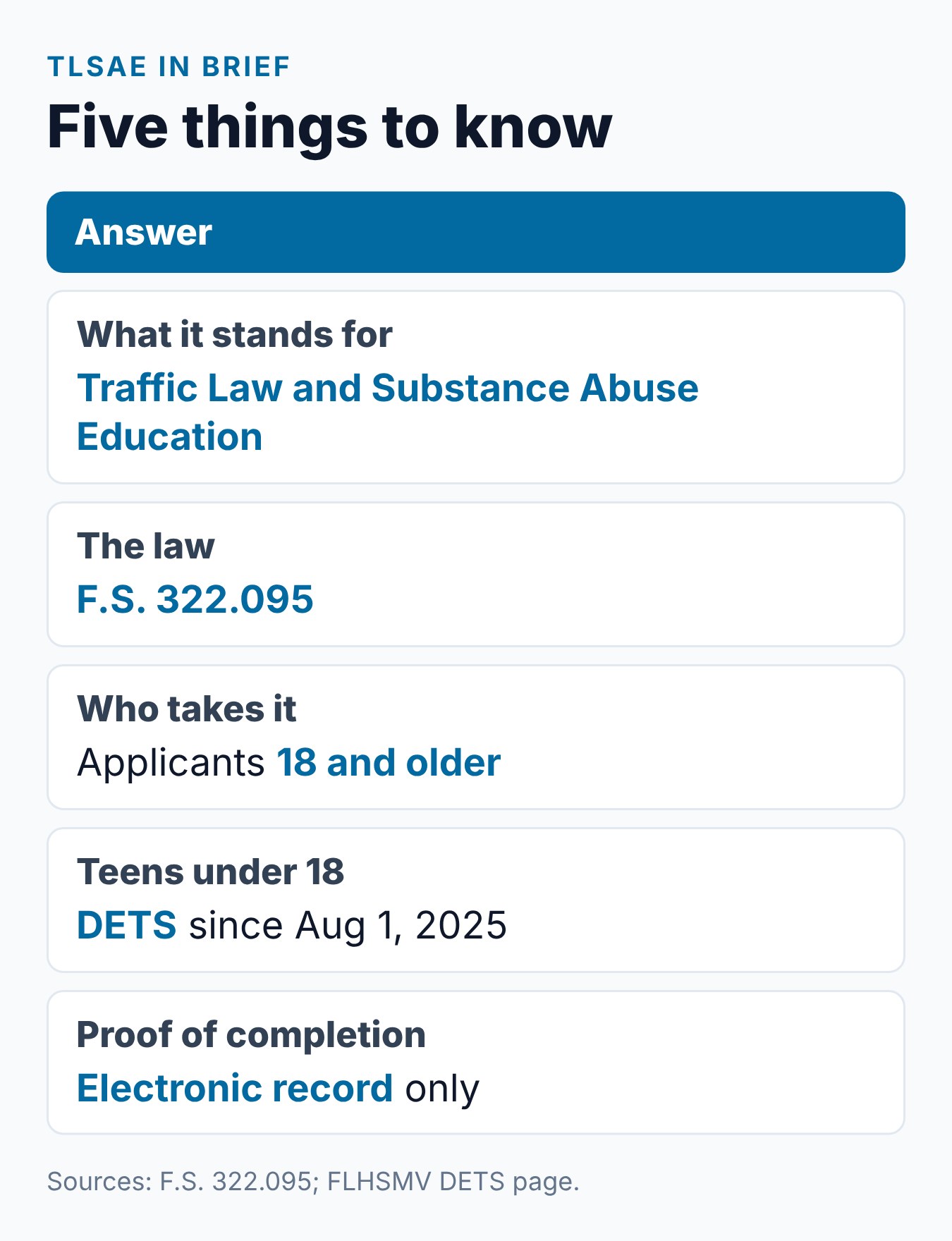
Florida TLSAE stands for Traffic Law and Substance Abuse Education, the 4-hour course that most first-time driver license applicants 18 and older must finish. It’s set by Florida Statute 322.095 and taught by providers that FLHSMV approves. Most people know it as the drug and alcohol course.
Key Facts
- Full name: Traffic Law and Substance Abuse Education. See the name.
- The law: F.S. 322.095 sets who takes it, what it covers and how it’s run. See the law.
- Who: License applicants 18 and older, with two exemptions. See who needs it.
- Length: At least 4 hours of content, not counting breaks. See the format.
- Teens: Since August 1, 2025, teens under 18 take DETS instead. See the 2025 change.
What TLSAE Stands For
TLSAE is short for Traffic Law and Substance Abuse Education. The name tells you the two halves of the course: Florida traffic law, and how alcohol and drugs affect drivers.
You’ll see it called by several names:
- The drug and alcohol course, the most common search term
- The 4-hour course, for its minimum length
- The first-time driver course, since it comes before a first license
They all mean the same course. When you shop, look for “TLSAE” on FLHSMV’s approved provider list, because that’s the official name.
The Law Behind Florida TLSAE
The course comes from F.S. 322.095. The section covers who must take the course, what it teaches, how long it runs and how providers are approved.
The law says course materials “must be designed to promote safety, education, and driver awareness.” That’s the closest thing it has to a purpose statement.
The Florida Department of Highway Safety and Motor Vehicles, or FLHSMV, runs the program. It approves courses, oversees providers and keeps the completion records used for licensing.
Who Needs Florida TLSAE
F.S. 322.095 applies to driver license applicants who are 18 or older. In practice, that means adults getting their first Florida license.
The law exempts two groups:
- People licensed in another jurisdiction. If you held a license in another state or country, you don’t need TLSAE.
- People who completed a Department of Education driver education course. This is a driver education course offered under s. 1003.48 of Florida law.
If neither exemption fits and you’re 18 or older, plan to take TLSAE before your knowledge exam.
Here are two quick examples. A 30-year-old who has never held a license anywhere needs TLSAE. A 30-year-old moving from Georgia with a valid Georgia license doesn’t, because they were licensed in another jurisdiction.
The 2025 Change for Teens
TLSAE used to be the first-time driver course for teens too. That changed on August 1, 2025.
Since then, teens under 18 take the 6-hour Driver Education Traffic Safety course, called DETS, before a learner’s license. TLSAE stayed in place for adults.
Some websites still say every new driver takes TLSAE. That’s out of date for teens. Our DETS vs TLSAE comparison explains which course fits which age.
What Florida TLSAE Covers
The law spells out the subjects every approved course must teach. Here’s what each one means for a new driver.
Florida’s driving laws. The basic rules of the road and a driver’s legal duties.
Effects of alcohol and drug abuse. The law names both the physiological effects, meaning on the body, and the psychological effects, meaning on the mind.
Costs of substance abuse. The societal and economic costs of alcohol and drug abuse, beyond the driver.
Impaired driving. How alcohol and drugs change a person’s ability to drive.
Vulnerable road users. Motorcyclist, bicyclist and pedestrian safety.
Risky driving. Speeding, reckless driving and running red lights and stop signs.
Electronic devices. What happens when drivers use phones and other devices while driving.
Providers decide how to teach these topics, but they can’t skip any of them. Every approved course has to cover the full list.
The course is classroom-style learning, not driving practice. You won’t get behind the wheel during TLSAE, so road skills still come from practice before your driving test.
Why These Topics Matter for New Drivers
Each topic connects to a choice you’ll make behind the wheel. The traffic law lessons help with everyday rules, but the rest of the course is about judgment.
Alcohol and drug lessons connect impairment to slower reactions and poorer decisions. The cost lessons show that a crash or arrest affects families, jobs and money, not only the driver.
The sections on speeding, red lights and phones focus on habits that feel minor but add risk every trip. The motorcycle, bicycle and pedestrian lessons remind drivers to look for people who are easy to miss.
What TLSAE Means for Drivers Under 21
Some adults who take TLSAE are 18, 19 or 20. For them, the alcohol lessons carry an extra rule.
Under F.S. 322.2616, a driver under 21 with a blood or breath alcohol level of 0.02 or higher has their license suspended. The suspension is 6 months for a first violation and 1 year if the driver was suspended under that law before.
Refusing a test brings a longer suspension: 1 year for a first refusal and 18 months for a later one. For drivers under 21, there’s very little room for even one drink.
Format and Length
A TLSAE course must include at least 4 hours of content. Breaks don’t count toward the 4 hours, and breaks may add up to no more than 30 minutes.
Providers offer the course online, in a classroom or both. Classroom locations must be free of distractions and reasonably accessible.
Three of the four providers we reviewed list a final exam, set by the provider. The law doesn’t set the exam’s format. See Florida Drug and Alcohol Course Test: What to Expect for what providers list.
How FLHSMV Approves TLSAE Courses
A provider can’t just write a course and sell it. F.S. 322.095 sets out an approval process.
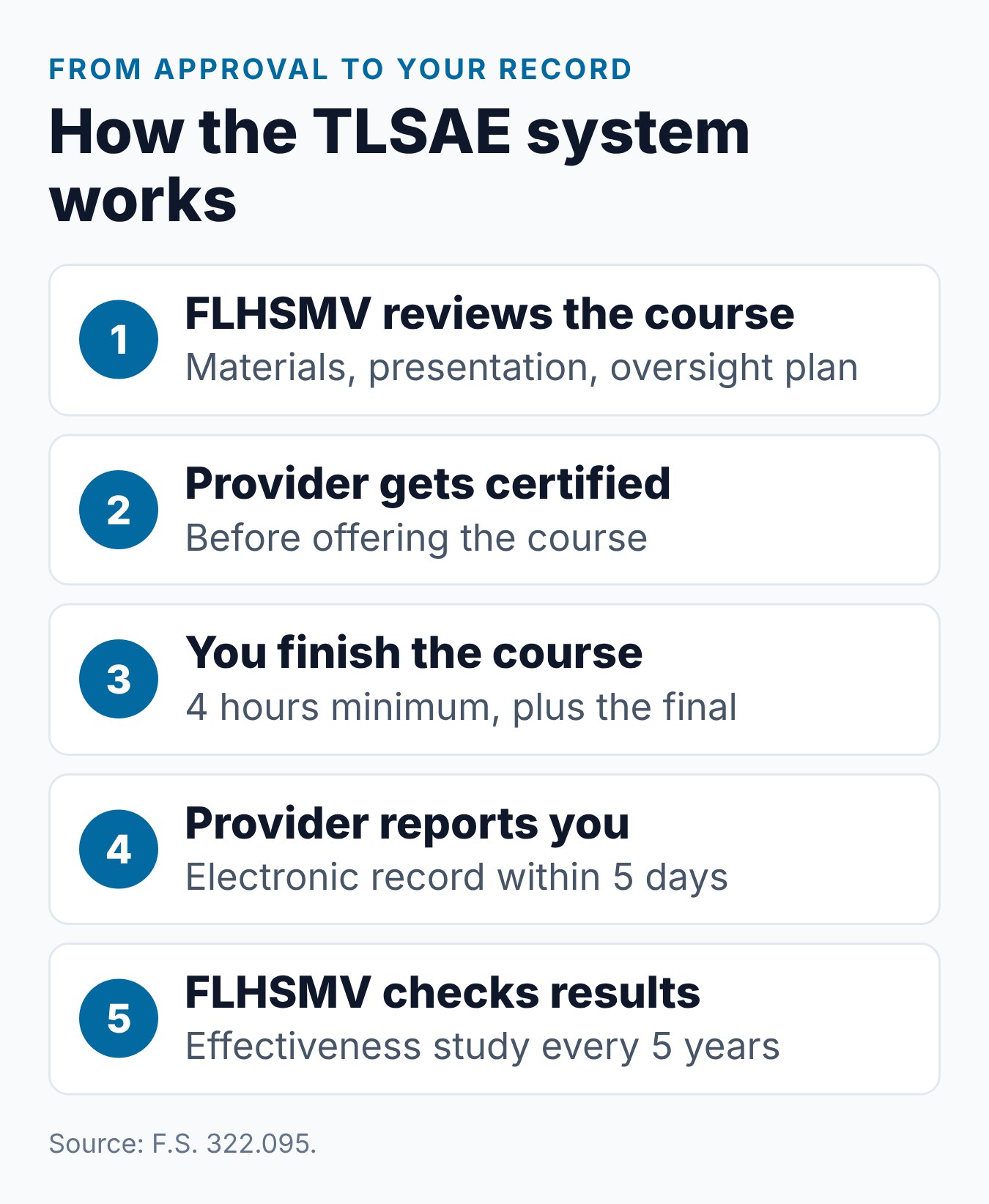
FLHSMV’s first review looks at:
- The course materials, to confirm they cover every required topic
- A presentation by the provider
- The provider’s plan for overseeing its instructors
The provider must also show it owns the course or has written permission to use it. It has to get FLHSMV certification before it offers the course to anyone.
Approval comes with ongoing duties. FLHSMV reviews changes to Florida’s major traffic laws each year, and providers must update their courses when FLHSMV asks. A provider that doesn’t update within 90 days has its approval suspended.
Who Can Teach TLSAE
The law sets limits on instructors too. A person can’t teach TLSAE if, within the past 5 years, they were convicted of:
- A drug-related or DUI offense
- A felony
- Fraud
- A crime that directly threatens student safety
Providers are responsible for making sure their schools follow the approved content, timing and materials.
Providers must also keep course records for 5 years and make them available to FLHSMV. If a student can’t finish because of the provider’s or school’s error, the provider must let that student complete the course at no extra cost.
How Completion Is Recorded
When you finish, your provider reports your completion to FLHSMV’s Driver Improvement Certificate Issuance System. The law gives providers 5 days and bars them from charging you for it.
Only that electronic certificate is valid for licensing. A paper certificate won’t be accepted at the office.
Each completion also carries a $3 assessment fee, which the school collects from you and the provider sends to FLHSMV. That fee is how each completion gets its own certificate number.
Before your office visit, check that the name and birth date in your course account match your identity documents. If the record still isn’t on file after 5 days, contact your provider, since it’s the one that sends and corrects the report.
How FLHSMV Checks That TLSAE Works
The law asks FLHSMV to measure results, not just approve courses. Every 5 years, it studies how well each delivery method works by looking at DUI citations, moving violations or crashes.
A course that fails that study must stop being offered right away. FLHSMV can also suspend or revoke a provider for breaking the rules, and it can fine providers $1,000 to $5,000 per violation.
If a provider is suspended or revoked, certificates from courses taken after that point aren’t accepted. That’s why checking the approved list matters.
Where TLSAE Fits in Getting a License
TLSAE is the first step for most adults. The full path looks like this:
- Finish an approved TLSAE course.
- Wait for your provider to report it, within 5 days.
- Pass the Class E knowledge exam in person. It has 50 questions, and you need 40 correct.
- Pass the vision test.
- Pass the driving skills test for your Class E license.
The knowledge exam asks about road signs, right-of-way and many rules TLSAE only touches on. Study the official driver handbook too, and plan for an English-only exam, since that rule took effect on February 6, 2026.
Adults don’t need a learner’s license first. Our guide to the first-time adult license process walks through each office visit.
Myths About TLSAE
A few common beliefs don’t match the law:
- “TLSAE was replaced by DETS.” Only for teens under 18. Adults still take TLSAE.
- “It’s a punishment for a DUI.” For first-time drivers, it’s a licensing step, not a penalty.
- “Any drug and alcohol course works.” Only FLHSMV-approved TLSAE courses count.
- “I need to bring my certificate.” FLHSMV uses the electronic record, and paper isn’t accepted.
- “Passing TLSAE means I passed the permit test.” The knowledge exam is a separate test.
Questions to Ask a TLSAE Provider
Once you know what TLSAE is, these questions help you pick a course:
- Is the course on FLHSMV’s approved TLSAE list?
- What is the full price, including any optional fees?
- How does the final exam work, and are retakes allowed?
- Can I stop and come back later?
- When will you report my completion to FLHSMV?
Our guide on how to get an FLHSMV-authorized TLSAE course covers the checks in more detail.
How Requirements Can Vary
Florida’s course and license rules apply statewide, but some details depend on where you live. Driver license services are often handled by your county tax collector’s office, and each office sets its own appointment process and hours. Some county school boards also offer driver education programs, such as DELAP courses, that can count instead of DETS.
FLHSMV can update course rules, forms, documents, and fees. Check FLHSMV and your county office for current requirements before your appointment.
Frequently Asked Questions
What does TLSAE stand for in Florida?
Traffic Law and Substance Abuse Education. It’s the drug and alcohol course required by F.S. 322.095.
Is TLSAE the same as the drug and alcohol course?
Yes. “Drug and alcohol course” and “4-hour course” are common names for TLSAE.
Who has to take Florida TLSAE?
Driver license applicants 18 and older, unless they were licensed in another jurisdiction or completed a Department of Education driver education course.
Do teens still take TLSAE?
No. Since August 1, 2025, teens under 18 take the 6-hour DETS course instead.
How long is the Florida TLSAE course?
At least 4 hours of content, not counting breaks. Breaks may total no more than 30 minutes.
Who approves TLSAE courses?
FLHSMV. It reviews the course materials, a provider presentation and the provider’s instructor oversight plan before approval.
Is a paper TLSAE certificate accepted?
No. Only the electronic certificate your provider reports to FLHSMV is valid for licensing.
Conclusion
Florida TLSAE is Traffic Law and Substance Abuse Education, the 4-hour course F.S. 322.095 requires for most first-time license applicants 18 and older.
It covers traffic law, alcohol and drug risks and road safety, and FLHSMV approves and checks every provider. Teens under 18 take DETS instead. Our online Florida TLSAE course is coming soon.
Related Articles
- Florida Drug and Alcohol Course (TLSAE): The Complete Guide for Adults
- Florida Drug and Alcohol Course Test: What to Expect
- How to Get a FLHSMV-Authorized TLSAE Course in Florida
- Florida DETS vs TLSAE: What Changed and Who Needs Which Course
Sources
- Florida Statutes — F.S. 322.095 (TLSAE)
- FLHSMV — Approved TLSAE Course Providers
- Florida Statutes — F.S. 322.1615 (Learner’s Driver License)
- FLHSMV — Driver Education Traffic Safety (DETS) and approved provider list
- FLHSMV — Driver Education Courses
- FLHSMV — First-Time Florida Driver
- Florida Statutes — F.S. 322.2616 (Drivers Under 21, 0.02 Alcohol)
- FLHSMV — Official Florida Driver License Handbook (PDF)
- Hillsborough County Tax Collector — Driver License Exams in English Only Beginning February 6
Billy Forte is the owner of Driving Logic, a state-approved driver improvement course provider serving Florida and other U.S. states.
This article is general information, not legal advice. Florida licensing requirements, course rules, documents, and fees are set by FLHSMV and Florida law and can change. Use official FLHSMV and Florida statute sources for current requirements before you enroll in a course or visit a driver license office.