
Updated October 2026 · Reviewed by Billy Forte
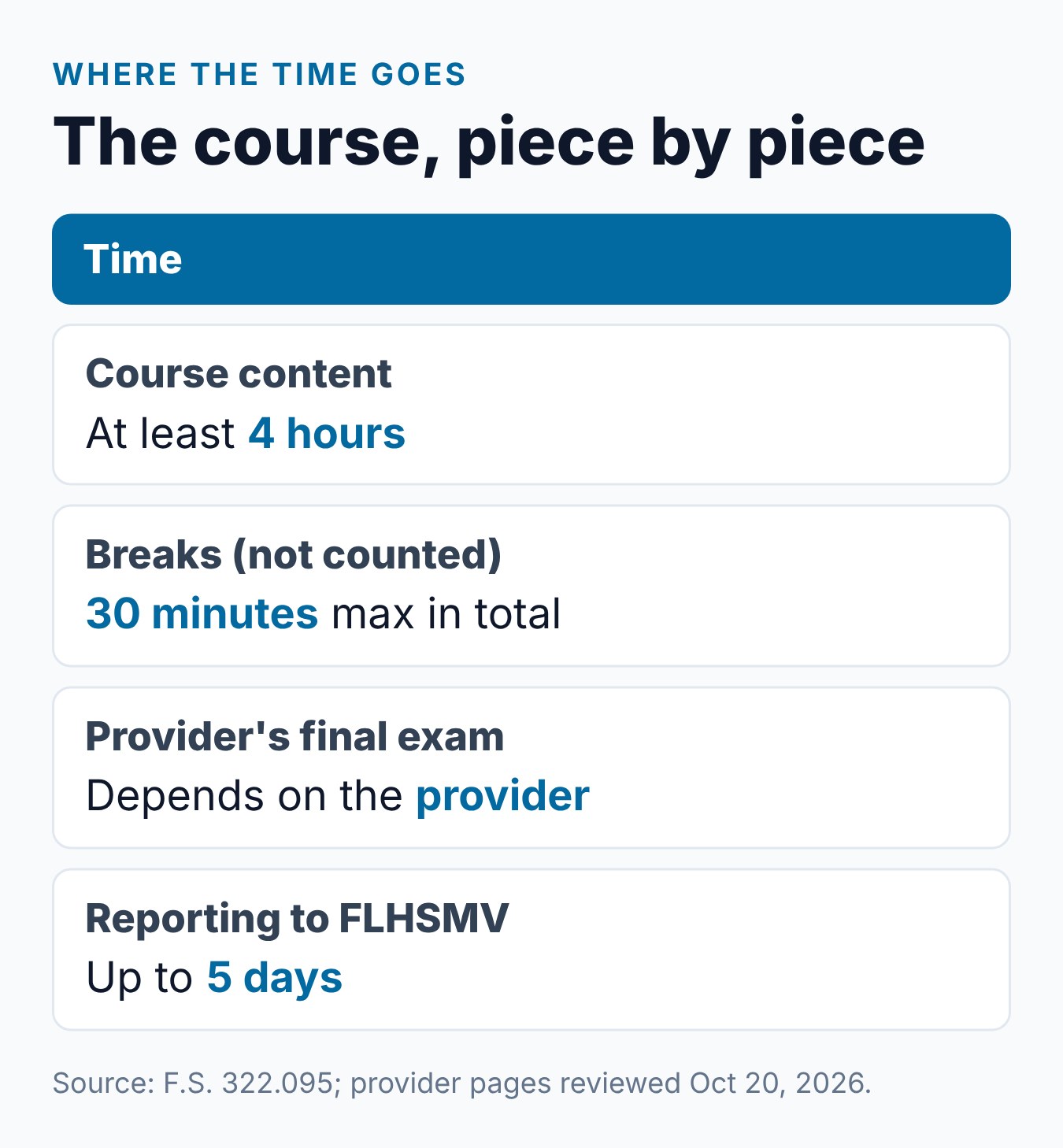
How long is the Florida drug and alcohol course? Florida law requires at least 4 hours of course content, not counting breaks, and breaks can add up to no more than 30 minutes. Plan for about half a day, plus up to 5 days for the provider to report the completion to FLHSMV.
Key Facts
- Course time: At least 4 hours of content, breaks not counted. See the law.
- Breaks: No more than 30 minutes in total. See what counts.
- Online: The providers we reviewed let you split the course into sessions. See online pacing.
- Reporting: Up to 5 days after you finish. See the reporting window.
- Compared with DETS: Teens under 18 take a 6-hour course instead. See the comparison.
What the Law Requires
The time rule comes from F.S. 322.095, the law that sets up TLSAE. It says each course must include at least 4 hours of content, not counting breaks.
The 4 hours is a minimum, not a cap. A provider can build a longer course if it wants to, but it can’t go shorter.
The minimum is the same for every adult. Your age, your driving experience and how fast you read don’t change it.
The law applies to every approved course, whether you take it online or in a classroom. A provider that claims you can finish in 2 hours isn’t offering an approved TLSAE course.
What Counts Toward the 4 Hours
Only course content counts toward the 4 hours. That means the lessons on Florida driving law, alcohol and drug effects, road safety and the other required topics.
Breaks don’t count. The law also caps breaks at 30 minutes in total.
So in a classroom, a course with the full 30 minutes of breaks takes at least 4 hours and 30 minutes of seat time. Online, how the time is tracked depends on the provider.
How Long Is the Florida Drug and Alcohol Course Online?
Online is where you get the most control over your time. Provider pages we reviewed on October 20, 2026 describe self-paced courses that you can split across sessions and pick up where you left off.
That doesn’t make the course shorter. You still need at least 4 hours of content. It just lets you spread those hours out.
Common ways adults fit it in:
- One afternoon, if you have a free block of time
- Two evenings, about 2 hours each
- A lesson a day over a week, if your schedule is tight
Check the provider’s rules before you start, including whether it sets a deadline to finish after you buy. Our article on the Florida TLSAE course online explains how online courses work.
Classroom Courses Run in One Block
A classroom course runs on the school’s schedule. You show up at a set time and stay until the course ends.
Plan for at least 4 hours of class, plus up to 30 minutes of breaks. Add travel time and a few minutes to check in.
The law requires classroom locations to be free of distractions and reasonably accessible. Ask the school about start times, parking and what to bring before you go.
Add Time for the Final Exam
Three of the four providers we reviewed list a final exam, set by the provider. That time is on top of the lessons.
We reviewed four approved providers’ public pages on October 20, 2026. Two list 40-question finals with 80% needed to pass, and two list unlimited retakes. If you need a retake, that adds more time.
Our guide to the Florida drug and alcohol course test covers what to expect.
The Reporting Window
When you pass, your provider reports your completion to FLHSMV electronically. The law gives providers up to 5 days and doesn’t let them charge you for it.
That window matters for planning. If you book your office visit the day after you finish, your record may not be on file yet.
The 5 days is the longest the law allows, not a set wait. Your record may show up sooner, but plan around the full window so a late report doesn’t cost you an appointment.
Only the electronic record counts for licensing, and paper certificates aren’t accepted. See our article on the Florida drug and alcohol course certificate for what to do if your record is late.
TLSAE vs DETS Length
Florida has two first-time driver courses, and they aren’t the same length.
| TLSAE | DETS | |
|---|---|---|
| Who takes it | Adults 18 and older | Teens under 18 |
| Length | At least 4 hours | 6 hours |
| Since | Still required for adults | August 1, 2025 for teens |
The age on the day you apply decides which one you take. If you’re 17, a 4-hour TLSAE course won’t meet the requirement, even though it’s shorter.
Our article on how long the Florida DETS course is covers the teen course.
Who Can Skip the 4 Hours
Some adults don’t need TLSAE at all, which saves the whole block of time. F.S. 322.095 exempts two groups:
- People who were licensed in another jurisdiction, such as another state or country
- People who completed a Department of Education driver education course
If you moved to Florida with a valid license from another state, you usually transfer it instead. Check our new Florida resident guide before you spend 4 hours on a course you may not need.
From Course to License: The Full Timeline
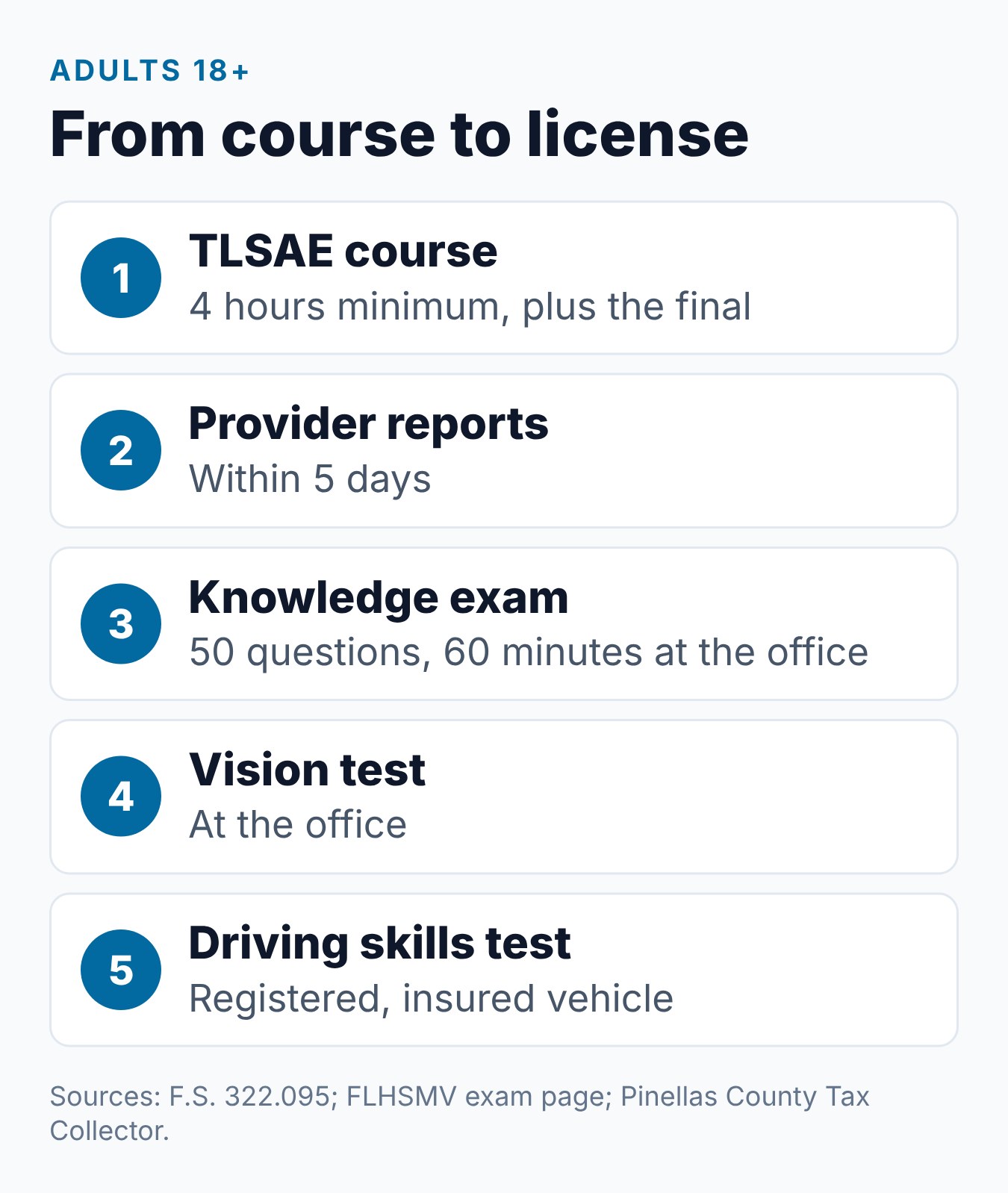
The course is only the first step. Here’s how the whole process stacks up for an adult who passes everything on the first try:
- The TLSAE course. At least 4 hours of content, plus the final exam.
- Reporting. Up to 5 days for the provider to send your completion to FLHSMV.
- The knowledge exam. The Pinellas County Tax Collector gives 60 minutes for the 50-question exam. Adults take it in person.
- The vision test. Done at the office.
- The driving skills test. Done with a registered, insured vehicle.
How long steps 3 to 5 take depends on your county’s appointment wait, so check it early.
If you fail the knowledge exam, offices allow two attempts per exam per day. A retest costs $10 plus any office fee.
How Long the Knowledge Exam Takes
After TLSAE, the next timed step is the Class E knowledge exam. It has 50 multiple-choice questions, and you need 40 correct to pass.
The Pinellas County Tax Collector and the Manatee County Tax Collector both give 60 minutes for the exam at the office. That’s about 72 seconds per question.
Office hours matter too. Pinellas stops in-office testing at 3:00 p.m., and Manatee says exams not finished before its end-of-day cutoff may be ended. Book an early slot so you have room for a second try if you need one.
Adults take this exam in person. FLHSMV’s teen FAQ says online knowledge exams are for applicants under 18 only.
If You Stop Partway Through
Life happens. If you need to stop an online course partway through, the providers we reviewed say you can log back in and continue.
Before you log out, finish the lesson you’re on if you can. Then write down where you stopped, in case you need to tell the provider.
A classroom course is different. If you leave early, ask the school what happens next, since you’ll need the full 4 hours of content to complete it.
If you can’t finish because of the provider’s or school’s error, the law says the provider must let you complete the course at no extra cost.
Fitting the Course Around Work
If you have a job, school or kids, a few tips make the 4 hours easier to fit in:
- Use your lunch breaks for short lessons if your provider supports a phone.
- Block out one evening on your calendar like an appointment.
- Save the final exam for a time when you won’t be interrupted.
- Tell your household you need quiet time for a couple of hours.
The course rewards focus. An hour of real attention beats two hours with the TV on.
Sample Schedules
Here are three ways to plan the course and the steps after it. Pick the one that matches your week.
The fast track. Finish the course on a Saturday. Study the driver handbook during the week while your provider reports the completion.
Then book your knowledge exam for the following week.
The weeknight plan. Do one or two lessons each night over four or five nights. Take the final exam on the last night, then wait for reporting while you study.
The slow and steady plan. Spread the course over two weekends. This works if you have kids at home or a long work week.
Whichever plan you choose, build in the 5-day reporting window before your office visit.
How to Finish Without Wasting Time
You can’t skip the 4 hours, but you can avoid delays:
- Pick an approved provider first. An unapproved course wastes all the time you put into it.
- Set up your account carefully. Use your legal name and birth date so the record matches your ID.
- Study in focused blocks. You’ll remember more and need fewer exam retakes.
- Finish before you book the office. Then add the 5-day reporting window.
- Study the handbook too. The knowledge exam covers more than the course does.
Common Timing Mistakes
These mistakes cost people the most time:
- Booking the office too soon. Your record can take up to 5 days to arrive.
- Expecting a 2-hour course. The law requires at least 4 hours of content.
- Taking TLSAE at 17. Teens need the 6-hour DETS course, so the time is wasted.
- Skipping study time for the knowledge exam. A failed exam can mean another office visit.
- Waiting until the last minute. Appointment waits vary by county.
How Requirements Can Vary
Florida’s course and license rules apply statewide, but some details depend on where you live. Driver license services are often handled by your county tax collector’s office, and each office sets its own appointment process and hours. Some county school boards also offer driver education programs, such as DELAP courses, that can count instead of DETS.
FLHSMV can update course rules, forms, documents, and fees. Check FLHSMV and your county office for current requirements before your appointment.
Frequently Asked Questions
How long is the Florida drug and alcohol course?
At least 4 hours of course content, not counting breaks. Breaks may total no more than 30 minutes.
Can I finish the TLSAE course in one day?
Yes, if you have a free afternoon. Online courses also let you split it into sessions.
Do breaks count toward the 4 hours?
No. Breaks don’t count, and they can add up to no more than 30 minutes.
Is the online course shorter than the classroom course?
No. Both must include at least 4 hours of content. Online just lets you choose when to do it.
How long until FLHSMV gets my completion?
Providers must report it within 5 days, at no charge.
Why is the teen course longer?
Teens under 18 take the 6-hour DETS course under a separate rule. TLSAE for adults has a 4-hour minimum.
How long does the whole license process take after TLSAE?
It depends on your county’s appointment wait. Plan for the 5-day reporting window, then the knowledge, vision and road tests.
Conclusion
The Florida drug and alcohol course takes at least 4 hours of content, with no more than 30 minutes of breaks that don’t count.
Online courses let you split that time, but plan for the final exam and up to 5 days of reporting before your office visit. Teens under 18 take the 6-hour DETS course instead. Our online Florida TLSAE course is coming soon.
Related Articles
- Florida Drug and Alcohol Course (TLSAE): The Complete Guide for Adults
- Florida TLSAE Course Online: How to Take It and What It Covers
- Florida Drug and Alcohol Course Test: What to Expect
- How Long Is the Florida DETS Course and How Is It Structured?
Sources
- Florida Statutes — F.S. 322.095 (TLSAE)
- FLHSMV — Approved TLSAE Course Providers
- FLHSMV — Driver Education Traffic Safety (DETS) and approved provider list
- FLHSMV — Class E Knowledge Exam and Driving Skills Test
- FLHSMV — Teen Licensing Frequently Asked Questions
- Pinellas County Tax Collector — Learner’s Permit
- Manatee County Tax Collector — Written Exams
Billy Forte is the owner of Driving Logic, a state-approved driver improvement course provider serving Florida and other U.S. states.
This article is general information, not legal advice. Florida licensing requirements, course rules, documents, and fees are set by FLHSMV and Florida law and can change. Use official FLHSMV and Florida statute sources for current requirements before you enroll in a course or visit a driver license office.