
Updated November 2026 · Reviewed by Billy Forte
The Florida 4 hour drug and alcohol course is the Traffic Law and Substance Abuse Education (TLSAE) course, and it is for first-time driver license applicants who are 18 or older. Florida law exempts an adult who has been licensed in another jurisdiction or who passed a Department of Education driver education class. Teens under 18 applying for a first license take the 6-hour DETS course instead, and one group of drivers under 21 takes TLSAE after an alcohol suspension notice.
Key Facts
- Main group: adults 18 or older applying for a first license. See the course match table.
- Length: the law sets at least 4 hours of course content. See why it is the 4 hour course.
- Teens: under 18, the course is DETS since August 1, 2025. See the under-18 rule.
- School driver education: a successful DELAP student is exempt. See school driver education.
- Under 21: a .02 to .05 notice can send a driver to TLSAE. See the under-21 case.
- Not an exam: the course does not replace the knowledge exam or driving test. See what it is not.
Who Needs the Florida 4 Hour Drug and Alcohol Course
The short answer comes from one sentence of state law. Under s. 322.095(1), Florida Statutes, each driver license applicant who is 18 years of age or older must complete a traffic law and substance abuse education course.
The same sentence lists two ways out. The first is a past license from another jurisdiction. The second is a school driver education course from the Department of Education, offered under s. 1003.48, that the applicant satisfactorily completed.
The Florida Department of Highway Safety and Motor Vehicles (FLHSMV) runs the program. Many people call it the Florida DMV, but FLHSMV is the state agency, and county tax collector offices handle many local driver license services.
This article sorts readers into groups, so you can find your own row fast. The full course, from topics to the final step, is in the complete guide to the Florida drug and alcohol course. For a yes-or-no answer with the exemptions explained in depth, read Is the TLSAE Course Required in Florida?
Which Course Do You Need
Pick the line that matches your age and license history. Each line names the course and the official page that says so.
| Situation | Course | Official source |
|---|---|---|
| Adult, age 18 or older, never held a license anywhere | The 4-hour TLSAE course | s. 322.095(1); FLHSMV TLSAE page |
| First-time driver under 18 applying on or after August 1, 2025 | The 6-hour DETS course | FLHSMV DETS page |
| Holds or held a license from another state or country | None under the statute | s. 322.095(1) |
| Finished a Department of Education driver education course or DELAP | None | s. 322.095(1); FLHSMV Driver Improvement Schools page |
| Under 21, got a suspension notice for a .02 to .05 alcohol level, reinstating on a hardship | The 4-hour TLSAE course | FLHSMV TLSAE page |
| Under 18 and finished TLSAE before August 1, 2025 | No DETS for now; the TLSAE completion can be used for one year after it was finished | FLHSMV DETS FAQ |
Two rows need a little more care. The out-of-state row and the school row each have fine print, covered in the sections below.
A note on wording: the statute says “18 years of age or older.” FLHSMV’s TLSAE page says drivers “over the age of 18.” This article follows the statute, which is the law the page is based on.
Why It Is Called the 4 Hour Course
The name comes from the law itself. Section 322.095(9) says these courses shall be conducted with a minimum of 4 hours devoted to course content, minus a maximum of 30 minutes allotted for breaks.
FLHSMV uses the same number. Its TLSAE page calls it a 4-hour Traffic Law and Substance Abuse Education course, and its DETS FAQ calls it “the 4-hour TLSAE course.”
So “4 hour drug and alcohol course,” “drug and alcohol course” and “TLSAE” all point to one course for adults. The “drug and alcohol” part matches what the law requires the course to teach. Under s. 322.095(2)(b), the curriculum covers:
- the physical and mental effects of alcohol and other drug abuse
- the social and money costs of alcohol and drug abuse
- how alcohol and drugs affect a driver
- Florida laws on driving a motor vehicle
- risky habits such as speeding, reckless driving and running red lights or stop signs
- the results of using electronic devices while driving
The law also asks the course to promote motorcyclist, bicyclist and pedestrian safety. How long the course really takes, from sign-up to the end, is covered in the pillar guide linked above.
Under 18: A Different Course
Teens do not use the 4-hour course for a first license anymore. FLHSMV’s DETS page says that as of August 1, 2025, a person under 18 who has never held a license from any other state, country or jurisdiction must complete a 6-hour DETS course before applying.
DETS stands for Driver Education Traffic Safety. FLHSMV says it meets or exceeds the Florida Department of Education Traffic Safety-Classroom 1900300 course version description. The learner’s license law, s. 322.1615(1)(c), uses that same 1900300 standard for the driver education course a learner must finish.
A teen who takes the 4-hour course now does not skip DETS. FLHSMV’s DETS FAQ says a person under 18 who completes TLSAE on or after August 1, 2025, will need DETS too. FLHSMV makes an exception for students enrolled in a DELAP course or in an FDOE Traffic Safety Classroom course, 1900300 or 1900310.
Teens Who Finished TLSAE Earlier
FLHSMV lists three groups the change does not affect:
- applicants under 18 who already hold a valid out-of-state license and are transferring it to Florida
- people who got a Florida learner’s license before August 1, 2025
- people under 18 who completed TLSAE before August 1, 2025
The last group can use the TLSAE completion for one year after the completion date. FLHSMV says a teen in that group who does not get a Florida driver license within the year will need DETS.
The teen course has its own article: Florida 6-hour drug and alcohol course.
If You Took Driver Education in School
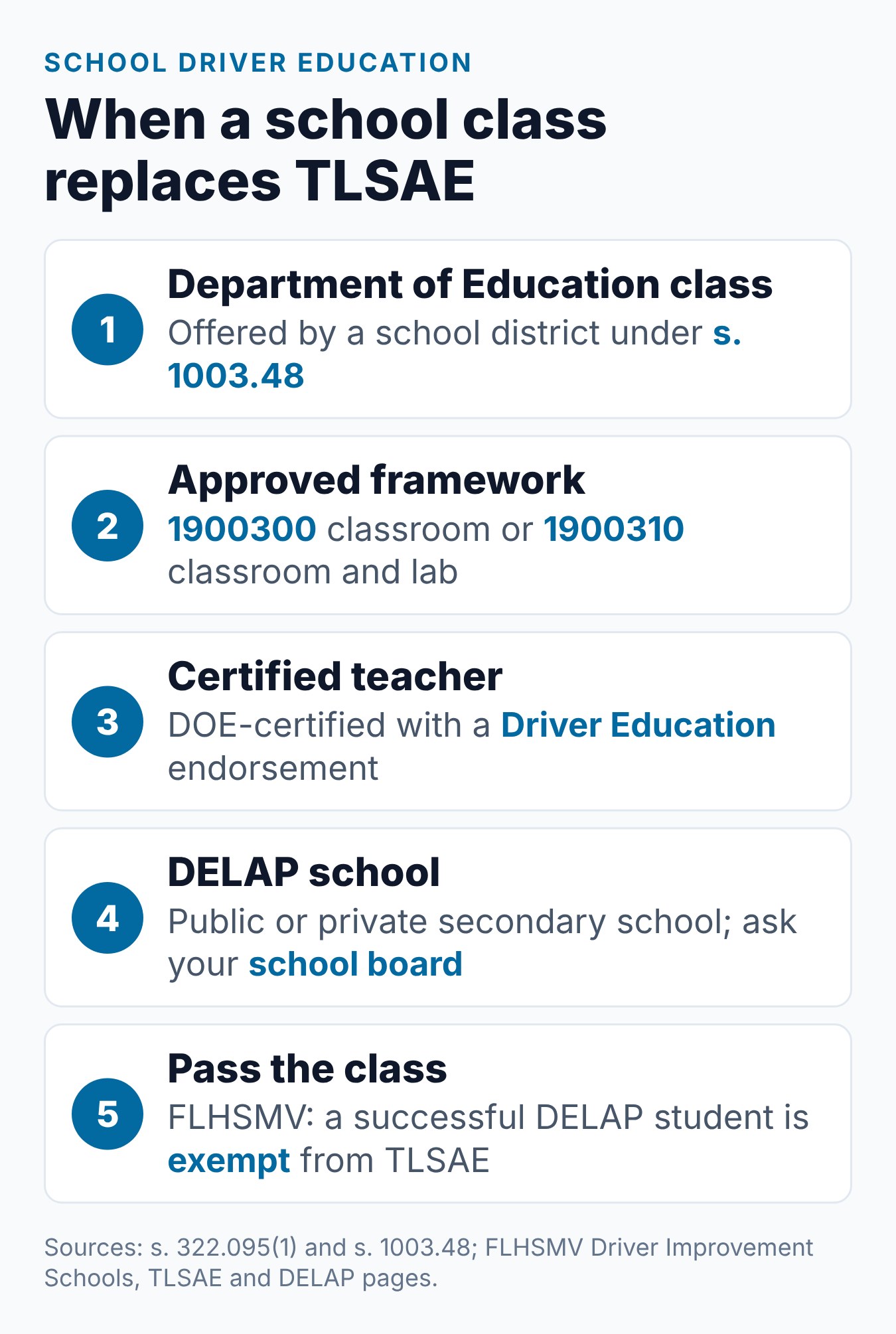
School driver education is the second exemption in the statute. The course has to be a Department of Education driver education course offered under s. 1003.48.
That section, s. 1003.48, Florida Statutes, says each district school board shall make a course in safe and lawful driving available to students in secondary schools. The school board sets the standards for the course.
FLHSMV ties this to a program called DELAP, the Driver Education Licensing Assistance Program. Its Driver Improvement Schools page says DELAP and high school driver education classes teach the drug and alcohol training. It also says a successful DELAP student is exempt from having to take TLSAE.
What Makes a School Course Count
FLHSMV’s DELAP page lists the rules a school course must meet to take part:
- teachers are Department of Education-certified with a Driver Education endorsement
- the school is part of a public or private secondary education program
- the course follows one of two Department of Education frameworks, Driver Education/Traffic Safety, Classroom 1900300, or Classroom and Laboratory 1900310
FLHSMV’s TLSAE page adds that DELAP courses are offered by some county school boards and may substitute for the requirement. It tells readers to contact the local school board for more information.
The Florida Department of Education driver education page listed for this article could not be opened during this review. So this section uses only the statute and FLHSMV’s pages. If you are not sure your class counted, ask the school that taught it before you sign up for TLSAE.
Licensed Before in Another State or Country
The first exemption is short in the law. An applicant who has been licensed in another jurisdiction does not need the course under s. 322.095(1).
FLHSMV’s wording adds a detail. Its TLSAE page names drivers who have never held, or do not have in their possession, a license from another state, country or jurisdiction. Its Class E Knowledge Exam & Driving Skills Test page says the course comes before applying for anyone never issued a license in any state or country.
If you held a license elsewhere but no longer have the card, the pages read for this article do not say what proof works. The required-or-not article linked above walks through that case. Call the driver license office before you pay for a course.
Drivers Under 21 and Alcohol Notices
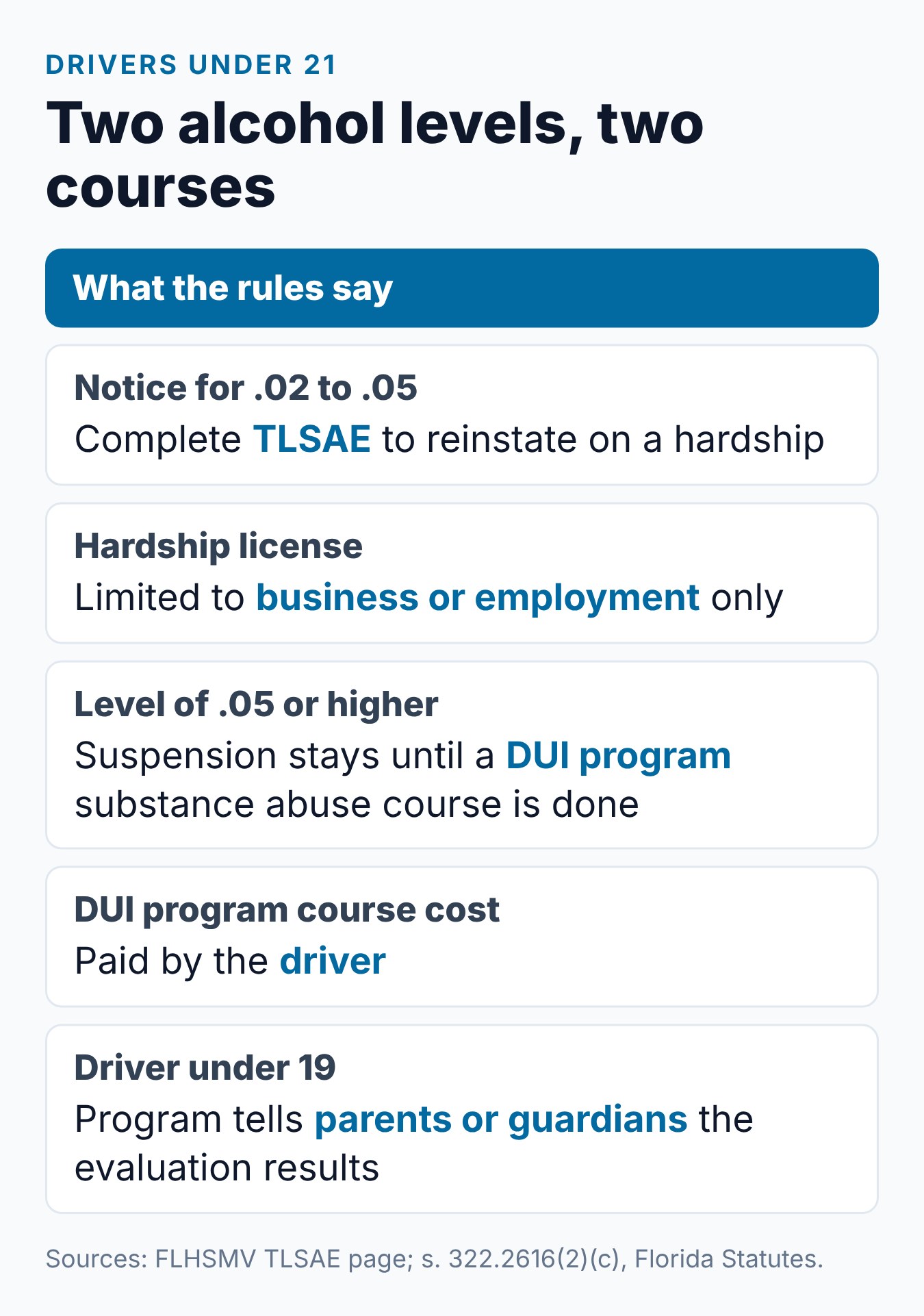
One group takes the 4-hour course for a reason that has nothing to do with a first license. FLHSMV’s TLSAE page names drivers under 21 who got a suspension notice for a blood alcohol level of .02 to .05. They must complete a TLSAE course to reinstate their license on a hardship.
FLHSMV defines a hardship license as one restricted to business or employment purposes only. So in this case the course is part of getting a limited license back.
A higher level brings a different course. Section 322.2616(2)(c) covers a driver under 21 with a level of .05 or higher. The suspension stays in effect until the driver completes a substance abuse course from a DUI program licensed by the department.
That DUI program course is not TLSAE. The same paragraph says the driver pays the reasonable costs, and the program does a substance abuse evaluation. For drivers under 19, the program tells the parents or legal guardians the results.
What the Course Is Not
The 4-hour course is one step toward a license. It does not stand in for the tests that come after it.
- Not the knowledge exam. FLHSMV’s Class E exam page lists the Class E Knowledge Exam as a separate step for a learner’s license. FLHSMV announced in a January 30, 2026 news release that, beginning February 6, 2026, all driver license knowledge and skills exams are given in English only.
- Not the driving skills test. The same page lists the Class E Driving Skills Test as its own step for a Class E license.
- Not ticket school. FLHSMV’s Driver Improvement Schools page says Basic Driver Improvement is a course a driver may elect after a non-criminal moving violation. That is a different course from TLSAE.
- Not a DUI program. FLHSMV lists Florida licensed DUI programs as a separate service, and the under-21 section above shows when the law sends a driver to one.
FLHSMV’s Class E page also says online knowledge testing is for applicants under 18. Adults take the knowledge exam in person, at a service center or with an approved third-party provider in a proctored setting.
What a County Tax Collector Page Says
Many readers first meet this course on a county website. The Indian River County Tax Collector help page on Florida driver education and improvement courses agrees with FLHSMV and the statute.
It says TLSAE is a four-hour course. It is required for first-time drivers age 18 and older who have never been licensed in another state, country or jurisdiction. It names DETS for drivers under 18 applying for a learner’s license on or after August 1, 2025.
The page also says FLHSMV does not accept paper certificates for licensing. A second county help page on first-time learner licenses was suggested for this article, but it could not be opened, so it is not used here.
What Happens After You Finish
You do not carry proof to the office. Under s. 322.095(12), the course provider sends your completion to FLHSMV through the Driver Improvement Certificate Issuance System within 5 days, free of charge to you.
FLHSMV’s Driver Improvement Schools page says completions can take 24 to 72 hours to post. The record is then available at all driver license issuing offices, and a physical copy of the certificate is not needed.
Section 322.095(10) adds that the only valid completion certificate is the electronic one in FLHSMV’s system. Paper certificates are not acceptable for any licensing purpose.
The course must also be approved. Under s. 322.095(2) and (3), FLHSMV approves each course, and a provider must get certification before offering it. The approved list is on FLHSMV’s TLSAE page.
Common Mistakes to Avoid
Each of these comes from the official rules above:
- Booking TLSAE for a 16-year-old. A first-time driver under 18 needs DETS now.
- Paying for a course after school driver education. A successful DELAP student is exempt.
- Assuming a past license always counts. If you no longer have it, ask the office first.
- Mixing up the under-21 cases. A .02 to .05 notice points to TLSAE; .05 or higher points to a DUI program course.
- Treating the course as the permit test. The knowledge exam is a separate step, given in English only.
- Going to the office the same day. Allow time for the completion to post.
How Requirements Can Vary
Florida’s course and license rules apply statewide, but some details depend on where you live. Driver license services are often handled by your county tax collector’s office, and each office sets its own appointment process and hours. Some county school boards also offer driver education programs, such as DELAP courses, that can count instead of DETS.
FLHSMV can update course rules, forms, documents, and fees. Check FLHSMV and your county office for current requirements before your appointment.
Frequently Asked Questions
Who needs the Florida 4 hour drug and alcohol course?
Driver license applicants 18 or older need it, unless they hold a past license from another jurisdiction or passed a school driver education course from the Department of Education. Some drivers under 21 also need it to reinstate on a hardship after a .02 to .05 suspension notice.
Is the 4 hour course the same as TLSAE?
Yes. TLSAE stands for Traffic Law and Substance Abuse Education, and FLHSMV calls it a 4-hour course. Section 322.095(9) sets a minimum of 4 hours of course content.
Can a 17-year-old take the 4 hour course instead of DETS?
No, not for a first license applied for now. FLHSMV says a person under 18 who completes TLSAE on or after August 1, 2025, will need DETS. Students enrolled in an FDOE 1900300 or 1900310 course or a DELAP course are the exception.
Does high school driver education replace the course?
It can. FLHSMV says a successful DELAP student is exempt from TLSAE, and the statute exempts a Department of Education driver education course offered under s. 1003.48.
Is the 4 hour course the permit test?
No. The Class E Knowledge Exam is a separate step, and since February 6, 2026, FLHSMV gives it in English only.
Do I need a paper certificate after the course?
No. The provider reports your completion electronically, and Florida law says paper certificates are not acceptable for any licensing purpose.
Conclusion
The Florida 4 hour drug and alcohol course is for adults 18 or older getting a first license, plus some drivers under 21 who need a hardship license back. Teens under 18 take DETS, and adults with a past license or school driver education may be exempt. Find your row in the table, then check the official page it names. To see how one course is laid out, visit the drug and alcohol course florida page.
Related Articles
- Florida Drug and Alcohol Course (TLSAE): The Complete Guide for Adults
- Is the TLSAE Course Required in Florida? Who Must Take It
- How Long Is the Florida Drug and Alcohol Course (TLSAE)?
- Drug and Alcohol Course Florida DMV: What the Office Sees
Sources
- FLHSMV — Driver Education Courses
- Florida Statutes — F.S. 322.1615 (DETS)
- Florida Statutes — F.S. 322.095 (TLSAE)
- FLHSMV — TLSAE Course Provider List
- FLHSMV — Driver Improvement Schools
- FLHSMV — Driver Education Traffic Safety (DETS)
- FLHSMV — DETS Course Frequently Asked Questions
- FLHSMV — Driver Education Licensing Assistance Program (DELAP)
- FLHSMV — Class E Knowledge Exam & Driving Skills Test
- FLHSMV — Driver License Exams in English Only (news release, January 30, 2026)
- Florida Statutes — s. 1003.48 (school driver education)
- Florida Statutes — s. 322.2616 (drivers under 21)
- Indian River County Tax Collector — Florida Driver Education and Improvement Courses
Billy Forte is the owner of Driving Logic, a state-approved driver improvement course provider serving Florida and other U.S. states.
This article is general information, not legal advice. Florida licensing requirements, course rules, documents, and fees are set by FLHSMV and Florida law and can change. Use official FLHSMV and Florida statute sources for current requirements before you enroll in a course or visit a driver license office.