
Updated November 2026 · Reviewed by Billy Forte
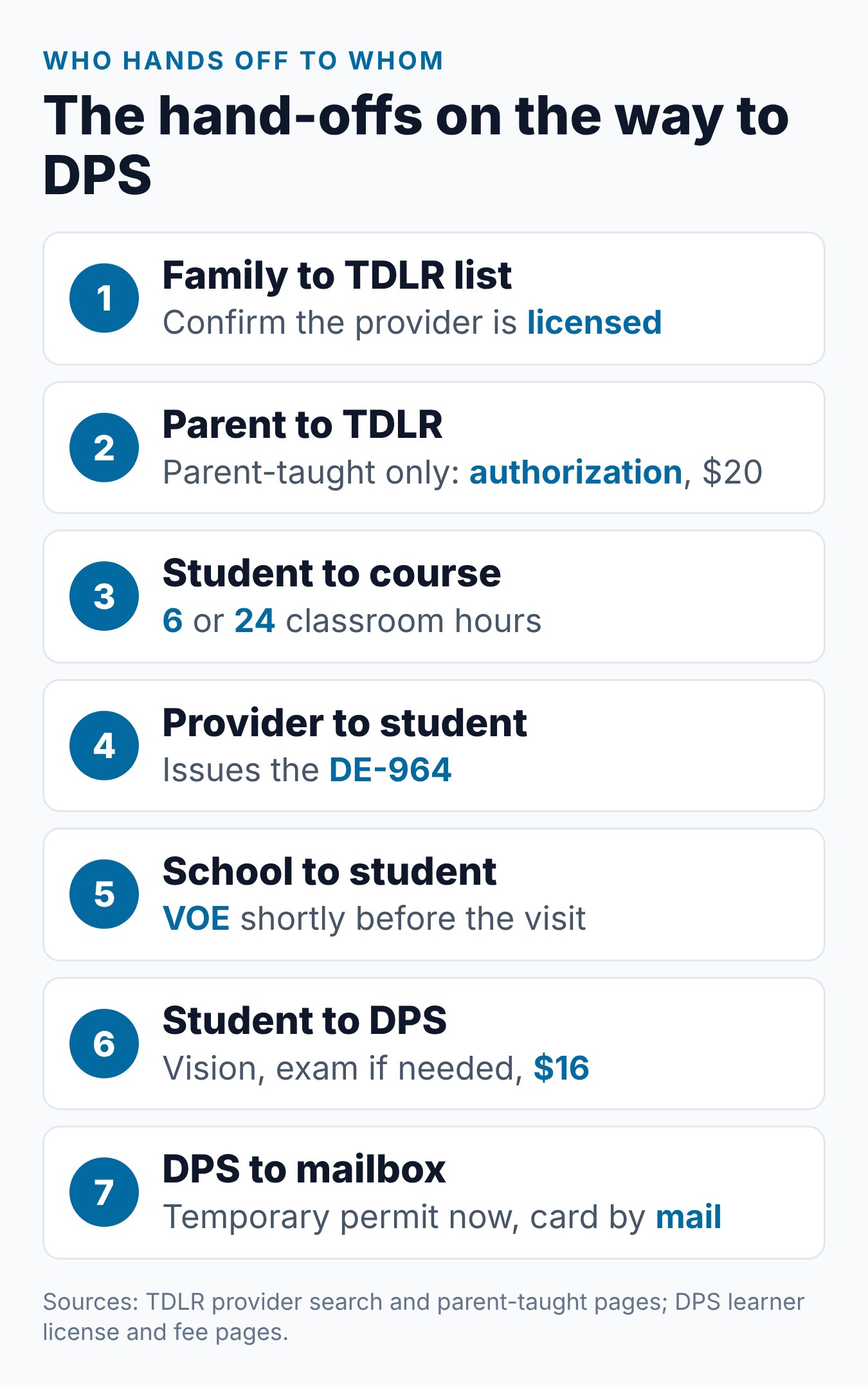
Online drivers ed gets a Texas teen to the permit after the first 6 classroom hours under the concurrent method, or after all 24 hours under the block method: the course provider issues the DE-964 certificate, and the teen, who must be at least 15, takes it to a Texas Department of Public Safety (DPS) driver license office, passes the vision exam and the knowledge exam if it was not passed in the course, and pays $16. In the drivers ed online Texas permit process, “permit” means the DPS learner license. Below is the timeline from enrolling online to permit in hand, one step at a time, with the official source for each step.
Key Facts
- Classroom first: 6 hours (concurrent) or 24 hours (block) before applying. See step 3.
- Certificate: the course provider issues the DE-964. See step 4.
- Timing trap: a VOE is valid 30 days, or 90 days when issued June through August. See step 6.
- At DPS: vision exam, knowledge exam if needed, and the $16 fee. See step 7.
- No set number of days: study time, the appointment date and the mail set the pace. See what sets the pace.
The Drivers Ed Online Texas Permit Timeline
The path from signing up online to holding a permit has nine steps. Most families do them in this order. Each step names the agency page it comes from, so you can check it yourself.
This timeline is for teens under 18. Adults 18 to 24 take a separate 6-hour adult driver education course instead.
Step 1: Pick the Course
DPS says teens can take an online course offered by a certified driving school, or use parent-taught education. Its page Choosing a Driver Education Course also says the classroom phase can start at age 14.
Before you pay for a course, check the provider’s license. The Texas Department of Licensing and Regulation (TDLR) runs the Driver Education Provider Search. It has filters named “Online for Minors and Adults” and “Parent Taught for Teens.”
TDLR also says being on the list is not an endorsement. So the search shows that a provider is licensed. It does not rank one course over another.
Step 2: Parent-Taught Families Apply to TDLR
This step is only for parent-taught driver education. The parent applies online to TDLR for authorization to teach, as the TDLR Parent Instructors page explains.
The fee is $20, and it is non-refundable. The program guide then comes by email, according to TDLR’s Parent Taught Program page.
TDLR’s page gives no approval time. Plan for this step, but do not count on a set number of days.
Step 3: The Classroom Hours Before the Permit
This is where online drivers ed does its main work. How many hours come before the permit depends on the method:
- Concurrent method: the first 6 classroom hours, then the permit application.
- Block method: all 24 classroom hours, then the permit application.
TDLR’s classroom instruction page, read on November 25, 2026, said instruction is limited to six hours per day, including not more than two hours of behind-the-wheel instruction per day. That cap is a limit, not a schedule. It does not mean a teen gets a permit on the first day.
For what the first 6 hours teach, read our article on the first 6 hours of the Texas learner’s permit online course.
Step 4: The DE-964 Certificate
When the classroom hours for the permit are done, the course provider issues the DE-964 certificate. The teen brings it to DPS.
The provider may give the written (knowledge) exam as part of the course. If it does not, the teen takes the knowledge exam at the driver license office. Ask your provider early which one applies, so you know what to expect at DPS.
Step 5: Book the DPS Appointment
Next, book a DPS driver license office appointment. The DPS learner license page describes the visit.
Pick a date that leaves time for the next step. No official page gives a wait time for an appointment, so this article does not give one either.
Step 6: Gather the Documents
DPS asks for these items at the learner license visit:
- The application, Form DL-14B
- Proof of U.S. citizenship or lawful presence
- Proof of Texas residency
- Proof of identity
- Proof of a Social Security number
- The DE-964 certificate
- A Verification of Enrollment (VOE), or a diploma or GED
Watch the timing of the VOE. DPS and TDLR’s Parent Taught: Learner License page say a VOE is valid for 30 days from issuance, or 90 days when issued June through August. Get it close to the appointment date.
Parent-taught students also bring the receipt for the parent-taught instructor designation. The parent instructor on record must go with the student to the office. For notes on every item, see our Texas learners permit checklist.
Step 7: The DPS Visit
At the office, a parent or guardian is present, or the teen brings a notarized application. Then the teen goes through these steps:
- The vision exam
- The knowledge exam, if it was not passed in the course
- Thumbprints
- A photo
- The $16 fee, listed on the DPS driver license fees page
Step 8: Permit in Hand
When DPS approves the application, the teen gets a temporary permit to drive right away. The learner license card arrives later by mail.
This is the end of the timeline that online drivers ed controls. From here, the teen starts learning behind the wheel.
Step 9: After the Permit
TDLR says no in-car instruction or practice is allowed until the learner license has been issued. Once it is, the in-car phase can begin.
Concurrent students then finish the remaining 18 classroom hours while they practice. The in-car phase is 44 hours: 7 hours of observation, 7 hours of behind-the-wheel instruction, and 30 hours of practice with at least 10 at night. The DPS provisional license page lists these hours.
The teen holds the permit at least six months before the provisional license, which can start at 16.
What Sets the Pace
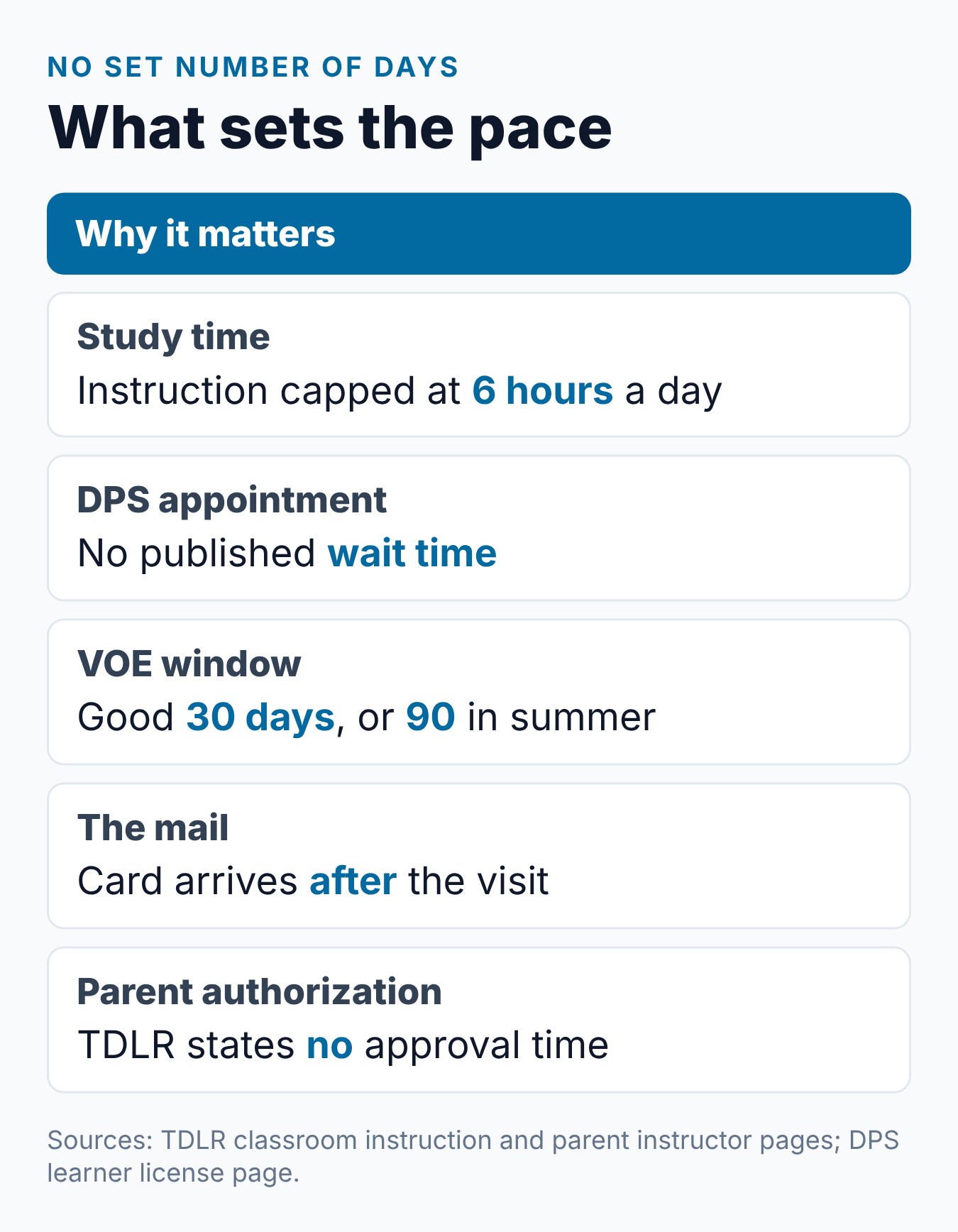
No official page gives a number of days from enrolling to the permit. That is why this article gives none. Three things set the pace instead.
The student’s study time: the classroom hours have to be done before the permit, and TDLR caps instruction at six hours per day.
The DPS appointment date: the teen cannot get the permit before the visit. DPS does not publish a wait time.
The mail: the teen can drive with the temporary permit right away, but the card itself comes by mail.
Parent-taught families have one more factor. TDLR gives no approval time for the parent’s authorization in step 2, so that step can add time too.
Concurrent or Block: Which Reaches the Permit First
The method changes how much classroom work comes before the DPS visit. Here is how the two compare on the permit timeline:
| Timeline point | Concurrent method | Block method |
|---|---|---|
| Classroom hours before the permit | First 6 | All 24 |
| Classroom hours after the permit | Remaining 18 | None |
| In-car practice starts | After the permit is issued | After the permit is issued |
Under the concurrent method, fewer classroom hours come before the permit. Under the block method, all classroom work is done before the visit. Both methods lead to the same learner license and the same six-month holding period.
Questions to Ask a Provider Before You Enroll
The provider’s answers shape your timeline more than anything on the sign-up page. Ask these before you pay, and write the answers down:
- Is the course in TDLR’s provider search? Look it up yourself under “Online for Minors and Adults” or “Parent Taught for Teens.”
- Is it a teen course? Teen driver education is for students under 18, not the 6-hour adult course.
- Which method does it use? The concurrent method reaches the permit after 6 hours, and the block method after 24.
- Does it give the knowledge exam? If not, the teen takes it at the DPS office.
- How is the DE-964 issued? You need it in hand before the DPS visit.
Clear answers to these five questions let you plan each step in order. They also help you spot a promise no official page supports, such as a permit by a fixed date.
What We Found on the Official Pages
We read nine DPS and TDLR pages about this timeline on November 25, 2026. None of them gives a number of days from enrolling online to getting the permit. Any course that promises a permit by a set date is promising something the state does not.
TDLR’s parent instructor pages give no approval time for the parent’s authorization either. The pace there depends on TDLR, not on the course.
We also found one page out of date. TDLR’s parent-taught learner license page still showed an older, higher number of classroom hours for the block method. The DPS driver education page and TDLR’s Parent Taught Program page both said 24 hours, so this article uses 24.
Common Timeline Mistakes
Each of these mistakes goes against a rule on a DPS or TDLR page:
- Getting the VOE too early. It is valid for 30 days, or 90 days when issued June through August.
- Practicing before the permit. No in-car instruction or practice is allowed until the learner license is issued.
- Booking DPS before the DE-964. The certificate comes after the classroom hours for the permit.
- Expecting a permit on day one. TDLR limits instruction to six hours per day.
- Leaving the parent instructor at home. In parent-taught courses, that parent goes to the office.
- Forgetting the receipt. Parent-taught students bring the receipt for the instructor designation.
How Requirements Can Vary
Texas driver education rules come from TDLR, and driver license rules come from Texas DPS. They apply statewide, but what you need depends on the student’s age, the course method, and whether the classroom part comes from a parent-taught course, a driving school, or a public school.
Fees, forms, and office procedures can change. Check the TDLR parent-taught pages and the DPS driver license pages before each step, and follow the instructions from your course provider.
Frequently Asked Questions
How many hours of online drivers ed come before the Texas permit?
The first 6 classroom hours under the concurrent method, or all 24 under the block method. The course provider then issues the DE-964.
Can a teen start online drivers ed at 14?
Yes. DPS says the classroom phase can start at 14. The teen must be at least 15 to get the learner license.
How long does it take to get a permit with online drivers ed?
No official page gives a number of days. The pace depends on the student’s study time, the DPS appointment date and the mail.
Is the knowledge test part of the online course?
It can be. The provider may give the written exam in the course, and if it does not, the teen takes it at the driver license office.
What does a parent-taught family do before the course?
The parent applies online to TDLR for authorization to teach and pays a $20 non-refundable fee. The program guide comes by email.
Can a teen practice driving during the online course?
Not before the permit. No in-car instruction or practice is allowed until the learner license has been issued.
Conclusion
Online drivers ed gets a Texas teen to the permit after 6 classroom hours (concurrent) or 24 hours (block), followed by the DE-964, a DPS visit and the $16 fee. No official page sets a number of days, so plan around study time, the appointment date, the VOE window and the mail. Read more about texas online drivers ed on our course page, and check any provider in TDLR’s provider search.
Related Articles
- Texas Learner’s Permit: How to Get It, What You Need, and What It Allows
- Texas Learner’s Permit Online Course: What the First 6 Hours Cover
- Texas Learners Permit Checklist: What to Bring to DPS
- How to Get a Texas Learner’s Permit at 15: Step-by-Step Guide
Sources
- TDLR — Parent-Taught Driver Education
- Texas DPS — Texas Learner License as a Teen
- Texas DPS — Texas Provisional License as a Teen
- 16 Tex. Admin. Code § 84.500 — Courses of instruction
- Texas DPS — Choosing a Driver Education Course
- Texas DPS — Driver License Fees
- TDLR — Driver Education Provider Search
- TDLR — Parent Instructors
- TDLR — Parent Taught Program
- TDLR — Parent Taught: Classroom Instruction
- TDLR — Parent Taught: Learner License
Billy Forte is the owner of Driving Logic, a state-approved driver improvement course provider serving Texas and other U.S. states.
This article is general information, not legal advice. Texas driver education and licensing rules are set by TDLR, Texas DPS, and Texas law, and can change. Check the official TDLR and DPS websites for current requirements.