
Updated November 2026 · Reviewed by Billy Forte
The agency people call the Florida DMV is the Florida Department of Highway Safety and Motor Vehicles (FLHSMV), and it approves traffic school courses but does not teach them, while the Clerk of Court in the county where the ticket was issued takes your election. So florida dmv traffic school is really three offices working on one ticket: FLHSMV approves the course, an approved provider teaches it and the clerk handles the election and the fine. “Traffic school” here means the Basic Driver Improvement (BDI) course, the course state law names for a ticket election.
Key Facts
- The name: state law calls the agency the Department of Highway Safety and Motor Vehicles. See where the DMV name comes from.
- Three offices, three jobs: FLHSMV approves, the provider teaches, the clerk takes the election. See who does what.
- FLHSMV keeps the record: after a valid election, points may not be assessed for that ticket. See what FLHSMV does.
- The clerk has the deadline: you tell the clerk within 30 days and pay the election fee to that clerk. See what the clerk does.
- One office per step: elect at the clerk, pick from the state list, take the course with the provider. See where to go for each step.
Florida DMV Traffic School: Where the DMV Name Comes From
Many people say “Florida DMV,” but the state agency is FLHSMV. Florida law uses the full name, the Department of Highway Safety and Motor Vehicles. You can see it in section 318.14(9), the part of the law that lets a driver elect the course for a ticket.
FLHSMV’s own pages use that same name.
So why do so many people say DMV? One reason is on FLHSMV’s own site. Its online service is called the MyDMV Portal, as FLHSMV’s Broward County locations page showed when read on November 25, 2026.
The name matters less than the job. When you search for a DMV traffic school, you are looking for a course that FLHSMV has approved. You are not looking for a class that a state office teaches.
- What the law asks for: “a basic driver improvement course approved by the Department of Highway Safety and Motor Vehicles” (s. 318.14(9)).
- What that course is called: the Basic Driver Improvement (BDI) course.
- Who teaches it: a course provider that FLHSMV has approved, not FLHSMV itself.
For the full picture of the course, from who can elect it to what happens after, see our pillar guide to the Florida Basic Driver Improvement (BDI) course.
Who Does What
A Florida ticket election touches three offices. Each one has a different job, and each job comes from a different rule.
| Office | Its job in a ticket election | Where the rule is |
|---|---|---|
| FLHSMV | Approves and regulates the courses, sets how long each course type runs, posts the approved provider list, receives completions and keeps the driver record | s. 318.1451(1), (6)(e) and (6)(f); s. 318.14(9) |
| The course provider | Teaches the course, collects the $2.50 state assessment, discloses all fees, issues the certificate and reports the completion | s. 318.1451(4), (6)(f) and (6)(h) |
| The Clerk of Court | Takes the election within 30 days, collects the election fee and the reduced civil penalty, and sets the date to finish | FLHSMV, Approved BDI Course Providers; s. 318.14(9); s. 318.15(1)(b) |
The table shows why one phone call rarely answers every question.
FLHSMV cannot accept your election. The clerk does not teach the course. And the provider does not decide whether your ticket can be elected.
The sections below take each office in turn.
What FLHSMV Does
FLHSMV is the approving agency. Section 318.1451(1) says the department approves and regulates the courses of all driver improvement schools. That is the root of the “DMV traffic school” idea.
FLHSMV’s role has five parts:
- It approves the courses. Only an approved BDI course counts for a ticket election (s. 318.14(9)).
- It sets course length. The department sets the duration of all course types (s. 318.1451(6)(e)). The BDI course is often called the 4-hour course, and that is its name.
- It posts the list. FLHSMV’s Approved BDI Course Providers page lists each provider with three columns: Name, Delivery Method and Contact Information.
- It receives completions. The provider reports each completion through the department’s certificate system (s. 318.1451(6)(f)).
- It keeps the driver record. After a valid election, points “may not be assessed” for that ticket (s. 318.14(9)).
FLHSMV’s Driver Improvement Schools page adds two practical points. It says to allow 24 to 72 hours for school completions to be posted. It also says FLHSMV does not accept paper certificates for any licensing purpose.
To check a provider on the state list, use our step-by-step guide to FLHSMV-approved BDI providers.
What the Course Provider Does
The provider is the school you actually deal with. FLHSMV says drivers may contact an approved BDI course provider to register.
FLHSMV’s page on how to start a traffic school explains how schools fit in. When read on November 25, 2026, it said a school must contract with a department-approved course provider. So the course a school teaches is a course the department has approved.
The law gives the provider several duties under section 318.1451:
- Collect the state fee. The school collects a $2.50 assessment fee from each person who elects to attend, and the provider sends it to the department (s. 318.1451(4)).
- Show every fee. The provider must disclose all fees for its courses (s. 318.1451(6)(h)).
- Issue a certificate. The provider must issue a certificate to each person who finishes (s. 318.1451(6)(h)).
- Report the completion. The provider reports it to the department within 5 days and files it with the clerk of the circuit court within 3 days after it receives the certificate number (s. 318.1451(6)(f)).
That last duty is why you do not mail a paper certificate to FLHSMV. The report goes from the provider to the department and to the clerk.
What the Clerk of Court Does
The clerk is where the ticket lives. FLHSMV’s BDI page says drivers must elect within 30 days, must inform the clerk of court in the county where the citation was issued, and must pay an election fee to that clerk.
The clerk also handles the money on the ticket. The civil penalty is paid to the clerk, and a valid election reduces it by 18 percent (s. 318.14(9)).
The election fee is a separate charge. No statewide amount is set for it, so ask the clerk in the county on your ticket.
The clerk or the court also sets the date to finish. Under section 318.15(1)(b), if you elect and do not finish by that date, you are adjudicated guilty and points are assessed. You also pay back the 18 percent, plus a processing fee of up to $18.
Not every ticket can be elected, and the clerk is the office that applies the limits. Section 318.14(9) rules out an election for:
- Commercial license holders. A person who holds a commercial driver license or a commercial learner’s permit cannot elect, in any vehicle.
- Speeding 30 mph or more over the limit.
- Tickets that require a hearing under section 318.19.
- A second election within 12 months.
- More than eight elections in a lifetime.
FLHSMV’s Driver Improvement Schools page shows an older lifetime number. The statute says eight, and this article follows the statute.
Where to Go for Each Step
Once you know who does what, each step has one office. This list answers the most common “who do I call?” questions.
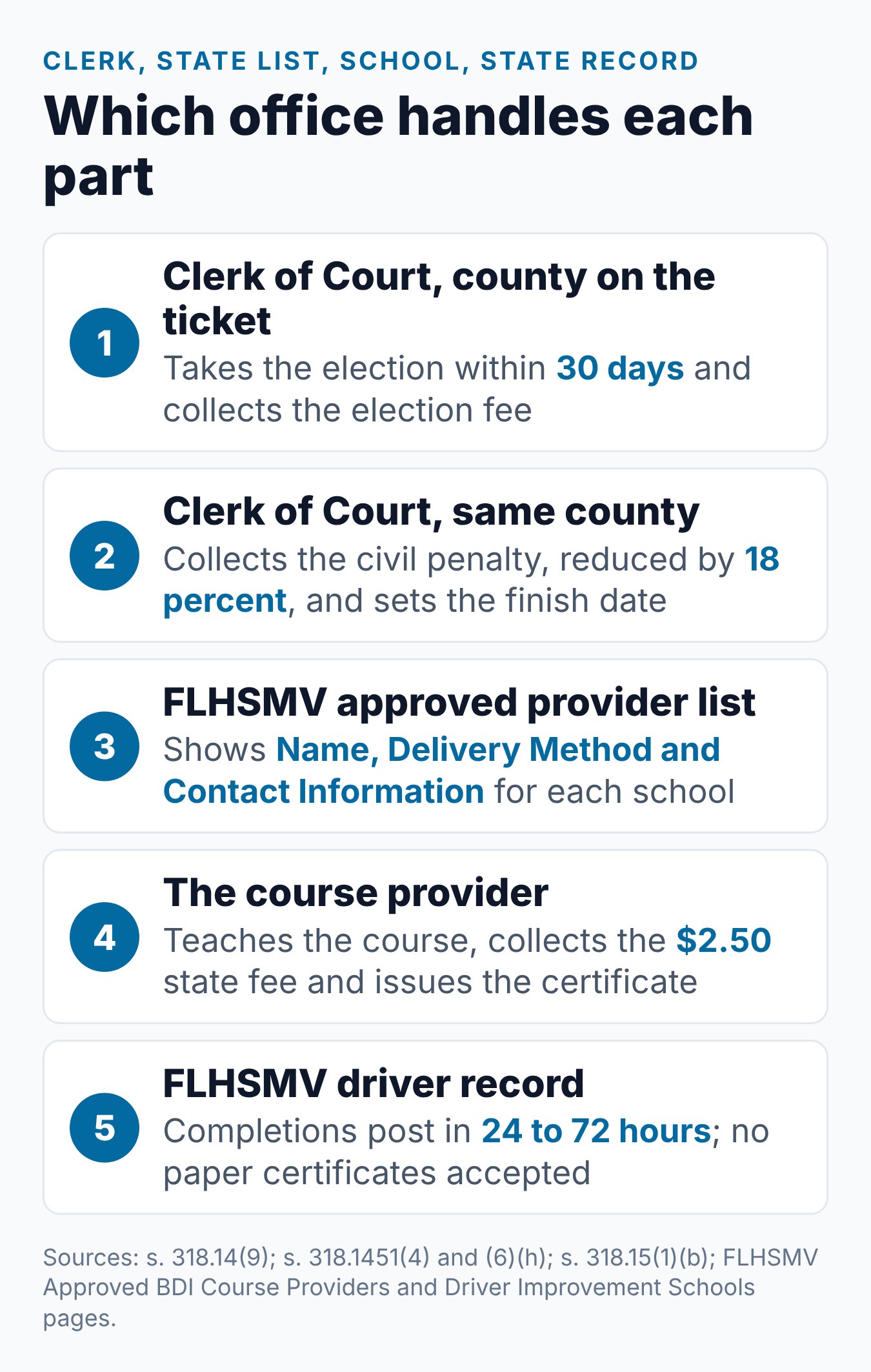
- Elect and pay: the Clerk of Court in the county on the ticket.
- Pick a course: FLHSMV’s Approved BDI Course Providers list.
- Take the course: the provider you chose.
- Get the completion reported: the provider, which reports to FLHSMV and files with the clerk.
- Check your driver record: FLHSMV.
Order matters. You tell the clerk first, within 30 days of the citation date, and then you take the course.
FLHSMV Offices and the Clerk
Some drivers go to a local office to ask about traffic school. It helps to know what those offices are.
FLHSMV’s Broward County locations page, read on November 25, 2026, showed two kinds of offices:
- State-sponsored driver license service centers.
- County tax collector-sponsored service centers.
The same page sent drivers to the Clerk of Court website to pay a traffic citation. In other words, even FLHSMV’s own office page points ticket payments to the clerk.
Offices are set up differently in each county. This article describes only the Broward page because that is the page that was read. Check FLHSMV’s locations page for your own county before you go.
What We Found on the Official Pages
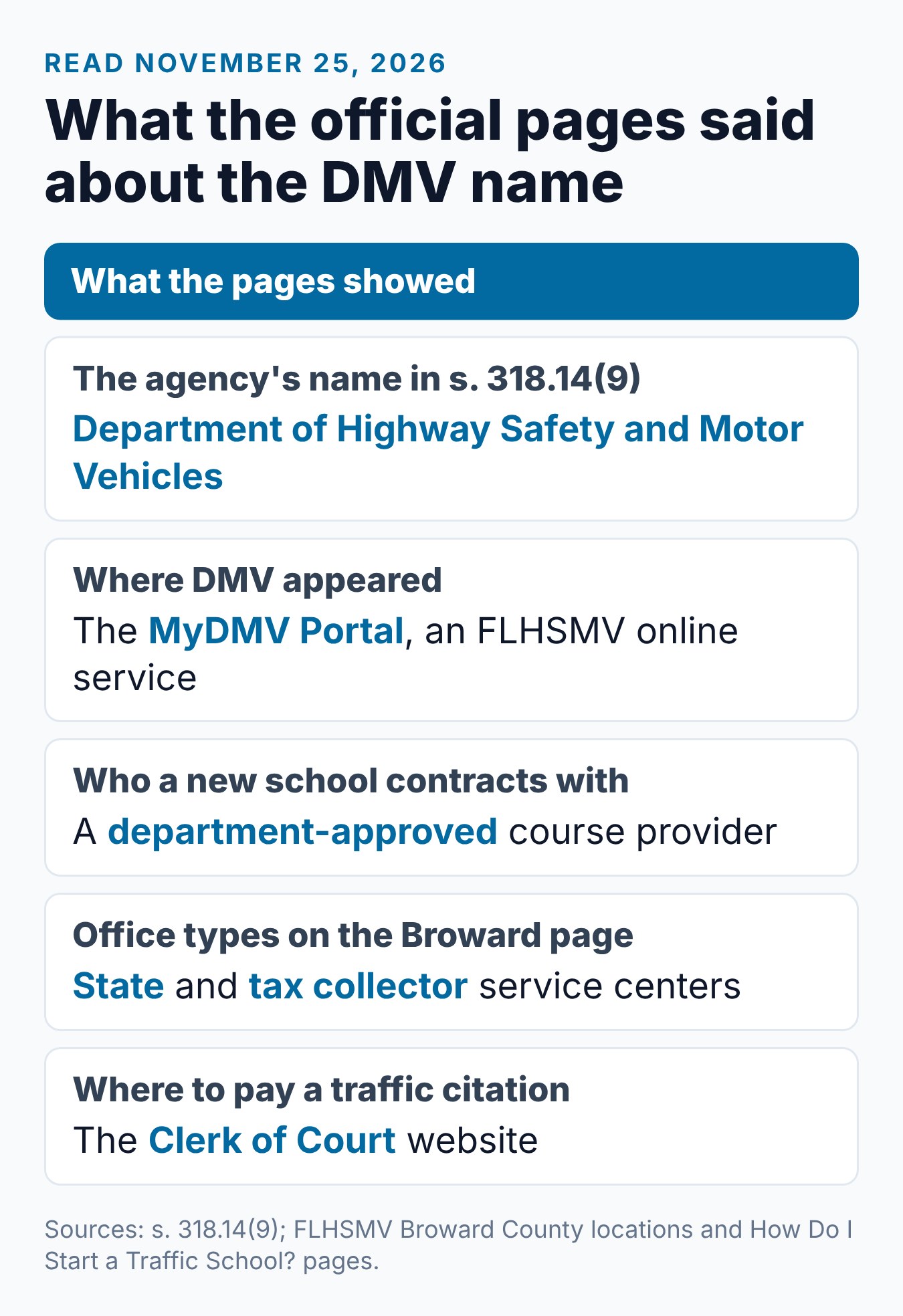
On November 25, 2026, the official pages behind this article were read for one question: who does the “Florida DMV” part of traffic school, and who does the rest? FLHSMV is the agency behind that phrase. Here is what the pages showed:
- The law’s name for the agency was the Department of Highway Safety and Motor Vehicles, in s. 318.14(9).
- The word DMV appeared in a service name, the MyDMV Portal, on FLHSMV’s Broward locations page.
- The FLHSMV provider list had three columns: Name, Delivery Method and Contact Information.
- FLHSMV’s start-a-school page said a school must contract with a department-approved provider.
- FLHSMV’s own office page sent traffic citation payments to the Clerk of Court website.
The finding that matters most is the split. The agency people call the DMV approves the course and keeps the record. It does not teach the course or take the election.
These pages can change. Read them again on the day you act.
Common Mistakes to Avoid
Each mistake below comes from mixing up the three offices:
- Asking FLHSMV to take your election. The election goes to the clerk in the county on the ticket.
- Taking the course before you elect. Tell the clerk first, within 30 days.
- Thinking FLHSMV teaches the course. It approves courses; providers teach them.
- Skipping the state list. Find the provider on FLHSMV’s Approved BDI Course Providers page.
- Mailing a paper certificate to FLHSMV. FLHSMV does not accept paper certificates for licensing purposes.
- Checking the record too soon. FLHSMV says to allow 24 to 72 hours for completions to post.
- Missing the clerk’s date. Points are assessed and the 18 percent comes back, plus up to $18.
How Requirements Can Vary
Florida’s election rules, point values and suspension levels come from Florida Statutes and FLHSMV, and they apply statewide. The election fee, the date to finish the course and how proof is filed are set by the Clerk of Court in the county on your ticket, or by the court. A court order sets its own deadline and proof steps.
Laws, fees and clerk practice can change. Check your citation, your clerk’s instructions, any court order and the FLHSMV website before you enroll or file anything.
Frequently Asked Questions
Does the Florida DMV run traffic school?
No. The agency people call the DMV is FLHSMV, and it approves and regulates the courses. Approved course providers teach them.
Who takes my traffic school election?
The Clerk of Court in the county where the citation was issued. FLHSMV says you must elect within 30 days and pay an election fee to that clerk.
Who approves Florida traffic school courses?
Florida law asks for a course approved by the Department of Highway Safety and Motor Vehicles, which is FLHSMV. Check the provider’s name on FLHSMV’s Approved BDI Course Providers list.
Do I send my certificate to FLHSMV?
No. The provider reports the completion to the department and files it with the clerk, and FLHSMV does not accept paper certificates for licensing purposes. Allow 24 to 72 hours for the completion to post.
Can I pay my ticket at an FLHSMV office?
FLHSMV’s Broward County locations page sends drivers to the Clerk of Court website to pay a traffic citation. Ask the clerk in the county on your ticket how to pay.
What does the election do to my points?
After a valid election, adjudication is withheld and points may not be assessed for that ticket. The civil penalty is reduced by 18 percent.
Conclusion
Florida DMV traffic school is a course that FLHSMV approves, an approved provider teaches and the Clerk of Court ties to your ticket. Elect with the clerk in the county on the ticket within 30 days, pick a provider from FLHSMV’s list and finish by the clerk’s date. The provider then reports your completion, and FLHSMV keeps the record. When you are ready to compare, see Driving Logic’s florida traffic school course page.
Related Articles
- Florida Basic Driver Improvement (BDI) Course: The Complete Guide
- Florida BDI Completion Certificate: What It Is and How to Submit It
- Florida Online Traffic School: How to Take the BDI Course
- Free Traffic School Florida: Is Any Approved Course Free?
- Approved Basic Driver Improvement Course Florida: Verify It
Sources
- Florida Statutes s. 318.14 — Noncriminal traffic infractions
- Florida Statutes s. 318.1451 — Driver improvement schools
- Florida Statutes s. 318.15 — Failure to comply with civil penalty or to appear
- FLHSMV — Basic Driver Improvement (BDI) Approved Course Providers
- FLHSMV — Driver Improvement Schools
- FLHSMV — How Do I Start a Traffic School?
- FLHSMV — Broward County Locations
Billy Forte is the owner of Driving Logic, a driver improvement course provider serving Florida and other U.S. states.
This article is general information, not legal advice. Election rules, deadlines, fines and penalties depend on your citation, county, court and case facts, and they can change. Use official FLHSMV, Florida Statutes and Clerk of Court sources, and consult a qualified Florida attorney for advice about your own case.