
Updated October 2026 · Reviewed by Billy Forte
This Florida permit test study guide covers what you need to know for the 50-question Class E knowledge exam: Florida traffic laws, safe driving practices and traffic controls. Your main study source is the official Florida Driver License Handbook from FLHSMV. Focus on the rules with numbers in them, such as speed limits and alcohol limits, since those are easy to mix up.
Key Facts
- Topics: Traffic laws, safe driving practices and traffic controls. See the topics.
- Study source: The official Florida Driver License Handbook. See how to use it.
- Numbers to know: Default speed limits are 30 mph in business and residential areas and 55 mph elsewhere. See the speed rules.
- Under-21 alcohol limit: 0.02, with a 6-month suspension for a first violation. See the alcohol rules.
- Teen rules: Learner’s permit and Class E hour limits are part of Florida law. See the teen rules.
What the Florida Permit Test Covers
FLHSMV’s exam page says the exam has 50 multiple-choice questions on three areas. You need 40 correct to pass.
- Florida traffic laws: the rules every driver must follow
- Safe driving practices: how a careful driver handles real situations
- Traffic controls: signs, signals and pavement markings
These are the Florida permit test topics in FLHSMV’s words. This guide breaks each one into what to study. For the exam format, see our Florida permit test guide.
How to Use This Florida Permit Test Study Guide
Use this guide as a map, not a replacement for the handbook. Each section below names a topic area, the rules to focus on and the numbers worth memorizing.
Give yourself at least a couple of weeks if you can. Read the handbook chapter for a topic, check it against the matching section here, then quiz yourself before moving on.
Start With the Official Handbook
The Florida Driver License Handbook is published by FLHSMV and explains the rules the exam tests. Use it as your main source, and use everything else as extra practice.
A few ways to make the handbook stick:
- Read one chapter per session. Short, focused sessions are easier to remember than one long one.
- Take notes in your own words. If you can explain a rule simply, you understand it.
- Write down every number. Speeds, distances, ages and times are easy to mix up, so keep them on one list.
- Go back to the handbook after every practice test. Reread whatever you missed.
Since February 6, 2026, the exam is given in English only. Study from the English handbook, even if you also read a version in another language. Learning the English terms early saves you from translating in your head during the exam.
Traffic Controls: Signs, Signals and Markings
Signs are a good place to start because they’re visual and quick to learn. Group them by what they do:
- Regulatory signs tell you what you must or must not do, such as stop, yield and speed limit signs.
- Warning signs alert you to what’s ahead, such as curves, merges and school crossings.
- Guide signs show routes, distances and services.
Learn the meaning of each sign shape and color as a group. Colors carry meaning too, so note which colors go with which kinds of signs as you read the handbook’s sign pages. Then study traffic signals, including flashing lights and arrows, and pavement markings such as lane lines, crosswalks and stop lines.
Traffic Laws to Know
Traffic law questions test the rules you must follow. Give these areas extra time:
- Right-of-way at intersections, four-way stops, roundabouts and for pedestrians
- Turning and passing, including where passing is not allowed
- Stopping for school buses and emergency vehicles
- Seat belts and child restraints
- Speed limits and school zones (see the table below)
Speed Limits and Zones
Florida sets default speed limits in its statutes. Posted signs can set different limits, but these are the rules when no other limit is posted or allowed.
| Where | Rule | Florida statute |
|---|---|---|
| Business or residence district | 30 mph default | F.S. 316.183 |
| All other locations | 55 mph default | F.S. 316.183 |
| Limited-access highways | Up to 70 mph may be set | F.S. 316.187 |
| Interstates with 4+ lanes | 40 mph minimum (50 mph where the limit is 70) | F.S. 316.183 |
| School zone in an urbanized area | Not more than 20 mph | F.S. 316.1895 |
F.S. 316.183 sets the 30 and 55 mph defaults and the interstate minimums. F.S. 316.1895 says reduced school zone limits apply from 30 minutes before a school session or breakfast program starts through 30 minutes after dismissal.
Safe Driving Practices
These questions ask what a careful driver should do. Expect topics like:
- Following distance and how to keep a safe gap
- Sharing the road with bicycles, motorcycles, pedestrians and large trucks
- Driving at night, in rain and in fog
- Distractions such as phones and passengers
- Emergencies, like a blowout or brake trouble
For these, picture yourself behind the wheel. The right answer is usually the safest legal choice, even if it means slowing down, waiting or giving up your turn. Following distance matters on the road test too: FLHSMV lists following at a safe distance of at least four seconds as one of the driving skills checked.
Alcohol and Drug Rules
Alcohol and drug laws are part of the exam’s traffic law and safe driving areas. One rule with a number is especially important for new drivers.
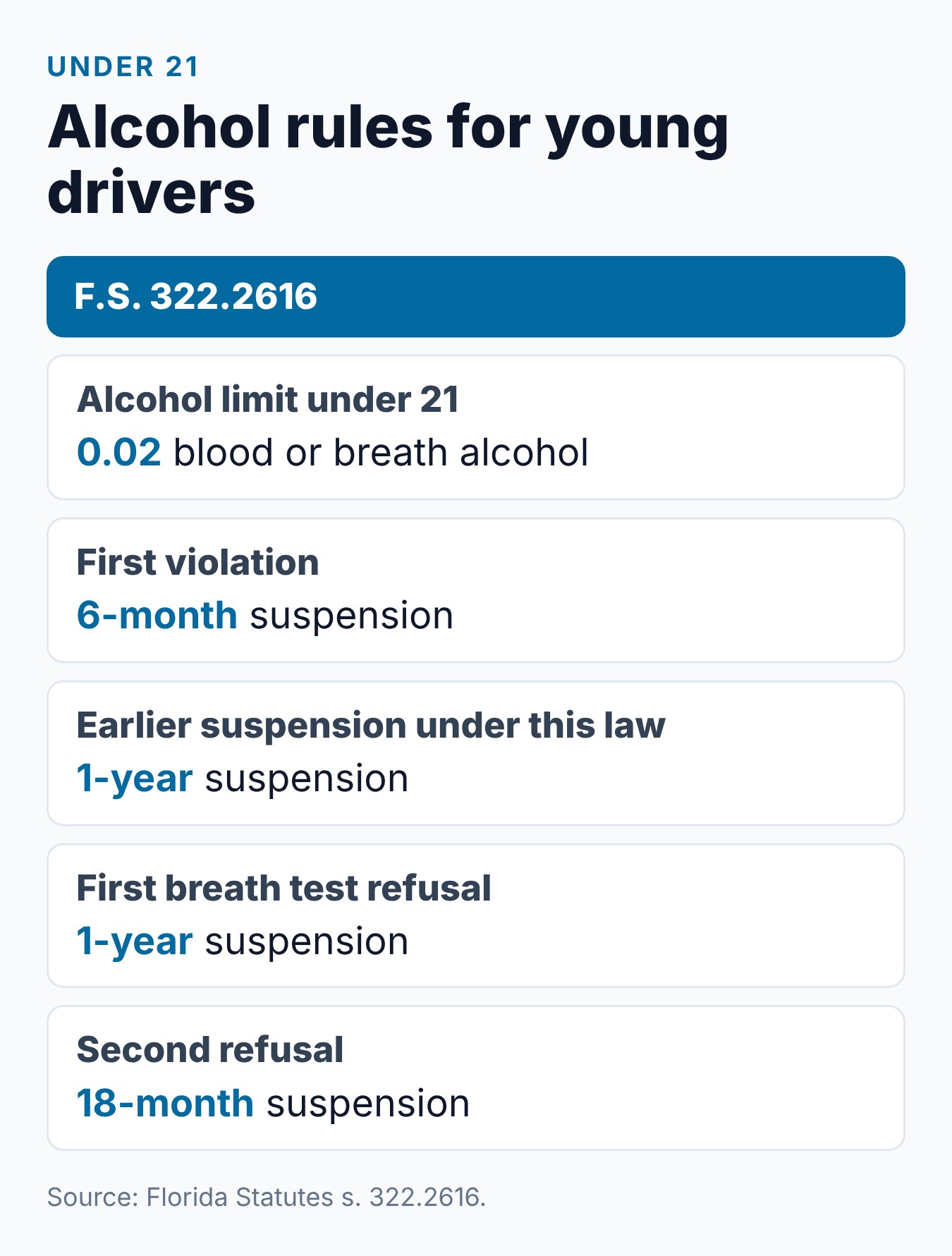
F.S. 322.2616 says it’s unlawful for a driver under 21 to have a blood or breath alcohol level of 0.02 or higher. The license is suspended for 6 months for a first violation, and for 1 year if the driver was suspended under this law before.
Refusing a breath test under this law also has a cost: a 1-year suspension for a first refusal, and 18 months for a second. Study the handbook’s section on alcohol, drugs and driving for the rest of the rules, including how alcohol affects reaction time and judgment, and the rules on breath tests.
Rules for Teen Drivers
Florida’s teen license rules are part of state law, so study them even if you’re an adult. FLHSMV’s teen licensing page lists them.
- Learner’s license: A licensed driver 21 or older in the front passenger seat at all times. Daylight only for the first 3 months, then until 10 p.m. (F.S. 322.1615)
- Holding period: 12 months, or until 18, plus 50 hours of supervised driving with 10 at night.
- Age 16 with a license: No driving from 11 p.m. to 6 a.m. unless with a licensed driver 21 or older or driving directly to or from work. (F.S. 322.16)
- Age 17 with a license: The same rule from 1 a.m. to 5 a.m.
Study in This Order
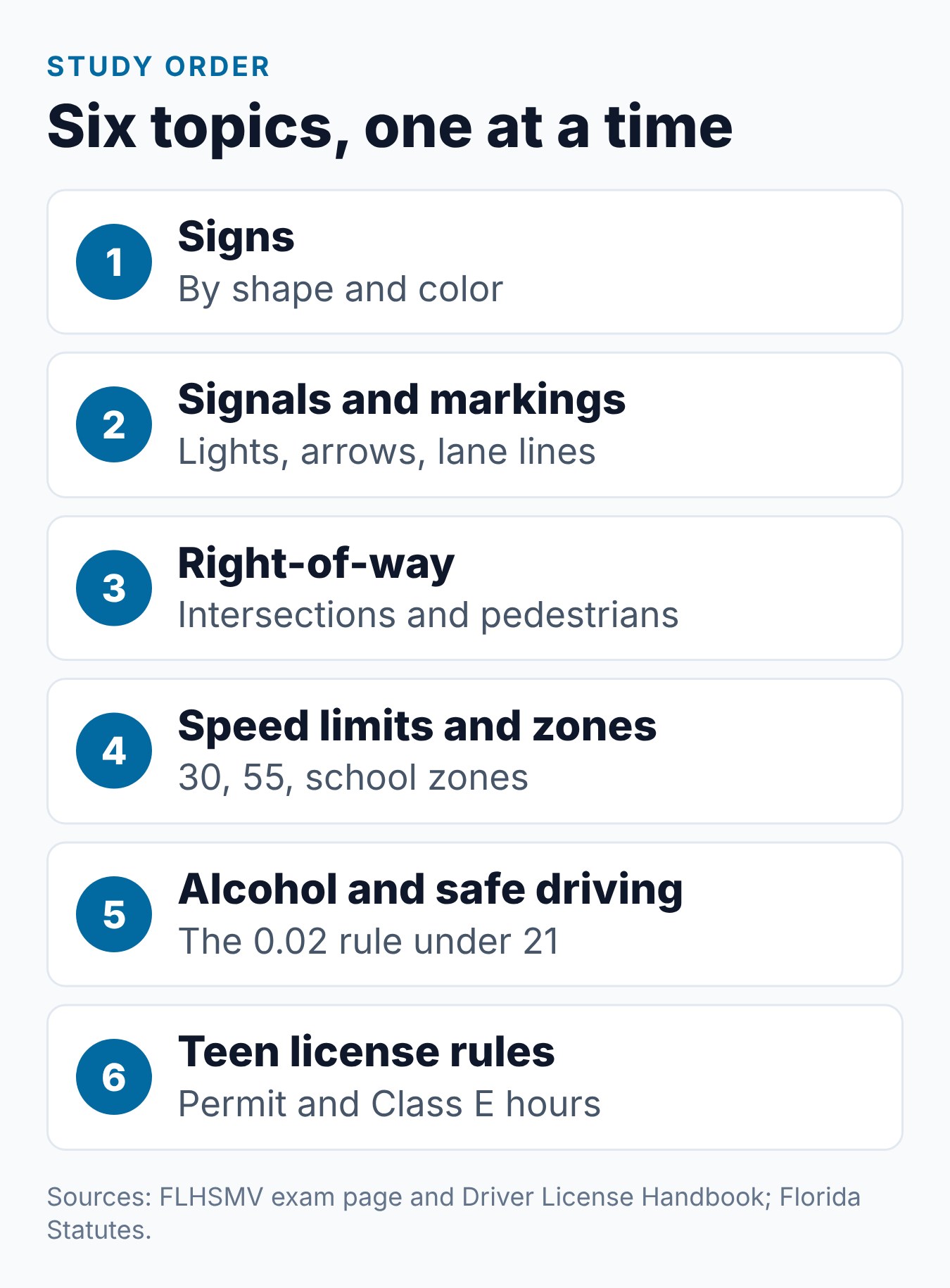
Going topic by topic keeps the handbook from feeling like one big block. It also makes it easy to see which topics you’ve finished and which still need work. This order starts with the quickest wins and ends with the rules that need the most memorizing.
- Signs by shape and color
- Signals and pavement markings
- Right-of-way and intersections
- Speed limits and school zones
- Alcohol, drugs and safe driving
- Teen license rules
After each topic, take a short practice quiz on just that topic. When all six are done, switch to full 50-question practice sets so you get used to the length of the real exam. Our Florida permit practice test guide explains how to use them.
Check Yourself on Each Topic
Before you move on from a topic, see if you can answer these questions without looking. If you can’t, reread that part of the handbook.
- Signs: What do the shapes of a stop sign, a yield sign and a warning sign tell you?
- Signals: What should you do at a flashing red light? At a flashing yellow light?
- Right-of-way: Who goes first when two cars reach a four-way stop at the same time?
- Speed: What’s the default limit in a residential area with no sign? In a school zone?
- Alcohol: What’s the limit for a driver under 21, and what happens after a first violation?
- Teen rules: When can a learner’s permit holder drive after dark?
Studying Alongside DETS or TLSAE
Teens take the 6-hour DETS course and adults take the 4-hour TLSAE course before getting licensed. Both teach Florida traffic laws, which helps with the permit test.
But the course and the exam are separate tests. Finishing the course doesn’t mean you passed the knowledge exam, so keep studying the handbook after the course ends.
Memory Tricks That Help
Many questions turn on one number or one word. These habits help you keep them straight.
- Make a one-page number sheet. List every speed, distance, age and time from your notes, and review it daily.
- Say the rule out loud. For example: “30 in town, 55 everywhere else, unless posted.”
- Link numbers to places. Picture a school zone sign when you study the 20 mph rule.
- Quiz with a friend or parent. Explaining a rule to someone else shows what you really know.
Your Test Week Checklist
In the last few days, switch from learning to reviewing.
- Review your one-page number sheet each day.
- Take one or two full practice sets from a source you haven’t used.
- Reread only the topics you still miss.
- Confirm your reservation and your office’s testing cutoff time.
- Sleep well the night before.
Common Study Mistakes
These are the habits that cost people points.
- Skipping the handbook and only taking practice tests
- Ignoring the teen rules because you’re an adult
- Mixing up the under-21 alcohol limit with the rules for older drivers
- Studying only signs and not the traffic laws
- Studying in another language when the exam is in English only
- Cramming the night before instead of reviewing over several days
How Requirements Can Vary
Florida’s course and license rules apply statewide, but some details depend on where you live. Driver license services are often handled by your county tax collector’s office, and each office sets its own appointment process and hours. Some county school boards also offer driver education programs, such as DELAP courses, that can count instead of DETS.
FLHSMV can update course rules, forms, documents, and fees. Check FLHSMV and your county office for current requirements before your appointment.
Frequently Asked Questions
What should I study for the Florida permit test?
Study the official Florida Driver License Handbook. Focus on traffic laws, safe driving practices and traffic controls such as signs, signals and markings.
What topics are on the Florida permit test?
FLHSMV lists three areas: Florida traffic laws, safe driving practices and traffic controls.
What are Florida’s default speed limits?
F.S. 316.183 sets 30 mph in business and residence districts and 55 mph elsewhere, unless another limit is posted.
What is the school zone speed limit in Florida?
In an urbanized area, a school zone limit can’t be more than 20 mph under F.S. 316.1895.
What is the alcohol limit for drivers under 21 in Florida?
0.02. Under F.S. 322.2616, a first violation means a 6-month license suspension.
Do adults need to know the teen driving rules?
Yes. The teen license rules are part of Florida law and are in the handbook, so study them whatever your age.
How long should I study for the Florida permit test?
There’s no set amount. Study until you can explain each rule in your own words and pass full practice sets from different sources.
Conclusion
This Florida permit test study guide comes down to three areas: traffic laws, safe driving practices and traffic controls.
Start with the official handbook, make a sheet of every number to memorize and study topic by topic before taking full practice tests. Study in English, since the exam is English only. Our online Florida DETS course is coming soon.
Related Articles
- Florida Permit Test: What to Expect and How to Prepare
- Florida Permit Practice Test: How to Prepare for the 50-Question Exam
- How Many Questions Are on the Florida Permit Test and What Score Do You Need?
Sources
- FLHSMV — Class E Knowledge Exam and Driving Skills Test
- FLHSMV — Official Florida Driver License Handbook (PDF)
- Florida Statutes — F.S. 316.183 (Speed Limits)
- Florida Statutes — F.S. 316.187 (Establishment of State Speed Zones)
- Florida Statutes — F.S. 316.1895 (School Speed Zones)
- Florida Statutes — F.S. 322.2616 (Drivers Under 21, 0.02 Alcohol)
- Florida Statutes — F.S. 322.1615 (Learner’s Driver License)
- Florida Statutes — F.S. 322.16 (License Restrictions)
- FLHSMV — Teen Licensing Requirements and Graduated Driver License Laws
- Hillsborough County Tax Collector — Driver License Exams in English Only Beginning February 6
Billy Forte is the owner of Driving Logic, a state-approved driver improvement course provider serving Florida and other U.S. states.
This article is general information, not legal advice. Florida licensing requirements, course rules, documents, and fees are set by FLHSMV and Florida law and can change. Use official FLHSMV and Florida statute sources for current requirements before you enroll in a course or visit a driver license office.