
Updated November 2026 · Reviewed by Billy Forte
Yes, you can take Florida traffic school in Spanish for a traffic ticket when the provider you choose offers the course in that language. The state’s list of approved providers marks some of them “(Additional Languages Available),” and the ticket rules are the same in any language. Driving Logic’s Florida Basic Driver Improvement (BDI) course, which most people call traffic school, is offered in Spanish as well as English.
Key Facts
- Spanish is up to the provider: the state list marks some providers for more languages but does not name them. See what the list shows.
- The law is silent on language: the driver improvement statute does not mention it. See what the law says.
- Same ticket rules: the election works the same way in English or Spanish. See the rules.
- 30 days: you must choose the course option within 30 days of the citation date. See the deadline.
- Reported for you: the provider sends your completion to the state and to the clerk. See how it is reported.
- Ask first: confirm the language with the provider before you pay. See what to ask.
Florida Traffic School in Spanish: What It Is
Most people say traffic school. The state’s name for the course is Basic Driver Improvement, or BDI.
A Spanish version is the same course in a different language. Florida does not have a second traffic school for Spanish speakers.
The agency in charge is the Florida Department of Highway Safety and Motor Vehicles, or FLHSMV. It approves the courses that driver improvement schools teach.
For a ticket, the local Clerk of Court is part of the process too. The clerk in the county where the ticket was issued takes your choice of the course option.
So three parties are involved. FLHSMV approves the course, the provider teaches it, and the clerk handles the ticket.
What the State Provider List Shows
FLHSMV publishes a list of Approved BDI Course Providers. It is the place to start.
The list has three columns:
- Name.
- Delivery Method.
- Contact Information.
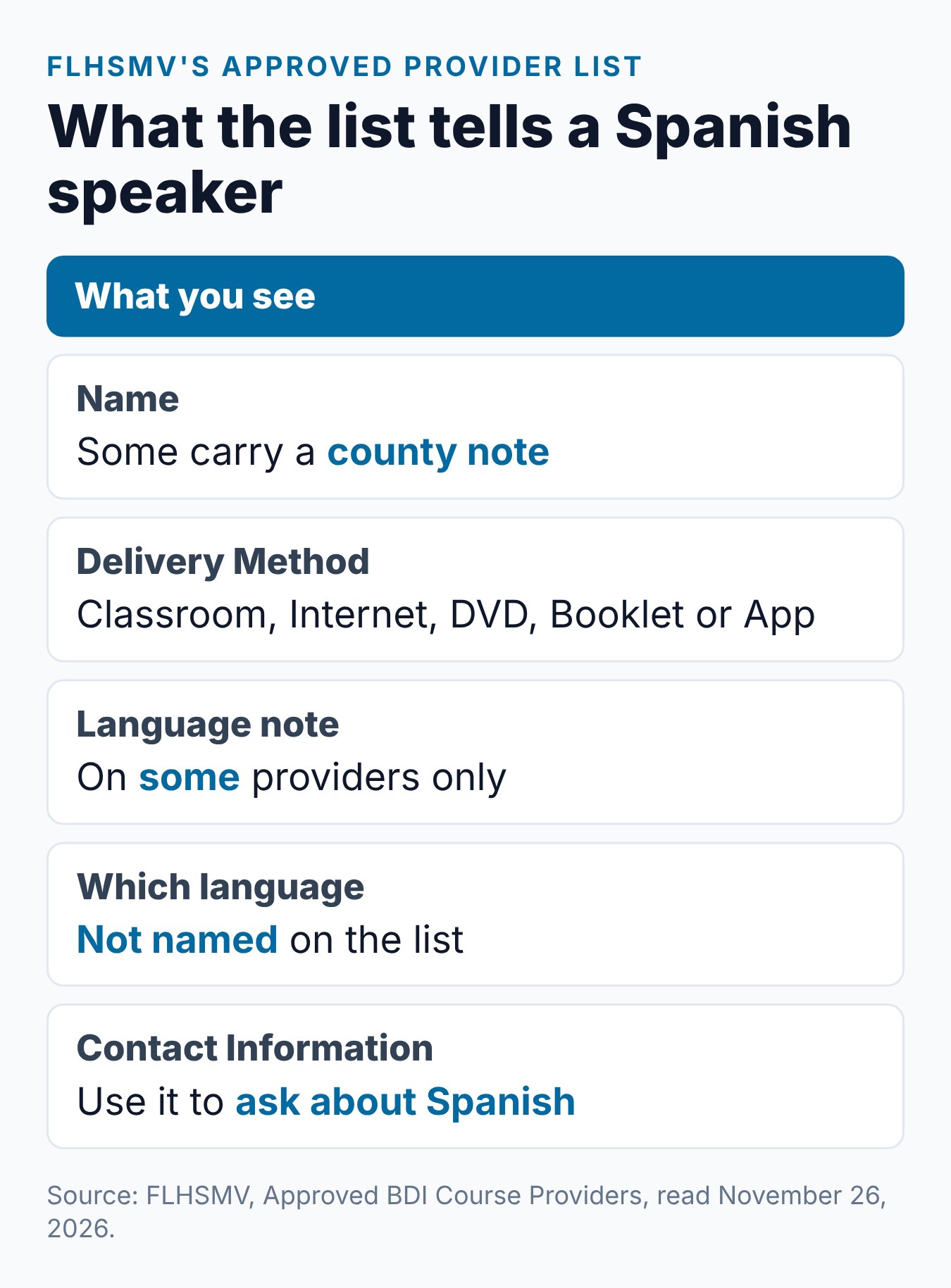
There is no language column. Language shows up only as a short note beside the delivery method of some providers.
The Language Notes
The note comes in two wordings. Some providers are marked “(Additional Languages Available).” Others are marked “(Other Languages Available).”
Neither note names a language. The list does not say Spanish, and it does not say which languages a provider has.
That is why the list alone cannot answer your question. A provider with the note may or may not teach in Spanish. A provider without the note may still offer it.
The only sure way to know is to ask. The Contact Information column gives a phone number and a link to each provider’s website.
The Delivery Method and County Notes
The Delivery Method column tells you how a provider teaches. The labels on the list are Classroom, Internet, DVD, Booklet and App.
Language and delivery are separate. A provider may teach in a classroom in one language and online in another. Ask about the exact format you want.
Many names on the list also carry a county note, such as citations from certain counties only. Read that note with care. Compare it with the county on your ticket before you pick a provider.
The Page Itself Comes in Spanish
FLHSMV’s page has a “Language | Idioma” switch near the top. It offers English and Español.
So a Spanish speaker can read the state’s own page in Spanish. That covers the page, not the courses on it.
What the Law Says About Language
The rules for these schools are in section 318.1451, Florida Statutes. The section is titled “Driver improvement schools.”
The statute does not mention language. It has no rule about Spanish, and no rule against it.
Here is what it does say. The department shall approve and regulate the courses of all driver improvement schools. That includes courses that use technology as a delivery method.
When the department reviews a course, the statute lists what it must consider. The list includes course content designed to promote safety, driver awareness and crash avoidance techniques.
The statute also covers how an approved course is run:
- Full course. Providers must ensure their schools conduct the approved course fully, to the required time limit and content requirements.
- Course length. The department sets the duration of all course types.
- Current content. The department sets and modifies course content requirements to keep current with laws and safety information.
- Fees. Providers must disclose all fees and may not charge fees that were not disclosed during registration.
- Certificate. Providers must issue a certificate to persons who successfully complete the course.
These rules are written for every approved course. The statute makes no separate set of rules for a course in another language.
One more line matters to every student. The department shall not accept proof of attendance from schools that do not teach an approved course.
The Ticket Rules Are the Same in Any Language
Taking the course in Spanish does not change your ticket. The election rules are in section 318.14.
Under subsection (9), a driver may choose a basic driver improvement course in lieu of a court appearance. Two conditions come first:
- License type. The driver does not hold a commercial driver license or a commercial learner’s permit.
- Vehicle. The driver was cited in a noncommercial vehicle.
When the election is valid, the statute gives three results:
- Adjudication must be withheld.
- The civil penalty must be reduced by 18 percent.
- Points may not be assessed.
Withheld is not dismissed. The course also does not take away points that are already on a record.
The statute sets limits on how often a driver may do this:
- 12 months. No election if one was made in the preceding 12 months.
- Eight. No more than eight elections in a lifetime.
FLHSMV’s page adds one more group that cannot elect. A driver cited for going 30 mph above the posted speed limit may not make the election.
Our complete BDI guide explains the election in full.
The 30-Day Deadline
The clock starts on the day of the ticket. Under section 318.14(4), a person who does not elect to appear must act within 30 days after the date of issuance of the citation.
FLHSMV’s page describes the same window for the course. Drivers must voluntarily elect the BDI option within 30 days from the citation date.
FLHSMV lists two more steps that come before the course:
- Tell the clerk. Prior to attending the course, drivers must inform the clerk of court in the county where the citation was issued.
- Pay the election fee. Drivers must also pay an election fee to that clerk.
After the first 30 days, the door closes. FLHSMV says drivers may not elect to take the BDI, in lieu of points, after the initial 30-day period.
FLHSMV also notes where your choices are printed. Options for satisfying a traffic citation are listed on the back of the citation.
A search for a Spanish course can take a few days. Start early, so the language question does not use up your 30 days.
How to Take Traffic School in Spanish, Step by Step
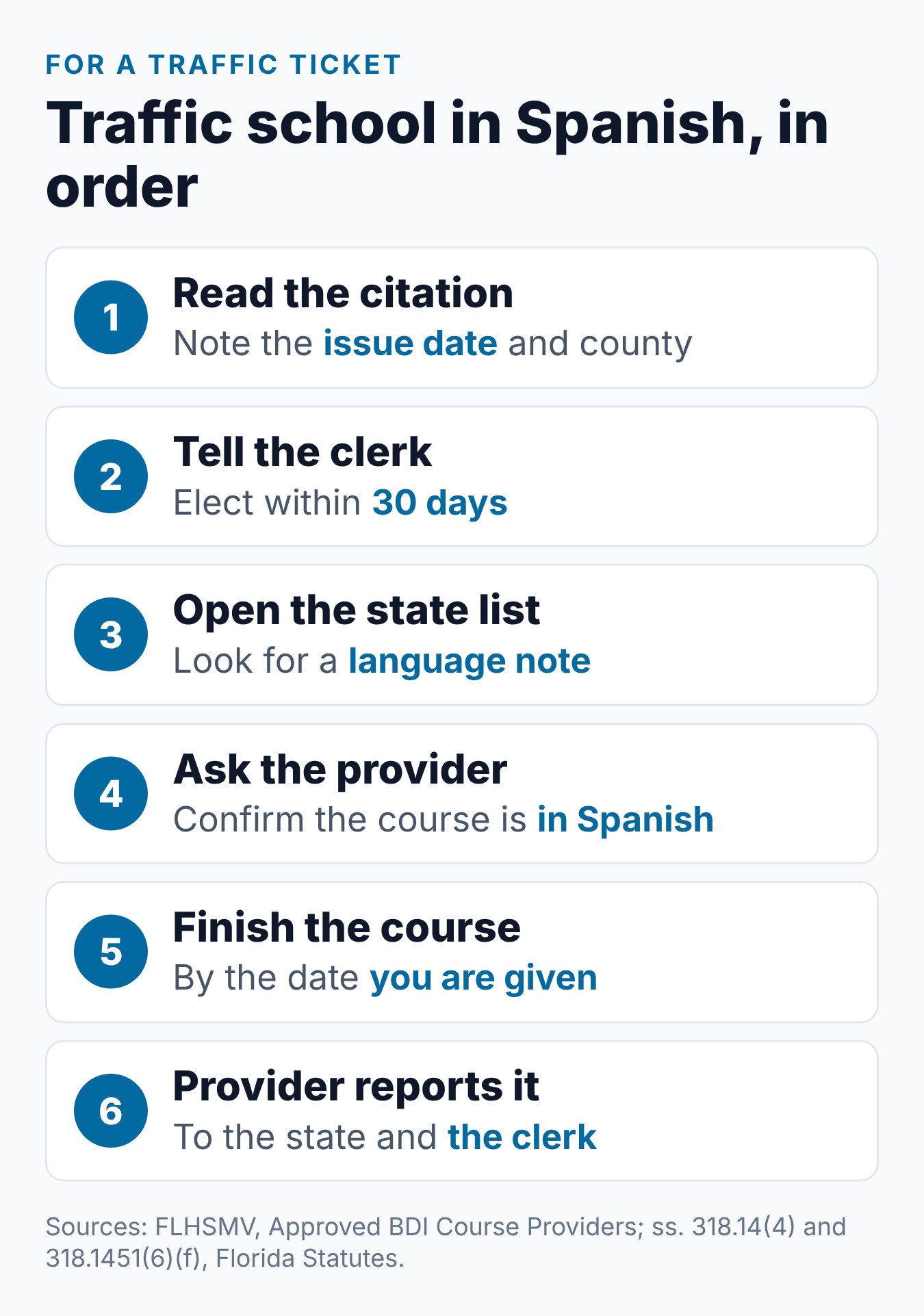
The steps below put the official rules in order. They are the same in either language.
- Read your citation. Find the date it was issued and the county. Read the options on the back.
- Tell the clerk. Inform the Clerk of Court in the county on the ticket that you elect the course, and pay the election fee.
- Open the state list. Look for providers with a language note and the delivery method you want.
- Ask about Spanish. Contact the provider and confirm the course is offered in Spanish.
- Check the county note. Make sure the provider can take a citation from your county.
- Finish the course. Complete it by the date the clerk or the court gives you.
- Keep your records. Save your certificate and your receipt from the clerk.
Step 2 comes before the course. FLHSMV says to inform the clerk prior to attending.
Our guide on how to take the BDI course online covers the online format in detail.
How Your Completion Is Reported
You do not carry the news of your completion alone. Section 318.1451(6)(f) puts reporting duties on the provider.
The provider reports to two places:
- The state. Course completion information goes to the department through its Driver Improvement Certificate Issuance System within 5 days.
- The clerk. The same information goes, together with the citation number, to the clerk of the circuit court of the county where the citation was issued. It is sent through the Florida Courts E-Filing Portal within 3 days after the provider receives the certificate number.
The citation number ties the report to your ticket. Give the provider the number exactly as it is printed.
This reporting does not depend on the language of the course. A course taken in Spanish is reported the same way.
Our guide on the BDI completion certificate explains the certificate and what to do if the clerk does not show it.
What the Official Pages Leave Out
Some language questions have no answer on the official pages. We make no claim about them:
- The certificate. No official page says what language the completion certificate is in.
- The clerk’s forms. No official page says what language a clerk’s forms are in.
- Which providers teach in Spanish. The state list does not name the languages behind its notes.
If one of these matters to you, ask before you act. Ask the provider about the course and the certificate. Ask the Clerk of Court about its forms.
Questions to Ask Before You Pay
A short call or message can settle the language question. Ask the provider:
- Is the full BDI course offered in Spanish?
- Is that true for the delivery method I want?
- Can you take a citation from my county?
- What are all of the fees?
- How will I receive my certificate?
Then ask the Clerk of Court:
- What date must I finish the course by?
- What do you need from me after I finish?
The fee question has the law behind it. Providers must disclose all fees during registration.
Write down the answers and the date you asked. Clerk practice can change.
What We Found on the State List
On November 26, 2026, we read FLHSMV’s list of approved BDI providers line by line. We looked for every sign of language. Here is what stood out:
- 54 providers were listed. Each one had a name, a delivery method and contact information.
- 9 carried a language note. Three were marked “(Additional Languages Available)” and six were marked “(Other Languages Available).”
- None of the notes named a language. The word Spanish did not appear beside any provider.
- 20 names carried a county note. Those entries were marked for citations from certain counties.
- The statute is silent. Section 318.1451 does not use the word language at all.
The second and third findings explain why this question is so common. Only a small share of the list has a language note, and the note does not say Spanish.
These counts are a snapshot. The list changes as FLHSMV adds and removes providers.
Common Mistakes to Avoid
These mistakes cost drivers time:
- Treating the language note as proof of Spanish. The note does not name a language.
- Skipping providers with no note. A provider may offer Spanish without one. Ask.
- Taking the course before telling the clerk. The election comes first.
- Letting the 30 days run out. After that, the election is not allowed.
- Ignoring the county note. Some entries are marked for citations from certain counties.
- Expecting the ticket to be dismissed. Adjudication is withheld. That is a different result.
- Guessing about the certificate’s language. No official page says. Ask the provider.
How Requirements Can Vary
Florida’s election rules, point values and suspension levels come from Florida Statutes and FLHSMV, and they apply statewide. The election fee, the date to finish the course and how proof is filed are set by the Clerk of Court in the county on your ticket, or by the court. A court order sets its own deadline and proof steps.
Laws, fees and clerk practice can change. Check your citation, your clerk’s instructions, any court order and the FLHSMV website before you enroll or file anything.
Frequently Asked Questions
Can I take Florida traffic school in Spanish?
Yes, when the provider offers the course in Spanish. The state list marks some providers for more languages but does not name them, so confirm with the provider.
Does Florida law require traffic school to be in English?
No. Section 318.1451 does not mention language. It says the department approves and regulates the courses of all driver improvement schools.
Is the Spanish course treated differently for my ticket?
No. The election rules in section 318.14 are the same in any language. Adjudication is withheld, the civil penalty is reduced by 18 percent and points may not be assessed.
How do I find a provider that teaches in Spanish?
Start with FLHSMV’s list of approved BDI providers. Look for a language note, then contact the provider and ask about Spanish.
How long do I have to choose traffic school?
You have 30 days from the citation date. FLHSMV says drivers may not elect the course after that period.
Is my certificate in Spanish?
No official page says what language the certificate is in. Ask the provider before you pay.
Who tells the clerk that I finished?
The provider does. It must send your completion and citation number to the clerk through the Florida Courts E-Filing Portal within 3 days of receiving the certificate number.
Conclusion
Florida does not set a language for traffic school, so a Spanish course depends on the provider you choose. The ticket rules stay the same: tell the clerk within 30 days, pay the election fee and finish by the date you are given. For questions about your own ticket, ask the Clerk of Court in the county where it was issued. When you are ready, see Driving Logic’s florida traffic school online course.
Related Articles
- Florida Basic Driver Improvement (BDI) Course: The Complete Guide
- Florida Online Traffic School: How to Take the BDI Course
- FLHSMV-Approved BDI Providers: What It Means and How to Verify Your Course
- Florida Driver Improvement Course: Online vs. In Person
- Florida BDI Completion Certificate: What It Is and How to Submit It
Sources
- Florida Statutes s. 318.14 — Noncriminal traffic infractions
- Florida Statutes s. 318.1451 — Driver improvement schools
- FLHSMV — Basic Driver Improvement (BDI) Approved Course Providers
- FLHSMV — Driver Improvement Schools
Billy Forte is the owner of Driving Logic, a driver improvement course provider serving Florida and other U.S. states.
This article is general information, not legal advice. Election rules, deadlines, fines and penalties depend on your citation, county, court and case facts, and they can change. Use official FLHSMV, Florida Statutes and Clerk of Court sources, and consult a qualified Florida attorney for advice about your own case.