
Updated June 2026 · Reviewed by Billy Forte
The later parts of the Impact Texas Adult Drivers (ITAD) course move from distraction to impaired driving and the lasting consequences of unsafe choices behind the wheel. Like the opening segment, these are awareness videos built around real Texas crash stories and DPS data, not a graded exam with answers to memorize. This overview describes the themes you will encounter in Lessons 2 and 3 so you know what to expect, while the only thing you truly need to manage is completing the course within the 90-day window.
Applies to first-time Texas driver licensing. Requirements are set by the Texas DPS (and TDLR for driver education) and can change.
Key Facts
- Impaired driving: Later segments address alcohol, drugs, and impairment behind the wheel.
- Consequences: They emphasize the human and legal fallout of unsafe driving decisions.
- Real stories continue: Texas crash accounts and DPS data carry through the program.
- Still awareness-based: No quiz answers to memorize — these are video segments, not exams.
- Completes the course: Finishing these parts earns the 90-day completion certificate.
What Impact Texas Adult Drivers Lesson 2 Covers
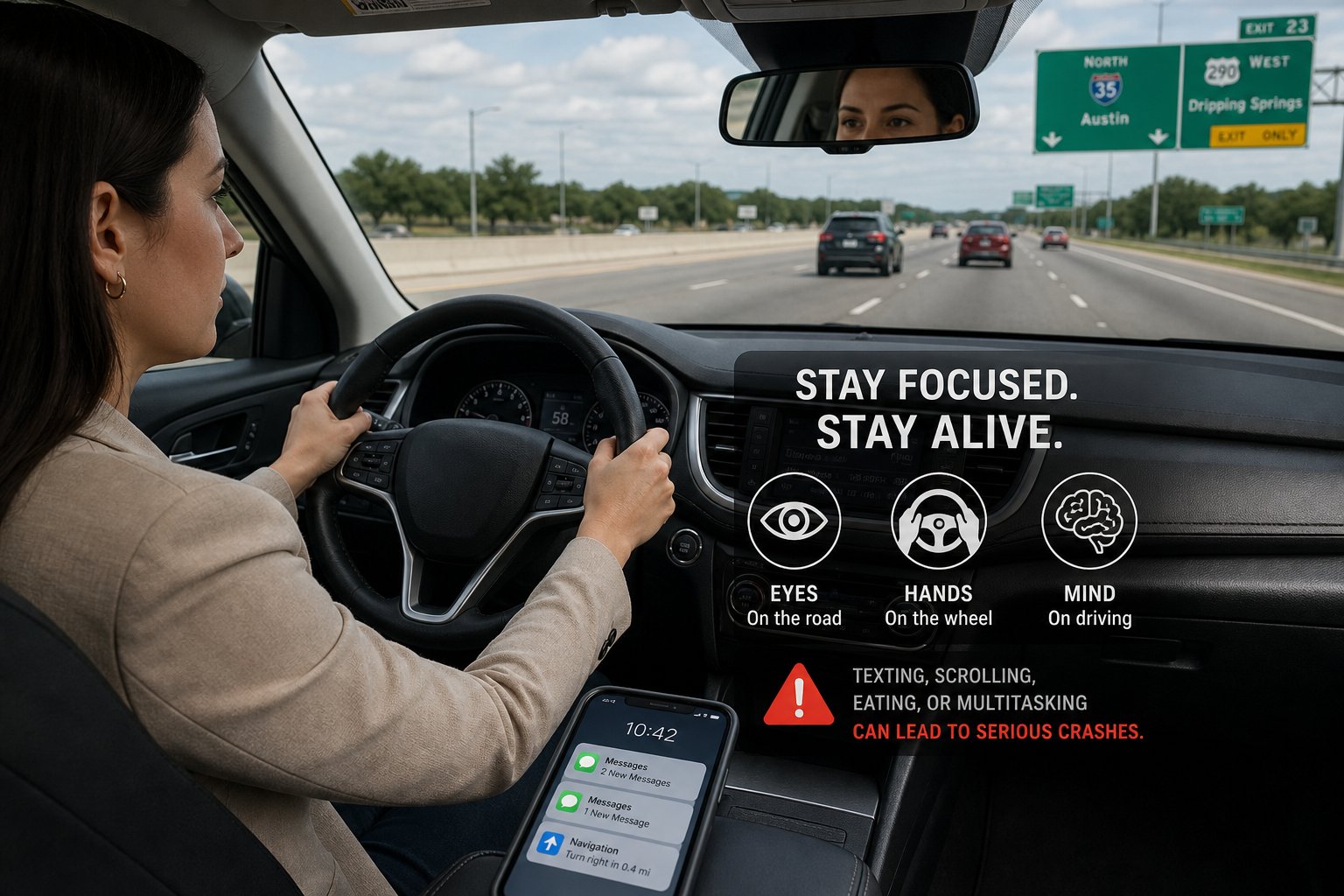
Impact Texas Adult Drivers Lesson 2 focuses on the danger of distraction behind the wheel. The main idea is simple: your brain cannot safely give full attention to driving and another task at the same time.
The course uses real-world examples to show how small distractions lead to big outcomes. That includes:
- Texting while driving
- Looking at a phone for maps, music, or messages
- Talking or scrolling on a device
- Eating, grooming, or reaching for objects
- Anything that takes your eyes, hands, or mind off driving
Texas DPS and the official Impact Texas Drivers portal frame ITAD around dangerous driving behaviors and the human cost of crashes. Lesson 2 is where that message gets more specific. Instead of treating distraction like a minor bad habit, it shows it as a real crash factor.
One of the useful takeaways is that distraction is not just visual. A lot of drivers think, “I only glanced down for a second.” But Lesson 2 pushes you to see the full picture. If your eyes leave the road, your hands leave the wheel, or your thoughts leave the driving task, your risk jumps.
This matters because many adults taking Adult Driver Education (ADE) are also juggling work, kids, errands, and phones all day. The lesson tries to break that normal habit loop. Not by giving quiz shortcuts or trick answers, but by making the cost feel concrete.
And that is really the point. Lesson 2 teaches that distracted driving is preventable, but only if you treat it like a serious safety issue before you start the car.
How Lesson 2 Fits Into Texas Adult Driver Education Requirements
Lesson 2 is only one part of the larger Impact Texas Adult Drivers (ITAD) requirement. It helps to separate ITAD from the other Texas courses, because people mix them up all the time.
Here is the key distinction:
- Adult Driver Education (ADE) is the state-required education course for many adults getting a first Texas driver license.
- ITAD is a free, separate 1-hour course from TxDPS.
- ITAD is not the same as defensive driving or a Driver Safety Course for ticket dismissal.
If you are age 18 to 24 and applying for your first license, you generally need both ADE and ITAD before your road test. ADE is approved through the Texas Department of Licensing and Regulation and gives you the training needed to move forward. A big benefit is that completing ADE can waive the DPS written knowledge test for eligible applicants, which saves time and stress.
Then ITAD comes after that. Texas DPS states that the course must be completed after driver education and before the driving skills test. That timing matters. If you take ITAD too early, you can run into date problems with your certificate.
This is also where impact texas adult drivers lesson 3 matters. Lesson 2 is not the end. The adult course is made up of three video parts, and you need to finish all required parts in sequence to earn your certificate.
One more point many adults miss: if you are 18 or older in Texas, you do not need a learner license first before getting your driver license. But you still must meet the education and testing rules that apply to first-time adult applicants through Texas DPS.
How To Access, Start, And Complete The Lesson Online
To take ITAD, go to the official Impact Texas Drivers website. That is the Texas DPS portal for the course and certificate process.
The basic flow is straightforward:
- Finish your Adult Driver Education first.
- Register or sign in through the ITAD portal.
- Start the video course in the required order.
- Complete all parts.
- Save and print your ITAD certificate.
There is one technical detail that trips people up a lot. Texas DPS guidance says the course should be completed on a desktop or laptop, not a phone or tablet. If you try to use the wrong device, the video may not work right or your progress may not save as expected.
That sounds minor. But for busy adults, it can become a real delay. You sit down thinking you will knock it out on your phone during a break, then have to start over later on a computer.
Since ITAD is a free course and only about 1 hour, the best move is to set aside one uninterrupted block of time. Close extra tabs. Turn off alerts. Treat it like an appointment.
Also, make sure the name and information you use match your driver education records. If the details do not line up, that can create problems when you need proof for the road test.
If your main goal is to move through the license process with fewer delays, finish your state-approved ADE course first, then complete ITAD on the correct device in one sitting if possible.
Common Questions About Timing, Certificates, And Next Steps
The most common question is simple: When should you take ITAD? The answer is after you complete driver education and before your driving test.
For many applicants, the safe rule is to complete it within the 90-day window before your skills exam. That is because the ITAD certificate is generally treated as valid for 90 days. If it expires before your test date, you may need to retake the course.
Another common question is whether Lesson 2 alone gives you anything you can use. It does not. You need to complete the required full ITAD program, including the later lesson parts, to receive the certificate.
People also ask what to bring to the test. Requirements can vary by location and testing path, but your ITAD completion proof should be available when you take the road test with Texas DPS or an approved third-party tester. Keep both a digital copy and a printed copy if possible.
Here are the practical next steps after you finish the full ITAD course:
- Download your certificate right away
- Print a backup copy
- Check the date so you know when the 90-day period ends
- Schedule your driving test within that window
- Gather your other license documents before the appointment
If you are still working on your education course, start there first. Driving Logic offers a Texas Adult Driver Education option built for busy adults who want a simple online format and the shortest state-allowed path to completion.
Mistakes That Delay Completion And How To Avoid Them
Most ITAD problems are not about hard content. They come from timing mistakes, device issues, or missing paperwork.
The biggest mistake is taking ITAD before finishing Adult Driver Education. Texas DPS checks dates, and if your ITAD certificate comes before your education completion, it may not work for the license process. That can mean doing the free course again.
Other common mistakes include:
- Using a phone or tablet instead of a desktop or laptop
- Waiting too long and letting the certificate expire
- Entering the wrong personal information
- Forgetting to save or print the certificate
- Assuming ITAD is the same as ADE or defensive driving
That last point matters more than people think. ITAD is separate from ADE, and ADE is separate from defensive driving for ticket dismissal. If you sign up for the wrong thing, you lose time.
A good way to avoid problems is to work in order:
- Complete your Texas-approved ADE course.
- Confirm your records and completion date.
- Take ITAD through the official DPS site.
- Save the certificate as soon as it appears.
- Book the road test before the 90-day window ends.
And if you are shopping for the education step first, check that the provider is approved by TDLR and built for Texas adult licensing. That helps you avoid a mismatch between what you took and what Texas requires.
What To Do After Lesson 2 To Stay On Track For Your License
After Lesson 2, keep going. You still need to complete the remaining ITAD lesson parts, including Lesson 3, so you can get your certificate.
Lesson 3 continues the safety message by reinforcing how risky choices turn into real crashes and life-changing outcomes. Together, Lessons 2 and 3 move from awareness to consequence. They are designed to leave you with a simple takeaway: safe driving is not just about knowing the rules. It is about controlling distraction, avoiding impaired driving, and making better choices before something goes wrong.
That is also how the full program connects back to Lesson 1. The course builds step by step. First it introduces the issue. Then it shows the behaviors. Then it drives home the consequences and the responsibility that comes with a Texas license.
Once ITAD is done, focus on the rest of your license path:
- Make sure your certificate is saved
- Confirm your road test timing fits the 90-day window
- Bring the needed documents to the exam
- Verify your testing details with TxDPS or your third-party tester
If you still need the education course that comes before ITAD, Driving Logic’s Texas Adult Driver Education course is built for first-time adult applicants who want a faster, simpler online option. It is the required ADE course, not ITAD, and finishing it can waive the DPS written knowledge test.
Texas rules can change, so always confirm final licensing steps with Texas DPS, the Impact Texas Drivers portal, and the Texas Department of Licensing and Regulation.
FAQ
What do Lessons 2 and 3 of ITAD cover?
They focus on impaired driving and the real consequences of unsafe choices, continuing the program’s use of Texas crash stories and DPS data.
Are there quiz answers for Lessons 2 and 3?
No. ITAD is an awareness video throughout — there are no answer keys to memorize. You watch the required segments to completion.
When should I take ITAD relative to my test?
Within 90 days before your driving test, since the certificate is valid for 90 days. Finishing these final segments produces that certificate.
Do these lessons replace the driver-education course?
No. ITAD is the free DPS safety video; for ages 18–24 the paid ADE course is a separate requirement that the Impact video does not satisfy.
Conclusion
The back half of ITAD widens the lens from distraction to impairment and the consequences that follow, keeping the same real-world, story-driven approach. There is still nothing to memorize — finishing the segments is what earns your certificate. Once Lessons 2 and 3 are done, your focus shifts entirely to timing: take the driving test while the 90-day certificate is still valid.
ITAD is free and ungraded; the paid education requirement for ages 18–24 is the separate Texas adult driver education course online, which waives your DPS written test.
Related Articles
- What Is Impact Texas Adult Drivers (ITAD)? The Complete Guide
- Impact Texas Adult Drivers: What Lesson 1 Covers
- Impact Texas Adult Drivers Questions: What to Expect in the Course
- How to Complete the Impact Texas Adult Drivers (ITAD) Course
Sources
Billy Forte is the owner of Driving Logic, a TDLR-approved Texas adult driver education and driver safety course provider. Driving Logic offers the online Texas Adult Driver Education (ADE) course that helps adults qualify for a first Texas driver license and waive the DPS written knowledge test.
This article is general information about Texas adult driver licensing, not legal advice. Requirements, fees, and procedures are set by TDLR and the Texas DPS and can change, so confirm current details with official Texas sources before you enroll or visit a DPS office.