
Updated June 2026 · Reviewed by Billy Forte
Careless and imprudent driving in Missouri can be charged as either a civil infraction or a criminal misdemeanor, depending on the conduct and how the case is filed. Read your ticket and any court paperwork to see how your charge is classified, since a careless and imprudent charge tied to an accident with injury or property damage is more likely to be a misdemeanor. If your case qualifies and the court or Fine Collections Center authorizes it, a Driver Improvement Program may help with points, but it does not turn a criminal charge into a non-criminal one.
This article covers Missouri requirements only.
Key Facts
- Missouri terminology matters; search wording may not match the charge on the citation.
- Careless and imprudent cases can be more serious than routine speeding.
- The final conviction code controls DOR point treatment.
- DIP must be authorized before it can matter.
- Attorney review may be appropriate when the ticket alleges dangerous driving.
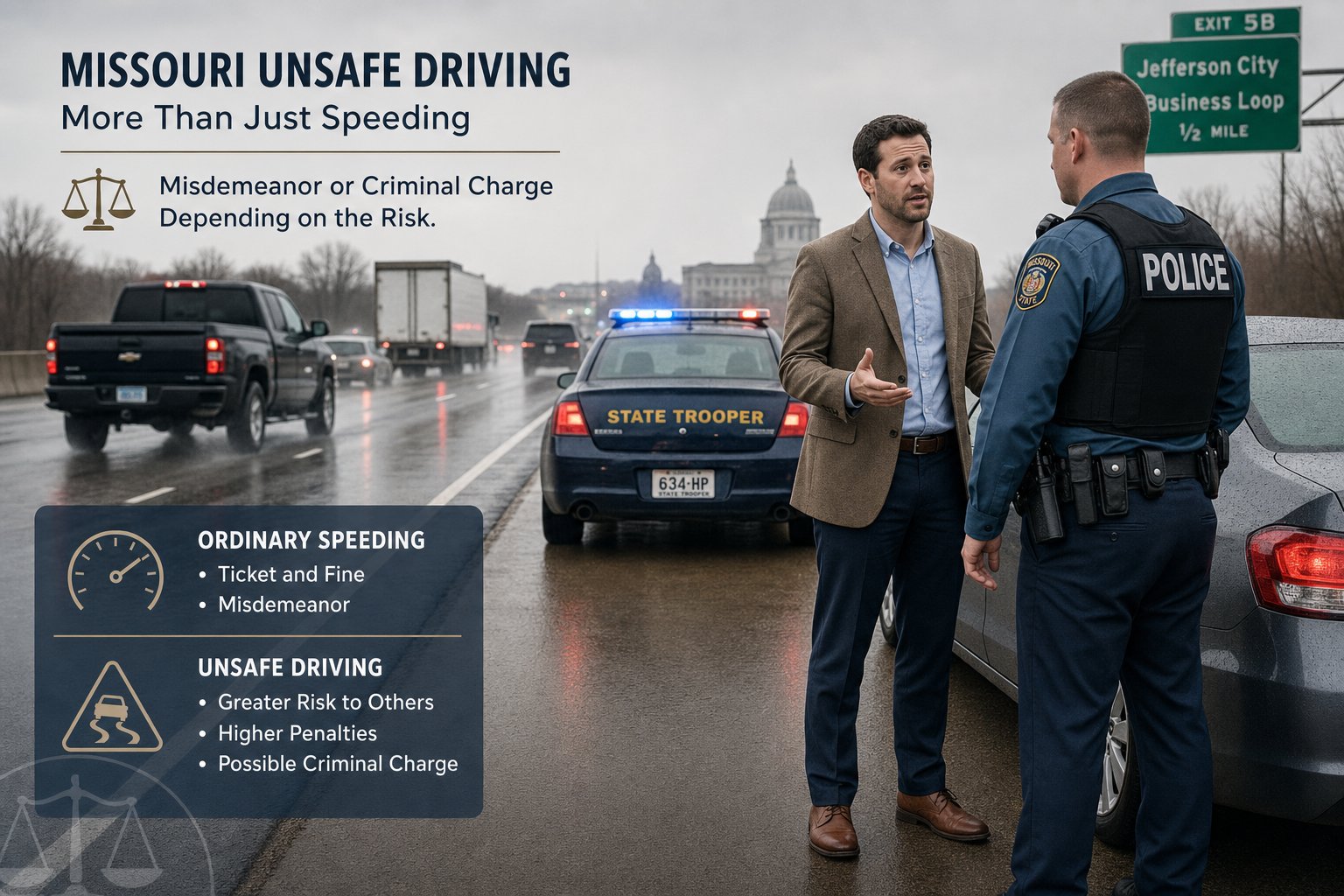
What Careless And Imprudent Driving Means Under Missouri Law
Careless and imprudent driving is Missouri’s main charge for unsafe driving that puts people or property at risk. Under Missouri Revised Statutes §304.012, a driver must use the highest degree of care and drive in a careful and prudent way.
That matters because this is more serious than a basic speeding ticket. A standard moving violation usually focuses on one rule, like going 12 mph over the limit. Careless and imprudent driving focuses on the whole driving behavior and whether it endangered life, limb, or property.
In real life, the same stop can start with speed but end with a C&I charge. For example, if an officer believes you were weaving, following too closely, or driving too fast for rain, the case may be written as careless and imprudent driving instead of ordinary speeding.
How it is charged also affects how people talk about it. Some Missouri tickets are handled like traffic infractions. But a missouri c&i driving criminal charge can carry criminal exposure, especially when a crash, damage, or injury is involved. That difference is one reason many drivers worry about jobs, licensing, and insurance after a C&I ticket.
Careless Vs. Imprudent Driving: Is There A Difference?
Missouri law treats careless and imprudent as one offense, not two separate tickets. People often shorten it to C&I.
Some lawyers explain “careless” as not paying enough attention and “imprudent” as using poor judgment. That can help you understand the idea, but the statute charges them together and the court generally punishes them under the same rule.
So if your ticket says careless and imprudent driving, do not assume it means one part is minor and the other part is not. The practical question is how the court filed the case, what facts the officer wrote, and whether there was any crash, injury, or property damage.
Common Examples That Can Lead To A C&I Charge
A C&I charge usually comes from dangerous driving behavior, not just speed alone. Officers often use it when they believe your driving created a real risk.
Common examples include:
- Excessive speeding or street racing
- Tailgating or sharp lane changes
- Driving too fast for rain, fog, ice, or traffic
- Distracted driving that puts others at risk
- Losing control, sliding, or almost causing a crash
Here is the key point: two drivers may both be speeding, but only one gets charged with careless and imprudent driving. If the officer thinks your actions showed poor control or danger to others, the charge can move beyond a normal speeding ticket.
This is also why C&I gets confused with reckless driving. Missouri commonly uses careless and imprudent driving as the main moving-violation charge for dangerous driving. People may say “reckless,” but the ticket often reads C&I instead.
Context matters a lot. Speed on a dry, open road may be treated one way. The same speed in heavy traffic, near a school zone, or during a storm may be viewed much more seriously. That is one reason officers and courts look at the whole event, not only the posted speed limit.
Missouri Misdemeanor Penalties, License Points, And Insurance Risks
Yes, careless and imprudent driving Missouri misdemeanor issues can bring criminal penalties. But the exact level depends on how the case is charged and what happened.
In general, Missouri sources commonly describe these ranges:
- Class B misdemeanor when there is no accident
- Class A misdemeanor when an accident is involved
- 4 demerit points for a Missouri state-law C&I conviction
You can review official license point rules through the Missouri Department of Revenue (DOR). Those points matter because they can add up fast. The Missouri DOR may suspend a license if a driver reaches certain point totals within set time periods.
Insurance is another major issue. A C&I conviction often looks worse than a simple moving violation because it suggests unsafe driving, not just a minor mistake. Insurers may treat that as higher risk, which can mean higher premiums for years.
There is also the job angle. A routine Missouri traffic ticket may stay in the traffic lane of your record. A misdemeanor charge can raise more concern for employers, especially if the job involves driving, company vehicles, deliveries, or a commercial setting. How it appears on a background check can vary by employer and screening process, but it can matter more than a standard speeding ticket.
And don’t forget court costs. Even when the fine is not the biggest part, fees and related costs can still make the case expensive.
How A Crash, Injury, Or Prior Record Can Raise The Stakes
A crash changes the case. In Missouri, when careless and imprudent driving involves an accident, the charge may be treated more seriously and can be filed as a Class A misdemeanor.
That does not only affect possible penalties. It also changes how prosecutors, judges, insurers, and employers may view the event. If there is injury or clear property damage, the case can look less like a routine traffic matter and more like a criminal driving incident.
A prior record can make things harder too. If you already have moving violations, past C&I cases, or a poor driving history, the court may be less willing to treat the matter lightly. That does not mean the outcome is fixed. It means the facts around your record may carry more weight.
Other factors that can raise the stakes include:
- A passenger or other driver was hurt
- Multiple vehicles were involved
- There was major vehicle damage
- The officer noted aggressive or repeated risky behavior
- You already have several Missouri DOR points
If your case involves a crash, one useful step is to collect records early. Keep photos, repair papers, witness names, and any dashcam footage. Those details can matter later if the facts are disputed or the court looks closely at what actually happened.
What To Do After A Missouri Careless And Imprudent Driving Ticket
First, do not ignore the ticket. Missing a deadline, court date, or order can create bigger problems with the court or the Missouri Department of Revenue (DOR).
Next, read the citation closely. Look for the court date, the charge wording, and whether the case appears tied to a crash. Then gather the basic facts while they are still fresh.
A smart checklist includes:
- Save photos of the road, weather, and vehicle damage
- Write down what happened as soon as you can
- Get witness names and contact details
- Keep repair bills or towing records
- Check your Missouri driving record and current points
You can request driving record information through the Missouri DOR, and some cases may also involve forms or court paperwork tied to the Fine Collections Center (FCC). If the court or FCC gives instructions, follow them closely.
Many drivers also consider speaking with a Missouri traffic or criminal defense attorney, especially if there was a crash, injury, or concern about a misdemeanor record. An attorney can explain factors to consider, including whether a reduction to a lesser offense, a non-moving violation, or another case result may be possible. Outcomes vary by county, judge, facts, and record.
If you need your record for review, Missouri uses documents such as the completion form or reporting instruction named in your court, FCC, or DOR paperwork for certain record requests and compliance steps. Use the official Missouri DOR site for the right version and instructions.
When A Driver Improvement Or Traffic School Course May Help
A Driver Improvement Program (DIP) or traffic school course may help in some Missouri cases, but it is not automatic. Courts or the Fine Collections Center (FCC) must allow it, and the result depends on the county, the charge, and your case facts.
That means you should not assume a course will dismiss the ticket, reduce points, or change the charge on its own. In some cases, a DIP is part of a court-approved outcome. In others, it may not be offered at all.
A course may be more likely to help when:
- You have a lighter record
- The event did not involve serious injury
- The court or FCC specifically authorizes it
- Your attorney negotiates it as part of the case
If you are allowed or ordered to take a Missouri course, an online option can make the process easier. Driving Logic offers Missouri driver improvement and traffic school options built for busy drivers, with flexible access on your phone or computer and fast completion built around state rules. If you need to Driving Logic.
For official state information on points and driver records, check the Missouri Department of Revenue (DOR). For the legal wording of the offense, review the Missouri Revised Statutes.
This information is general education only and not legal advice: for legal guidance on a Missouri careless and imprudent driving charge, especially one involving a crash, injury, or possible misdemeanor record, consult a qualified Missouri attorney.
FAQ
Can the Missouri Driver Improvement Program erase my ticket?
No. The Missouri Driver Improvement Program does not erase a ticket or conviction by itself. It may help with points only when the court or Fine Collections Center authorizes it and the Missouri DOR accepts the completion.
Do I need court approval before taking DIP?
Usually, yes. For a ticket or point-related case, confirm authorization with the court or Fine Collections Center before enrolling, then note the completion deadline and where proof must be sent. Taking a course without authorization may not help your record.
Does Missouri use DMV or DOR for points?
Missouri uses the Department of Revenue, often called DOR, for driver records and points. Many people say DMV, but Missouri’s agency is DOR.
Where should I check my deadline?
Check your ticket, court notice, Fine Collections Center notice, or Missouri DOR correspondence for the completion deadline, appearance date, reporting destination, and whether DIP is authorized. Those documents control your next step.
Conclusion
Careless and imprudent driving in Missouri can be a civil infraction or a criminal misdemeanor depending on the facts and how it is charged. Check your ticket and court paperwork to see how your case is classified before deciding how to respond. If it is charged as a misdemeanor or involves an accident, speak with a Missouri traffic attorney.
Related Articles
- Missouri Speeding Ticket: Costs, Points, and What to Know
- Missouri Speeding Ticket Fines: What Affects the Cost?
- Missouri Speeding Ticket Options: Pay, Contest, or Request DIP
- How Does a Missouri Speeding Ticket Affect Your Car Insurance?
Sources
- Missouri DOR — Tickets and Points FAQ
- Missouri DOR — Form 899, Driver Record Traffic Violation Descriptions and Points Assessed
- Missouri DOR — Driver License
- Missouri Revised Statutes § 304.010 — Speed Limits
- Missouri Revised Statutes § 304.012 — Careless and Imprudent Driving
Billy Forte is the owner of Driving Logic, a state-approved driver improvement course provider serving Missouri and other U.S. states. Driving Logic offers online driver improvement courses for drivers handling court, point, and state requirements.
This article is general information, not legal advice. Missouri DOR rules, court procedures, deadlines, insurance decisions, and case facts can differ. Use official Missouri DOR and court sources for current requirements, and consult a qualified Missouri attorney for legal guidance specific to your situation.