
Updated June 2026 · Reviewed by Billy Forte
If your teenage driver gets too many points in Tennessee, the Tennessee Department of Safety and Homeland Security can place them in the Driver Improvement Program, require a hearing with a parent or guardian, and suspend driving privileges if they do not comply. For drivers under 18, 6 or more points in 12 months can trigger this process, which is a lower limit than the adult standard. In many cases, the teen may have to complete an 8-hour defensive driving course within a set completion deadline, and any court order, traffic ticket, or notice from TDOSHS must be followed exactly.
This article covers Tennessee requirements only.
Key Facts
- Teen drivers: Tennessee minor drivers can face stricter driver-improvement consequences after points or violations.
- Parent role: Parents should read the TDOSHS notice or court paperwork with the teen driver.
- Course length: Minor-driver requirements may involve an 8-hour driver improvement course.
- Deadline: Missing the listed deadline can create license problems.
- Proof: Keep the certificate and follow the filing instructions exactly.
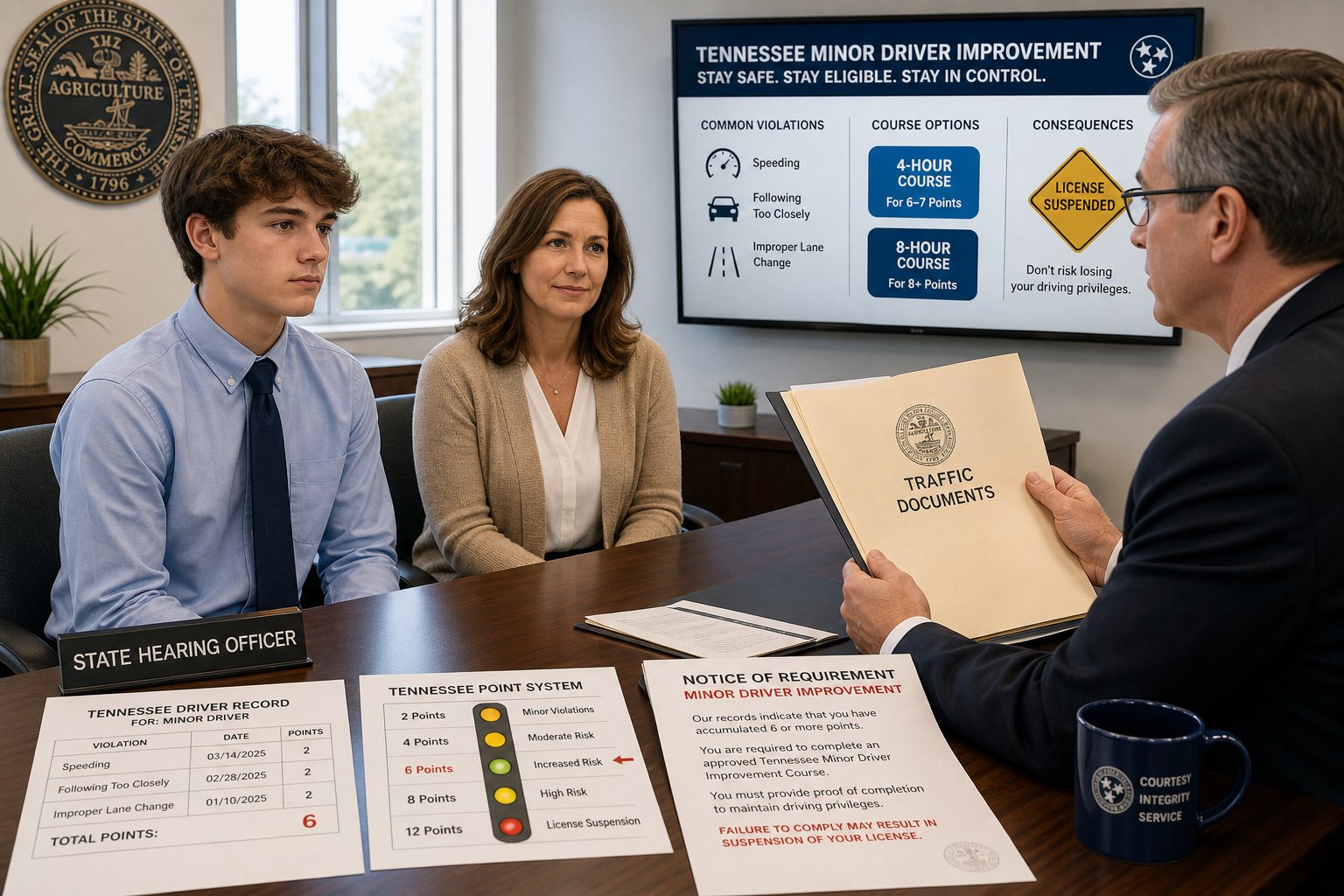
What The Tennessee Minor Driver Improvement Program Is And Who May Be Required To Take It
The tennessee minor driver improvement program is part of the state’s Driver Improvement system for drivers under 18. It usually starts when a teen gets 6 or more points in 12 months. That point total can come from one serious traffic ticket or several smaller violations.
When that happens, TDOSHS may send a notice. The notice can require the teen to appear for a Driver Improvement hearing. A parent or guardian must attend with the minor. That part matters. If the hearing is missed, the teen can face a mandatory suspension, often for six months.
A teen may also be ordered into a course by a court. This can happen after speeding, texting while driving, or another moving violation. In some cases, a judge may allow a defensive driving course as part of a court order. But ticket dismissal or point reduction is never automatic. It depends on the court, the case, and the judge’s rules.
Tennessee courses often come in two lengths:
- 4-hour course: often used for court-ordered ticket diversion cases
- 8-hour course: often used for TDOSHS Driver Improvement or near-suspension situations
The key point is simple: if your teen has too many points, do not assume it will go away. Read the notice, check the completion deadline, and contact the Clerk of Court or TDOSHS if anything is unclear.
How The Program Fits Into Tennessee’s Graduated Driver Licensing Rules
Tennessee’s teen licensing system gives more freedom in steps, not all at once. So, a bad driving record can slow that path. The tennessee teen driver improvement process matters because points, hearings, and suspensions can interrupt a teen’s progress through the state’s Graduated Driver Licensing, or GDL, rules.
If a teen is on a learner permit or intermediate license, new violations can bring more than just fines. They can lead to extra limits, a delayed move to the next license stage, or loss of driving privileges. That is why a clean record matters so much before age 18.
A Driver Improvement case can also affect a teen who already has a restricted or intermediate license. More violations after a warning, hearing, or course may lead to stronger action by the state. In plain terms, the more a teen keeps getting tickets, the fewer options they may have.
License Stages For Teen Drivers
Tennessee’s GDL system has three main stages:
- Learner Permit: supervised driving only, with rules on time and who can be in the car
- Intermediate License: limited unsupervised driving, but still with restrictions
- Regular License: full privileges after age, time, and record rules are met
You can review state license rules through the Tennessee Department of Safety and Homeland Security. If your teen gets a traffic ticket while in one of these stages, the effect can be bigger than many parents expect.
Eligibility, Documents, And What To Have Ready Before You Start
Before you start anything, make sure you know who is requiring the program. That could be a court, or it could be TDOSHS after a point review. The steps are not always the same, so the paperwork matters.
For a standard teen licensing matter, Tennessee may require documents such as:
- Proof of U.S. citizenship or lawful status
- Primary and secondary identity documents
- Proof of name change, if any
- Two proofs of Tennessee residency
- Social Security number or allowed affidavit
- SF-1010 school attendance form, when required
- Teenage Affidavit/Financial Responsibility form
- SF-1256 for required driving hours, when applying for an intermediate license
For a Driver Improvement matter, the teen and parent should have basic case details ready, including:
- Full legal name
- Driver license number
- Date of birth
- Traffic ticket or notice information
- Court papers or TDOSHS notice
If the case involves a court order, read it line by line. If it mentions a class, ask whether the court wants a 4-hour course or an 8-hour course. Also ask whether the court accepts online completion. Do not assume an online class will be accepted. Confirm with the Clerk of Court first.
You can also review Tennessee driver rules and forms through TDOSHS and state law through the Tennessee Code Annotated.
How The Course Works Online, Including Time, Devices, And Completion Basics
Many Tennessee defensive driving courses can be taken online, but court acceptance varies. That is the first thing to know. Some courts allow online study. Others want a live class, an in-person class, or a provider from an approved list.
If the course is allowed online, it is usually simple to access. Most providers let you use:
- A phone
- A tablet
- A laptop or desktop computer
The course length depends on the reason for the order. In Tennessee, that is often:
- 4 hours for some court-ordered diversion or traffic school matters
- 8 hours for TDOSHS-approved Driver Improvement or near-suspension situations
Most online courses are self-paced. That means your teen can stop and start, as long as the provider and court allow it. To finish, the student usually must complete all lesson sections and pass a final quiz or assessment. After that, the provider issues a certificate of completion.
Driving Logic offers a Tennessee defensive driving course designed for busy people who want a simple online format on almost any device. Still, the smart move is to confirm with your court first if the course is for a traffic ticket, possible ticket dismissal, or a requested point reduction, because those results depend on the specific court and case, not just on finishing a class.
What Happens After You Finish And How To Submit Proof Of Completion
Finishing the course is only part of the job. You still have to make sure the right office gets proof. If proof is not sent on time, the court or TDOSHS may treat the case as incomplete.
In many Tennessee cases, the next step is one of these:
- The school sends a completion record to the court
- You or your parent submit the certificate to the court
- You or your parent submit proof to TDOSHS, if the notice says to do so
For Driver Improvement cases tied to points, the completion deadline is critical. Tennessee information commonly states that a required defensive driving course must be completed within 90 days of the suspension notice to receive credit. Also, Driver Improvement course credit may only count once in a five-year period in some situations.
If your teen’s license has already been suspended, course completion alone may not be enough. Reinstatement can also require other steps, such as proof of insurance and state fees, depending on the case.
Use the instructions on the notice. If the notice names TDOSHS, follow that. If it names the court, call the Clerk of Court and ask how to submit the certificate and whether email, upload, mail, or in-person delivery is required. You can find court contacts through the Tennessee court system.
Common Reasons Teens Are Assigned The Program And Mistakes That Can Delay Completion
Most teens are assigned the program because they reach the point limit or because a court orders a class. The most common trigger is simple: 6 or more points in 12 months while under age 18.
Those points may come from violations such as:
- Speeding
- Failure to yield
- Other moving violations
- Texting while driving, if the court orders education
Some parents focus only on the ticket fine. That can be a mistake. The bigger issue is what the ticket does to the teen’s driving record and license status.
The most common delays happen when families miss a required step. Watch for these problems:
- Not requesting or attending the Driver Improvement hearing
- Parent or guardian not appearing with the teen
- Missing the 90-day course deadline
- Taking a course the court does not accept
- Failing to send the certificate to the right office
- Ignoring a court date or notice from TDOSHS
If your teen needs a Tennessee defensive driving course and your court allows online completion, you can review options and enroll through Tennessee defensive driving course. Before you register, confirm the provider, course length, and format with your court or TDOSHS so the completion will count.
Before You Enroll, Check These Items
Before you choose a Tennessee defensive driving course, match the course to the reason you need it. A court ticket program, a TDOSHS driver-improvement requirement, and a suspension-related notice can each have different rules.
Check these items before you pay:
- The course length listed in your paperwork
- Whether the court or TDOSHS accepts online completion
- The deadline to finish the course
- Where the certificate must be sent
- Whether the course affects points, a ticket, suspension status, or only proof of completion
This step helps prevent the most common mistake: completing a real course that does not match the requirement in your notice.
FAQ
Can I take a Tennessee defensive driving course online?
Sometimes. Online acceptance depends on the court, TDOSHS notice, or program that requires the course. Check your paperwork before enrolling.
Does the course dismiss my ticket?
Not automatically. A court or agency decides whether a course affects your ticket, points, or license status.
Do I need a 4-hour or 8-hour course?
Your court order or TDOSHS notice should tell you the required course length. Do not assume a 4-hour and 8-hour course are interchangeable.
Conclusion
Tennessee treats under-18 drivers more strictly: as few as 6 points in 12 months can trigger the Driver Improvement Program and a proposed suspension. Parents should read any TDOSHS notice closely, meet every deadline, and confirm the required course before the teen enrolls. Missing a requirement can mean a six-month suspension.
Take the Tennessee driver improvement course online when you are ready to begin.
Related Articles
- Tennessee Driving School for a Speeding Ticket: What You Need to Know
- Can a Tennessee Defensive Driving Course Help With a Traffic Ticket?
- Tennessee Notice of Proposed Suspension: What It Means and What to Do
- Tennessee 8-Hour Defensive Driving Course and License Suspension: What to Know
Sources
- TDOSHS — Defensive Driving Schools
- TDOSHS — Driver Improvement / Traffic School
- TDOSHS — Driver Improvement Points Accumulation
Billy Forte is the owner of Driving Logic, a state-approved driver improvement course provider serving Tennessee and other U.S. states. Driving Logic offers online driver education, defensive driving, and traffic school courses for drivers handling court, state, and insurance-related requirements.
This article is general information, not legal advice. Tennessee court rules, TDOSHS requirements, deadlines, insurance decisions, and case facts can differ. Use official Tennessee court and state sources for current requirements, and consult a qualified Tennessee attorney for legal guidance specific to your situation.