
Updated June 2026 · Reviewed by Billy Forte
In Tennessee, drivers under 18 use the same demerit point scale as adults, but the state can start suspension action at 6 points in 12 months, which is half the adult 12-point threshold. When that happens, the Tennessee Department of Safety and Homeland Security (TDOSHS) can send a notice of proposed suspension, notify a parent or guardian, and require the teen to address the points before keeping driving privileges. Those points can also affect Graduated Driver License (GDL) progress, because some license stages require a clean enough driving record for a set period before a teen can move forward.
This article covers Tennessee requirements only.
Key Facts
- Minor threshold: Tennessee minor drivers can face action at fewer points than adult drivers.
- 6-point risk: Under-18 drivers should pay close attention once points start adding up.
- Notice controls: TDOSHS or court paperwork controls deadlines and required steps.
- Course role: A driver education course may help only when accepted for the specific situation.
- No erasure: A course does not erase the ticket or conviction from the record.
How Tennessee’s Point System Applies To Minor Drivers
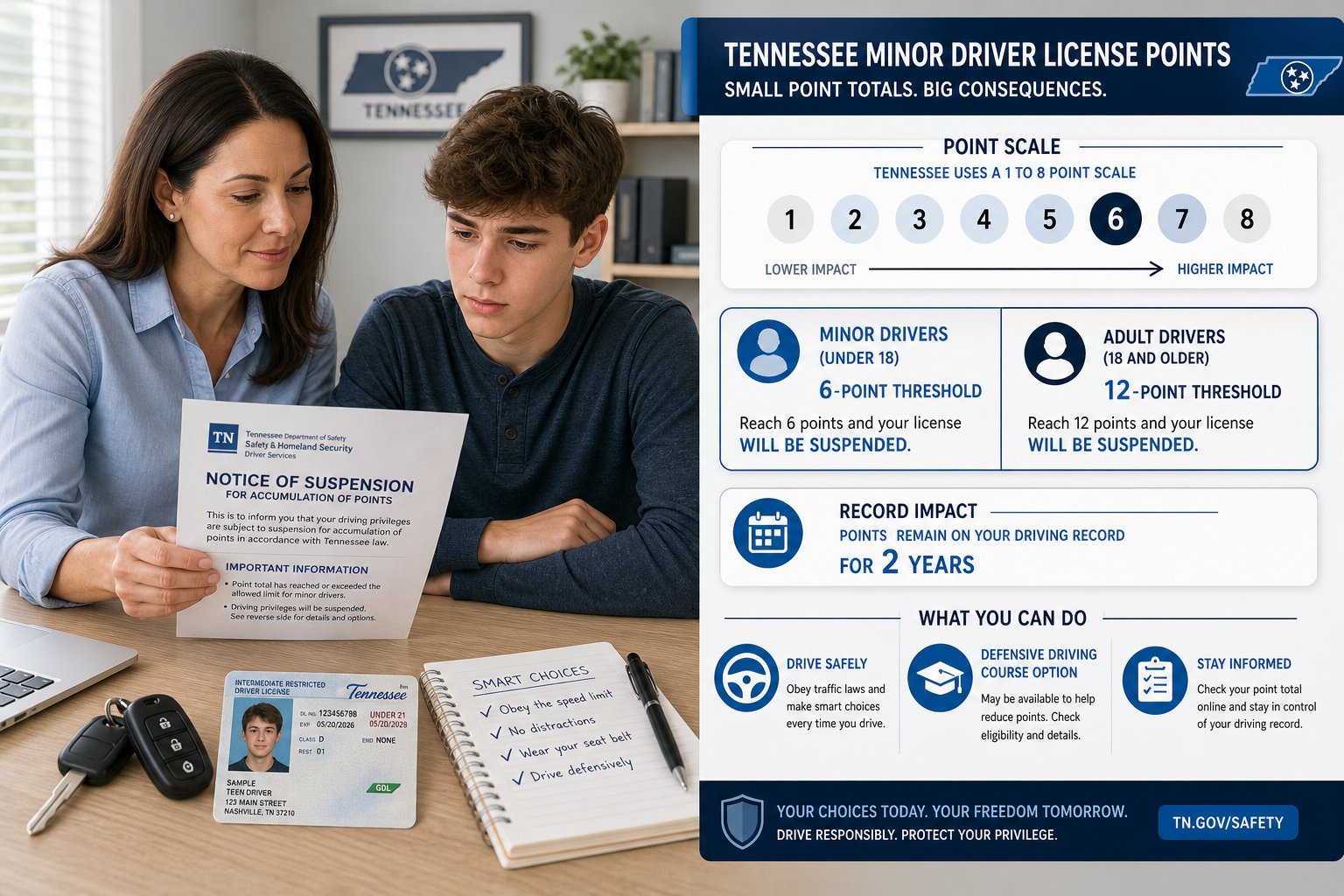
Tennessee minor driver license points work on the same basic 1 to 8 point scale used for adult moving violations. The big difference is what happens after the points add up. For most adults, TDOSHS looks closely at a 12-point threshold in a 12-month period. For minors, TDOSHS can begin the Driver Improvement Program process at 6 or more points in 12 months.
That lower limit matters a lot. A teen can reach it fast with only one serious ticket or a couple of smaller ones. For example, a phone-related offense or reckless driving can carry enough points to put an under-18 driver in a danger zone right away.
Here is the simple version:
- Adults: closer review at 12 points in 12 months
- Minors: proposed action at 6 points in 12 months
- Point scale: generally 1 to 8 points per violation
- Record impact: points stay on the driving record for 2 years
Once a minor reaches that lower threshold, TDOSHS may mail a notice of proposed suspension. Because the driver is under 18, a parent or guardian is also notified. The teen may need to complete a required step, such as a hearing process or a defensive driving course, depending on the case and the state’s instructions.
You can review the state’s licensing and safety rules through the Tennessee Department of Safety and Homeland Security. For under-18 drivers, the lesson is simple: small point totals are not small problems.
Common Violations That Add Points To A Teen’s Record
Many teen drivers assume only major offenses cause trouble. In Tennessee, that is not true. A few common tickets can build points accumulation faster than expected, especially when the suspension trigger for minors is only 6 points in 12 months.
Some examples often cited in Tennessee’s point system include:
- Speeding 1 to 5 mph over: 1 point
- Speeding 6 to 15 mph over: 3 points
- Speeding 16 to 25 mph over: 4 points
- Failure to obey traffic signals: 4 points
- Reckless driving: 6 points
- Cell phone use while driving under 18: 6 points
That last one stands out. For a minor, an under-18 phone violation can create the same kind of risk as a much more dramatic offense. One ticket may be enough to trigger a proposed suspension review.
Teens also need to think beyond points alone. A violation can affect insurance, cause court duties, and slow movement through Tennessee’s GDL system. And if a court gives directions on a citation, you should follow them exactly. Do not skip court dates, due dates, or required appearances.
If you want to check court-related information, use the Tennessee court system. For the legal framework behind traffic and licensing rules, Tennessee laws are published through the Tennessee Code Annotated resources.
When A Minor Can Lose Driving Privileges In Tennessee
A minor can lose driving privileges in Tennessee much sooner than an adult. The key trigger is 6 or more demerit points in 12 months. At that level, TDOSHS can begin the suspension process and send a notice of proposed suspension.
The notice is not something to ignore. It tells the driver what action TDOSHS plans to take and what steps may be available. For minors, the state also notifies a parent or guardian. That extra notice reflects the stricter under-18 rules.
What may happen next depends on the record and the violations involved. In many cases, the driver must deal with the Driver Improvement Program process. That can include:
- A hearing or review opportunity
- Required compliance steps from TDOSHS
- A possible defensive driving course
- A period of license suspension if problems continue
A suspension period is often described as 3 to 6 months in this kind of situation, and risk rises sharply at 10 or more points in 12 months. School-related issues can also affect a teen license in Tennessee, including certain attendance problems.
If a teen is close to suspension, an 8-hour TDOSHS-approved defensive driving course may be relevant in some near-suspension situations. A 4-hour course is more often tied to court-ordered ticket diversion. But whether any course will help depends on the exact case, the state order, and the court involved.
If you have a notice in hand, read it fully and act by the listed deadline.
How Long Points Stay On A Tennessee Driving Record
In Tennessee, points usually stay on a driving record for 2 years. That rule matters for teens because the under-18 point threshold is low, and old tickets do not disappear right away.
This creates a stacking problem. A teen might get one ticket, then another months later, and still have both count on the record. Even if the second violation seems minor, the combined total can push the driver into a proposed suspension situation.
There are two time frames to keep straight:
- 12 months: used for suspension review thresholds like 6 points for minors
- 2 years: how long points generally remain on the driving record
So, a ticket may stop counting toward a 12-month suspension total after enough time passes, but it can still remain visible on the record for longer. That can matter for licensing progress, record reviews, and other driving-related decisions.
Because records change over time, it is smart to check the current status through TDOSHS if you are unsure how many points are posted. Keep copies of citations, court papers, and any completion certificates. Small record mistakes are rare, but paperwork helps if you need to confirm what happened and when.
For teens trying to move up in the GDL system, keeping a clean record for the required period is often just as important as simply avoiding suspension.
License Stages, Required Documents, And Why GDL Rules Matter
Tennessee’s Graduated Driver License system adds another layer for young drivers. Even when a teen avoids suspension, points can still slow or block progress from one license stage to the next.
Here is the basic path:
- Learner Permit (age 15+): requires a parent or guardian signature, proof tied to financial responsibility, and school attendance proof: the permit must be held for at least 180 days
- Intermediate Restricted (age 16+): requires the permit for 180 days, supervised driving hours, and no 6 or more points in the last 180 days
- Intermediate Unrestricted (age 17+): requires holding the restricted license for 1 year, with limits tied to points, crashes, and certain belt violations
- Regular license: typically at 18, or sooner in some graduation or GED situations
This is why Tennessee under 18 license points are such a big issue. A teen may not lose the license right away, yet still fail to qualify for the next stage. That can mean more months under nighttime or passenger limits.
GDL rules matter because they are built around safe driving habits. A point total can show TDOSHS that the driver is not ready for fewer restrictions. And some offenses, like phone use or reckless driving, can raise both safety concerns and points accumulation at the same time.
If you need the official licensing details, check the TDOSHS driver license information.
Can Minors Reduce The Impact Of A Ticket Or Points?
Sometimes, yes, but the answer depends on the ticket, the court, and the driver’s record. Tennessee does have options that may reduce the impact in some cases, but there are no blanket promises.
One important rule is that paying a ticket before the due date may reduce assessed points in some situations. For example:
- A 2-point violation may be reduced by 1 point
- Other eligible violations may be reduced by 2 points
That does not mean every ticket gets reduced the same way. And paying a ticket can still count as admitting the violation, so read the citation and court instructions carefully.
A defensive driving course may also help in some cases. Tennessee commonly uses two course lengths:
- 4-hour course: often used for court-ordered ticket diversion
- 8-hour course: often used when TDOSHS requires action in a near-suspension situation
Still, whether a course can dismiss a ticket or reduce points depends entirely on the specific Tennessee court and case. Also, whether a court accepts online completion varies, so you should confirm with your Clerk of Court or judge before enrolling.
If you need a state-approved option, Driving Logic offers Tennessee defensive driving courses built for busy schedules and mobile access. You can review the available TennesDriving Logic.
FAQ
Can a Tennessee driver education course remove points?
No. A course does not automatically remove points or erase a conviction. It may help only when the court, TDOSHS, insurer, or notice accepts it for your situation.
How do I know what deadline applies?
Check the ticket, court order, TDOSHS notice, or insurer instructions. Those documents control your deadline and proof requirements.
Should I check my Tennessee driving record first?
Yes. Checking your record helps you understand points, convictions, and license status before choosing your next step.
Conclusion
Under-18 Tennessee drivers face a lower threshold than adults: 6 points in 12 months can trigger the Driver Improvement Program and a proposed suspension. Parents should monitor a teen’s record and respond to any TDOSHS notice quickly. The stricter limit leaves far less room for a second mistake.
Take the Tennessee defensive driving course when you are ready to get started.
Related Articles
- Tennessee Driver License Points System Explained
- How Long Do Points Stay on Your License in Tennessee?
- Tennessee Demerit Points Chart: How Many Points for Each Traffic Violation
- How Many Points Is a Speeding Ticket in Tennessee?
Sources
- Tennessee Department of Safety and Homeland Security
- Tennessee Department of Safety — Driver Services
- Tennessee Driver Services Online
- Tennessee Code — Motor and Other Vehicles
Billy Forte is the owner of Driving Logic, a state-approved driver improvement course provider serving Tennessee and other U.S. states. Driving Logic offers online driver education, defensive driving, and driver improvement courses for drivers handling court, state, insurance, and ticket-related requirements.
This article is general information, not legal advice. Tennessee court rules, TDOSHS rules, deadlines, insurance decisions, and case facts can differ. Use official Tennessee court and state sources for current requirements, and consult a qualified Tennessee attorney for legal guidance specific to your situation.