
Updated June 2026 · Reviewed by Billy Forte
Tennessee demerit points stay on your driving record for 2 years from the violation date. But for license suspension review, the Tennessee Department of Safety and Homeland Security (TDOSHS) mainly looks at your points accumulation in the past 12 months, so older points may still show on your record without counting toward the 12-point threshold. Adult drivers can face a notice of proposed suspension at 12 points in 12 months, while some drivers near suspension may be able to complete an 8-hour TDOSHS-approved defensive driving course within the required time frame.
This article covers Tennessee requirements only.
Key Facts
- Tennessee points: Traffic convictions can add points to a Tennessee driver license record.
- Deadlines matter: Court and TDOSHS notices control required deadlines.
- Course role: Driver education may help only when accepted for the situation.
- No erasure: A course does not erase old tickets, convictions, or points by itself.
- Check records: Verify your record and paperwork before choosing a next step.
How Long Tennessee License Points Stay on Your Record
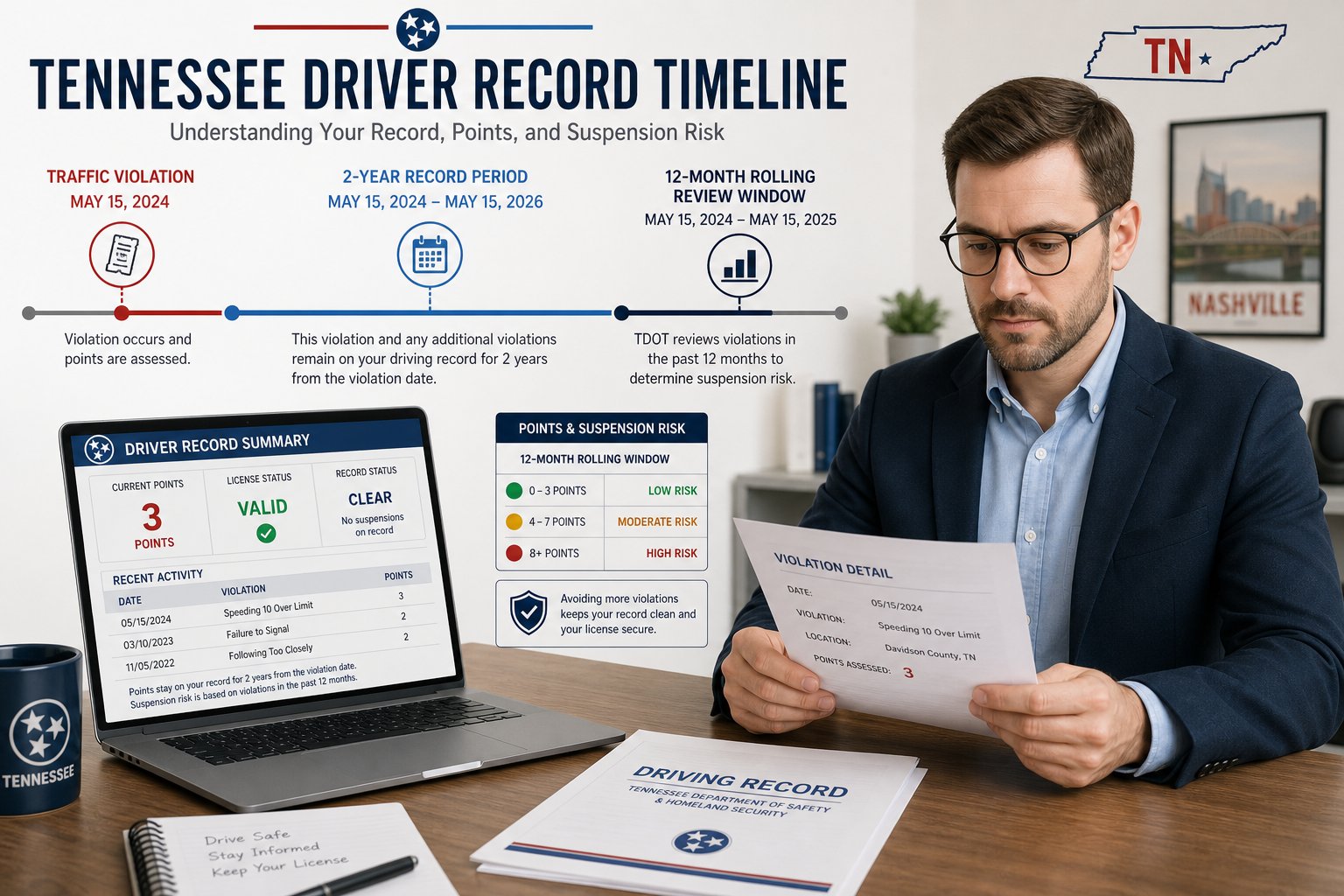
Tennessee license points stay on your record for 2 years. That is the short answer to how long do points stay on your license in TN.
The key date is the violation date, not the date you pay the ticket. If you got a moving violation on June 1, 2026, those demerit points usually remain on your Tennessee driving record until about June 1, 2028.
That said, there is an important second rule. TDOSHS uses a 12-month rolling window when it reviews points for suspension. So a ticket from more than 12 months ago may still appear on your record, but it usually does not count toward the current suspension trigger.
That difference matters a lot. Many drivers hear that points stay for 2 years and assume all 2 years count against them for a suspension. In Tennessee, that is not how the review works. The points can stay visible on your record for 2 years, while the suspension review focuses on the points you built up during the most recent 12 months.
You can check official rules through the Tennessee Department of Safety and Homeland Security. If you need a copy of your record, TDOSHS also provides ways to review your driving history.
If you are close to a suspension, do not guess about dates. Look at the violation dates for each ticket and match them against the last 12 months. That gives you a much clearer picture of your real risk.
How the Tennessee Driver License Point System Works
Tennessee uses a demerit point system to track moving violations and some crashes. Each traffic offense can add points to your driving record.
The more serious the offense, the more points you can get. Smaller violations may add only a few points. Riskier conduct, like reckless driving, can add more.
TDOSHS uses this system as part of its Driver Improvement Program. The main idea is simple: if you keep getting violations in a short time, the state may treat you as a higher-risk driver.
For most adult drivers, these are the main markers:
- 6 points in 12 months may trigger a warning or advisory
- 12 or more points in 12 months can lead to a notice of proposed suspension
- If you do not respond or request a hearing, your license can be suspended for 6 to 12 months
This is why the 12-month rolling window matters so much. Every new violation can push your total higher if it lands inside that same 12-month span.
You may also see references to Tennessee law in the Tennessee Code Annotated. And if your case involves a court date, records, or diversion option, check with your local Tennessee court system.
In plain terms, points are not just a line on paper. They are a warning sign that can affect your right to drive.
Common Traffic Violations and Their Point Values
Most Tennessee moving violations carry between 1 and 8 points. The exact number depends on the offense.
Common examples often include:
- Speeding
- Failure to signal
- Texting while driving
- Reckless driving
- Other moving violations tied to unsafe driving
Lighter offenses tend to bring fewer points. More serious conduct usually brings more. Tennessee uses these point values to measure driving behavior over time, not just one bad day.
For example, a single minor ticket may not put your license in danger. But several lower-point violations in one year can still create a real problem. That is why repeated speeding tickets are often more serious than drivers expect.
Point values can also matter when you decide how to respond to a citation. In some cases, a court may allow a class or another outcome. In other cases, it may not. Whether a defensive driving course can dismiss a ticket or reduce points depends on the specific Tennessee court and the facts of your case.
Also, if you are thinking about an online class, ask your court first. Some courts accept online completion, and some may not for your case type.
If you want the most accurate point impact, review the citation, your court notice, and TDOSHS information together. Small details can change the result.
What Happens When You Get Too Many Points
Too many points in a 12-month period can put your Tennessee license at risk. For adults, the big number is usually 12 points in 12 months.
When that happens, TDOSHS may send a notice of proposed suspension. That notice matters. It explains your next step, which may include the right to request an administrative hearing.
If you do nothing, Tennessee may suspend your driving privilege for 6 to 12 months. So if you get a notice, read it closely and follow every deadline.
License Suspension Risks for Adult Drivers and Minors
Adults and minors are not treated the same way. Tennessee uses stricter rules for drivers under 18.
For adult drivers:
- 6 points in 12 months may bring a warning or advisory
- 12 points in 12 months can trigger a proposed suspension
For drivers under 18:
- 6 or more points in 12 months can trigger a proposed suspension
- The driver may also be placed in the Driver Improvement Program
That lower limit for minors is important. A teen driver can face state action much faster than an adult driver.
And remember, the suspension review is tied to the past 12 months, not the full 2 years the points stay on the record. A ticket from 18 months ago may still appear on the record, but it usually no longer counts toward the current suspension threshold.
Can You Reduce Points or Clean Up Your Driving Record in Tennessee?
Sometimes, but not always. Tennessee does have options that may help in some cases, especially if you are close to a suspension.
One of the most important is the 8-hour TDOSHS-approved defensive driving course. Tennessee says some drivers who receive a suspension notice may avoid or reduce suspension by completing this school within 90 days of the notice. This option is generally limited to once every 5 years.
Tennessee also has a 4-hour defensive driving course in some court cases. That shorter class is often tied to court-ordered ticket diversion. But it is not the same as the 8-hour near-suspension course.
Here is the simple breakdown:
- 4-hour course: often used for court-ordered diversion
- 8-hour course: often used for TDOSHS near-suspension situations
- Court use and point impact depend on the case and court
Do not assume any course will dismiss your ticket, erase points, or satisfy a court. That depends entirely on your court, your citation, and the orders in your case.
If your court allows online completion, Driving Logic offers a flexible way to take a Tennessee defensive driving course on your own schedule. But before you enroll for a court matter, confirm acceptance with your Clerk of Court or judge first.
If you have a TDOSHS notice in hand, act fast and follow the deadline on the notice.
How to Avoid More Points and Protect Your License
The best way to protect your license is to stop points before they stack up. In Tennessee, several small tickets in one year can hurt more than many drivers think.
Start with basic habits:
- Obey speed limits
- Use your turn signals
- Do not text while driving
- Leave more space in traffic
- Watch school zones and work zones
Next, keep track of dates. Since Tennessee reviews points accumulation over a 12-month period, the timing of each ticket matters. Two tickets close together can be much worse than two tickets spread far apart.
If you get a citation or a notice of proposed suspension, respond on time. Do not miss a court date. Do not ignore a hearing deadline. And do not assume the problem will go away on its own.
If a court or TDOSHS allows a class, make sure you take the right one. The state may use an 8-hour course for near-suspension cases, while a court may order a 4-hour course for diversion. If you want a simple online option, you can review the Tennessee course from Driving Logic.
One last point: if you are asking how long do points stay on your license in Tennessee, remember both timelines. Points stay on your record for 2 years, but the suspension trigger looks at the last 12 months.
FAQ
Can a Tennessee driver education course remove points?
No. A course does not automatically remove points or erase a conviction. It may help only when the court, TDOSHS, insurer, or notice accepts it for your situation.
How do I know what deadline applies?
Check the ticket, court order, TDOSHS notice, or insurer instructions. Those documents control your deadline and proof requirements.
Should I check my Tennessee driving record first?
Yes. Checking your record helps you understand points, convictions, and license status before choosing your next step.
Conclusion
In Tennessee, points stay on your record for two years from the violation date, longer than many drivers expect. That timing means a single ticket can keep affecting your total well after you have paid it. Avoiding new violations is the only reliable way to let older points age off.
Take the Tennessee defensive driving course when you are ready to get started.
Related Articles
- Tennessee Driver License Points System Explained
- Tennessee Demerit Points Chart: How Many Points for Each Traffic Violation
- How Many Points Is a Speeding Ticket in Tennessee?
- How to Check Points on Your Tennessee Driver’s License
Sources
- Tennessee Department of Safety and Homeland Security
- Tennessee Department of Safety — Driver Services
- Tennessee Driver Services Online
- Tennessee Code — Motor and Other Vehicles
Billy Forte is the owner of Driving Logic, a state-approved driver improvement course provider serving Tennessee and other U.S. states. Driving Logic offers online driver education, defensive driving, and driver improvement courses for drivers handling court, state, insurance, and ticket-related requirements.
This article is general information, not legal advice. Tennessee court rules, TDOSHS rules, deadlines, insurance decisions, and case facts can differ. Use official Tennessee court and state sources for current requirements, and consult a qualified Tennessee attorney for legal guidance specific to your situation.