
Updated June 2026 · Reviewed by Billy Forte
In Tennessee, each moving violation adds 1 to 8 demerit points to your driving record, depending on the offense, and 12 points in 12 months can put your license at risk of suspension. For example, speeding 1 to 5 mph over adds 1 point, while speeding 46 mph or more over adds 8 points, and offenses like reckless driving or driving while suspended also carry high totals. The Tennessee Department of Safety and Homeland Security (TDOSHS) tracks these points under the state driver improvement system, and a conviction date usually controls when points count toward the 12-point threshold.
This article covers Tennessee requirements only.
Key Facts
- Tennessee points: Traffic convictions can add points to a Tennessee driver license record.
- Deadlines matter: Court and TDOSHS notices control required deadlines.
- Course role: Driver education may help only when accepted for the situation.
- No erasure: A course does not erase old tickets, convictions, or points by itself.
- Check records: Verify your record and paperwork before choosing a next step.
How The Tennessee Driver Points System Works
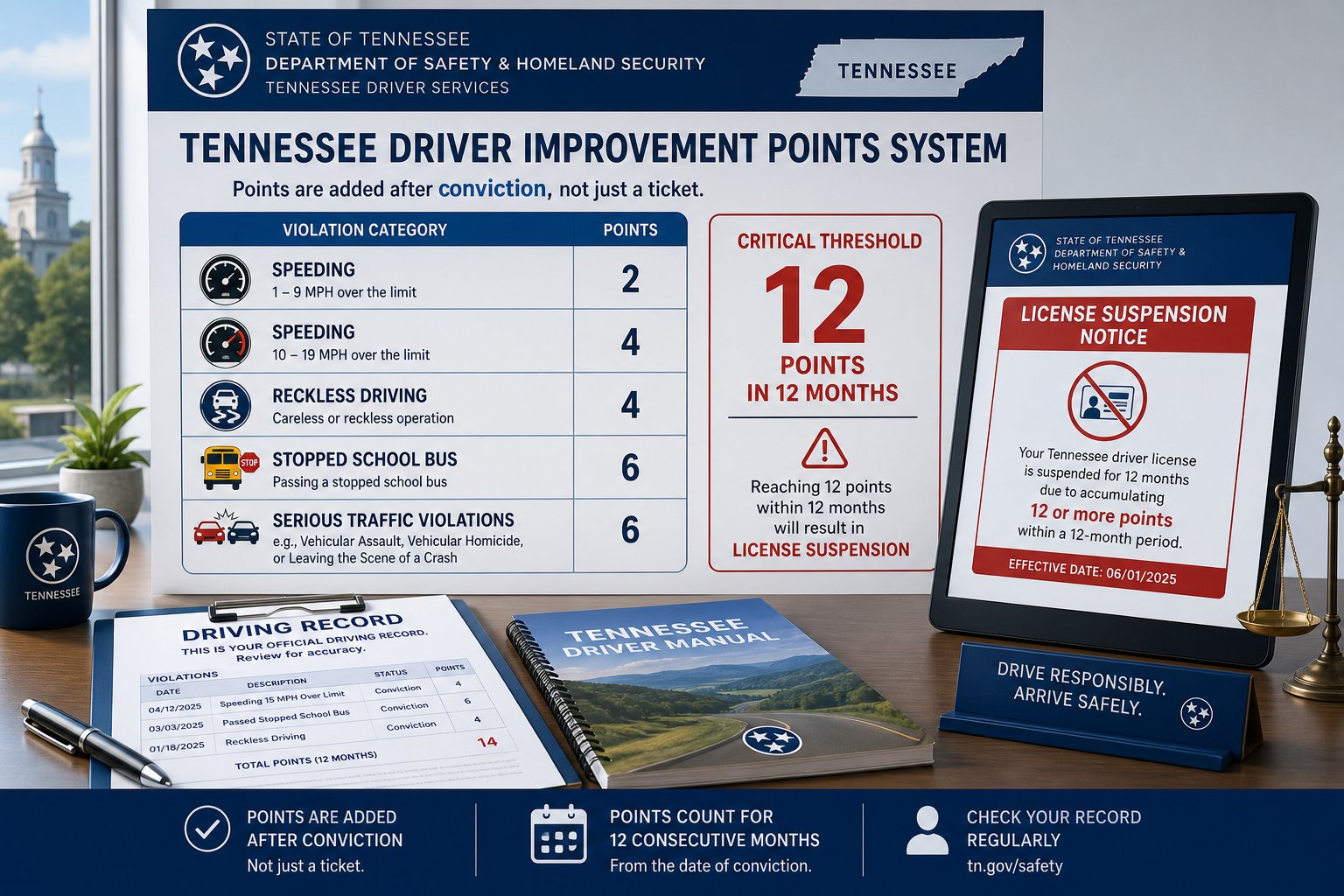
Tennessee uses a driver improvement points system to track unsafe driving. When you are convicted of a moving violation, TDOSHS adds points to your driving record. Parking tickets and most other non-moving violations do not add points.
The key number is 12 points in 12 months. If your points accumulation reaches that level, TDOSHS can send a notice of proposed suspension. That notice explains your right to request an administrative hearing before a suspension takes effect.
Points are based on the type of violation. Lower-level speeding can add just 1 point. More serious conduct, such as passing a stopped school bus, reckless driving, or causing a fatal crash, can add much more.
Tennessee’s point system is tied to the state’s driver improvement rules. The schedule appears in Tennessee regulations, and related suspension rules are enforced by the Tennessee Department of Safety and Homeland Security. You can also review Tennessee law through the Tennessee Code Annotated and court information from the Tennessee court system.
One important detail: points are generally triggered by a conviction, not just by getting a ticket. So if your case is changed by the court, the final outcome matters more than the charge written on the citation.
Tennessee Driving Points Chart By Violation
Here is the core Tennessee driving points chart many drivers need when checking their risk level. These are common point values used under Tennessee’s driver improvement rules:
- 1 point: speeding 1 to 5 mph over
- 3 points: speeding 6 to 15 mph over
- 3 points: following too closely
- 3 points: improper turn
- 3 points: failure to signal
- 3 points: cell phone use in a covered traffic offense context
- 4 points: speeding 16 to 25 mph over
- 4 points: careless or negligent driving
- 4 points: failure to yield
- 4 points: improper passing
- 5 points: speeding 26 to 35 mph over
- 5 points: leaving the scene
- 6 points: speeding 36 to 45 mph over
- 6 points: reckless driving
- 6 points: failure to yield to an emergency vehicle
- 8 points: speeding 46+ mph over
- 8 points: passing a school bus
- 8 points: driving while suspended
- 8 points: violation tied to a fatal crash
Even a few mid-level tickets can add up fast. Two 6-point convictions within a year can put you at the 12-point threshold.
Common 3- To 4-Point Violations
The most common range on a Tennessee traffic violation points chart is 3 to 4 points. That matters because these are the tickets many drivers pick up during normal commuting.
A typical 3-point violation includes speeding 6 to 15 mph over, following too closely, improper turns, and failure to signal. A cell phone use offense can also fall in this range when it is recorded as a moving violation under the driver improvement system.
Common 4-point violations include speeding 16 to 25 mph over, careless or negligent driving, failure to yield, and improper passing. These are not the highest-point offenses, but they can still create a real suspension risk if you already have points on your record.
For example, a 4-point speeding ticket plus a 4-point failure-to-yield case plus a 4-point improper passing case would already total 12 points in a year.
Common 5- To 8-Point Violations
Higher-point violations create the fastest path to a suspension notice. These offenses signal more serious risk in the eyes of the state.
A 5-point offense includes speeding 26 to 35 mph over and leaving the scene. A 6-point offense includes speeding 36 to 45 mph over, reckless driving, and failure to yield to an emergency vehicle.
The top range is 8 points. That includes speeding 46 mph or more over, passing a stopped school bus, driving while suspended, and certain violations tied to a fatal crash.
You do not need many of these convictions to reach the danger zone. One 8-point offense and one 4-point offense in the same 12-month period can trigger a notice of proposed suspension from TDOSHS.
What Happens When You Accumulate Too Many Points
If you accumulate 12 or more points in 12 months, TDOSHS can begin the license suspension process. The agency usually sends a notice of proposed suspension to the address on your driving record.
That notice is important. It explains the action TDOSHS plans to take and tells you whether you can request a hearing. If you do not respond by the deadline in the notice, a suspension may be imposed without you presenting your side.
For many adult drivers, the main trigger is the 12-point threshold. Some drivers may receive warning or advisory contact before that point, especially when they are trending toward suspension.
For drivers under 18, the rules can be stricter. Juvenile drivers may face action at lower totals and may be placed into a driver improvement process with a parent or guardian involved.
Possible outcomes after too many points can include:
- Administrative hearing
- Probation or restrictions in some cases
- Suspension for 6 to 12 months
- Requirement to complete defensive driving
If you receive a notice, read it closely and follow every deadline. You can also check court information through the Tennessee court system and license information through TDOSHS.
How Long Points Stay On Your Tennessee Driving Record
In Tennessee, demerit points stay on your driving record for 2 years from the date of conviction. That means old cases can continue to affect your points accumulation for quite a while.
This 2-year period matters for two reasons. First, points can push you toward the 12-point threshold during that window. Second, even if you avoid suspension, your driving history may still show a pattern of recent violations.
The clock usually runs from the conviction date, not from the date you were stopped. So if a case is delayed in court, the timing may be different than you expect.
A simple example helps. If you are convicted of a 4-point violation in June and another 8-point violation the next March, both can count together because they fall within a 12-month period. Then the earlier points may remain on your record for the rest of their full 2-year life.
If you want to see what is already posted, you can request your Tennessee driving history through TDOSHS records services. Check it carefully so you know your current total.
How To Avoid Or Reduce The Impact Of Points
You cannot erase a valid conviction just by waiting a few weeks, but you may have options to reduce the impact of points depending on your court, your record, and the stage of the case. In Tennessee, the details matter.
One option is a defensive driving course. Tennessee drivers may see two common formats:
- 4-hour course: often used for court-ordered ticket diversion
- 8-hour course: often used when TDOSHS is dealing with a near-suspension or driver improvement situation
But there is a big warning here: a course does not automatically dismiss a ticket or remove points. Whether a class helps depends on the specific Tennessee court and case. And if you want to take a class online, confirm with your court first, because online acceptance varies.
If you are trying to meet a court or state requirement, Driving Logic’s Tennessee defensive driving course is built for busy drivers who want a flexible online option on any device.
Other possible steps may include:
- Requesting an administrative hearing after a notice of proposed suspension
- Paying close attention to court deadlines and orders
- Driving violation-free until older points age off
- Checking whether your Clerk of Court or judge allows a course in your case
For the official rules, review TDOSHS materials and the Tennessee regulations behind the driver improvement system.
FAQ
Can a Tennessee driver education course remove points?
No. A course does not automatically remove points or erase a conviction. It may help only when the court, TDOSHS, insurer, or notice accepts it for your situation.
How do I know what deadline applies?
Check the ticket, court order, TDOSHS notice, or insurer instructions. Those documents control your deadline and proof requirements.
Should I check my Tennessee driving record first?
Yes. Checking your record helps you understand points, convictions, and license status before choosing your next step.
Conclusion
Tennessee assigns points by offense — roughly 1 to 8 — and serious violations like reckless driving carry enough to push you toward state action fast. Use the chart as a guide, but confirm the exact points posted to your own record. Two or three moderate tickets can add up faster than you think.
Take the Tennessee defensive driving course when you are ready to get started.
Related Articles
- Tennessee Driver License Points System Explained
- How Long Do Points Stay on Your License in Tennessee?
- How Many Points Is a Speeding Ticket in Tennessee?
- How to Check Points on Your Tennessee Driver’s License
Sources
- Tennessee Department of Safety and Homeland Security
- Tennessee Department of Safety — Driver Services
- Tennessee Driver Services Online
- Tennessee Code — Motor and Other Vehicles
Billy Forte is the owner of Driving Logic, a state-approved driver improvement course provider serving Tennessee and other U.S. states. Driving Logic offers online driver education, defensive driving, and driver improvement courses for drivers handling court, state, insurance, and ticket-related requirements.
This article is general information, not legal advice. Tennessee court rules, TDOSHS rules, deadlines, insurance decisions, and case facts can differ. Use official Tennessee court and state sources for current requirements, and consult a qualified Tennessee attorney for legal guidance specific to your situation.