
Updated October 2026 · Reviewed by Billy Forte
How many points is a speeding ticket in tn? In a car, it is 1 to 8 points, based on how far over the limit you were. Work zone tickets carry higher values, and 12 or more points in any 12 months brings an adult a notice of proposed suspension.
Key Facts
- Car values: 1, 3, 4, 5, 6 or 8 points, rising with your speed over the limit. See points by mph over.
- Work zones: each band is higher, from 2 to 8 points. See work zone speeding.
- Adding up: two speeding tickets can reach the adult limit of 12 points. See how tickets add up.
- Paying counts: paying the fine is a conviction, so the points apply. See points come from the conviction.
- Point removal: a course within 90 days of the conviction can remove up to 5 points, once in four years. See removing speeding points.
How Many Points Is a Speeding Ticket in TN by MPH Over?
The Tennessee Department of Safety and Homeland Security (TDOSHS) sets the values on its Schedule of Points Values. For speeding, the number depends on how many miles per hour over the limit you were.
| Miles over the limit | Points in a car | Points in a work zone |
|---|---|---|
| 1-5 mph | 1 | 2 |
| 6-15 mph | 3 | 4 |
| 16-25 mph | 4 | 5 |
| 26-35 mph | 5 | 6 |
| 36-45 mph | 6 | 8 |
| 46 mph or more | 8 | 8 |
In a work zone, the top band starts at 36 mph over, so 36-45 and 46 or more are both 8 points. The car values apply to a regular, non-commercial vehicle.
When Your Speed Is Not on the Ticket
Some tickets or court reports do not list your speed. For a car, the Schedule gives these “speed not indicated” cases 3 points. That is the same as the 6-15 mph band.
The Speed Limits Behind the Bands
The bands count miles over the posted limit. Under TCA 55-8-152(a), the general limit is 65 mph. On controlled-access state highways with 4 or more lanes, it is 70 mph (TCA 55-8-152(c)).
So 80 mph in a 70 mph zone is 10 over, which is 3 points in a car. The same 80 mph in a 65 mph zone is 15 over, still 3 points.
Work Zone Speeding
The Schedule has a separate set of values for construction zones. Every band is higher than the car value, except at the top, where both reach 8.
Work zones also bring a higher fine. Under TCA 55-8-152, speeding in a work zone when workers are present is a Class B misdemeanor with a fine of $250 to $500. Court costs are set by each court.
Some special residential zones have their own fine. Under TCA 55-8-152, speeding there is a Class C misdemeanor with a fine of $200.
Outside work zones and those special residential zones, speeding is a Class C misdemeanor (TCA 55-10-301(a)). That carries up to 30 days and/or up to $50 (TCA 40-35-111).
Commercial Vehicles
Commercial vehicles have their own speeding values on the Schedule, and they differ from the car values. If you were driving a commercial vehicle, use that section of the Schedule.
Federal rules add a separate layer for commercial license holders. Under 49 CFR 383.51, speeding 15 mph or more over the limit is a serious traffic violation. Two in 3 years means a 60-day disqualification, and three means 120 days.
In a personal vehicle, that rule applies only if the conviction leads to a suspension, revocation or cancellation. Tennessee’s court course option also does not apply to Class A, B or C license holders (TCA 55-10-301(c)).
How Tickets Add Up
Each speeding conviction adds its value to your record. TDOSHS then looks at totals within any 12-month period.
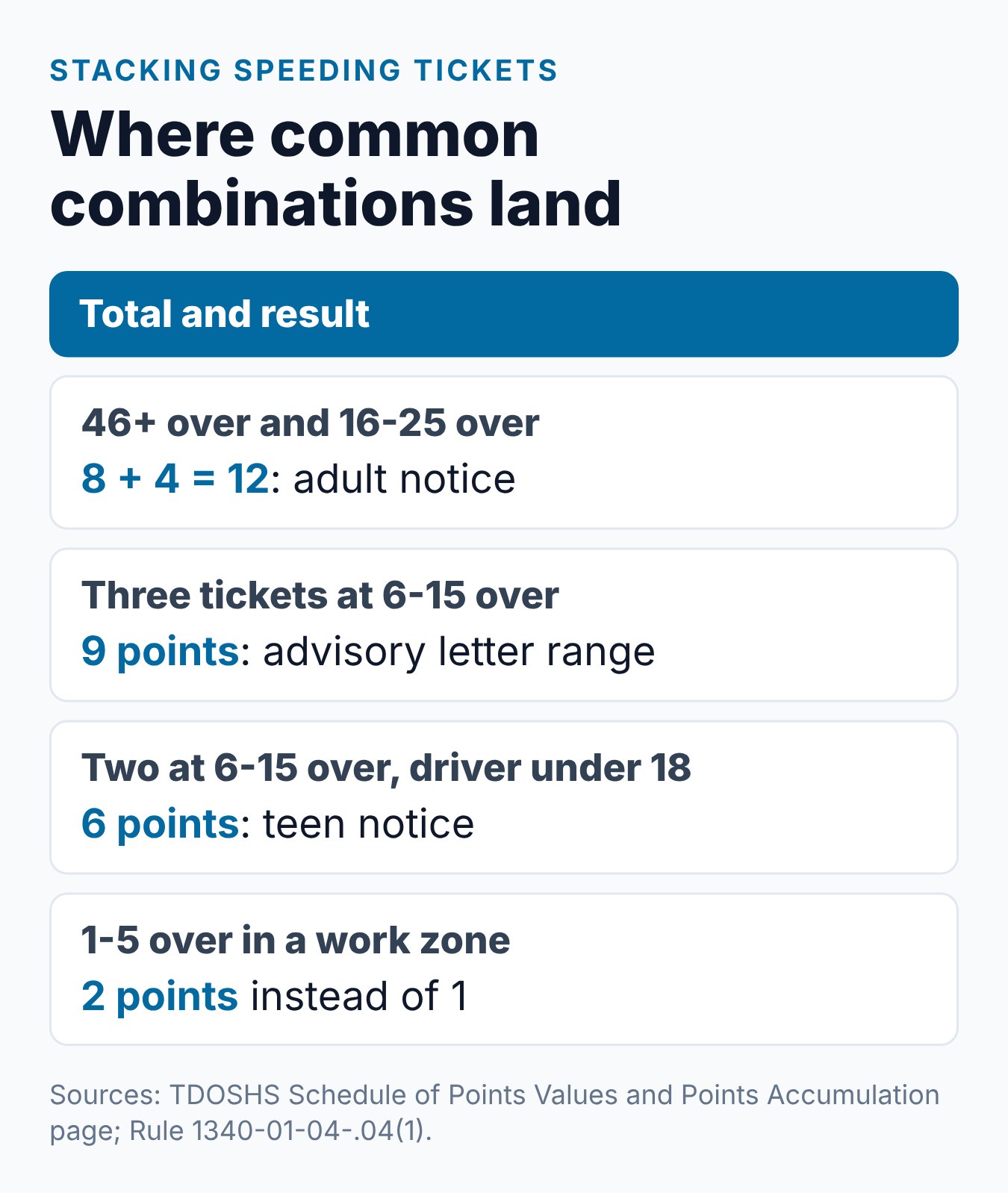
Here is how speeding tickets can stack, using only Schedule values:
- 46 mph or more over (8) plus 16-25 mph over (4): 12 points, the adult limit.
- Three tickets at 6-15 mph over (3 each): 9 points, in the adult advisory letter range of 6 to 11.
- Two tickets at 6-15 mph over for a driver under 18: 6 points, the teen limit.
At 12 or more points in any 12 months, the Points Accumulation page says adults are “sent a notice of proposed suspension and given an opportunity to attend an administrative hearing.” It is not an automatic suspension.
Under Rule 1340-01-04-.04(6), each new posting starts a 24-month look back for 12 points within any 12-month period. Our guide to license suspension for points covers what happens after a notice.
Teens and Speeding Points
Speeding points hit drivers under 18 harder. With fewer than 6 points, TDOSHS sends a warning letter, and a copy goes to a parent or guardian. At 6 or more points in any 12 months, the teen gets a notice and a hearing that a parent or guardian attends.
The intermediate license has its own rule. Under TCA 55-50-311, 6 or more points after the intermediate license is issued means 90 more days before applying for an unrestricted license. A second moving violation means a certified driver education course first.
Our guide to minor driver license points covers the teen rules in full.
Points Come From the Conviction
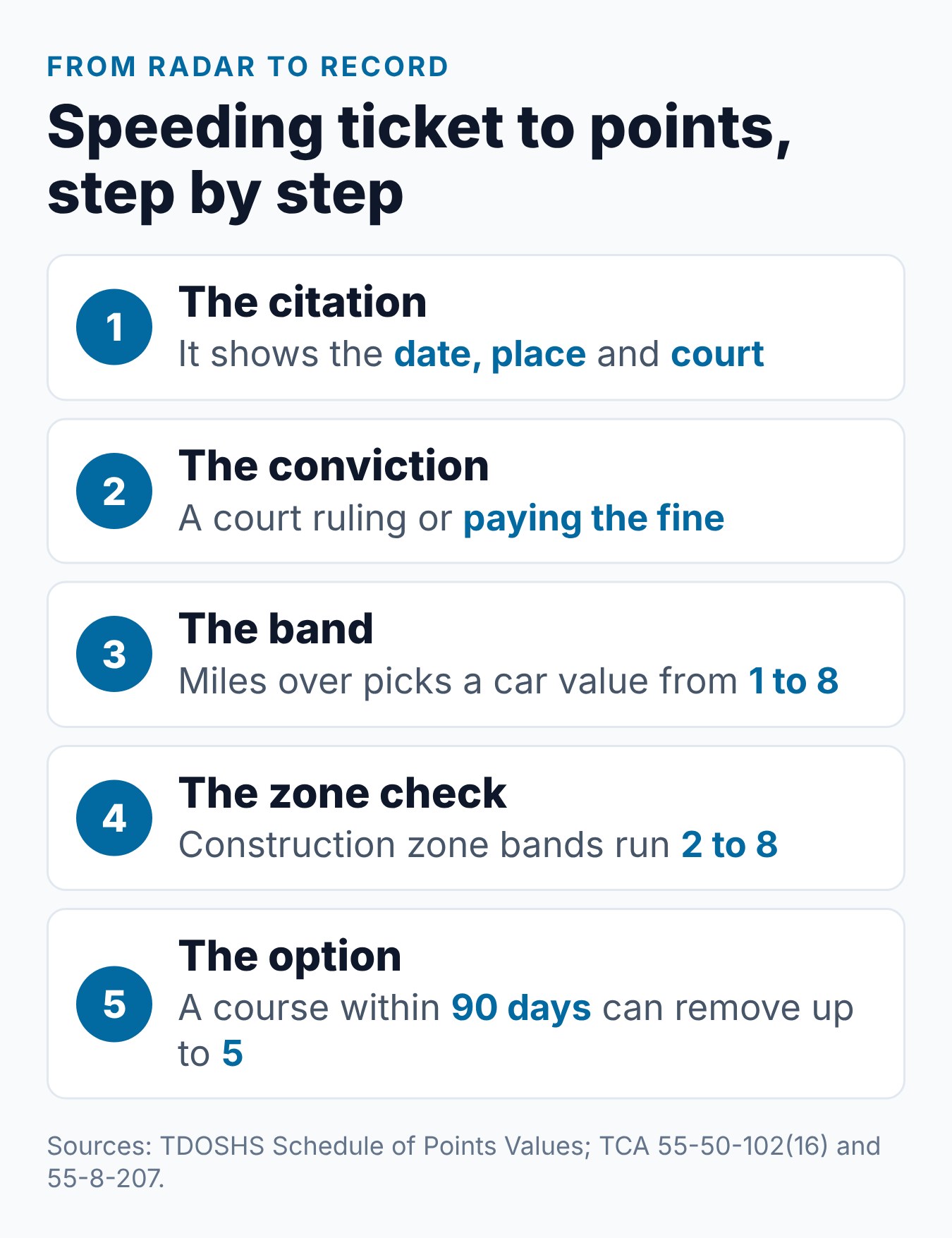
Points go on your record after a conviction, not when the ticket is written. Under TCA 55-50-102(16), “the payment of a fine or court cost” counts as a conviction.
With the court’s approval, you may pay the fine and costs to the court clerk instead of going to court (TCA 55-10-207(f)). That payment is still a conviction, and the speeding points apply.
If you neither pay nor appear, the court may issue an arrest warrant or declare a judgment of forfeiture (TCA 55-10-207(g)). For questions about your own ticket, ask the court clerk on your citation or a Tennessee attorney.
Removing Speeding Points
Speeding is the one violation where Tennessee lets you remove points. Under TCA 55-8-207, finish a department-approved course within 90 days of the speeding conviction, and the points for that conviction come off, up to 5 points.
The rule applies to one speeding offense per course and only once in a four-year period. The TDOSHS Traffic School page says, “Only the points will be removed, the conviction will remain.”
That page uses a 4-hour Driver Education Course. A careless driving conviction, for example, gets no point removal under this rule.
Providers must send certificates of completion to TDOSHS within 30 days. The rule covers speeding only.
Paying and Registering Since July 1, 2026
Public Chapter 993 took effect on July 1, 2026. A person who pays a speeding ticket instead of appearing may also register for a department-approved course.
TDOSHS has to make these courses available on its website. The same 90-day and 5-point limits from TCA 55-8-207 still apply. Our guide on removing points covers every limit.
The 8-Hour Class Is a Different Step
If speeding tickets push an adult to 12 points, a hearing may follow. TDOSHS says that “In most cases” a driver at the hearing may take a defensive driving class “in lieu of suspension or a reduction of suspension time.”
That 8-hour class is part of the TDOSHS Driver Improvement Program. It must be done within 90 days of the letter or hearing, and it counts once every 5 years.
The 8-hour class does not remove points. Instead, 12 months of probation follow it. The Defensive Driving Schools page says “Live-stream classes are now approved.”
Checking Your Speeding Points
Your driving record shows your convictions. Order your MVR from TDOSHS for $5 online, in person or by mail. Then match each speeding conviction to its band on the Schedule.
Our guide on how to check points covers each way to order it.
What We Found on the Official Pages
On the TDOSHS pages we checked on October 27, 2026, the speeding values matched the Schedule last modified on August 12, 2025. The Schedule words each band as miles “in excess of speed zone.” The work zone section uses “in excess of posted speed.”
The Points Accumulation page, updated July 20, 2026, still gives the adult limit as 12 points “within any 12-month period.” Neither page lists a speed at which speeding stops being scored by band.
Common Mistakes
Each item below is checked against the TDOSHS Schedule or Tennessee law:
- Using one value for every speeding ticket. The points rise with your speed over the limit.
- Using car values in a work zone. Work zone bands are higher.
- Thinking paying keeps points off. Paying the fine counts as a conviction.
- Waiting too long for the course. It must be done within 90 days of the conviction.
- Counting on a full reset for an 8-point ticket. The cap is 5 points per course.
- Taking the course twice in four years. Point removal works once in a four-year period.
How Requirements Can Vary
Tennessee point values, the Driver Improvement Program and the speeding point-removal rule come from state law and TDOSHS rules (TCA 55-50-505, TCA 55-8-207 and Rule 1340-01-04) and apply statewide. Whether a court orders a course for your ticket, which course it orders, and how your case is handled are up to the court on your ticket or the TDOSHS letter you received. Fines and court costs depend on the court and the charge.
Laws, rules and court practice can change. Check your ticket, any court order or TDOSHS letter, the TDOSHS website and the Tennessee Code before you enroll or pay.
Frequently Asked Questions
How many points is 10 mph over in Tennessee?
Speeding 10 mph over falls in the 6-15 mph band. That is 3 points in a car and 4 points in a work zone.
How many points is 5 mph over in Tennessee?
Speeding 1-5 mph over is 1 point in a car. That is the lowest speeding value on the Schedule. In a work zone, the same band is 2 points.
How many points is 20 mph over in Tennessee?
Speeding 20 mph over falls in the 16-25 mph band. That is 4 points in a car and 5 in a work zone.
How many speeding tickets lead to a suspension notice?
It depends on the points, not the number of tickets. Adults get a notice at 12 or more points in any 12 months, so two tickets at 8 and 4 points can reach it. Drivers under 18 get a notice at 6 points.
Can a course take speeding points off my record?
Yes, within limits. A department-approved course finished within 90 days of the speeding conviction removes that conviction’s points, up to 5, once in a four-year period. The conviction stays on your record.
Does paying a speeding ticket add points?
Yes. Paying the fine or court costs counts as a conviction under TCA 55-50-102(16), so the Schedule value applies. Since July 1, 2026, a person who pays may also register for a department-approved course.
Does a court-ordered course remove speeding points?
Point removal comes from TCA 55-8-207, not from the court. A court may require a course “in addition to or in lieu of any portion of other penalty imposed,” and the court decides what that means. Ask the court clerk about your own case.
Is speeding a crime in Tennessee?
Speeding is a Class C misdemeanor (TCA 55-10-301(a)). Outside special zones, the maximum is up to 30 days and/or up to $50 (TCA 40-35-111). Work zone speeding with workers present is a Class B misdemeanor with a fine of $250 to $500.
Conclusion
A Tennessee speeding ticket adds 1 to 8 points in a car, more in a work zone, and those points count toward 12 in any 12 months for adults. Order your MVR to see your convictions, and read any TDOSHS letter with care. To have up to 5 points removed for one speeding conviction under TCA 55-8-207 (once in four years), the course must be on the TDOSHS 4-hour list and finished within 90 days of the conviction. Take the Tennessee Driver Education Course online if that fits your case.
Related Articles
- Tennessee Points on License: How the System Works
- Tennessee Demerit Points Chart: How Many Points for Each Traffic Violation
- How to Remove Points From License in TN: What the Law Allows
- How Many Points to Suspend License in TN? What Happens
Sources
- TDOSHS — Schedule of Points Values
- TDOSHS — Driver Improvement (Points Accumulation)
- TDOSHS — Traffic School: How to Remove Points (4-Hour)
- Tennessee Public Chapter No. 993 (2026) — Driver courses for speeding (PDF)
- Tennessee Rule Chapter 1340-01-04 — Tennessee Driver Improvement Program (PDF)
- TDOSHS — Defensive Driving Schools (8-Hour Driver Improvement)
- 49 CFR § 383.51 — Disqualification of drivers
Billy Forte is the owner of Driving Logic, an online driver education course provider serving Tennessee and other U.S. states.
This article is general information, not legal advice. Tennessee course rules, point values, fines and penalties depend on your ticket, court, TDOSHS notice and case facts, and they can change. Use official TDOSHS, Tennessee Code and court sources, and consult a qualified Tennessee attorney for advice about your own case.