
Updated June 2026 · Reviewed by Billy Forte
No, a Tennessee defensive driving course does not automatically remove points from your license record. In Tennessee, demerit points stay on your driving record for two years, and whether a court-ordered class leads to any point reduction depends on the specific court and your case. But if TDOSHS says you are near or over the 12-point threshold, an approved 8-hour course may help you avoid a license suspension after a hearing, which is different from taking points off your record.
This article covers Tennessee requirements only.
Key Facts
- Tennessee points: Traffic convictions can add points to a Tennessee driver license record.
- Deadlines matter: Court and TDOSHS notices control required deadlines.
- Course role: Driver education may help only when accepted for the situation.
- No erasure: A course does not erase old tickets, convictions, or points by itself.
- Check records: Verify your record and paperwork before choosing a next step.
How Tennessee’s Driver License Point System Works
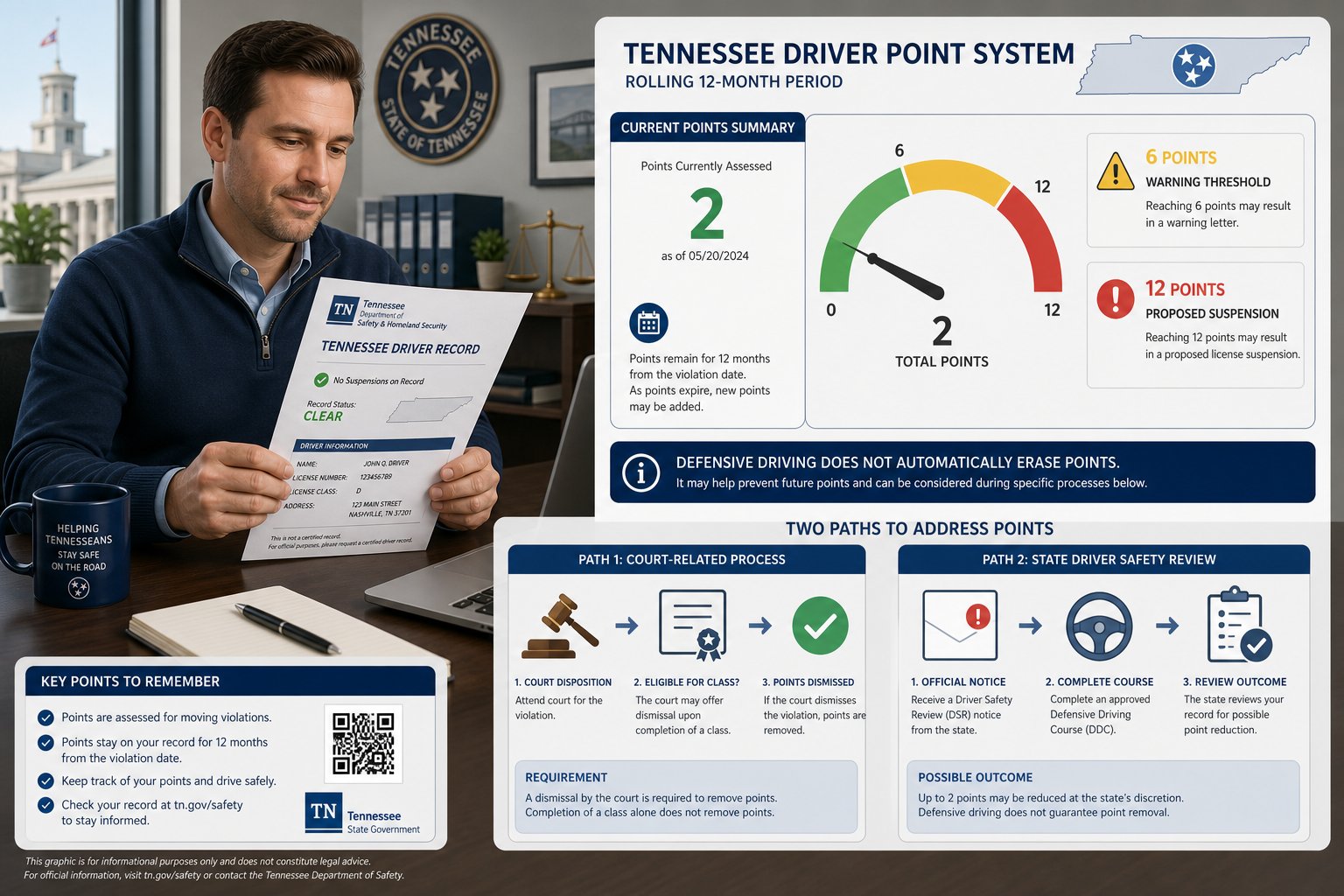
Tennessee uses a driver improvement point system to track moving violations. Each traffic offense carries a set number of demerit points, and the Tennessee Department of Safety and Homeland Security (TDOSHS) watches your points accumulation over any rolling 12-month period.
Here is the key rule: for most adult drivers, 6 points in 12 months can trigger a warning letter. Once you reach 12 or more points in 12 months, TDOSHS can send a notice of proposed suspension and offer you a chance for a hearing.
That point matters because many drivers search for tennessee defensive driving points hoping a class will erase the record. Usually, it does not work that way. A traffic school or defensive driving course is not the same as automatic point removal.
Instead, Tennessee handles this in two different lanes:
- Court side: A judge may order a 4-hour or 8-hour class as part of a case outcome.
- TDOSHS side: The state may require or allow an 8-hour defensive driving course when your point total puts you close to suspension.
If your issue is with a traffic ticket, check with the Clerk of Court or the court named on your citation. If your issue is a state warning or suspension notice, review the instructions from TDOSHS closely. Those are separate processes, and the outcome can differ.
Common Tennessee Violations and Their Point Values
Point values depend on the offense. Tennessee assigns different totals to different moving violations, and the exact schedule can be found through state law and TDOSHS materials.
A few common examples include:
- Speeding: often 1 to 8 points, based on how far over the limit you were
- Speeding 16 to 25 mph over: commonly 4 points
- Reckless driving: 6 points
- At-fault crashes: may also add points
- Other moving violations: point values vary by offense
That range is why one ticket may not affect you much, while a second or third one can quickly create a problem. A reckless driving charge, for example, carries enough points to put an adult driver straight into warning territory.
If you want the legal framework, Tennessee point rules connect back to the Tennessee Code Annotated. You can review Tennessee statutes through TCA resources and state court information through the Tennessee court system.
If a court tells you to complete traffic school after a citation, do not assume that means your points disappear. Whether a Tennessee defensive driving course helps with points depends on the specific court order or TDOSHS action. Always confirm the exact result before you enroll.
How Long Points Stay on Your Tennessee Driving Record
In Tennessee, points stay on your driving record for two years. That is longer than many drivers expect.
This means even if one ticket seems minor, it can still affect your total for a long time. And because TDOSHS reviews your record based on point totals within a 12-month period for suspension purposes, an older violation can still matter in one context while remaining visible on your record in another.
This is where confusion often starts. Some people hear that a class can “help with points” and assume the points vanish. In most cases, that is not accurate. The record still shows the violation and the associated point history for the period set by the state unless a court or agency takes a specific action.
So what can a class actually do?
- It may satisfy a court order
- It may support a diversion or probation outcome, if the court allows that
- It may help in a TDOSHS administrative process near suspension
- It does not automatically erase demerit points
If you are unsure what is on your record, get your Tennessee driving history and compare it with any court paperwork or notice from TDOSHS. That gives you the clearest answer on where you stand.
What Happens If You Get Too Many Points
If you get too many points, Tennessee can move from warning letters to a proposed suspension. For adults, 6 to 11 points in 12 months usually leads to an advisory notice. At 12 or more points in 12 months, TDOSHS can issue a notice of proposed suspension and offer a hearing.
If a suspension is imposed, it is often in the 6- to 12-month range. The exact result depends on the record and the hearing outcome.
This is one of the few places where an approved course can make a major difference. In a TDOSHS driver improvement case, an 8-hour defensive driving course may be used as part of the process to avoid suspension or shorten the impact, depending on what the department allows. That is very different from saying the class removes points.
You should read the notice carefully and follow every deadline. Do not skip a hearing request, ignore mail from TDOSHS, or miss a completion deadline if a course is offered as part of the solution.
Adults vs. Minors: How Point Consequences Can Differ
The rules are stricter for minors. Drivers under 18 can face a notice of proposed suspension at 6 or more points in 12 months, not 12. They may also be placed in the Driver Improvement Program and required to complete defensive driving.
If a minor fails to appear or fails to meet the requirement, the state can impose a 6-month suspension. Adults and minors are not treated the same, so age matters a lot in Tennessee driver improvement points cases.
When Defensive Driving or Traffic School May Be Required
A Tennessee defensive driving course may be required by a court or by TDOSHS, but the reason matters. Tennessee commonly uses two course lengths:
- 4-hour course: often used for court-ordered traffic school or ticket diversion
- 8-hour course: often used for TDOSHS driver improvement or near-suspension cases
If a court orders a 4-hour class, the outcome depends on that court and your case. Some courts may allow a dismissal, some may reduce consequences, and some may simply require the course as part of probation or compliance. Never assume point reduction or dismissal. Also, confirm with your specific court whether online completion is accepted before you sign up.
If TDOSHS sends a notice tied to the 12-point threshold, the 8-hour course may help you keep your license from being suspended after the administrative process. In some cases, drivers are told to complete the course within 90 days, and credit may be limited to once every five years.
If you need a state-approved option, Driving Logic’s Tennessee defensive driving course is built for busy drivers who want to complete the required material on their own schedule. Still, you should confirm whether you need the 4-hour or 8-hour version and who must receive the certificate.
What to Expect From an Online Tennessee Defensive Driving Course
An online Tennessee defensive driving course is usually made for flexibility. You log in from your phone, tablet, or computer, work through the lessons, and the system saves your progress if you stop and return later.
Many Tennessee programs are offered in 4-hour and 8-hour formats. The shorter one is often used for court matters. The longer one is more common in TDOSHS point or suspension-related situations.
A typical course includes:
- short reading sections or modules
- quizzes during the course
- a final exam
- a completion certificate
Some providers use a final test of about 20 questions and require a passing score such as 80%, sometimes with more than one attempt allowed. Exact rules depend on the provider and the program approval.
After you finish, you usually receive a certificate to send to the court, the Clerk of Court, or TDOSHS. Pay close attention to deadlines in your paperwork. Missing the deadline can cancel the benefit of taking the class at all.
Before you enroll, verify three things:
- Which course length you need
- Whether your court accepts online completion
- Where your certificate must be sent
If you are trying to address a warning, a court order, or a notice of proposed suspension, getting the right course matters more than finishing fast. You can review your options and start with Driving Logic once you confirm your exact Tennessee requirement.
FAQ
Can a Tennessee driver education course remove points?
No. A course does not automatically remove points or erase a conviction. It may help only when the court, TDOSHS, insurer, or notice accepts it for your situation.
How do I know what deadline applies?
Check the ticket, court order, TDOSHS notice, or insurer instructions. Those documents control your deadline and proof requirements.
Should I check my Tennessee driving record first?
Yes. Checking your record helps you understand points, convictions, and license status before choosing your next step.
Conclusion
Defensive driving rarely erases Tennessee points on its own — relief depends on whether a court or TDOSHS specifically allows it for your case. Confirm the outcome with the court or read your TDOSHS notice before assuming a class will help. The violation usually stays on your record unless an official action removes it.
Take the Tennessee defensive driving course when you are ready to get started.
Related Articles
- Tennessee Driver License Points System Explained
- How Long Do Points Stay on Your License in Tennessee?
- Tennessee Demerit Points Chart: How Many Points for Each Traffic Violation
- How Many Points Is a Speeding Ticket in Tennessee?
Sources
- Tennessee Department of Safety and Homeland Security
- Tennessee Department of Safety — Driver Services
- Tennessee Driver Services Online
- Tennessee Code — Motor and Other Vehicles
Billy Forte is the owner of Driving Logic, a state-approved driver improvement course provider serving Tennessee and other U.S. states. Driving Logic offers online driver education, defensive driving, and driver improvement courses for drivers handling court, state, insurance, and ticket-related requirements.
This article is general information, not legal advice. Tennessee court rules, TDOSHS rules, deadlines, insurance decisions, and case facts can differ. Use official Tennessee court and state sources for current requirements, and consult a qualified Tennessee attorney for legal guidance specific to your situation.