
Updated October 2026 · Reviewed by Billy Forte
The Texas adult driver education test is the set of exams on highway signs and traffic laws that every TDLR-approved adult course must give before it issues a certificate. In a classroom you need at least 70 percent on each exam, and online the final has at least 30 questions, with a retest if you miss more than 30 percent. A test passed in a licensed course can count for those parts of the DPS knowledge test, with limits.
Key Facts
- Subjects: highway signs and traffic laws, as required by Transportation Code § 521.161. See what the test covers.
- In person: at least 70 percent on the signs exam and on the laws exam. See in-person exams.
- Online: a final of at least 30 questions; miss more than 30 percent and you retest. See the online final.
- Three-fail rule: online, three failed finals means you fail the course. See retests.
- At DPS: a passed course test can count for the sign and law parts, with limits. See how it relates to DPS.
What the Texas Adult Driver Education Test Covers
TDLR rules name two subjects: highway signs and traffic laws. Both rules tie them to Transportation Code § 521.161, in Chapter 521. That section lists what DPS tests for a license.
That law has DPS test your eyesight, your reading of English road signs and your grasp of Texas traffic laws. It adds bicyclist safety duties, the effects of phones and other distractions, and a driving demo. The course test deals with the sign and law parts.
Neither TDLR rule lists sample questions, and DPS gives its knowledge exams only to driver education schools, for the school’s sole use. So be wary of any list that claims to show the real questions.
So be wary of any list that claims to show the real questions. The tested subjects are public, though, and the free handbook covers them.
In-Person vs Online Tests
The two formats test the same subjects in different ways:
| Rule | In-person course (16 TAC 84.502) | Online course (16 TAC 84.503) |
|---|---|---|
| Exams | A highway signs exam and a traffic laws exam | One final exam on signs and laws |
| Size | Not set in the rule | At least 30 questions |
| Passing mark | At least 70 percent on each exam | Retest if you miss more than 30 percent |
| Question pool | Not set in the rule | Drawn equally from two test banks |
| Retest | Not set in the rule | New questions; review allowed; no course repeat |
| Limit | Not set in the rule | Three failed finals fails the course |
Either way, no certificate is issued until you pass.
The In-Person Exams
Classroom courses follow 16 TAC 84.502. The rule says no certificate may be issued without a passing grade. That means “at least 70 percent” on the highway signs exam and on the traffic laws exam.
These are two separate marks. A high score on one exam does not make up for a low score on the other.
The classroom setting has its own rules too. A licensed instructor must be physically present, and a class may not enroll more than 36 students, not counting makeup students. The provider must also make a reasonable effort to verify each student’s identity at sign-up.
The rule does not set the number of questions or a retest policy. Ask the school how its exams work and what happens if you miss 70 percent.
The Online Final Exam
Online courses follow 16 TAC 84.503. The final must have “at least 30 questions covering the highway signs and traffic laws.” The questions are drawn equally from two separate test banks.
They come at the end of the course. The rule says they must require real participation to answer.
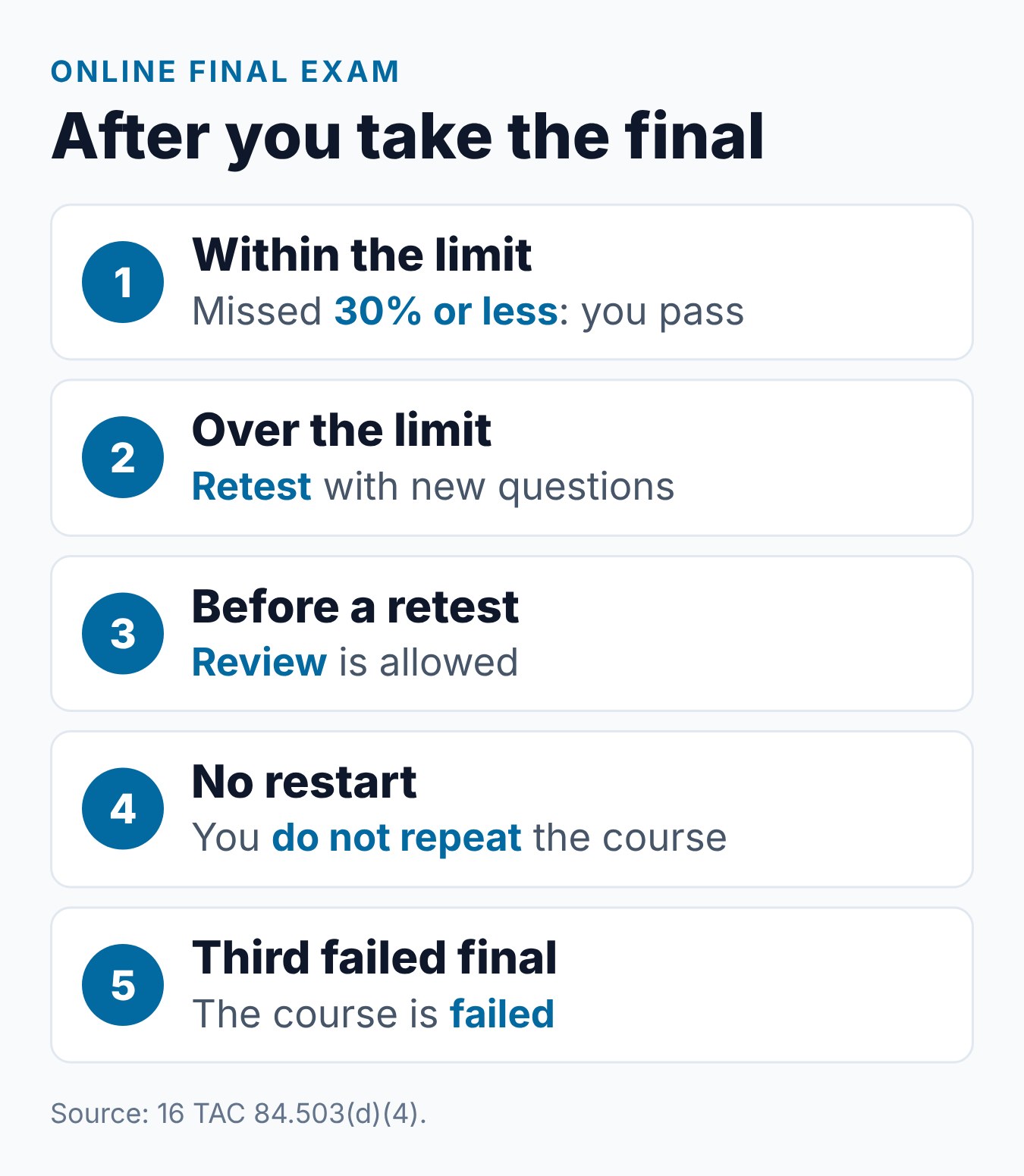
The rule frames passing as a limit on misses. If you miss more than 30 percent, you must retest. With 30 questions, that means 9 or fewer wrong answers is within the limit.
What the Provider Must Record
Online providers keep a detailed record of your test. Under 16 TAC 84.503, the record must include every question asked and your answers. It must also name any staff member who retests you, and show the time you spent in each unit.
TDLR can inspect these records. That is part of how the state checks that each course follows the rules.
Retests and the Three-Fail Rule
Online retests have clear rules under 16 TAC 84.503:
- New questions. The retest uses different questions.
- No course repeat. You do not have to take the course again.
- Review allowed. You may review the material before you retest.
- Three strikes. A student who fails the final exam three times fails the course.
The rule does not say what happens after a failed course. Ask the provider before you enroll.
Other Questions During an Online Course
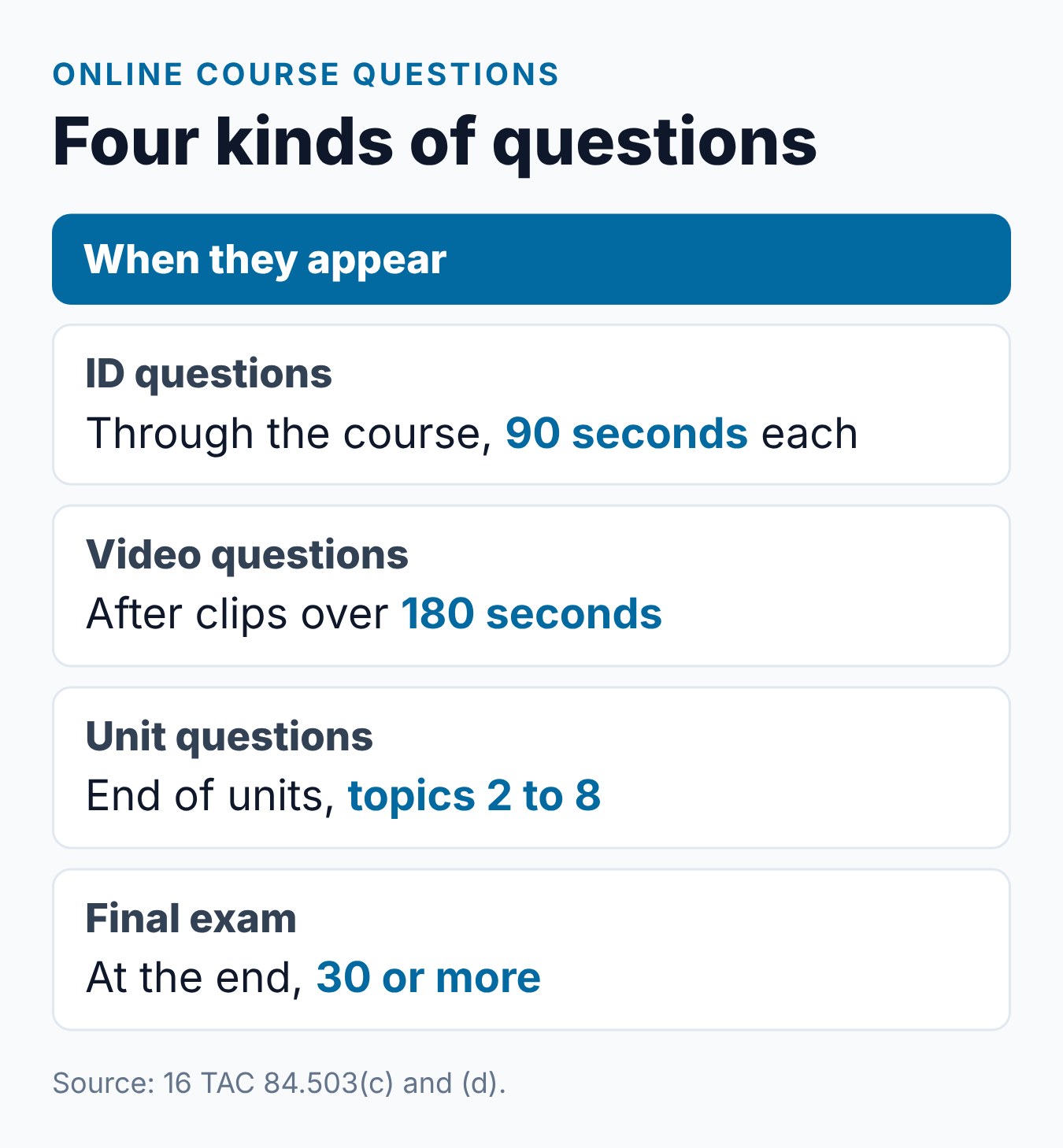
The final is not the only set of questions. Online courses also ask personal ID questions, which you answer within 90 seconds. They ask questions after longer videos and at the end of some units.
These questions check that you are the student and that you took part. They are separate from the final exam. Our online course guide explains them.
How to Prepare
Start with the official book. Both TDLR rules say each student must have access to the current Texas Driver Handbook or similar study material. The Texas Driver Handbook is free from DPS.
A few steps based on the rules:
- Read the handbook’s sign and law sections. Those are the tested subjects.
- Finish every unit. The final comes at the end of the course.
- Take the unit questions seriously. They require real participation.
- Review before a retest. The online rule allows it.
- Ask about your provider’s format. Question style and timing are up to the provider.
How the Course Test Relates to DPS
Texas law lets a licensed provider give the highway sign and traffic law parts of the license exam. Under § 521.1655, a test passed this way satisfies those parts for DPS.
TDLR’s online rule connects the two. Before an instructor signs your ADE-1317 and waives the sign and law exam, the instructor must check that you completed and passed the course.
There are limits:
- The two-year rule. Under 37 TAC 15.55, applicants under 25 whose certificate is dated two or more years before applying “will not have any examinations waived.”
- Ages 25 and older. No official source confirms the course test counts for adults who take the course by choice.
- Not every provider. The law says a provider “may” give the test, so check with yours.
Our written test waiver guide covers these limits in depth.
If You Take the Knowledge Test at DPS
Some applicants still test at DPS. The handbook says you need 70 percent or better to pass any knowledge exam. DPS does not say how many questions it asks.
State law gives you three tries for each application and fee paid. DPS holds the application for 90 days, and after 90 days or three failed exams, you need a new application and fee. Our DPS knowledge test guide explains it.
If You Are 25 or Older
The course is optional at your age, and the in-person adult course is for ages 18 to under 25. If you take a course, the online one is open to you.
Plan to take the knowledge test at DPS, since no official source confirms the course test counts at 25 or older. Our over-25 guide explains the rest.
What the Course Test Does Not Cover
The adult course is classroom or online teaching, so its test has no driving part. Two DPS tests stay separate:
- Vision. Under DPS rule 37 TAC 15.62, eyesight is checked at the office for an original license.
- Driving. The handbook puts the driving exam last, “only after all other exams are passed,” once you show proof of insurance.
No official source says the course test helps you pass the driving test. Study the handbook’s driving test section for that.
After You Pass
Passing leads to your certificate, the ADE-1317. Online providers must issue it by the 15th working day after you finish. Under 16 TAC 84.43, certificates go only to students who complete the course.
Next comes ITAD, the free DPS video. DPS says to take it after the course and no more than 90 days before the driving test, and to print its certificate.
Then comes your DPS application. DPS’s apply page lists the steps.
What We Found in the Test Rules
On the TDLR rule text we checked on October 26, 2026, the in-person rule set a 70 percent mark on each exam. It did not set a question count or a retest policy.
The online rule set a 30-question minimum, two test banks, a retest after more than 30 percent missed, and a three-fail limit. Neither rule listed sample questions.
The DPS handbook we checked, DL-7 revised January 2026, said 70 percent passes any knowledge exam. It gave no question count.
Common Mistakes to Avoid
Each item comes from a TDLR rule, DPS rule or Texas law:
- Studying a fake question list. Neither TDLR rule lists the questions.
- Leaning on one strong score. In person, each exam needs 70 percent on its own.
- Rushing a retest. Online, you may review first, and a third failed final fails the course.
- Assuming every course gives the DPS test. The law says a provider “may” give it.
- Waiting two years to apply. Under 25, an older certificate waives no exams.
- Expecting a road test in the course. The driving test is separate.
How Requirements Can Vary
Texas driver license rules come from state law, Texas DPS rules and TDLR rules, and they apply statewide. What you need still depends on your age, whether you hold a license from another state, and which tests you have already passed.
Laws, fees and office procedures can change. Check the Texas DPS and TDLR websites for current rules before you book an appointment or enroll in a course.
Frequently Asked Questions
What is on the Texas adult driver education test?
Highway signs and traffic laws. TDLR rules require both, tied to Transportation Code § 521.161. TDLR rules do not list the questions.
What score do I need to pass?
In person, at least 70 percent on the signs exam and on the laws exam. Online, missing more than 30 percent on the final means a retest.
How many questions are on the online final?
At least 30, drawn equally from two separate test banks. A provider may use more.
What happens if I fail the online final?
You retest with different questions, and you may review first. You do not repeat the course. Three failed finals means you fail the course.
Do I take the test again at DPS?
A test passed in a licensed course can count for the sign and law parts at DPS. Limits apply by age and certificate date, so confirm with your provider and DPS.
Is there a driving test in the course?
No. The adult course is classroom or online teaching. You take the driving test at DPS or with a DPS-certified school.
Does the online final have a time limit?
The TDLR rule we read does not set a time limit for the final. The 90-second limit applies to personal ID questions, which are not part of the final. Ask your provider about its own rules.
Can I get the certificate without passing?
No. TDLR rules say certificates go only to students who complete and pass the course.
Conclusion
The Texas adult driver education test covers highway signs and traffic laws, with a 70 percent mark in person or a 30-question minimum final online. Online, you may review and retest, but three failed finals ends the course.
Study the free handbook and ask your provider how its test works. To begin, see Driving Logic’s online Texas adult driver education course.
Related Articles
- Texas Adult Driver Education (ADE) Course: The Complete Guide
- How the Texas 6-Hour Adult Driver Education Course Works Online
- Does Texas Adult Driver Education Waive the Written Test at DPS?
- Texas DPS Written Knowledge Test: What It Covers and How ADE May Help
Sources
- 16 Tex. Admin. Code § 84.502 — Adult driver education (in person)
- 16 Tex. Admin. Code § 84.503 — Adult driver education (online)
- Texas Transportation Code Chapter 521 — Driver’s Licenses (PDF)
- 37 Tex. Admin. Code § 15.55 — Examination requirements
- Texas DPS — Texas Driver Handbook (DL-7, PDF)
- Texas DPS — Apply for a Texas Driver License
- 16 Tex. Admin. Code § 84.43 — Driver education certificates
- 37 Tex. Admin. Code § 15.62 — Impact Texas Drivers program
Billy Forte is the owner of Driving Logic, a state-approved driver improvement course provider serving Texas and other U.S. states.
This article is general information, not legal advice. Texas driver license and driver education rules are set by Texas law, Texas DPS and TDLR, and they can change. Check the official DPS and TDLR websites for current requirements before you apply.